
Gramercy in Art
The Park and its neighboring streets, seen by painters, illustrators, printmakers and photographers. Some views appeared on magazine covers; others began as a sketch or a greeting sent to friends.
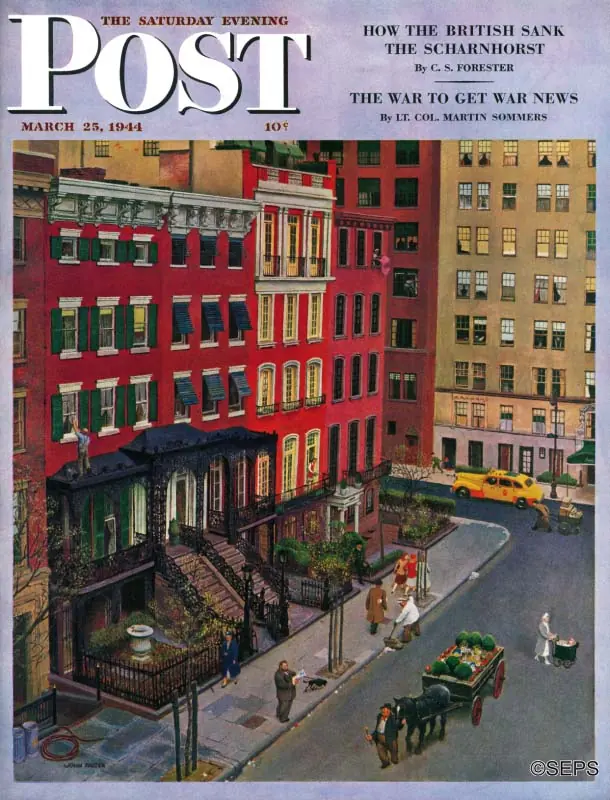
John Falter · March 25, 1944
A day on Gramercy Park West
A vegetable cart rolls past the paired porches of Nos. 3 and 4. A yellow taxi rounds the corner, and people attend to the small business of the street. Falter gives the ironwork and red-brick facades as much attention as the passersby.
The Park itself is outside the frame. Its western neighbors supplied the scene for this cover of The Saturday Evening Post.
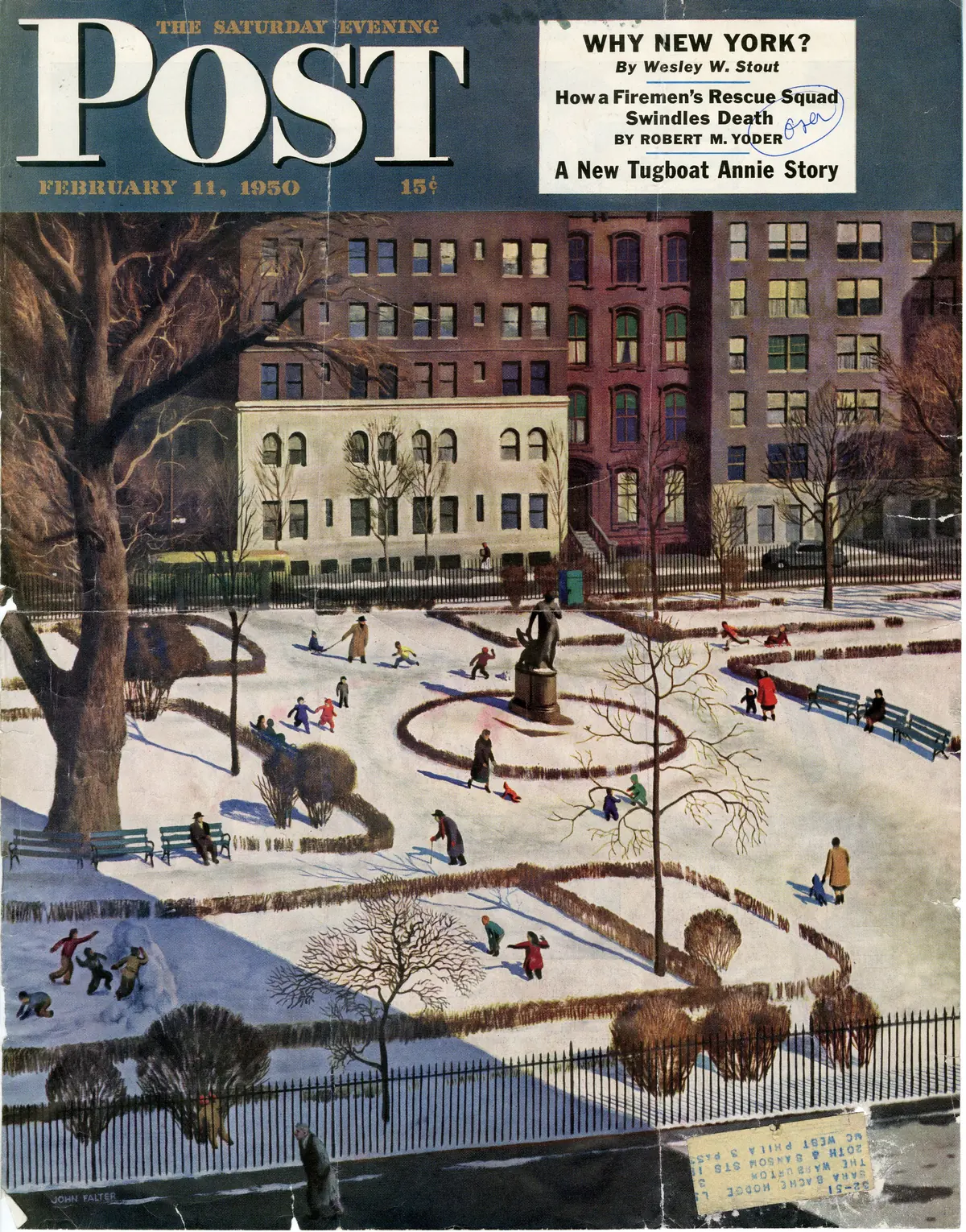
John Falter · February 11, 1950
The Park in snow
Six years later, Falter looked into the Park. Children play in the snow around the Edwin Booth statue; bare trees reveal the houses beyond the fence. One Lexington Avenue rises at the upper right.
This copy of the Saturday Evening Post cover was saved by neighborhood writer Dorothy Dignam. Her collection is now held by the Museum of the City of New York.
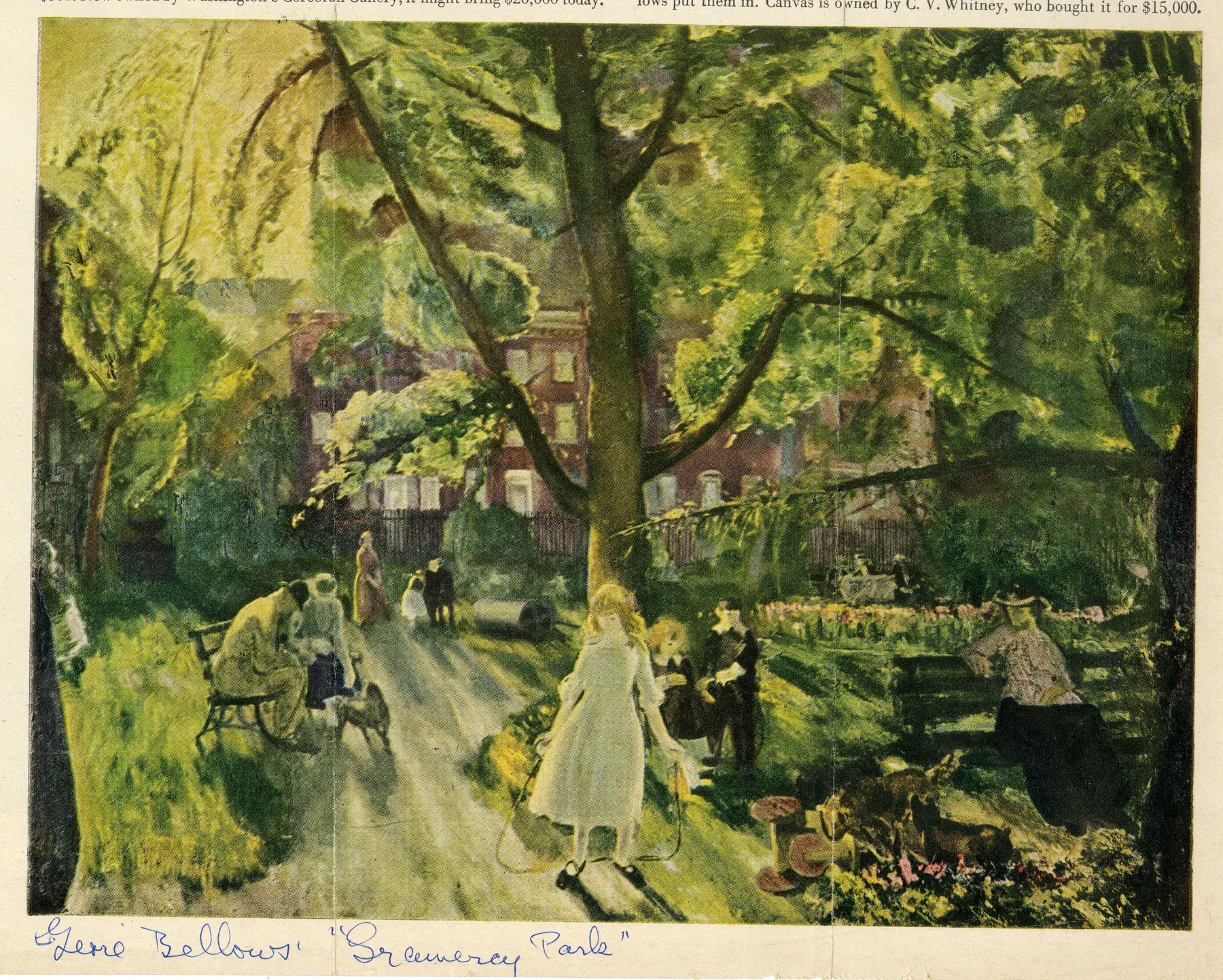
George Bellows · May 1920
Spring beneath the trees
A girl in a white dress holds a skipping rope near the center of Bellows’s Gramercy Park. Around her, people sit and stroll beneath the trees, with the western row of houses visible through the foliage.
Bellows lived nearby on East 19th Street. The painting dates from May 1920; this view comes from a printed reproduction preserved in Dorothy Dignam’s collection.
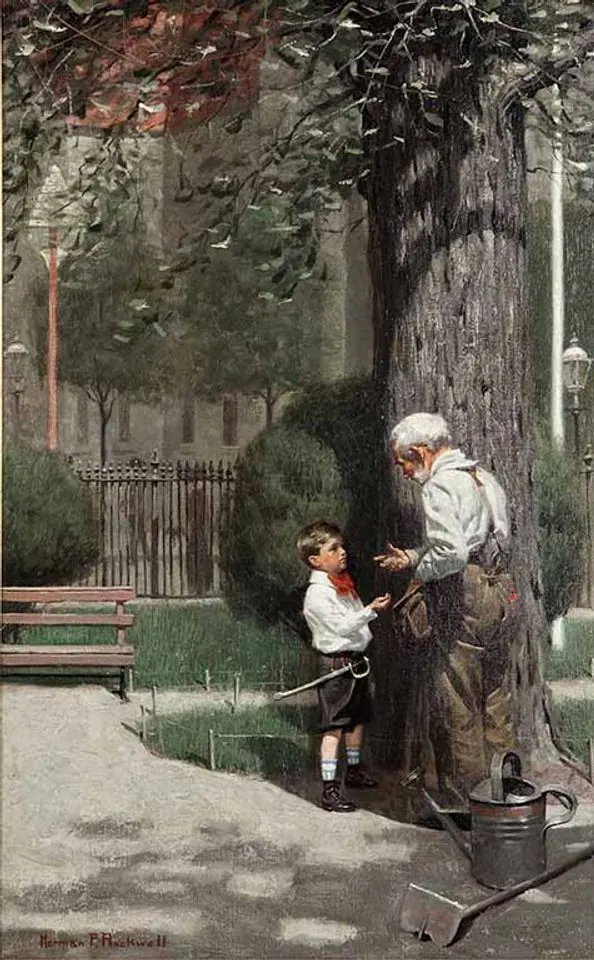
Norman Rockwell · c. 1918
A conversation by a tree
Rockwell brings the view down to the scale of two people: a boy and a gardener, meeting beside a great tree trunk. Beyond them are the fence, the sidewalk and the facades across the street.
The small encounter is the subject of Gramercy Park, an early oil painting in the Hirschfeld collection of New York scenes.
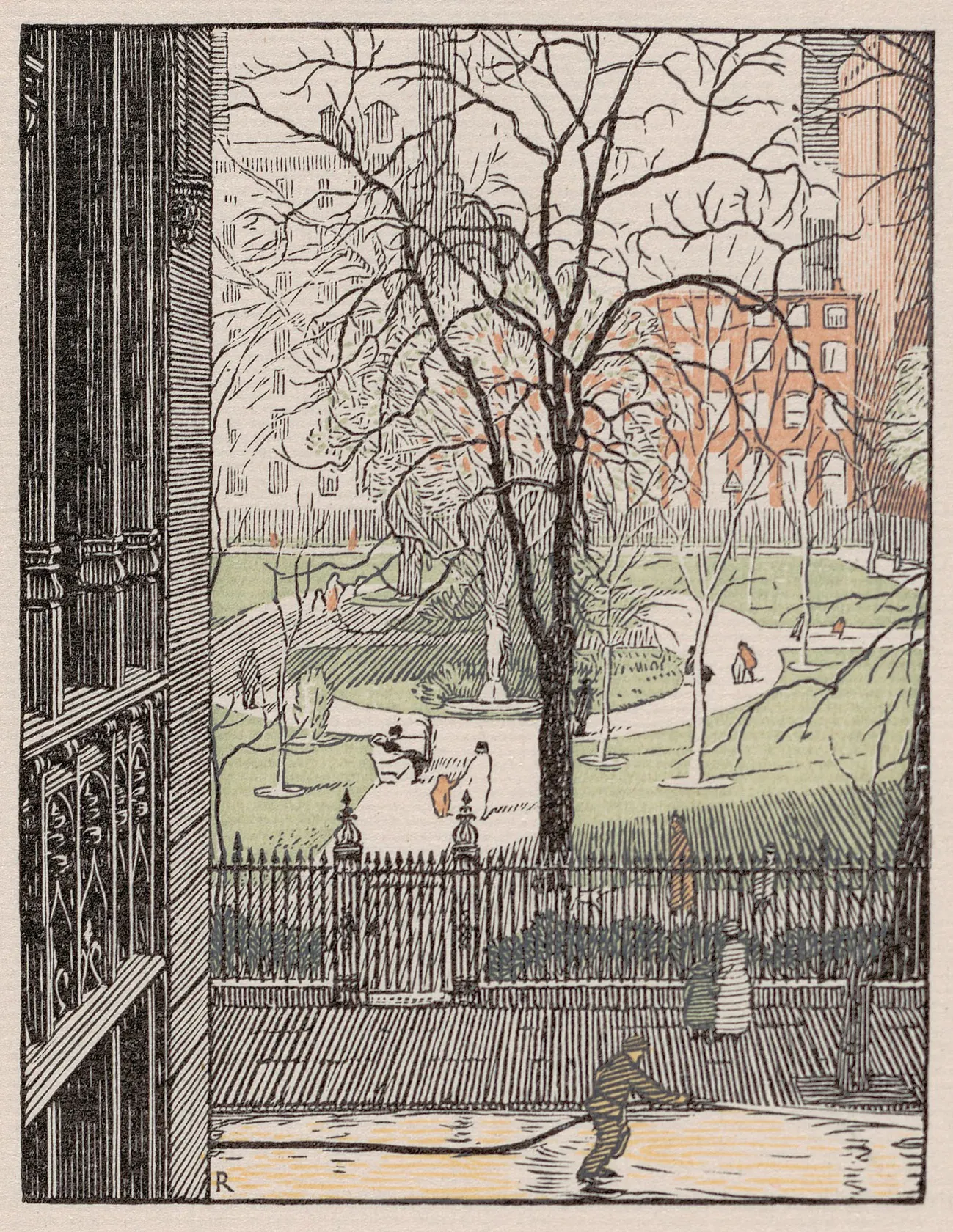
Rudolph Ruzicka · 1919
A Christmas greeting from No. 36
Gothic windows and carved stone frame a view into the Park. Ruzicka made this wood engraving as a Christmas greeting from Dr. and Mrs. William S. Dennett in 1919.
At its original size, the engraved image measures only three by three and seven-eighths inches. The lines carry an extraordinary amount of the building and the Park into that small space.
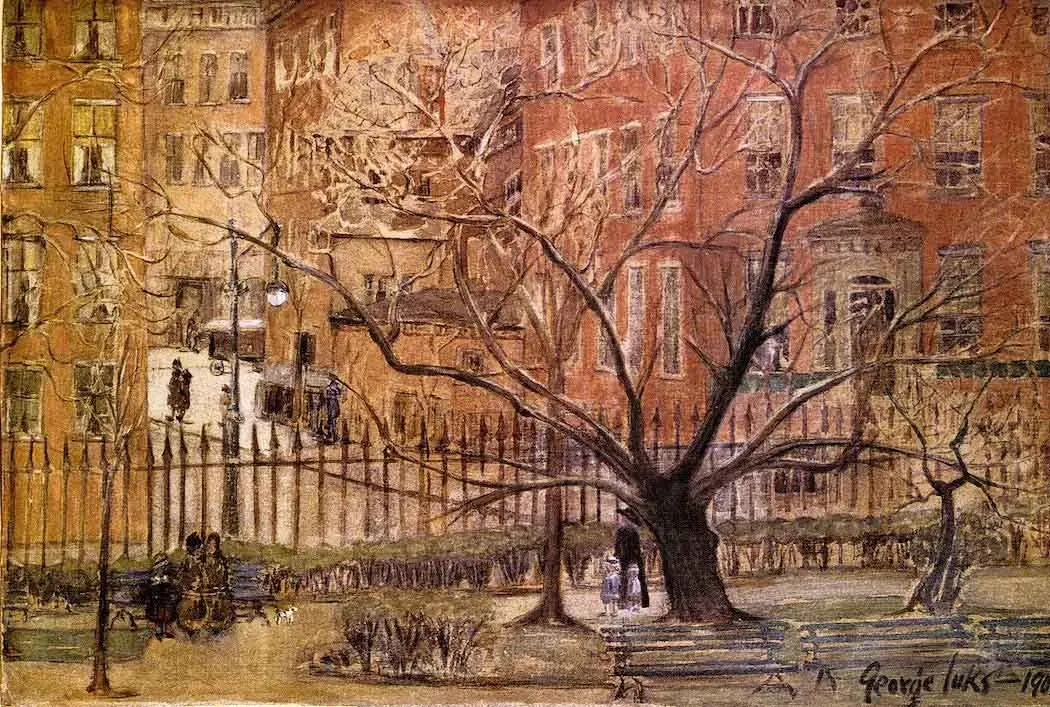
George Luks
Branches, benches and brownstones
A spreading tree fills the foreground of Luks’s Gramercy Park. Behind its bare branches, the houses form a wall of ochre, rose and brick red. The iron fence runs across the scene, separating the street from the quieter paths and benches within.
Figures are scattered through the Park, small against the tree and the buildings. The view takes in the surrounding city as readily as the garden.
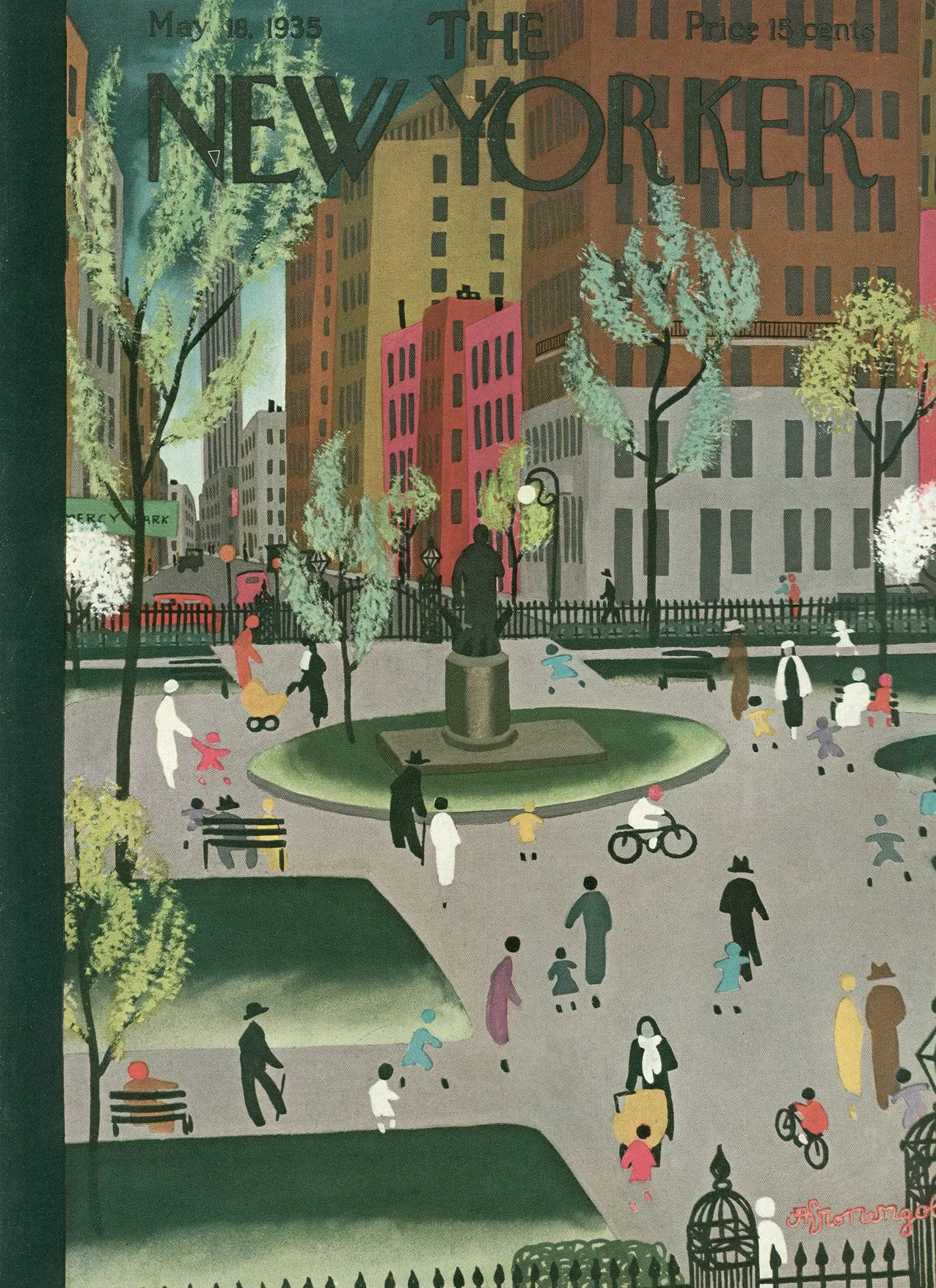
Adolph K. Kronengold · May 18, 1935
Booth among the leaves
Kronengold fills the Park with strolling adults, children, bicycles and baby carriages. Pale spring foliage rises around the Edwin Booth statue, while the surrounding buildings form a dense backdrop beyond the iron fence.
Kronengold’s design appeared on the May 18, 1935 issue. The magazine’s masthead, date and price remain part of the cover.
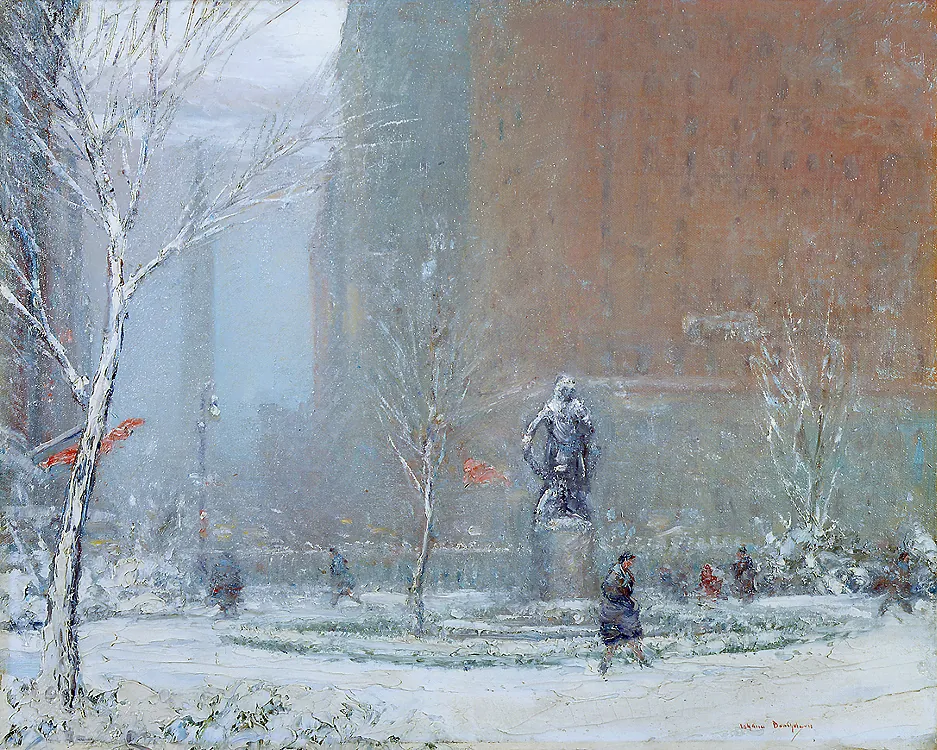
Johann Berthelsen · Undated
Snow around the statue
Snow covers the paths and branches in Berthelsen’s Gramercy Park. The statue and the small figures around it remain distinct, while the buildings beyond the Park soften into blue and gray.
This signed painting is oil on canvasboard, measuring 16 by 20 inches. Rehs Galleries records the work as sold; its listing does not give a date.
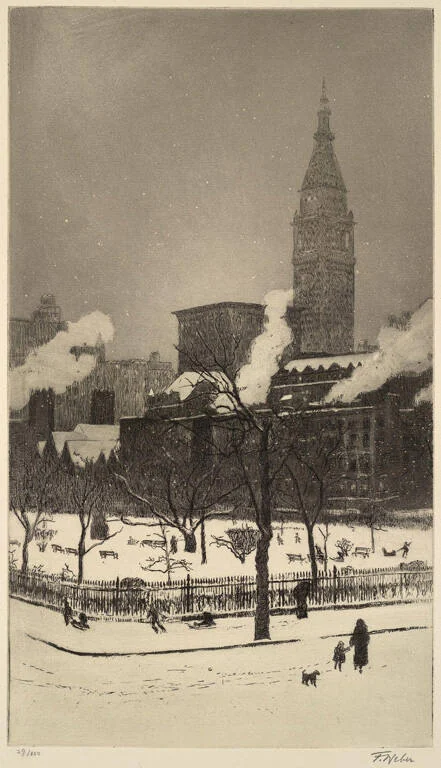
Frederick Theodore Weber · Undated
Snow, smoke and a distant tower
Weber looks across the corner of the Park in winter. Snow rests on the paths and rooftops; pale plumes rise above the houses. The iron fence and bare trees form a fine web of lines against the white ground, while a clock tower rises beyond the neighborhood.
This etching belongs to the Herbert F. Johnson Museum of Art at Cornell University. The museum records its dimensions as 13½ by 7¾ inches and gives no date.
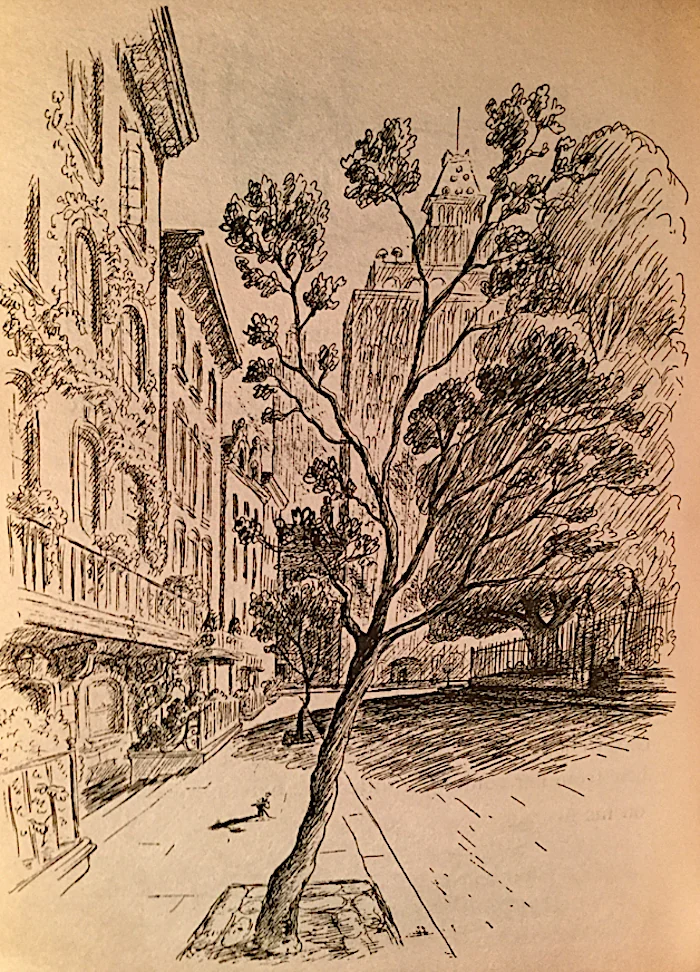
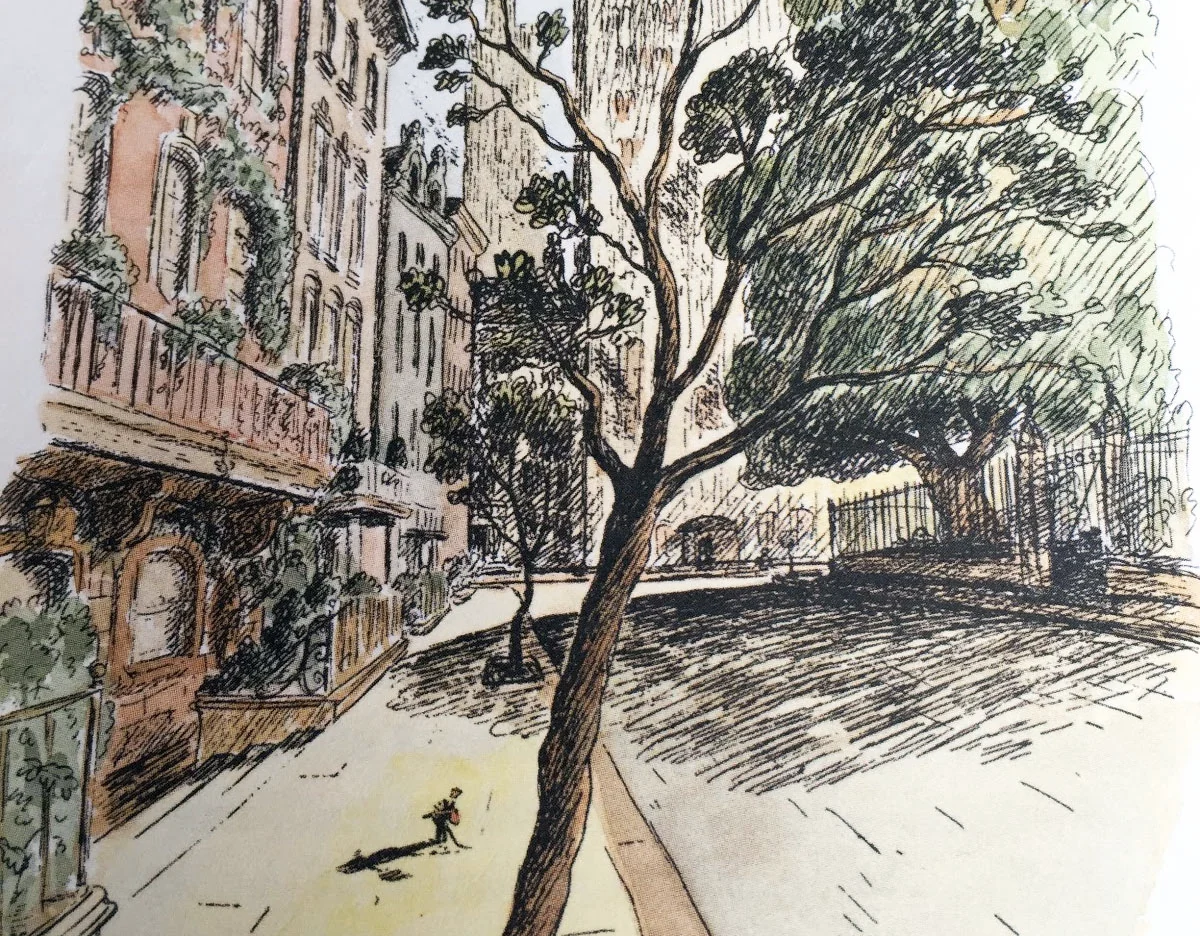
Garth Williams · Stuart Little, 1945
A very small figure on a familiar street
A tiny Stuart stands outside the Little family’s home, dwarfed by the houses, trees and his own long shadow. Williams’s drawing for E. B. White’s Stuart Little gives the street a scale its smallest resident can measure in adventures.
The iron fence and row of houses have led local readers to Gramercy Park West. Arlene Harrison and Sean Thomas Brady proposed No. 4 as the Little home; White’s text supplies no numbered address. The connection remains an interpretation of the illustration.
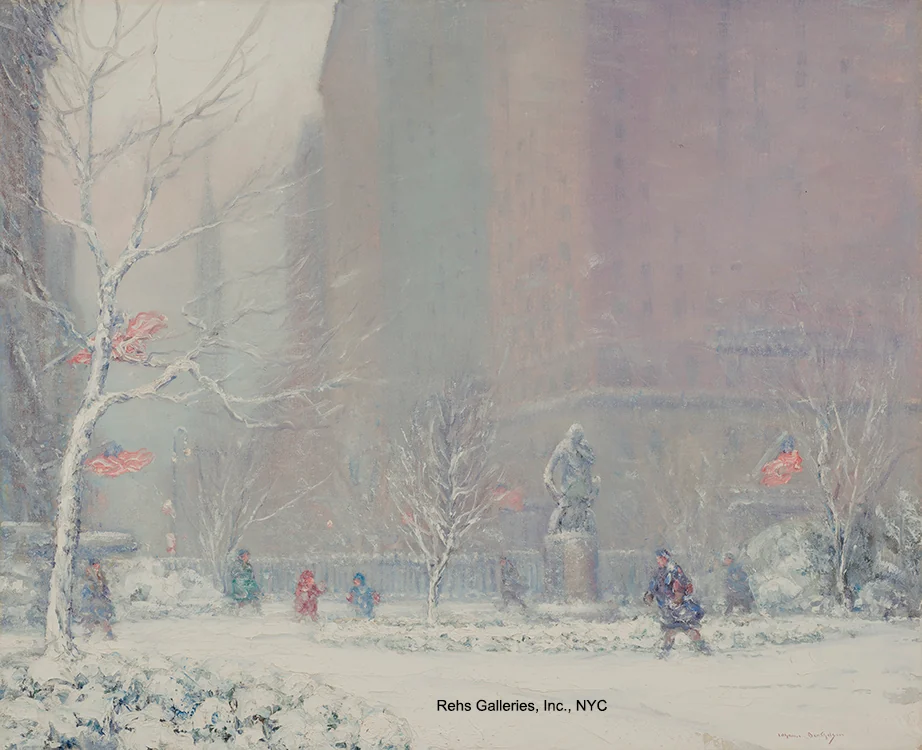
Johann Berthelsen · Undated
Flags in a winter haze
Red accents in the flags and bright coats punctuate the pale blues and grays of another snowy Park. The Edwin Booth statue stands at the center, with bundled figures crossing the paths beneath bare branches. Beyond the fence, buildings almost disappear into the winter sky.
This signed Gramercy Park is a separate painting from the smaller canvasboard view above. It is oil on canvas, 25 by 30 inches. Rehs Galleries lists it as sold, with a private collection as the final entry in its provenance; the painting is undated in the record.
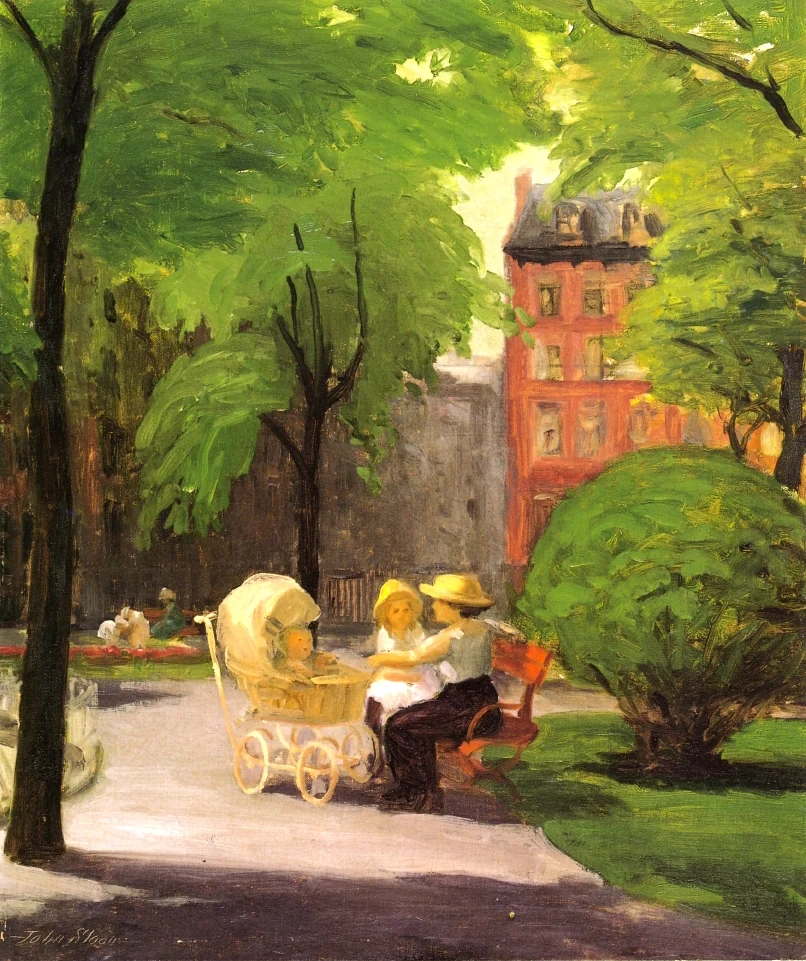
John Sloan · 1912
Spring beside a red bench
A woman seated beside a baby carriage reaches toward its occupant while a young girl looks on. Fresh foliage fills the upper part of Sloan’s Spring, Gramercy Park; a red house glows through an opening in the trees.
The painting is oil on canvas, 24 by 20 inches. The house has been suggested as No. 19 Gramercy Park South, though that identification is uncertain. The painting also appears in our profile of the house.
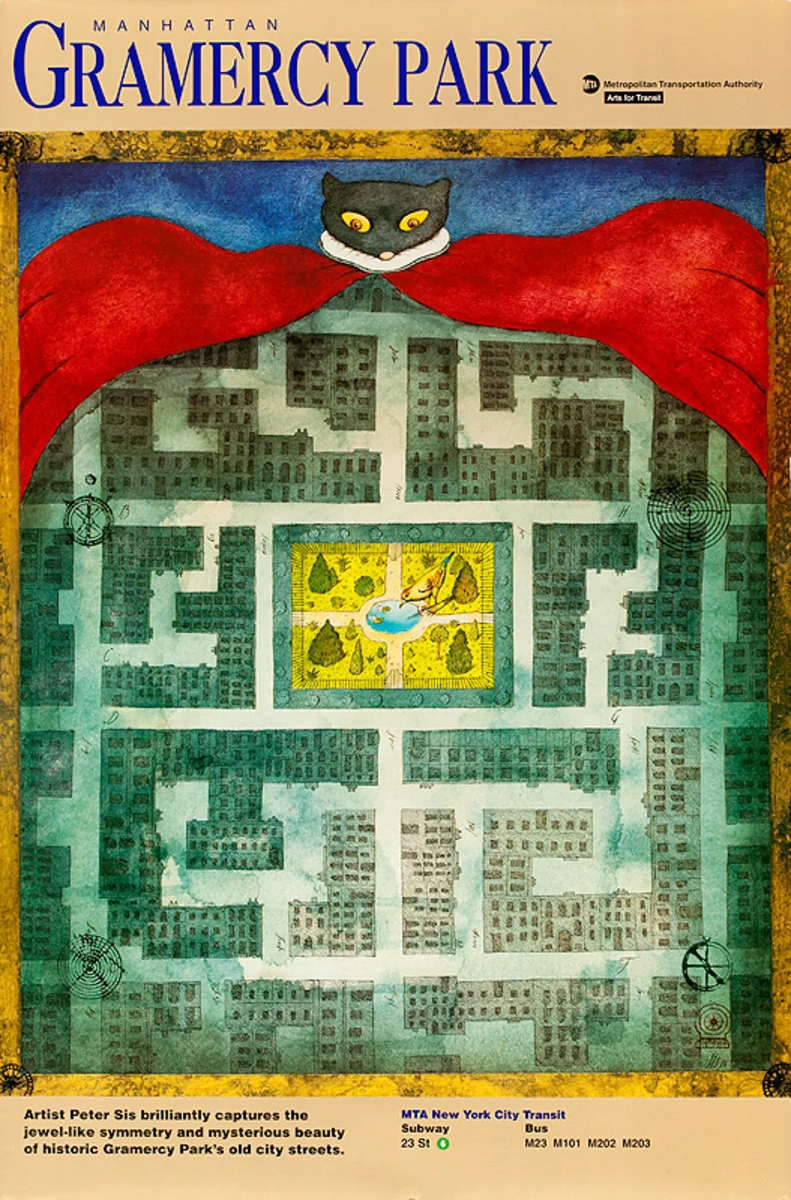
Peter Sís · 1997
A cat watches over the neighborhood
A yellow-eyed cat spreads a red cape over the neighborhood. Below it, the streets and buildings form a patterned grid around a bright rectangle of green and yellow: Gramercy Park.
Sís made Gramercy Park for MTA Arts for Transit in 1997. The complete poster surrounds his imagined view with the neighborhood’s name and transit directions, inviting riders to discover the Park for themselves.
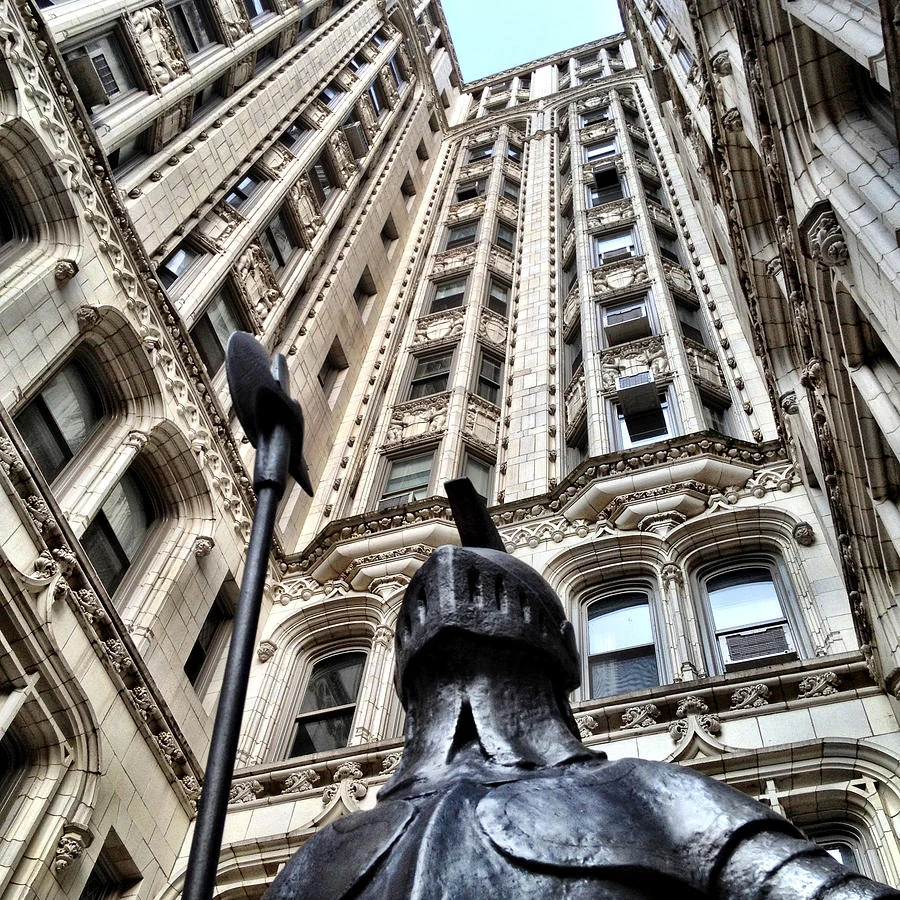
Natasha Marco · Photograph
Looking up past a knight
Natasha Marco looks upward past one of the entrance knights into the tall court of No. 36. The dark armor fills the foreground while projecting windows, pointed arches and bands of ornament draw the eye toward the sky.
Her photograph, Gothic Gramercy #2, gives the building’s glazed terra cotta a different scale: the details seen from the sidewalk become the walls of an enclosed world.
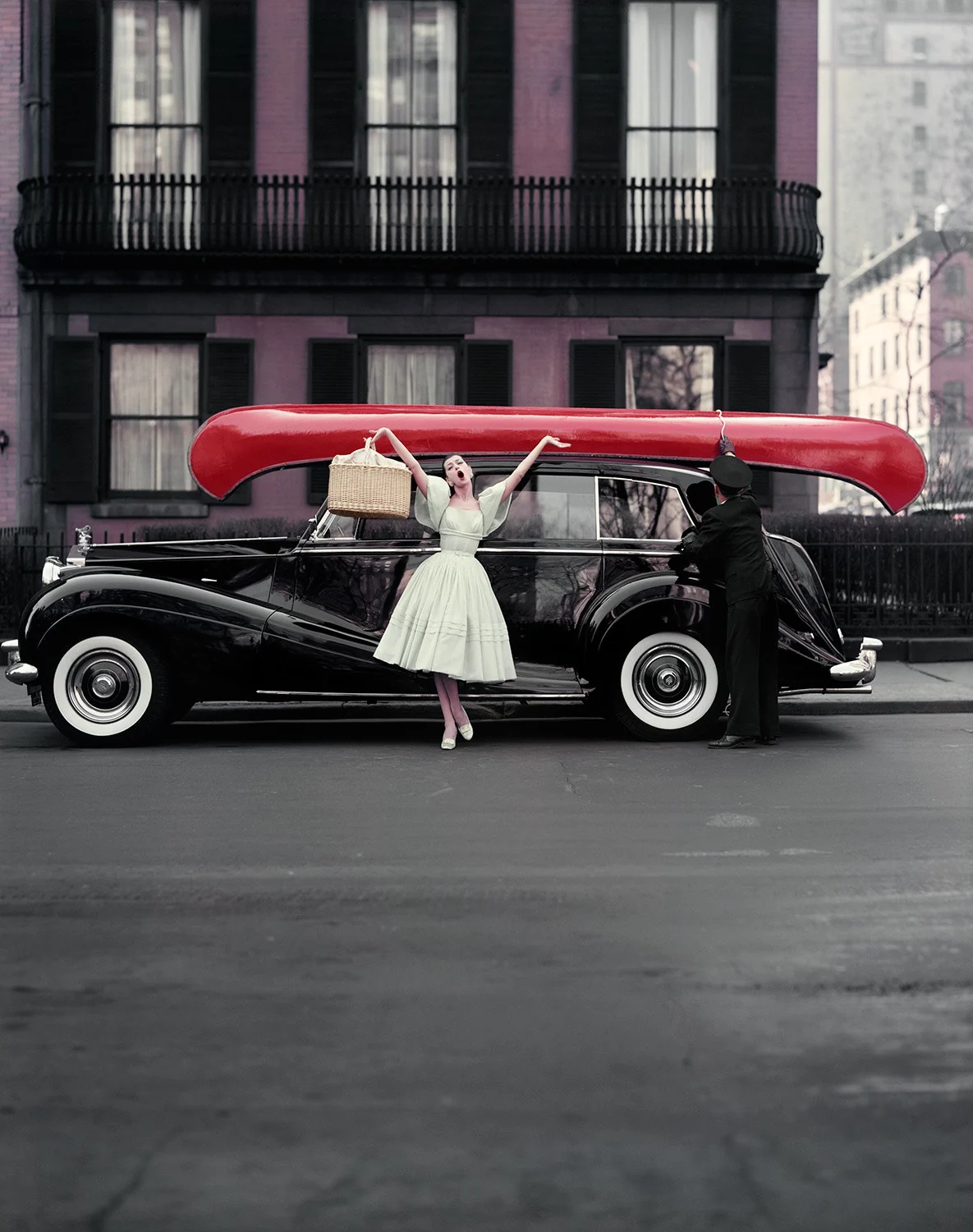
William Helburn · 1957
A red canoe in Gramercy Park
A red canoe stretches across the roof of a black car. Beside it, Barbara Mullen raises her arms, a wicker basket hanging from one hand. The dark shutters and iron balcony behind her give William Helburn’s fashion photograph a distinctly residential stage.
Red Canoe, Barbara Mullen, Gramercy Park, New York, NY dates from 1957. The photographer’s archive identifies the neighborhood; the image adds a view of its mid-century life to the story of Gramercy Park West.