
Calvary Church & Calvary House
A church for the changing city
277 Park Avenue South · 61 Gramercy Park North
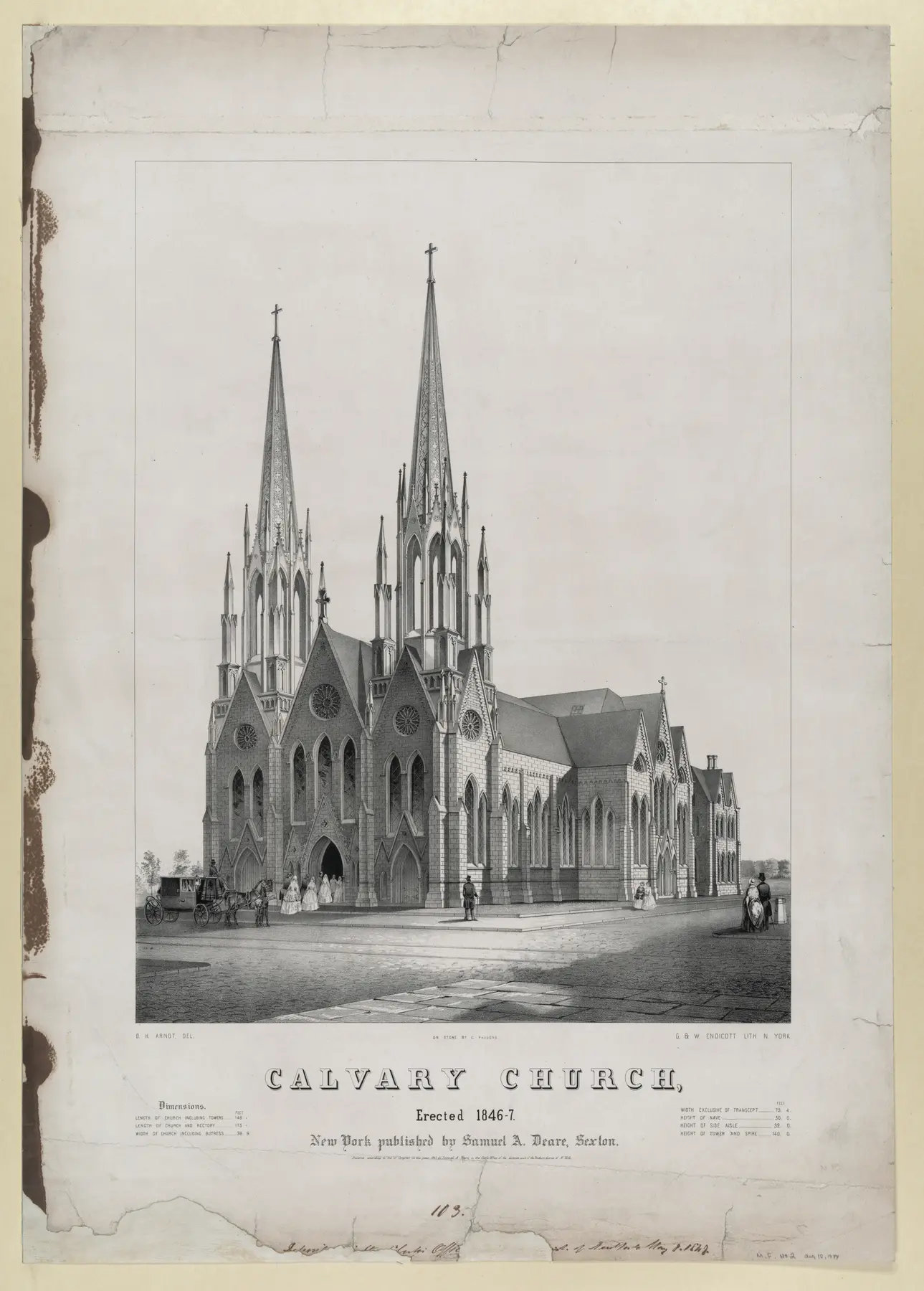
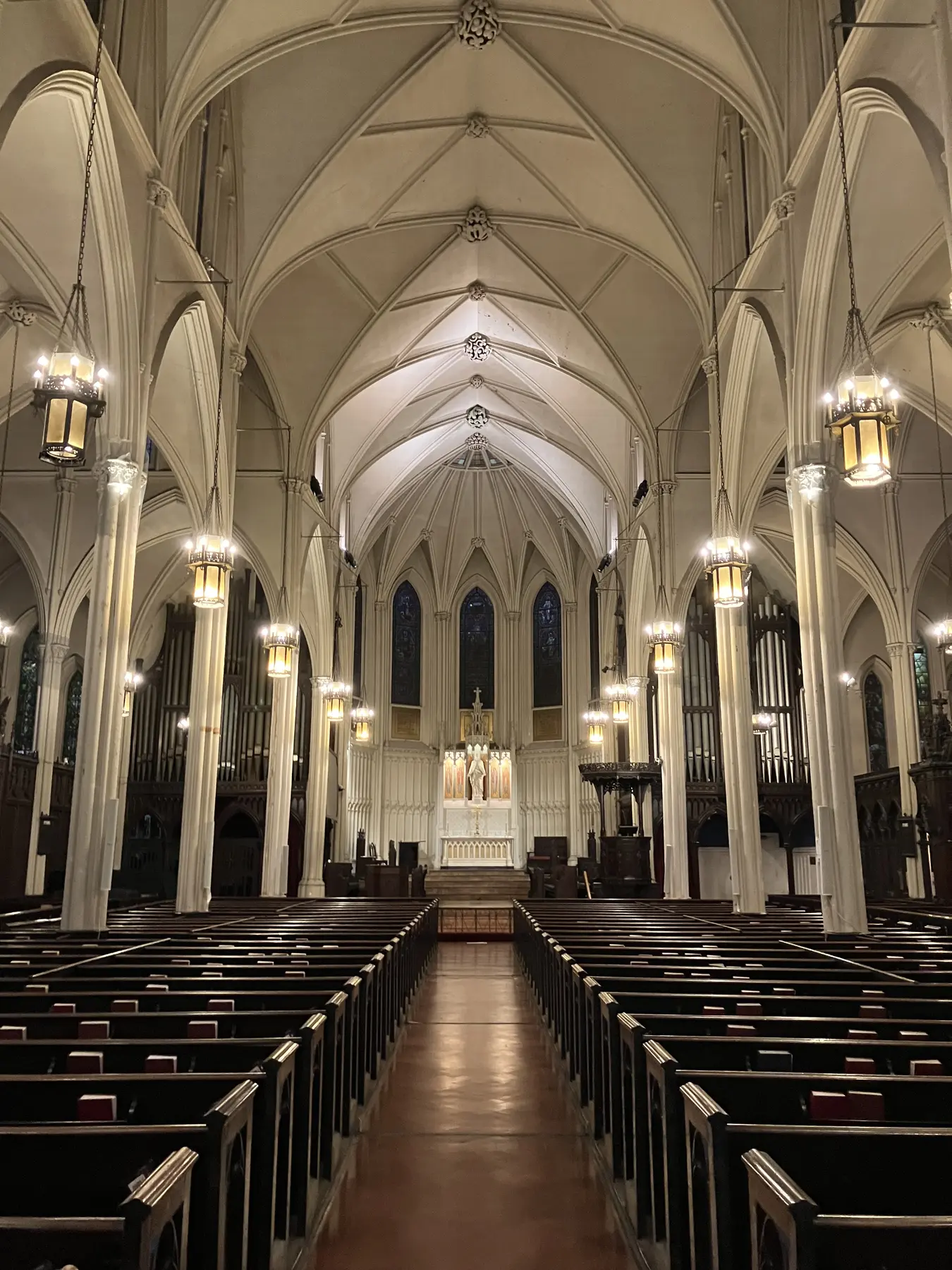
Calvary once had two spires. They rose above Fourth Avenue when this part of Manhattan was still becoming a city neighborhood. The avenue has changed its name, the spires have disappeared, and much taller buildings have gathered around the church. Behind its brownstone walls, the story has kept changing, too.
A future president married here. Edith Wharton knew the rector’s family. A woman who began her mornings in the church became an advocate for prisoners in the Tombs. In the parish house, conversations about faith and recovery helped shape Alcoholics Anonymous. Decades later, people came through the doors at midnight to hear an organist with an unusually adventurous idea of a church concert.
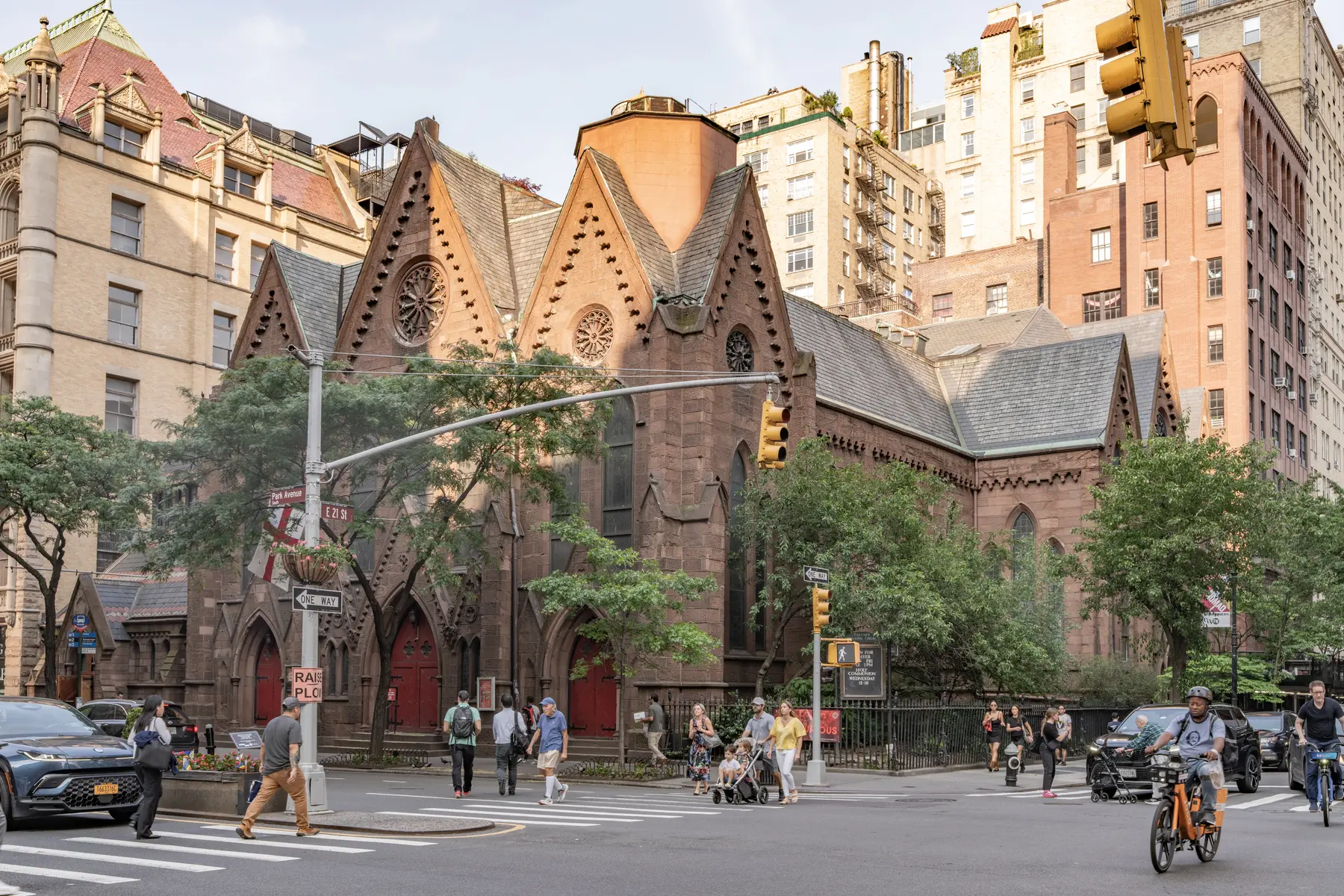
The church at Park Avenue South and East 21st Street and Calvary House at 61 Gramercy Park North belong to the same story. One is a nineteenth-century sanctuary; the other is a much later building designed for people to meet, work and live. Together they show how much can happen at a single neighborhood corner.
Before the brownstone
Calvary began in the 1830s, when the settled city lay largely downtown and a church near Fourth Avenue and 30th Street was an undertaking on the urban frontier. The first congregation worshipped in a modest frame building. At its consecration on New Year’s Day, 1837, Bishop Benjamin Onderdonk defended the practical decision to build something small immediately, instead of waiting until a grander church could be afforded.
Charles Henry Brent’s 1916 biography of Henry Yates Satterlee, drawing on Calvary’s earlier parish history, describes the scattered settlements, pastures and ponds beyond the city’s densely built streets. A small church could serve the people already there and anticipate the people still to come. It was an ambitious idea, even if the first building was not.
After another temporary home farther south on Fourth Avenue, Calvary acquired its present corner in 1845. James Renwick Jr. designed the new church and its rectory. The cornerstone was laid in 1846; the American Guild of Organists’ history dates the consecration to June 4, 1847. Renwick’s other great New York churches would include Grace Church and St. Patrick’s Cathedral. At Calvary, his material was warm brownstone.
A fine building did not immediately produce a sound balance sheet. Debt nearly cost Calvary its independence. There was even an attempt to have Trinity absorb it as a chapel. The solution, in 1850, was distinctly of its time: existing pew owners surrendered their deeds, the pews were auctioned again, and the proceeds cleared the church’s outstanding obligations.
The episode remained uncomfortable enough for Satterlee to criticize it a generation later. It also established an enduring question for Calvary: how could an expensive building support a church meant to serve more than the people who could afford the best seats?
The church with the missing spires
The 1847 architectural print makes the original ambition unmistakable. Two slender spires frame the front, rising well above the steep roofs. Pointed openings, little pinnacles and elaborate Gothic tracery draw the eye upward. The church occupies a corner, so its long side is as important to the street as its entrance front.
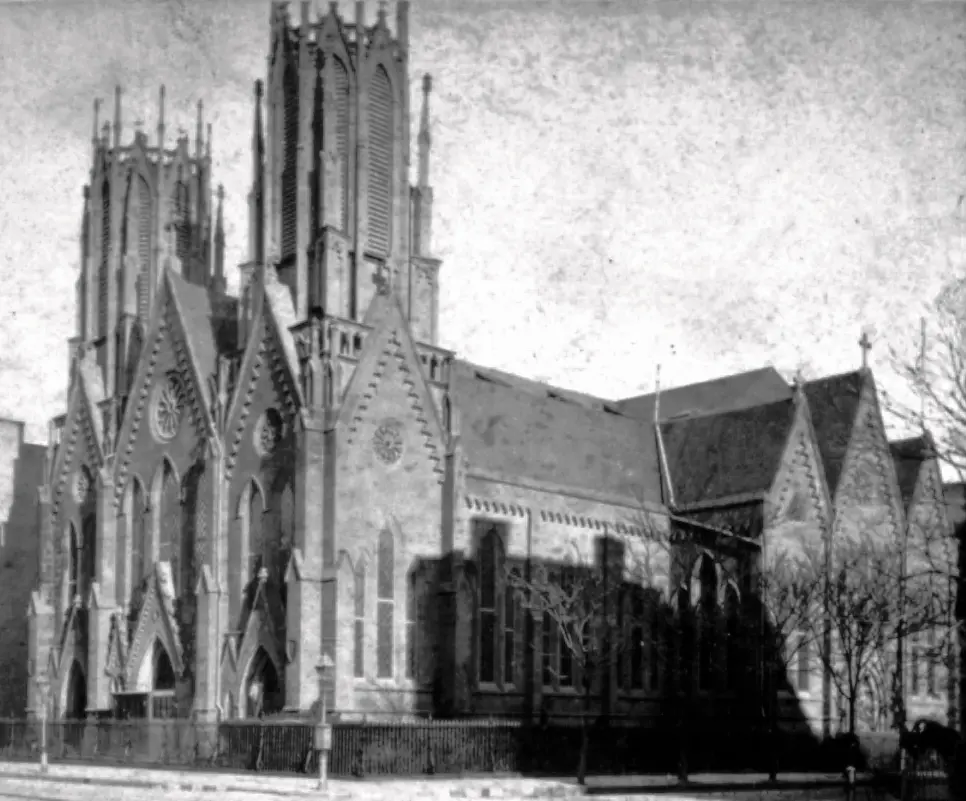
That first silhouette did not last. The Flatiron NoMad Partnership’s history dates the removal of the unstable spires to 1860. Nineteenth-century photographs and the illustration in King’s Handbook of New York City show the church with the shorter towers that remained. Those, too, eventually disappeared. Looking between the old views and the building today explains the abrupt, low tower base that can puzzle a passerby.
The broad composition survives: brownstone, a sequence of sharp gables, pointed windows and the conspicuous contrast between a low church and its increasingly tall neighbors. The 1966 Gramercy Park Historic District report singled Calvary out as one of the city’s fine small Gothic Revival churches. Its inclusion in the district recognized an architectural work that had already undergone substantial change.
There is a third building to keep in view. The little Renwick Gem schoolhouse, north of the church on Park Avenue South, dates to 1867. It is a separate part of the historic complex. Its date should not be attached to the tall Calvary House on Gramercy Park North, which arrived more than sixty years later.
A church in the snow
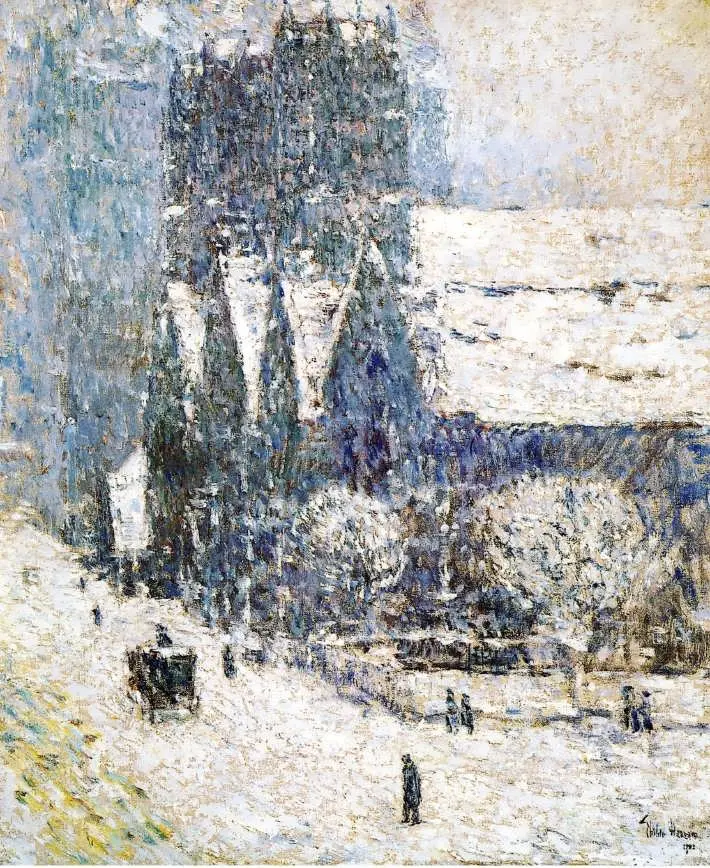
Childe Hassam gave Calvary another kind of historical record. In his 1893 painting, the church rises through falling snow, its dark Gothic forms broken by pale roofs and a nearly white street. People and a carriage pass in front. The architecture remains recognizable, but the weather has transformed its weight and color.
Set beside the early print and street photograph, the painting offers a different way to look at the same place. The print presents an architectural achievement. The photograph records a building among its neighbors. Hassam shows the church as something New Yorkers encountered in the course of an ordinary day.
The snow has not emptied the street. Calvary belongs to the moving life around it.
The world Edith Wharton knew
Calvary’s register reads, at moments, like the opening of a social history of New York. Chester A. Arthur married Ellen Lewis Herndon here on October 25, 1859, long before he became president. George B. McClellan married here the following May, before the Civil War made him one of the most closely watched men in the country. In 1875, Alva Smith married William Kissam Vanderbilt at Calvary.
But the church’s most revealing literary connection began in a quieter way. Young Edith Newbold Jones, the future Edith Wharton, came with her family and became close to Emelyn Washburn, daughter of the rector, Edward Abiel Washburn. The parish’s own history credits Emelyn with introducing her to Goethe. The friendship opened a door into the reading life of a future novelist.
The familiar church world stayed with Wharton. Calvary and its rector are associated with the church setting and Dr. Ashmore in The Age of Innocence. The connection gives the building a particular place in the neighborhood’s literary geography: the people, manners and expectations of old New York were things Wharton had observed from inside.
Another child brought to Calvary would become famous for challenging inherited expectations. Eleanor Roosevelt’s parents, Elliott Roosevelt and Anna Hall, married here in 1883. The Episcopal Diocese of New York’s account confirms her baptism at Calvary in 1885. Her uncle Theodore stood as godfather.
The names are striking, but the occasions were ordinary parish occasions: a wedding, a baptism, a family in a pew, a friendship with the rector’s daughter. A neighborhood church accumulates national history through the private milestones of people who do not yet know what they will become.
Seven people waiting in the vestibule
When Henry Yates Satterlee became rector in 1882, Calvary had distinguished parishioners but an aging congregation. One colleague compared its leading men to a stand of full-grown trees with no saplings underneath. Satterlee’s task was to recruit a new generation and give it work to do.
He resisted the idea that a church should simply follow its wealthier members uptown. During his rectorship, Calvary developed an extensive ministry on the East Side. The Galilee Mission, established in 1883, was accompanied by lodging, a reading room, a coffee house, a workingmen’s club and other practical ventures. These operated beyond the Gramercy sanctuary; their story should not be squeezed into the footprint of the present parish house.
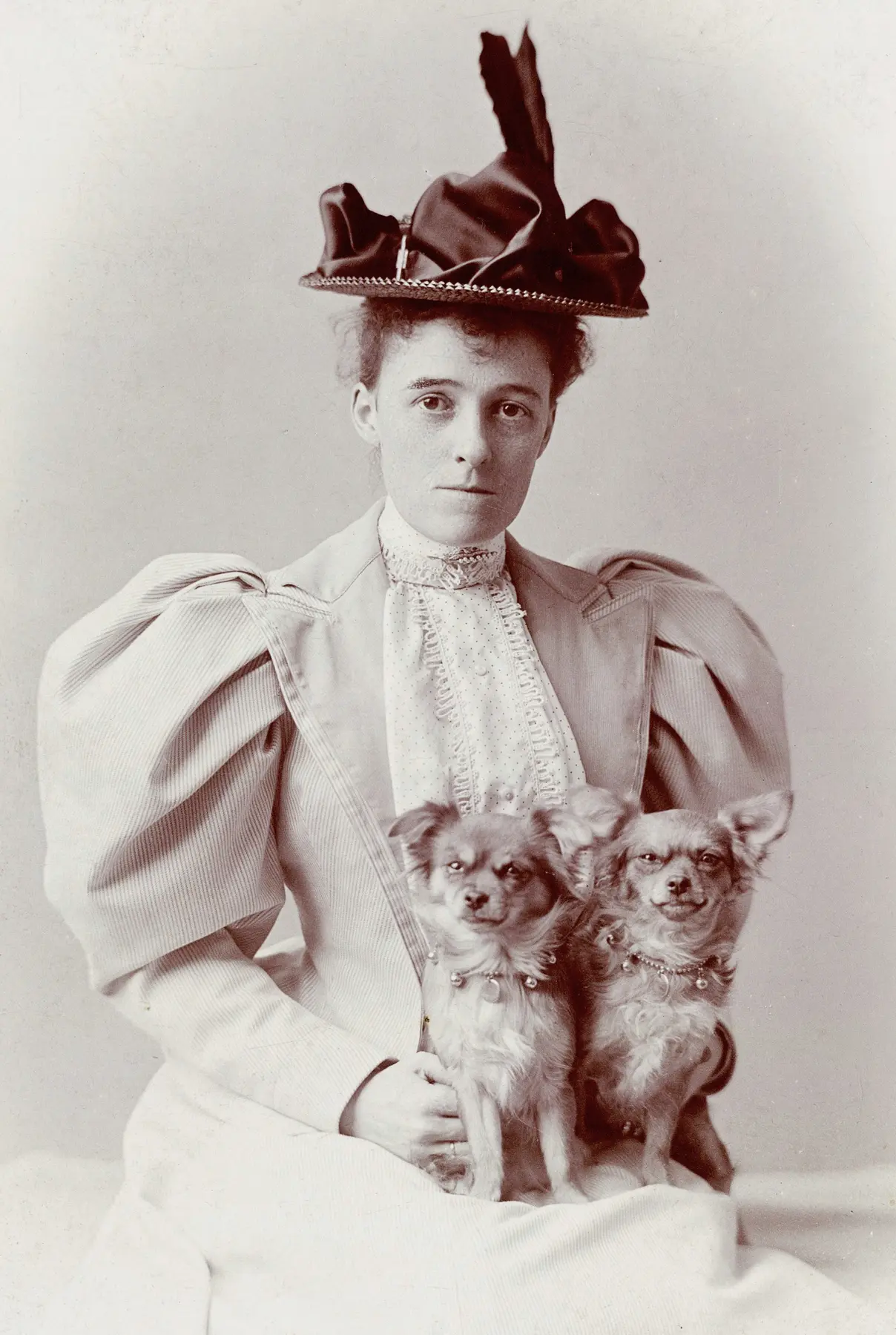
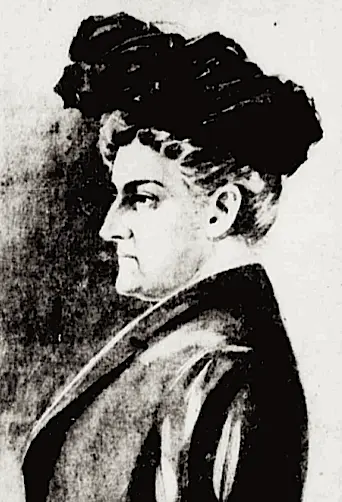
One of the people Satterlee encouraged was Rebecca Salome Foster. After devastating losses in her own family, she found a purpose in helping people caught up in the criminal courts. She investigated cases, spoke to judges, visited prisoners and found food, clothing, jobs and temporary support for people who had very little room for another setback. New Yorkers came to call her the “Tombs Angel,” after the city prison.
Brent preserves her account of a working day. It began at nine in Calvary’s vestibule, where seven people were waiting. Two needed food money, one needed rent, two needed shoes. She took the other two to department-store superintendents in search of employment. Her day then continued through courts, prison visits and further errands. It is an unusually concrete picture of what service through a church could mean.
The Historical Society of the New York Courts places Foster within the history of assistance to prisoners and defendants. Her work depended on close attention to individual circumstances, in a system that offered few of the organized supports that would come later. When Satterlee left to become the first Episcopal bishop of Washington in 1896, friends and parishioners formed a support organization to help her continue.
Foster died in the Park Avenue Hotel fire in 1902. At her funeral at Calvary, judges and prominent New Yorkers shared the crowded church with people she had helped. It was a different gathering from the famous society weddings, and every bit as revealing of the building’s place in the city.
A new kind of parish house
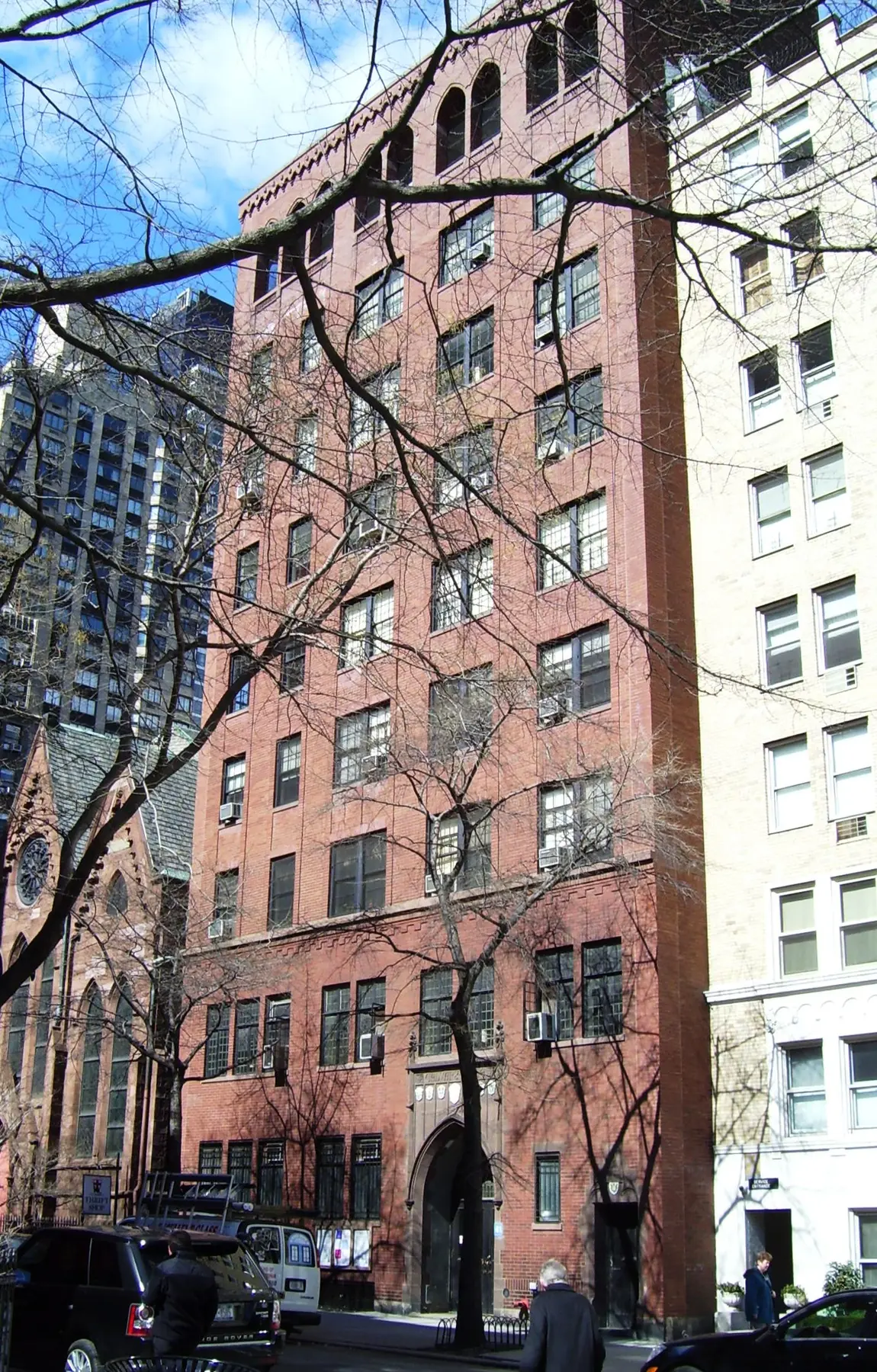
The tall building beside the church belongs to Sam Shoemaker’s Calvary. He became rector in 1925, bringing an energetic interest in personal religious experience and the work ordinary people could do in their daily lives. Meetings, conversations and hospitality were central to that approach. They needed rooms.
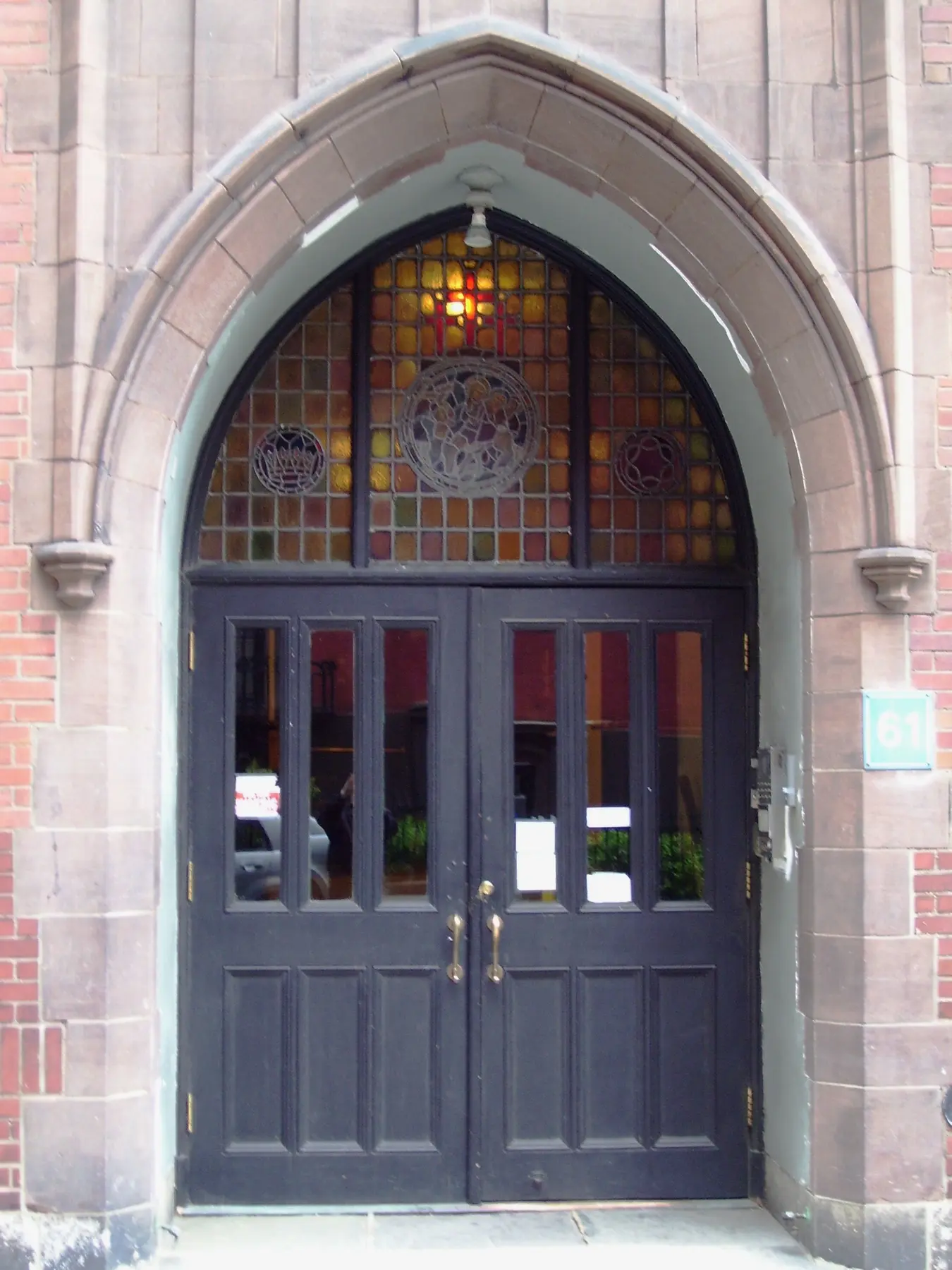
In 1927–28, part of the church property was sold and the old rectory was replaced. A.A.’s account of Shoemaker’s life dates the opening of Calvary House to 1928. Its height and concentration of different uses belonged to the modern city around it, even as its pointed entrance maintained a visual connection to the church.
A remarkably useful report in The Witness on February 9, 1928 catches the building before it was finished. A duplex apartment was planned for the rector at the top. Below were quarters for assistant clergy, the choirmaster, the house-mother and staff. Offices and an auditorium occupied the ground floor. Smaller, welcoming rooms were intended for personal interviews and meetings.
The arrangement was deliberately flexible. Rooms would serve several groups rather than belong permanently to one organization. A large room near Shoemaker’s study would accommodate small gatherings and Sunday-afternoon tea. The object was to make it easy for people to meet the clergy and one another.
That description changes the way the facade reads. Calvary House was more than an administrative annex. It brought a residence, working offices, hospitality and gathering spaces into one building. The ordinary business of people coming upstairs to talk was part of its design from the beginning.
Calvary House and the beginnings of A.A.
Calvary’s most far-reaching twentieth-century connection grew from those conversations. Shoemaker was a leading American figure in the Oxford Group, a Christian movement that emphasized personal change, honest self-examination, making amends and helping others. The Episcopal Church’s archives records his weekly meetings for working people and the rescue mission through which he came into contact with men struggling with alcoholism.
Calvary House and the Calvary Rescue Mission were distinct places. The mission served a different part of the neighborhood; the meetings behind the church took place at the parish house. Both figure in the history, and collapsing them into one building obscures how the connections were made.
After his experience at Towns Hospital in late 1934, Bill Wilson and his wife, Lois, began attending Oxford Group meetings at Calvary House. A.A.’s historical account describes Bill speaking about alcoholism there and meeting others who wanted help. Some continued the conversation afterward at a cafeteria. The early attempts were uneven, but the importance of one person talking directly to another was becoming clearer.
A.A. itself emerged in Akron in 1935 through Bill W. and Dr. Bob. Calvary was an important New York setting in the history that led to it, and Shoemaker a major spiritual influence. His role is substantial enough without calling him one of its two founders or assigning the whole origin story to this corner.
Alcoholics Anonymous’ account of Shoemaker credits his influence on the ideas that became the Twelve Steps. It also describes a relationship that developed rather than proceeding without disagreement. The alcoholics’ decision to meet independently initially troubled him; after leaving the Oxford Group in 1941, he apologized to Wilson for the earlier lack of encouragement.
Shoemaker left New York in 1952 to become rector of another Calvary Church, in Pittsburgh. His friendship with Wilson and support for the fellowship continued. The legacy at Gramercy is both intellectual and physical: ideas passed from person to person, in rooms designed to make that exchange possible.
A history you could hear
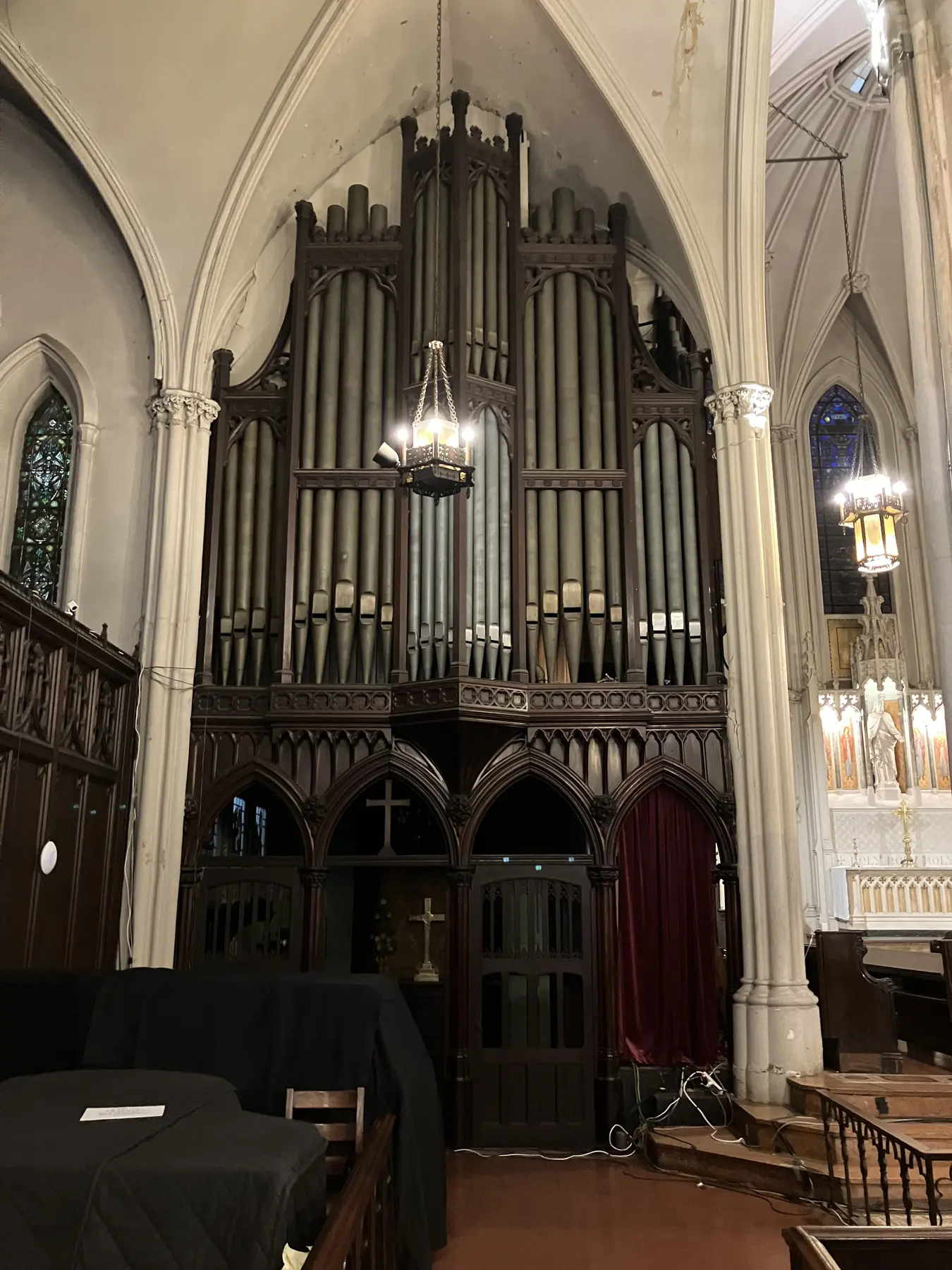
Calvary’s musical history is also a history of rebuilding. The first organ in the brownstone church was made by Davis & Ferris in 1847. Remarkably, it survived its departure from Manhattan: the instrument went to the auditorium at Round Lake, New York.
Its successors formed a sequence of overlapping generations. A Roosevelt organ was installed in the 1880s; Ernest M. Skinner rebuilt it in 1907. The 1936 Aeolian-Skinner instrument retained fifteen stops from the Roosevelt organ. The Guild of Organists’ detailed record traces this continuity through contracts and specifications.
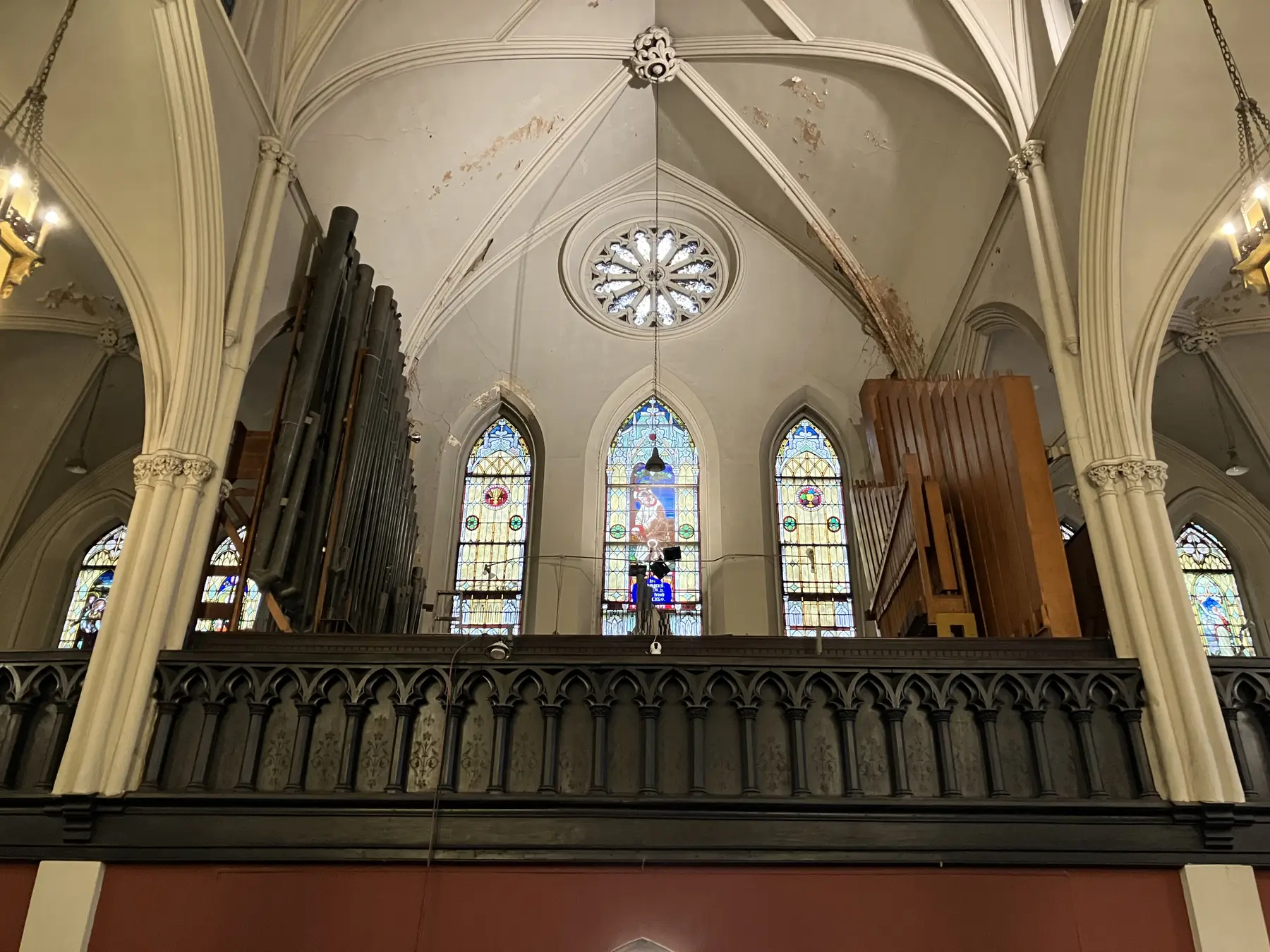
Later, Calvin Hampton and organ curator Randolph Gilberti revised and enlarged the instrument. What a listener heard was the result of choices made by musicians and builders over decades. The organ cases are part of the room’s appearance; the instrument behind them has its own, less visible history of preservation and change.
The doors opened at midnight
Calvin Hampton arrived as Calvary’s organist and choirmaster in 1963 and stayed for twenty years. He made the church a place to hear music at an hour when most sanctuaries were dark.
The New York Public Library’s account of his career dates his free Friday at Midnight concerts to 1974–83. They attracted public attention and brought an audience into the church outside the rhythms of Sunday worship. His repertoire included Bach and his own organ transcriptions of music by composers including César Franck, Grieg and Messiaen.
Hampton was also a prolific composer. He wrote hymn tunes and choral music, but worked with synthesizer, orchestra and chamber ensembles as well. His musical life extended far beyond the organ loft.
He stepped down in 1983 after an HIV/AIDS diagnosis and died the following year, aged forty-five. The library now preserves his papers, scores, programs, photographs and hundreds of recordings. They offer a way back into an extraordinary chapter of Calvary’s life: a historic church whose late-night music gave New Yorkers a new reason to come inside.
A larger parish, a neighborhood church
In the mid-1970s, Calvary joined with St. George’s and the Church of the Holy Communion. The combined parish brought together three histories and more than one set of buildings. St. George’s, at Stuyvesant Square, remained a separate church site; Calvary remained here at Park Avenue South. That distinction matters when following the lives of the people associated with each.
The Rev. Thomas F. Pike became rector in 1975 and served for thirty-three years. His concerns extended from the life of the congregation to the future of historic religious buildings. When Partners for Sacred Places was founded in 1989, Pike was its first board chair. The organization’s purpose joined two questions he knew firsthand: how to preserve these places and how to keep them useful to their communities.
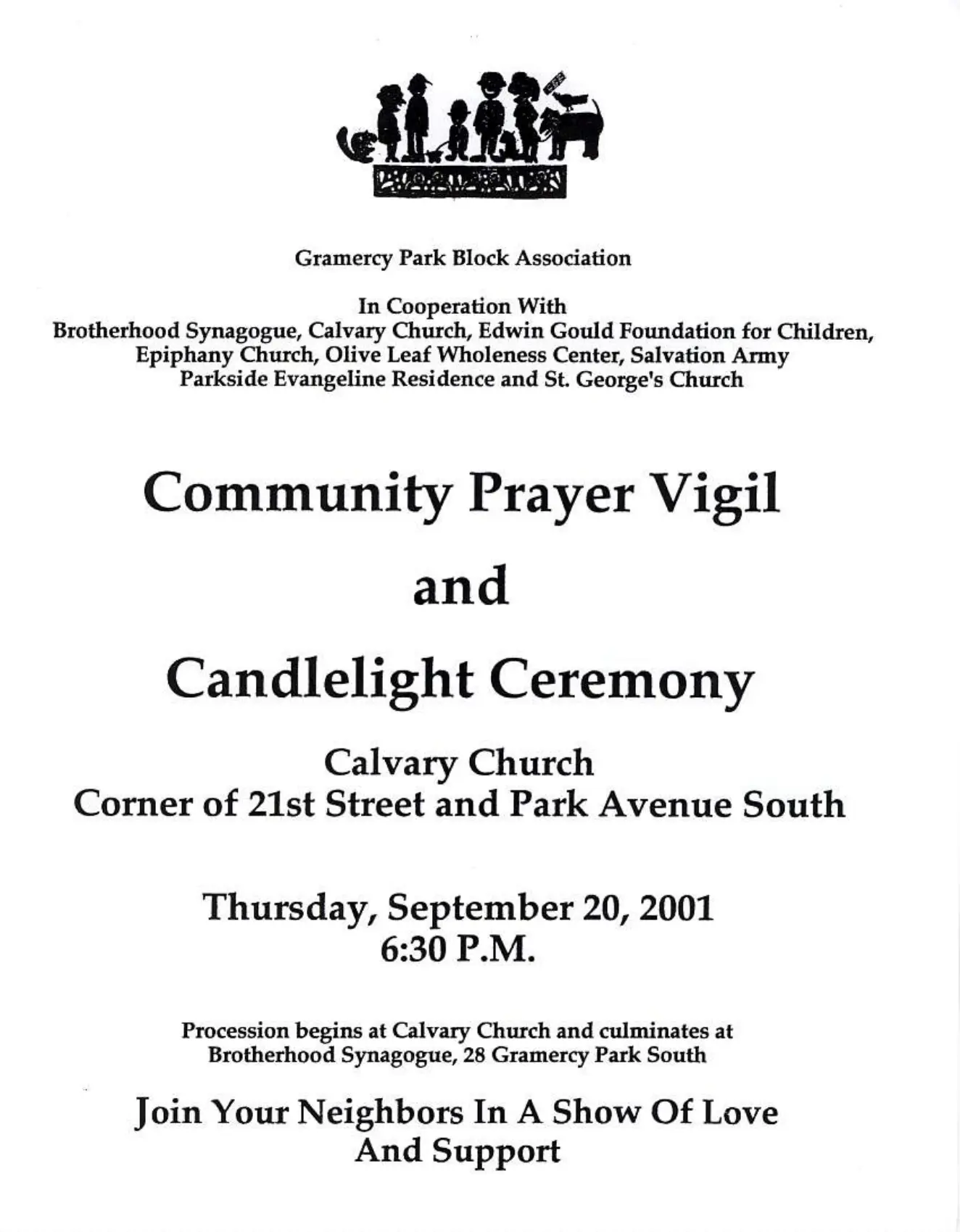
Calvary’s neighborhood role became particularly visible after September 11, 2001. The Block Association’s relief record describes the church offering space to unload supplies sent from Ohio. On September 20, a community prayer vigil and candlelight procession connected Calvary with Brotherhood Synagogue.
The contemporary announcements place religious institutions alongside the Block Association, the Edwin Gould Foundation and other neighborhood organizations. A building whose history includes celebrated weddings and important musicians was also a place where neighbors could bring supplies, meet one another and grieve together.
Another generation at the door
Calvary remains part of the active Episcopal parish of Calvary–St. George’s. The Rev. Jacob Smith, who has served the parish since 2006, became rector in 2017. Parish offices remain at 61 Gramercy Park North. Worship, music, family activities and community programs continue across the parish’s sites.
Maintaining those sites is a continuing undertaking. The parish’s capital campaign for building restoration is separate from its annual support for ministry and operations. The distinction is a familiar one in Calvary’s history: people need the building, and the building requires sustained care.
Calvary House has also acquired a new chapter. EGF, the Edwin Gould Foundation, now identifies 61GPN as its headquarters and a gathering place for nonprofit leaders. Its spaces support organizations working on educational equity, with room for meetings, retreats, board sessions and community events. The foundation’s public galleries show the building in contemporary use.
It is a fitting use for a house planned around shared rooms and encounters between people. Nearly a century separates Shoemaker’s Sunday-afternoon tea from the present meeting spaces. The practical value of giving people somewhere to gather is easy to recognize in both.
In October 2026, the parish marks fifty years together with an anniversary celebration. For the latest service locations, opening arrangements and events, consult the parish’s current website.
The spires are gone. The doors still give this corner its purpose.
Calvary at a glance
- 1830s
- Calvary begins in a small frame church north of the settled city.
- 1846–47
- Renwick’s brownstone church is built; the consecration is recorded in June 1847.
- 1850
- A new auction of the pews clears the church’s outstanding debt.
- 1860
- The original spires are removed, according to the Flatiron NoMad history.
- 1882–96
- Henry Yates Satterlee serves as rector and expands the parish’s work beyond the sanctuary.
- 1885
- Eleanor Roosevelt is baptized at Calvary.
- 1902
- Rebecca Salome Foster’s funeral brings together people from across the city.
- 1925
- Sam Shoemaker becomes rector.
- 1928
- The present Calvary House opens.
- 1930s
- Oxford Group meetings at Calvary House form part of the early history of A.A.
- 1936
- Aeolian-Skinner builds the organ that will later be enlarged and revised.
- 1963–83
- Calvin Hampton serves as organist and choirmaster.
- 1966
- The church is included in the Gramercy Park Historic District.
- Mid-1970s
- Calvary, St. George’s and Holy Communion combine as one parish.
- 2001
- The September 20 community vigil and procession begin at Calvary.
- 2017
- Jacob Smith becomes rector.
- 2026
- The parish celebrates fifty years together; EGF’s 61GPN headquarters gives Calvary House another community use.
Sources & historical notes
- 1916Charles H. Brent, A Master Builder: The Life and Letters of Henry Yates SatterleeEspecially pp. 74–92 and the chapters on Satterlee’s Calvary years: early buildings, parish finances, outreach and Rebecca Salome Foster.
- ReferenceAmerican Guild of Organists, New York City Chapter: Calvary Episcopal ChurchThe 1847 consecration and successive organs, with specifications and references to original contracts.
- 1847Library of Congress: Calvary Church, erected 1846–7Period architectural print showing the original twin-spired design.
- 1966Landmarks Preservation Commission: Gramercy Park Historic DistrictThe district designation, Calvary’s brownstone Gothic architecture and its connection to the Jones family.
- 2008Flatiron NoMad Partnership: Calvary Episcopal ChurchThe lost spires, Vanderbilt wedding and Thomas Pike’s years as rector. Its baptism date is superseded here by the diocesan biography.
- Parish archiveCalvary–St. George’s: Church HistoryThe parish’s historic people and consolidation. Several dates in this account are reconciled with the sources listed below.
- 2026Episcopal Diocese of New York: Commemoration of Eleanor RooseveltConfirms Roosevelt’s baptism at Calvary in 1885.
- ReferenceHistorical Society of the New York Courts: The Tombs and the Tombs AngelRebecca Salome Foster’s prison work and place in the history of the courts.
- 2011Tom Miller, Daytonian in Manhattan: Calvary Episcopal ChurchThe changing exterior and Foster’s funeral. The present Calvary House is dated here from the contemporary 1928 report, not this article.
- 1928The Witness, February 9, 1928, p. 8A contemporary account of Calvary House under construction, describing its rooms, residents and intended use.
- ArchivesArchives of the Episcopal Church: Samuel Moor ShoemakerRector from 1925 to 1952; lay evangelism, the rescue mission and his writings.
- A.A. historyAlcoholics Anonymous: Sam ShoemakerCalvary House’s 1928 opening and Shoemaker’s influence. The same biography is also available through A.A. Brazil.
- A.A. historyAlcoólicos Anônimos do Brasil: Sam ShoemakerAccessible version of the A.A. biography, including the building and the Oxford Group relationship.
- A.A. historyWestchester A.A. General Service Assembly: 1935Bill and Lois Wilson at Calvary House, the Oxford Group meetings and A.A.’s beginnings in Akron.
- ArchivesNew York Public Library: Calvin Hampton papers, JPB 24-6Archival finding aid prepared in 2024: Hampton’s Calvary career, midnight concerts, compositions and surviving recordings.
- Institutional historyPartners for Sacred Places: Our FoundingThomas Pike’s role as the organization’s first board chair in 1989.
- 2001–2026Gramercy Park Block Association: September 11 and the neighborhood relief effortCalvary’s place in the relief effort and the September 20, 2001 vigil and candlelight procession.
- Community archiveGPBA illustrated relief-effort record, Part 1Contemporary announcements and documentation of the community’s response after September 11.
- Current parishCalvary–St. George’s: Who We AreCurrent clergy, including Jacob Smith, rector since 2017.
- 2026Calvary–St. George’s: Giving and building restorationThe parish distinguishes its building-restoration capital campaign from annual operating support.
- 2026Calvary–St. George’s: Fiftieth-anniversary celebrationThe October 23, 2026 celebration of the combined parish.
- 2026EGF: 61GPNThe foundation’s present headquarters and collaboration spaces at 61 Gramercy Park North.
- 2018The Real Deal: Fotografiska expanding at Park Avenue SouthIdentifies the separate 1867 Renwick Gem schoolhouse north of Calvary Church.
The church was built in 1846–47; the 1847 date follows the period print, Brent’s early history and the Guild of Organists’ consecration record. The current Calvary House opened in 1928, as documented by a contemporary construction report and A.A.’s Shoemaker biography; it should not be confused with the 1867 Renwick Gem. Sources differ on Calvary’s earliest organizational date and the dating of the combined parish: this account uses “the 1830s” and “the mid-1970s,” while retaining the parish’s own 2026 fiftieth-anniversary observance. Current information checked September 2026.
Gramercy Stories explores the buildings, addresses and places that give the neighborhood its character.