
The Edwin Booth Statue
An eternal curtain call
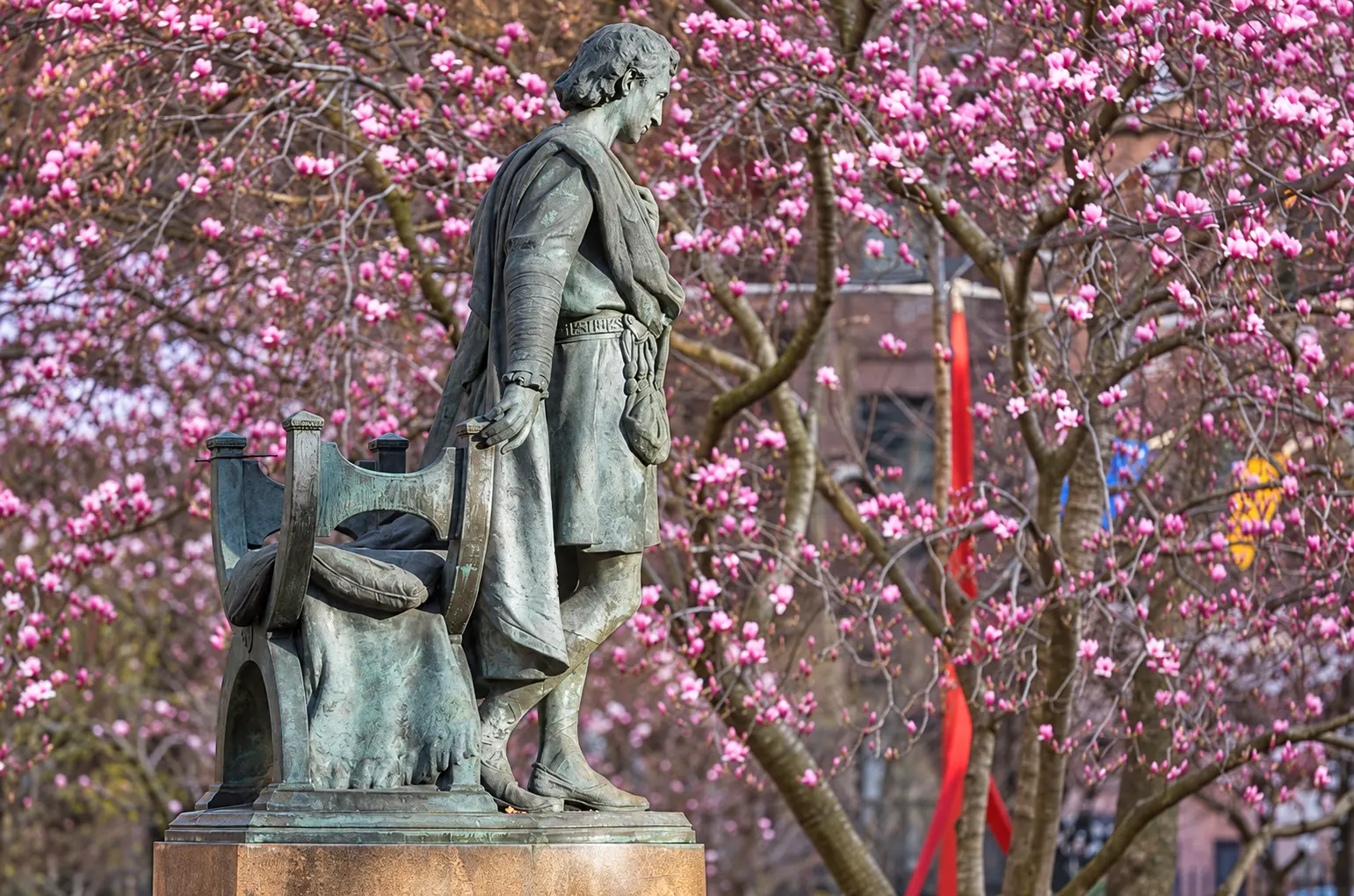
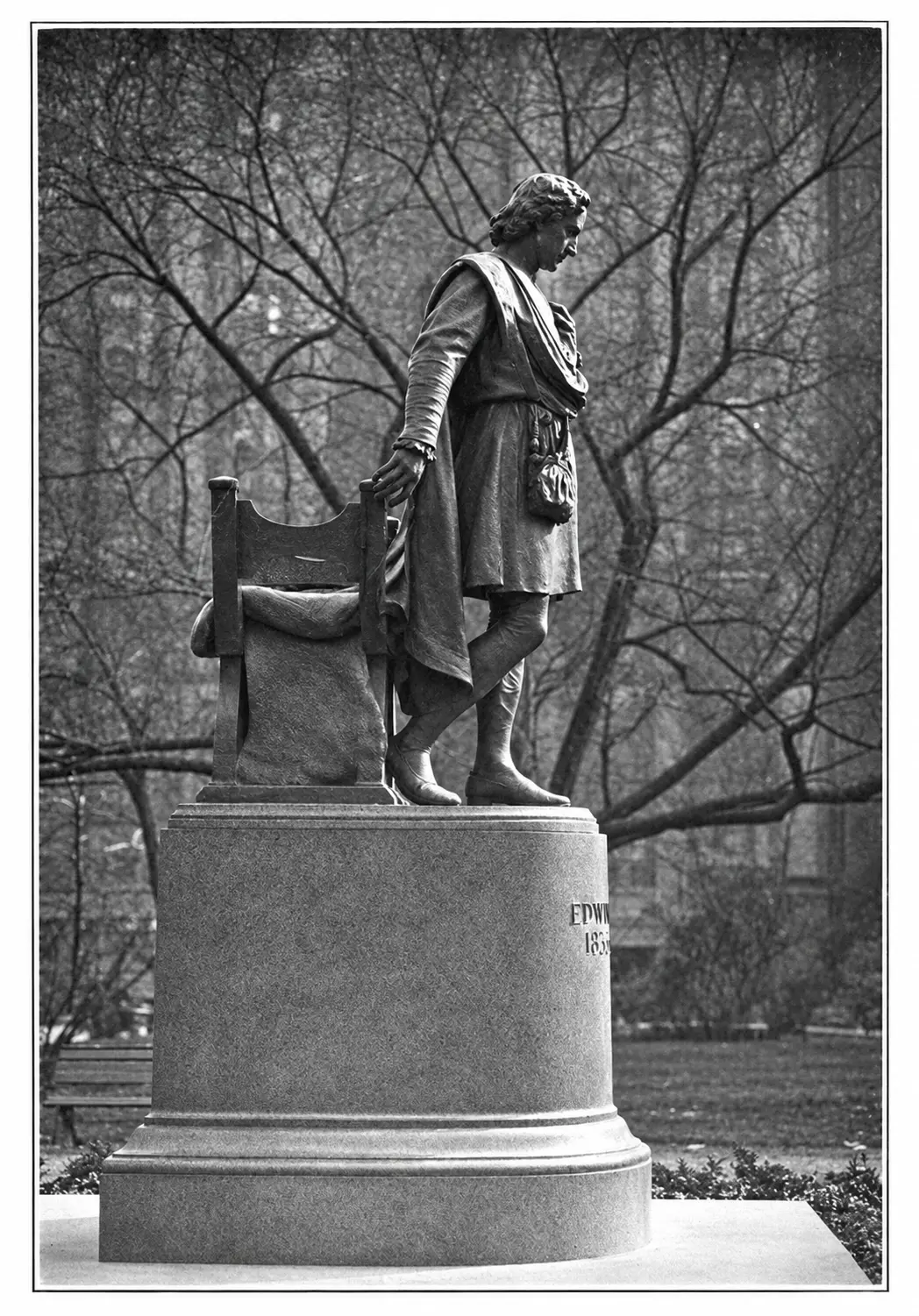
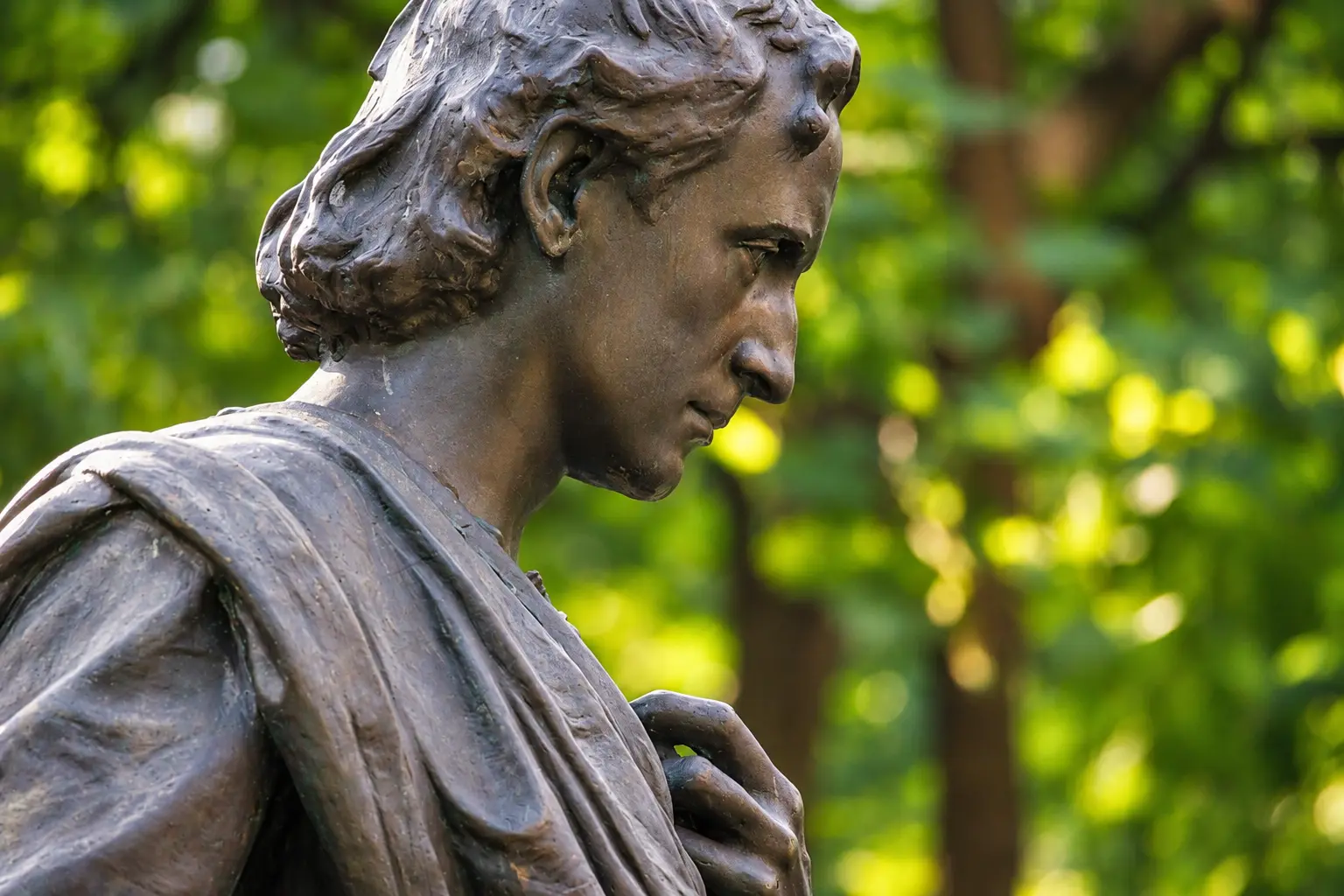
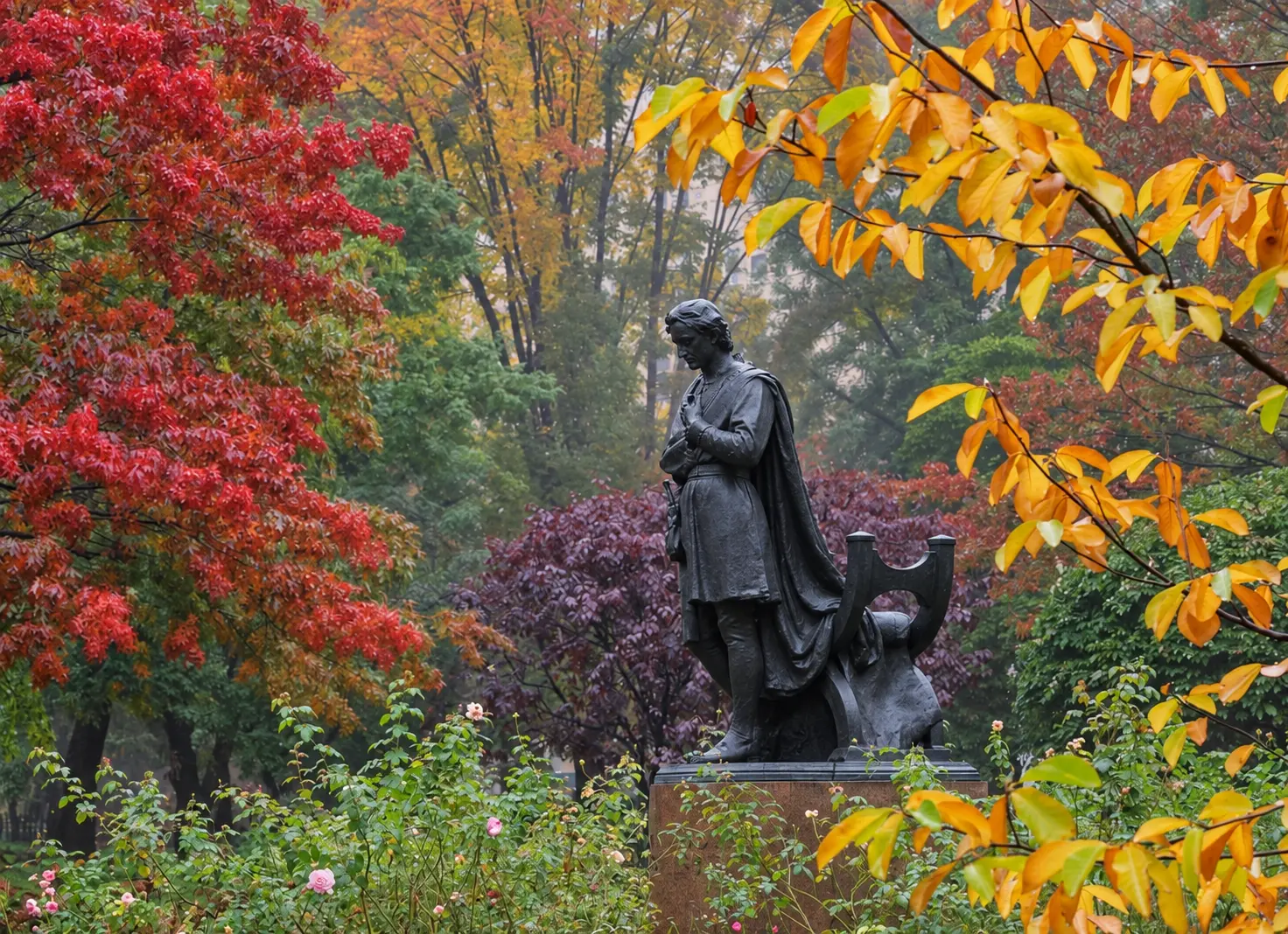
At the center of Gramercy Park, Edwin Booth stands as Hamlet, one hand resting on the chair behind him. His head is bowed; the words have not yet come. Edmond T. Quinn’s bronze has held that pause since November 1918, facing the house Booth gave to The Players. Getting it there took twelve years, three successive sculptors and a world war.
The moment before the words
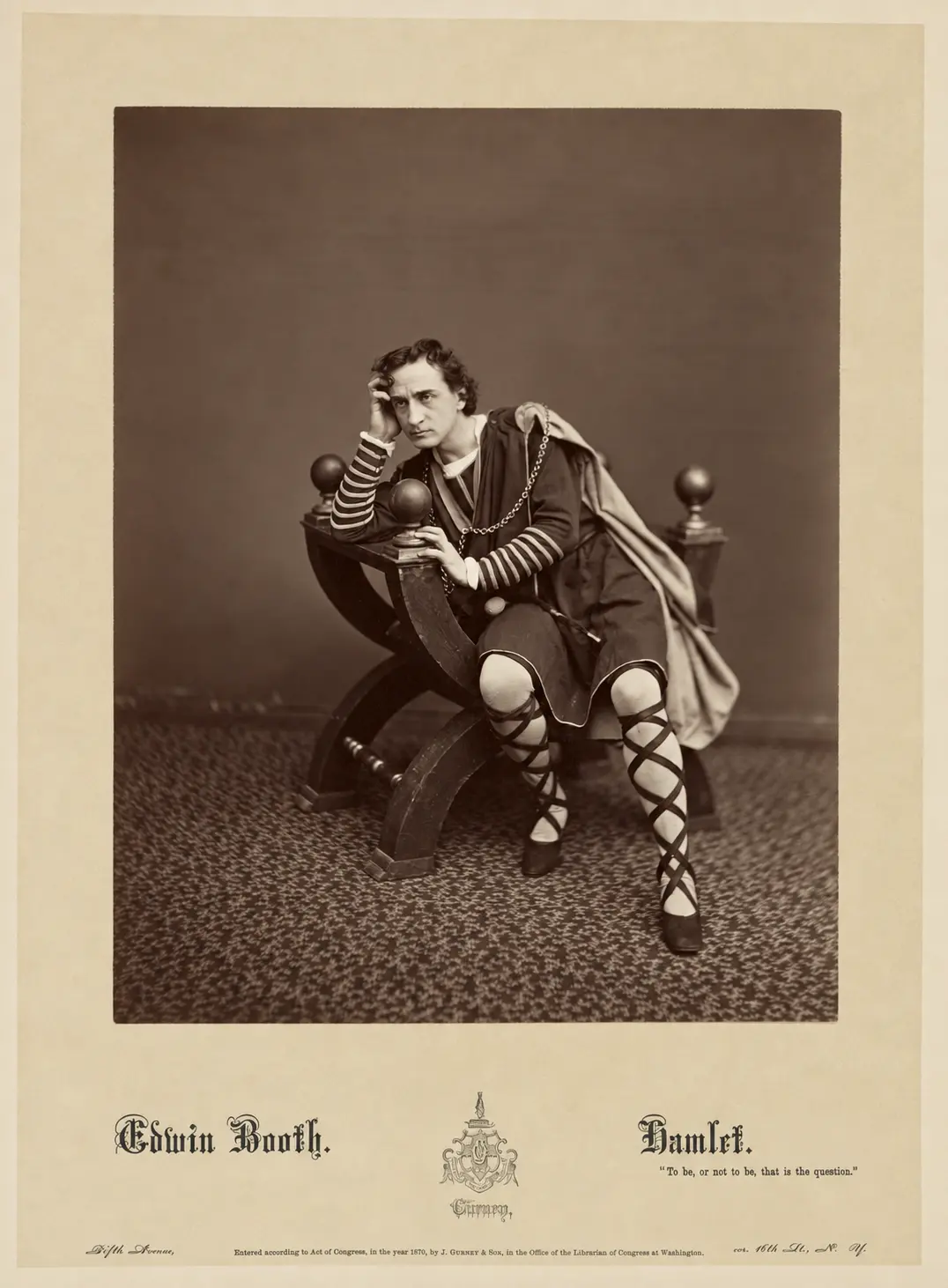
Howard Kyle, the actor who served as secretary of the memorial committee and wrote its history, described the figure as Hamlet “about to utter the soul-searching soliloquy on life and death.” It is the pause before “To be, or not to be.” Booth had been photographed beside a chair in the role at Gurney’s studio about 1870; the photograph carries the line as its title.
Quinn’s Hamlet wears a belted tunic under a long cloak, a chain and medallion at the chest, and a sheathed dagger at the hip. The committee had supplied a replica of Booth’s Hamlet costume and copies of its accessories during the earlier MacMonnies commission. These were details of a remembered performance, down to what the actor wore.
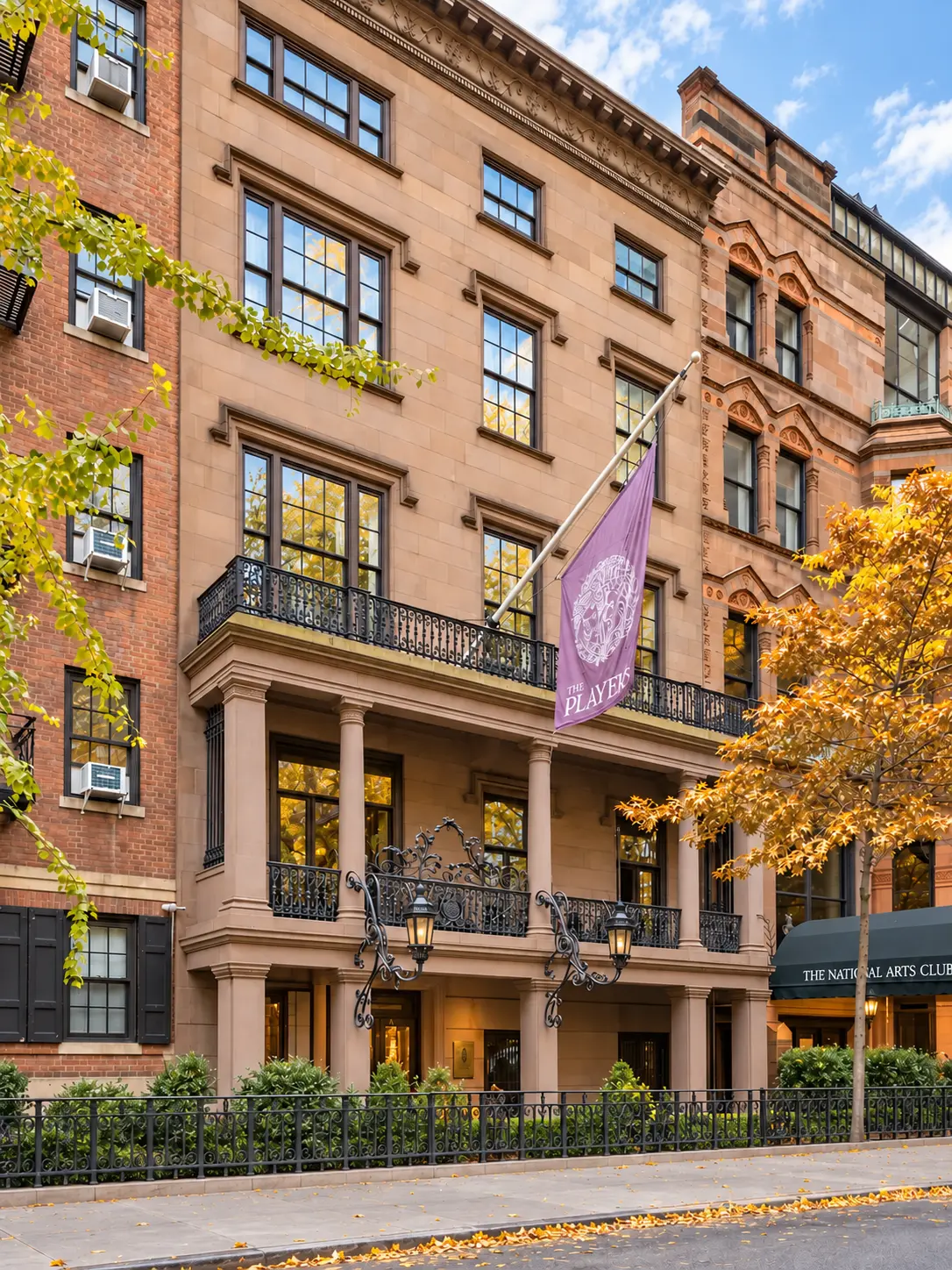
Unveiled on November 13, 1918, the memorial faces south toward The Players, the club Booth founded and the house in which he spent his last years. The bronze actor looks toward his old home; the windows of his rooms look back into the Park.
The part that belonged to Booth
Hamlet was Booth’s part in a way few roles have belonged to any actor. His celebrated run at the Winter Garden Theatre began in 1864 and reached its hundredth consecutive performance on March 22, 1865. The commemorative program survives at the Folger Shakespeare Library. Twenty-three days later, his younger brother John Wilkes Booth shot President Abraham Lincoln.
Edwin supported the Union and Lincoln. A letter to Colonel Adam Badeau in October 1864, also preserved at the Folger, makes his sympathies plain. Before the assassination, he had saved Lincoln’s son Robert from a railway accident in Jersey City, pulling him out of the gap between a moving train and the platform. Robert Todd Lincoln later recalled the rescue himself. None of that spared the Booth name in April 1865.
Edwin withdrew from the stage. When he returned to the Winter Garden on January 3, 1866, he returned as Hamlet. His career continued for another quarter century, ending with the same role at the Brooklyn Academy of Music on April 4, 1891.
In 1888 he bought 16 Gramercy Park South, had Stanford White adapt it, and on New Year’s Eve gave it to the club he had founded. He kept a bedroom and sitting room on the third floor. Booth died there on June 7, 1893. Twenty-five years later, some of the people gathered around his statue could still remember his voice.
First a bust. Then an arch.
The idea began modestly. In March 1906 William Bispham wrote to the Trustees of Gramercy Park on behalf of The Players, asking permission to set the club’s Launt Thompson bust of Booth as Hamlet on a pedestal opposite the clubhouse. The Trustees approved the request at their May 8 meeting and replied on May 29. Their terms were practical: the club would bear the expense, risk and responsibility, and agree to remove the bust on reasonable notice.
Within months, the modest idea had grown. An art committee chaired by the painter Francis D. Millet met Augustus Saint-Gaudens in July 1906, and Saint-Gaudens offered to make a full bronze Booth as Hamlet for $50,000. He was already ill. He died in 1907 before a contract could be signed.
The committee turned next to Frederick MacMonnies, whose Nathan Hale stood in City Hall Park. It signed with him in September 1909 for $25,000. He had offered to undertake the commission for $20,000; the committee, convinced that he could not afford to do it for that sum, insisted on paying more.
MacMonnies wanted the center of the Park rather than a position by the fence. There, he argued, the monument could honor the theater itself as well as the founder of a particular club. That choice of site preceded his design, which reached the committee in March 1910: Booth beneath an arch recalling a theater’s proscenium, with Comedy and Tragedy incorporated into the architecture.
The arch divided The Players. Some admired it; others found it too baroque; still others objected to any arch at all. From Giverny, MacMonnies defended the theatrical setting in a letter to the painter Thomas Dewing. To put Hamlet on a bare pedestal without the suggestion of a proscenium, he wrote, would be as incongruous as “a statue of an admiral seated in a Morris chair.”
The disagreement lasted years. In February 1913 the committee asked for a version without the arch. MacMonnies resigned that June, returned the reference materials and settled the financial account. Booth’s daughter, Edwina Booth Grossman, remained an admirer of his design. Writing from Lucerne that August, she called it “beautiful and harmonious.” Seven years had passed, and there was still no statue.
“He was a man”
The committee’s next solution was a competition among sculptor-members of The Players. At a meeting in the club library in September 1913, the sculptors divided four to four over whether competition was the proper way to choose an artist at all. Gutzon Borglum, later the sculptor of Mount Rushmore, initially agreed to participate but withdrew before the judging. Eight sculptors ultimately entered.
Each competitor was allowed $150 toward the cost of a model. The contract on offer was $25,000. Entries included a three-foot figure and a scale drawing of the pedestal, submitted anonymously; a sealed envelope held the maker’s name. Even the positions of the models in the exhibition were assigned by lot.
The decision came on October 2, 1914, in the National Arts Club’s gallery, a few doors from Booth’s house. Twenty-one jurors were present. They included Stuyvesant Fish, whose former home stood at No. 19, and three outside sculptors chosen by the competitors: Lorado Taft, Charles Henry Niehaus and Albert Jaegers.
All three outside sculptors preferred J. Massey Rhind’s more elaborate composition. A majority favored the model marked “HE WAS A MAN.” The words came from Hamlet’s remembrance of his father: “He was a man, take him for all in all, / I shall not look upon his like again.” When the envelope was opened, it named Edmond T. Quinn, working with his chosen architect, Edwin S. Dodge. What carried their design was its likeness: judges who had known Booth felt they recognized him.
The choice was not entirely free of criticism. Some thought the design conventional. Its defenders remembered the lifelike quality of Quinn’s bust of Edgar Allan Poe in The Players’ library. They were prepared to wait for the finished figure. The models remained on public view at the National Arts Club for a week after the judging.
The people who remembered him
Quinn worked at 135 DeKalb Avenue in Brooklyn. As the figure developed, committee members who remembered Booth’s Hamlet crossed the river to see it. Quinn later said that their questions and suggestions had helped him. He was making a portrait of a performance, with living witnesses still available to guide him.
The project had already assembled an unusually intimate body of reference material. During the MacMonnies commission, Howard Kyle himself dressed in the replica of Booth’s Hamlet costume and posed for eighteen photographs. Fellow Players directed each attitude, searching for something characteristic of the actor they remembered. The effort to preserve Booth had briefly required another actor to play him.
Quinn and Dodge explained their restraint in terms of both the man and the place. A small park called for “simple dignity of treatment.” They rejected subsidiary figures and an elaborate architectural setting. The pedestal had to work from every direction, and the bronze had to stand high enough to be seen above the fence from the sidewalks across the surrounding streets.
The Smithsonian’s sculpture inventory identifies the founder as the Gorham Manufacturing Company and dates the sculpture to 1917. Its public unveiling followed in 1918.
Two names behind the monument
Quinn came to sculpture through painting. Born in Philadelphia in 1868, he studied with Thomas Eakins and later trained in Paris with Jean-Antoine Injalbert. A 1910 Art Institute of Chicago exhibition catalogue lists him as both painter and sculptor, exhibiting a bust of Poe. Portraiture remained central to his work. New Yorkers can also find his Victor Herbert memorial on the Mall in Central Park, dedicated in 1927.
Dodge brought an architect’s training at Harvard, MIT and the École des Beaux-Arts. Before the Booth commission, he and his wife, the future Mabel Dodge Luhan, had spent years transforming the Villa Curonia outside Florence. Mabel would become famous for the artists and writers she gathered around her. Here, Dodge’s task was quieter: to give Quinn’s figure a setting that could be seen from all sides without competing with it.
The stone that missed its entrance
By 1917, the committee hoped to unveil the memorial on April 23, the club’s Ladies’ Day and Shakespeare’s traditional birthday. Then the granite arrived from New Hampshire with a serious flaw. A seam had developed in the stone, making it unusable.
October became the next target. This time the obstacle was the war: restrictions on nonessential freight prevented shipment of the replacement. Another April 23 passed. Only after a special appeal to railroad officials did Quinn report, at the end of May 1918, that the stone had finally been loaded and shipped.
A July ceremony was considered and rejected. The committee wanted its audience in New York, not away for the summer. Some thought the entire undertaking should wait until the war ended. Eventually they chose November 13, Booth’s birthday. They could not have known how well the date would work. The Armistice came two days before the unveiling.
Twenty-four minutes, then the matinees
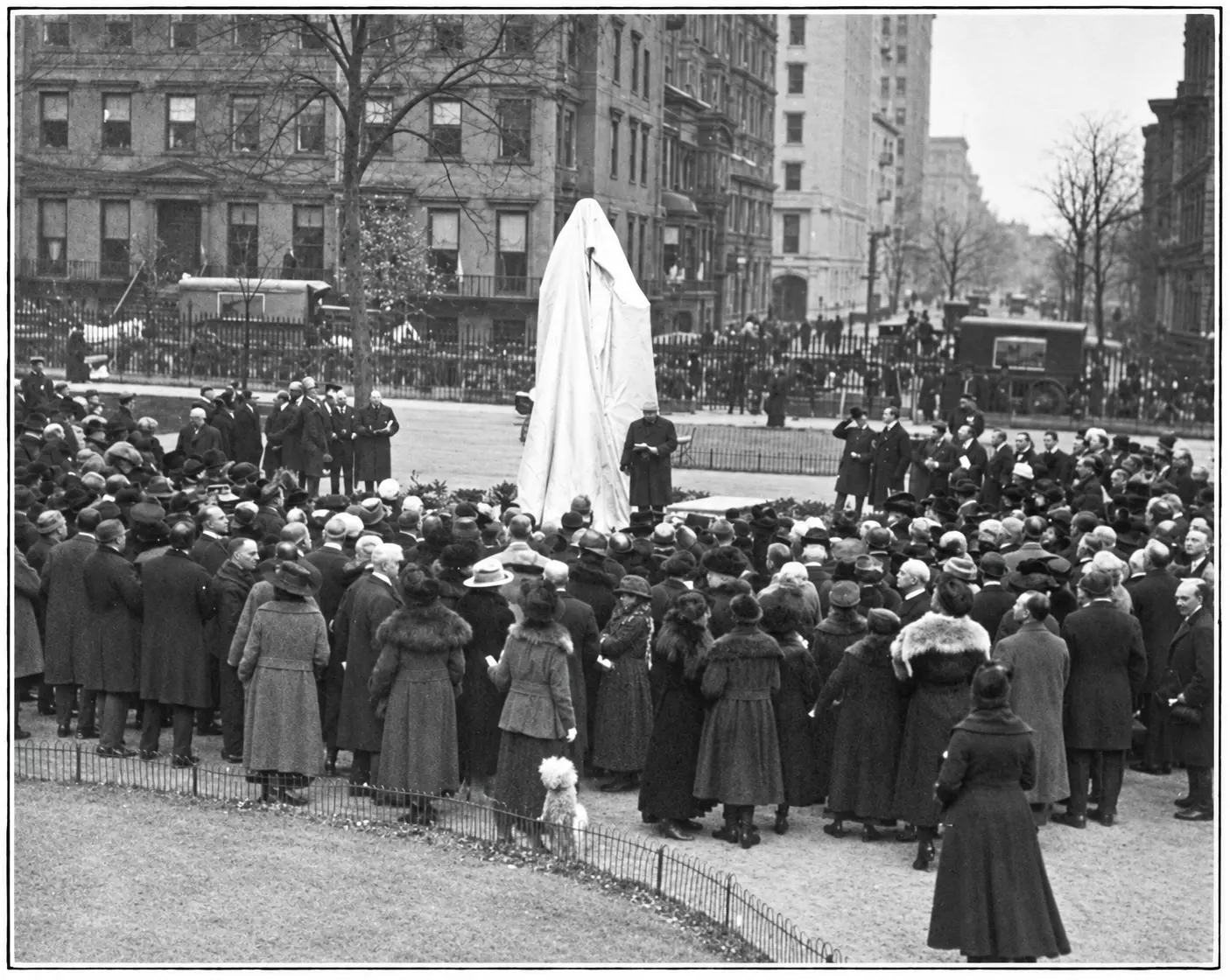
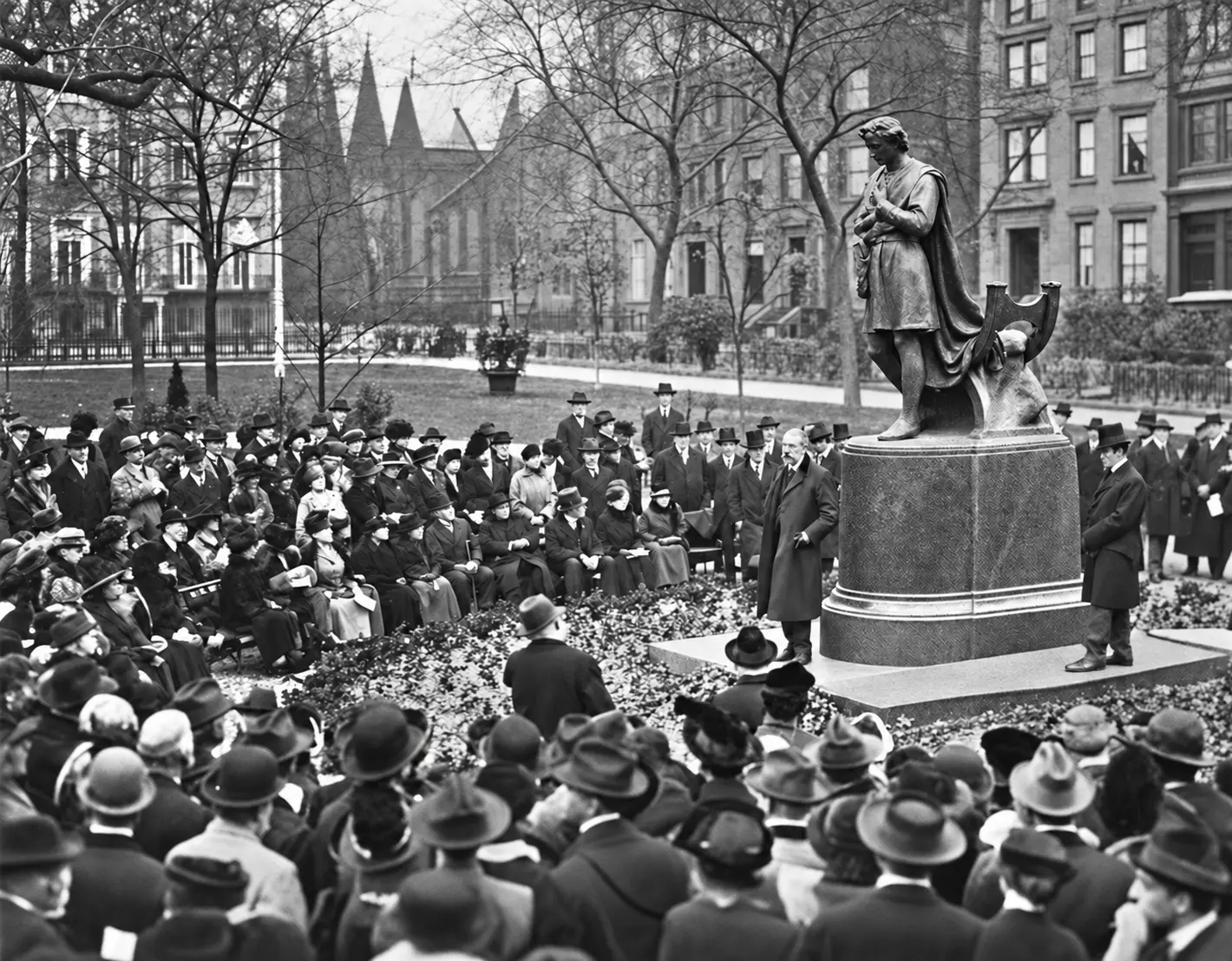
At noon on Wednesday, November 13, 1918, actors, friends, neighbors and Booth’s family gathered around the covered statue. It would have been his eighty-fifth birthday. The hour accommodated the performers’ matinees; the brevity also spared an outdoor audience a long spell in the November cold.
A male quartet directed by C. L. Safford opened with Shakespeare’s “Blow, Blow, Thou Winter Wind.” The Rev. George C. Houghton, rector of the Church of the Transfiguration—the actors’ beloved Little Church Around the Corner—gave the invocation. The church had held Booth’s funeral in 1893; The Players later gave it a memorial window by John La Farge, installed in 1898. Howard Kyle then presented the memorial, asking The Players to accept it “free from encumbrances, and assume the duty of its care and preservation.”
The unveiling had its own small cast. Booth’s grandson, Edwin Booth Grossman, loosened the covering at the front. Guy Nichols, an actor, Booth’s old friend and the club’s librarian, drew it away. Walter Ottel, the steward who had served Booth, carried the cloth from the scene.
John Drew accepted the monument for The Players, remembering Booth as “our leader and our friend” and the trees the actor had loved to look at from his windows. John B. Pine responded for the Trustees of Gramercy Park, welcoming “the distinguished guest you have brought us.” Brander Matthews spoke about Booth’s art and the home he had created for the arts. He found an appropriate companion elsewhere in the city: the statue of Shakespeare in Central Park.
The quartet sang “Who Is Sylvia?” and the ceremony was over. It had taken twenty-four minutes. The Evening Post noticed the babies: noon was their customary hour in the Park, and they had not been turned out for the occasion. Among the youngest guests were Booth’s great-grandchildren. Older actors, who remembered the man as well as the performances, stood looking at their friend.
“It is my father as I knew him”
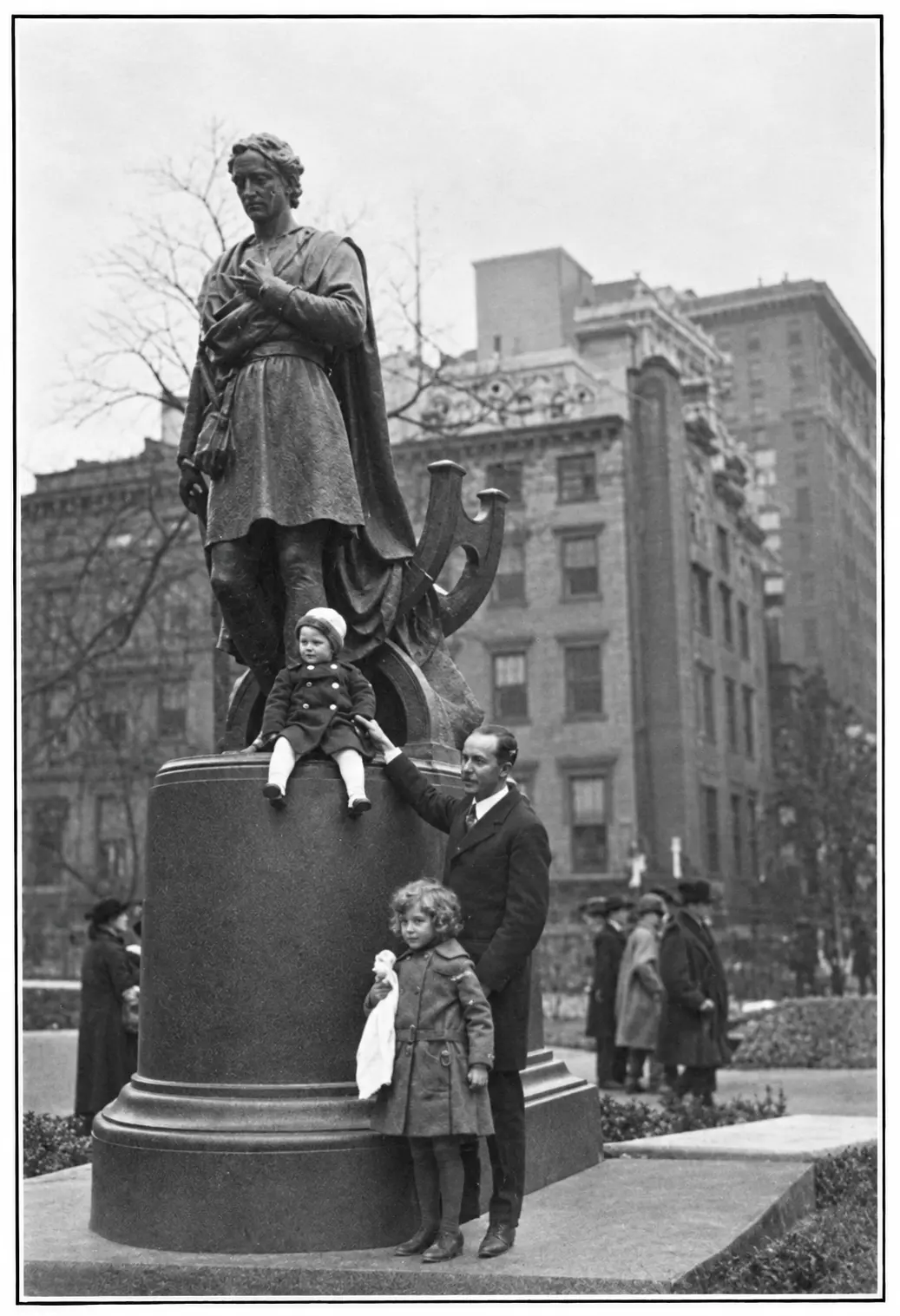
The most personal verdict came from Booth’s daughter, Edwina Booth Grossman. Kyle recorded her words after the ceremony: “Everything has been just right. The statue is wonderful. It is my father as I knew him. He seems to live again and the more I look at the figure the more deeply I am moved.” The motto on the winning model had been Hamlet’s line about his own father.
Photographs in the committee’s history show the family at the pedestal. In one, Edwina’s son, Edwin Booth Grossman, stands with two small great-grandchildren of Booth: Lois Fellows Grossman and Livingston Booth Waterbury. The monument already belonged to a generation that had never seen him perform.
As the gathering dispersed, playwright Percy MacKaye looked back from the south gate and supplied a final line for the occasion.
“There he is, Edwin Booth taking his eternal curtain call!”
Percy MacKaye, November 13, 1918 · recorded by Howard Kyle
The company keeps returning
The Players had marked Booth’s birthday from the first November after his death. On November 13, 1893, the club held a memorial evening at Madison Square Garden Concert Hall. Joseph Jefferson gave the introductory address, and the program included tributes from Henry Irving and Tommaso Salvini. Walter Damrosch directed the music, which opened with Handel’s Dead March from Saul—a piece Booth had used in Hamlet.
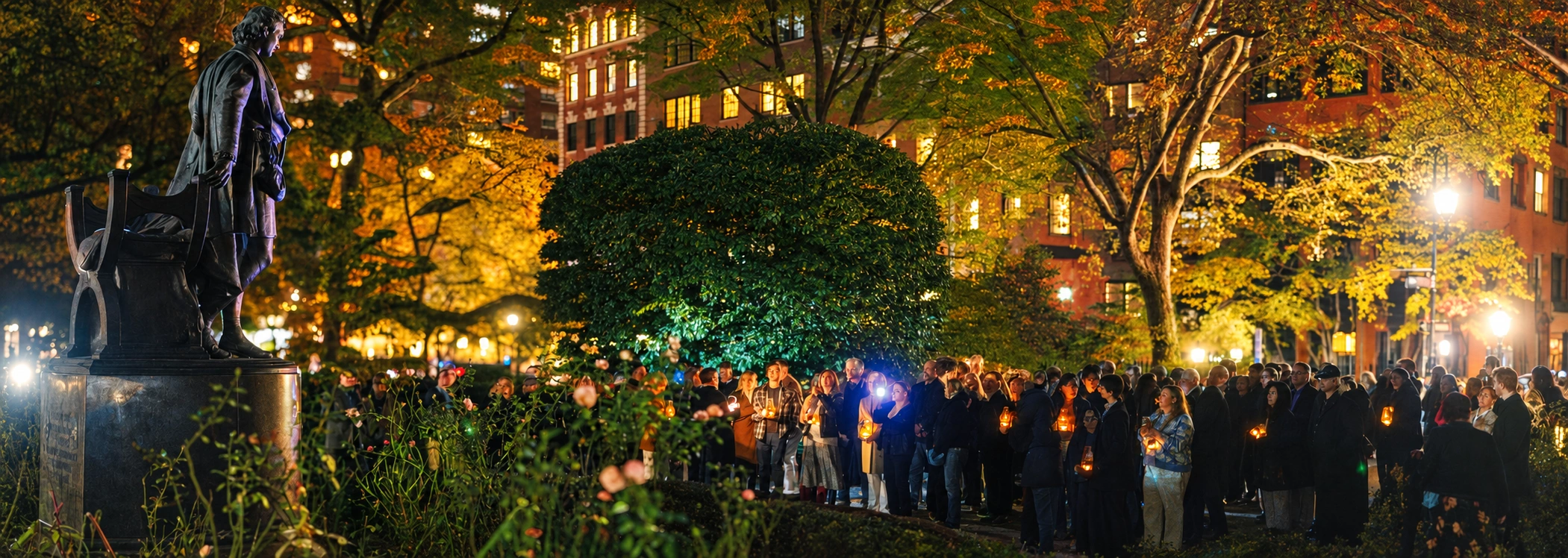
The statue gave later generations a place to gather. The Players’ Founder’s Day observances have included a candlelight procession from the clubhouse and the laying of a laurel wreath at the pedestal. The gesture is simple enough to repeat across generations: leave the house he gave, walk into the Park he knew, and gather around his likeness.
The setting has attracted painters as well as actors. Johann Berthelsen, who began his working life as a singer, painted Gramercy Park, Edwin Booth Statue, Looking from the Players Club. The title describes the other half of the relationship: Booth seen from the home he left behind.
A century of care
For the memorial’s centenary in 2018, the Trustees of Gramercy Park undertook its restoration with preservation specialist Gabriel Popian, funded by The Players Foundation for Theatre Education. A century outdoors had made practical work necessary alongside the birthday wreaths.
Across the street, the Foundation’s restoration of Booth’s rooms in 2023 and 2024 renewed another part of the same story. Original materials were conserved and lost finishes carefully recreated. The windows again admit protected daylight and frame the Park. Outside, the bronze Hamlet remains beside his chair, still just about to speak.
The monument at a glance
The monument record
- Location
- Center of Gramercy Park
- Faces south toward The Players at 16 Gramercy Park South.
- Sculptor & architect
- Edmond T. Quinn · Edwin S. Dodge
- Quinn modeled the figure; Dodge designed the pedestal.
- Materials & foundry
- Bronze on granite
- Cast by Gorham Manufacturing Company. The Smithsonian inventory dates the sculpture to 1917; it was unveiled in 1918.
- Selection & dedication
- 1914 · 1918
- Design selected October 2, 1914; memorial unveiled November 13, 1918.
- Commission
- Members of The Players
- Voluntary contributions funded the memorial. The competition specified a $25,000 contract.
- A view from the street
- Gramercy Park South
- The figure was deliberately elevated to be visible from outside the Park. Park entry is restricted to authorized keyholders and their guests.
- Care & conservation
- The Players · Trustees of Gramercy Park
- The Players accepted responsibility for care at the dedication. The Trustees undertook the 2018 centenary restoration with Gabriel Popian, funded by The Players Foundation for Theatre Education.
Over time
A home across the street
Booth gives The Players its clubhouse on New Year’s Eve and keeps his rooms upstairs.
A first birthday tribute
Booth dies on June 7. The Players holds a memorial evening on November 13 at Madison Square Garden Concert Hall.
A bust, then a larger memorial
The Trustees approve the bust proposal on May 8, 1906. Saint-Gaudens offers a full bronze that July but dies in 1907 before a contract is signed.
The arch and the argument
MacMonnies signs in September 1909, chooses the center of the Park and proposes an arch. He resigns in June 1913.
An anonymous winner
Twenty-one jurors are present when Quinn and Dodge’s design is selected from eight entries at the National Arts Club.
Stone and freight delays
Flawed granite and wartime shipping restrictions postpone the dedication.
The unveiling
Booth’s eighty-fifth birthday, two days after the Armistice, is marked with a twenty-four-minute ceremony.
Centenary restoration
The Trustees oversee restoration funded by The Players Foundation for Theatre Education.
The rooms across the street
The Foundation restores Booth’s rooms overlooking the Park.
Documents & further reading
- 1918Howard Kyle, The History of the Edwin Booth MemorialThe committee’s firsthand account, including the initial bust proposal (pp. 1–2), Saint-Gaudens and MacMonnies (pp. 6–25), competition (pp. 33–46), delays (pp. 47–48) and dedication (pp. 49–61).
- SmithsonianEdwin Booth as Hamlet — sculpture inventoryQuinn, Gorham, the bronze and granite materials, physical description and dedication date. The inventory dates the sculpture to 1917; the unveiling was in 1918.
- FolgerNora Titone on the Folger’s Booth collectionBooth’s Union sympathies and the original program for his hundredth Hamlet performance on March 22, 1865.
- NYPLBooth-Grossman family papersFamily history, theatrical records and photographs of the 1918 unveiling in the Billy Rose Theatre Division.
- The FoundationThe collection and Booth’s roomsThe gift of the clubhouse, Booth’s retained apartment, his death and the collections.
- 2017The Players’ Founder’s Day observanceA dated account of the candlelight procession and laurel wreath tradition.
- RestorationWhich monument in Gramercy Park is being restored?The neighborhood report documents the Trustees’ restoration and funding by The Players Foundation for Theatre Education.
- 2023–2024Booth Room restorationThe Foundation’s account of the two phases of conservation across the street.
- ArtJohann Berthelsen’s view from The PlayersGallery record for the oil painting, 12 × 16 inches, signed and titled on the reverse.
- 1893The Players’ first birthday memorialThe program and addresses for the memorial evening at Madison Square Garden Concert Hall on November 13, 1893.
- 1909Edwin Booth and LincolnThe Century account includes Robert Todd Lincoln’s own recollection of Booth rescuing him at a railway platform.
- BAMBrooklyn Academy of Music timelineRecords Booth’s final public performance as Hamlet on April 4, 1891.
- 1910Art Institute of Chicago sculpture catalogueA contemporary entry records Quinn’s study with Eakins and Injalbert and his work as both painter and sculptor.
- The architectEdwin Dodge and the Villa CuroniaThe Mabel Dodge Luhan House’s account of Dodge’s training and the couple’s work on their home outside Florence.
- Quinn’s workVictor Herbert memorialThe Central Park Conservancy’s history of Quinn’s later memorial, dedicated in 1927.
- The actors’ churchChurch of the Transfiguration tour guideThe parish guide records Booth’s 1893 funeral and the memorial window The Players gave in 1898.
Gramercy Stories is a series from the Gramercy Park Block Association about the buildings, addresses and places that give the neighborhood its character.