Monuments of Gramercy Park
The Ruggles
Fountain
A grandson’s gift.
A founder remembered.
A fountain flowing again.
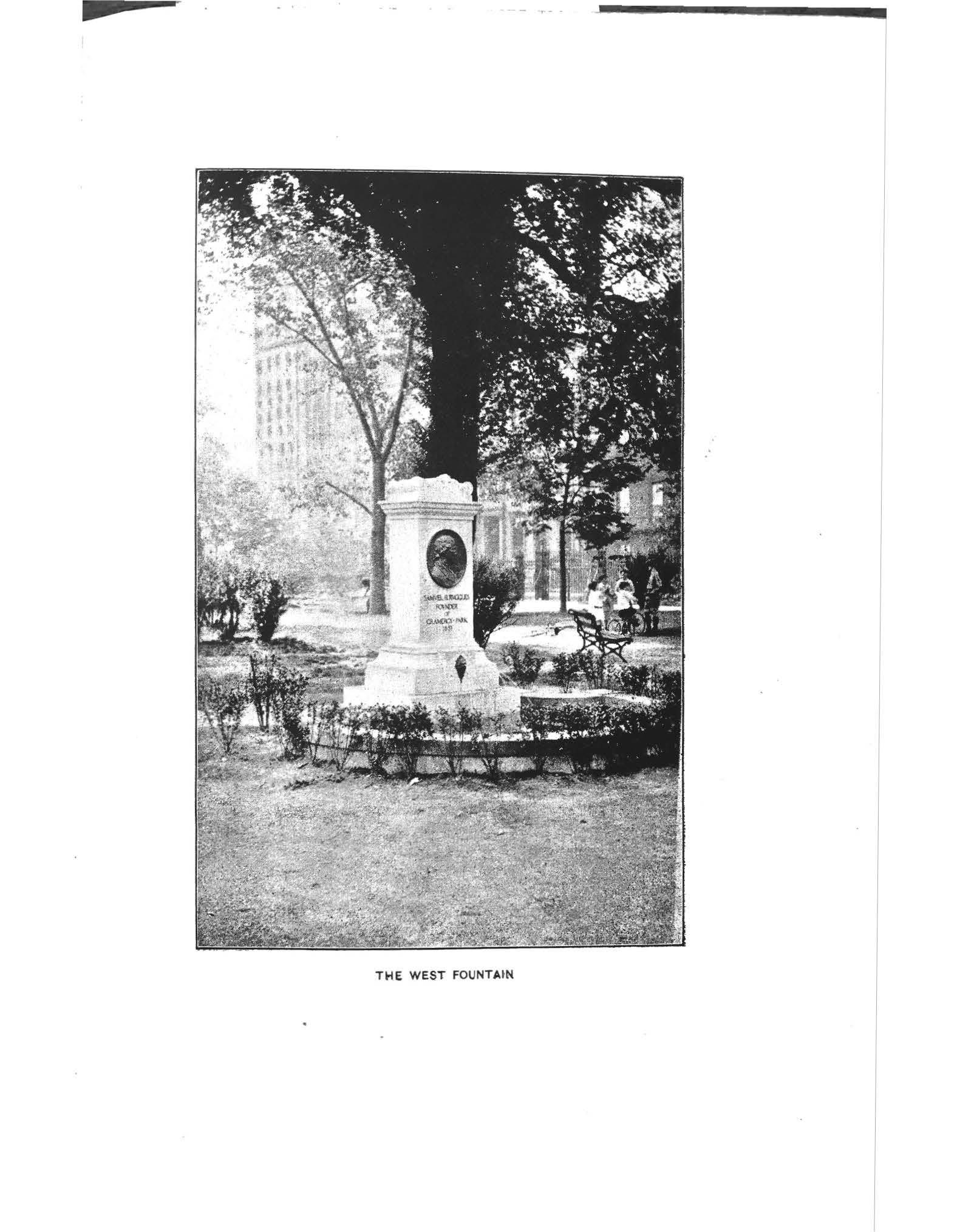
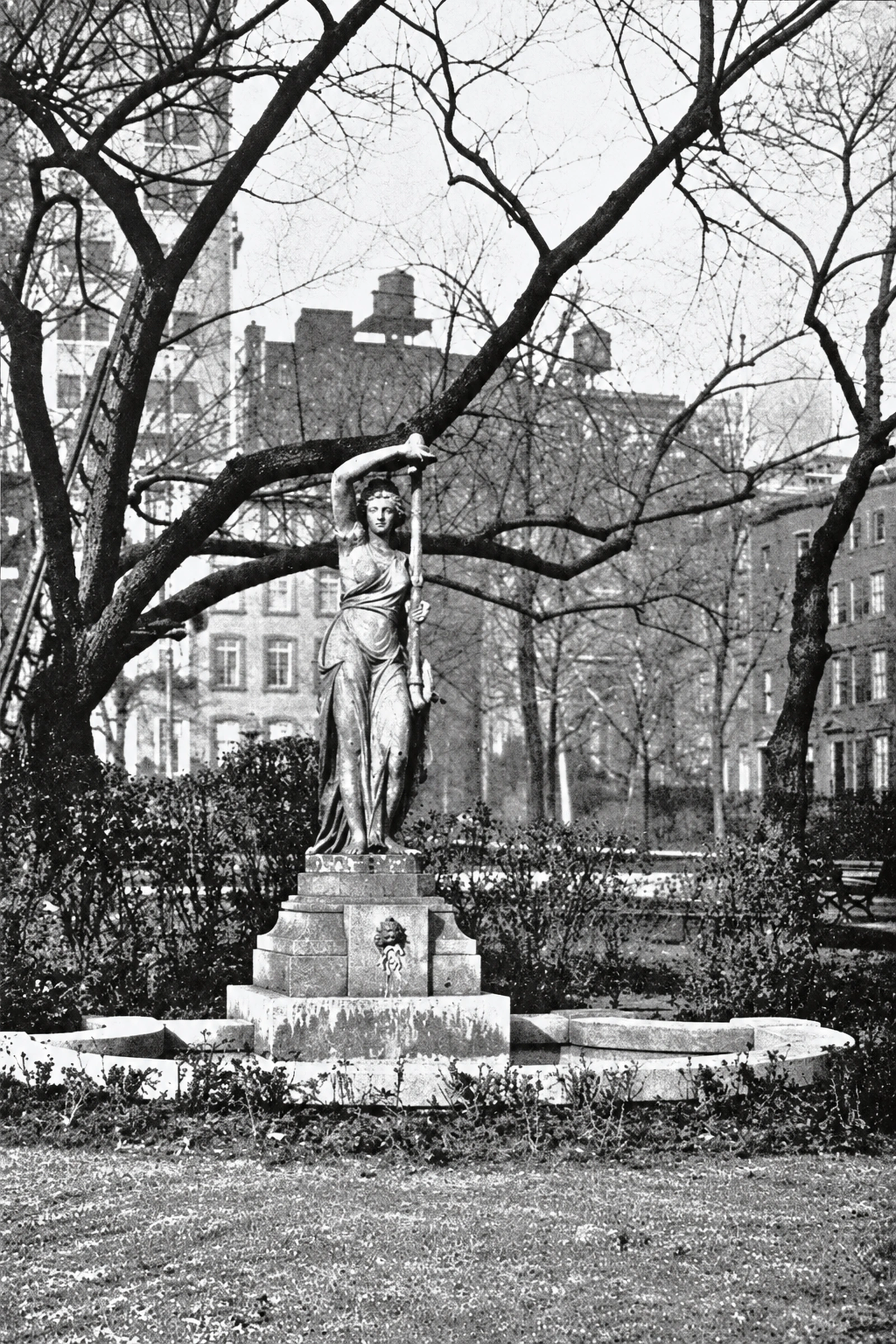
Western end of Gramercy Park · Around 1920
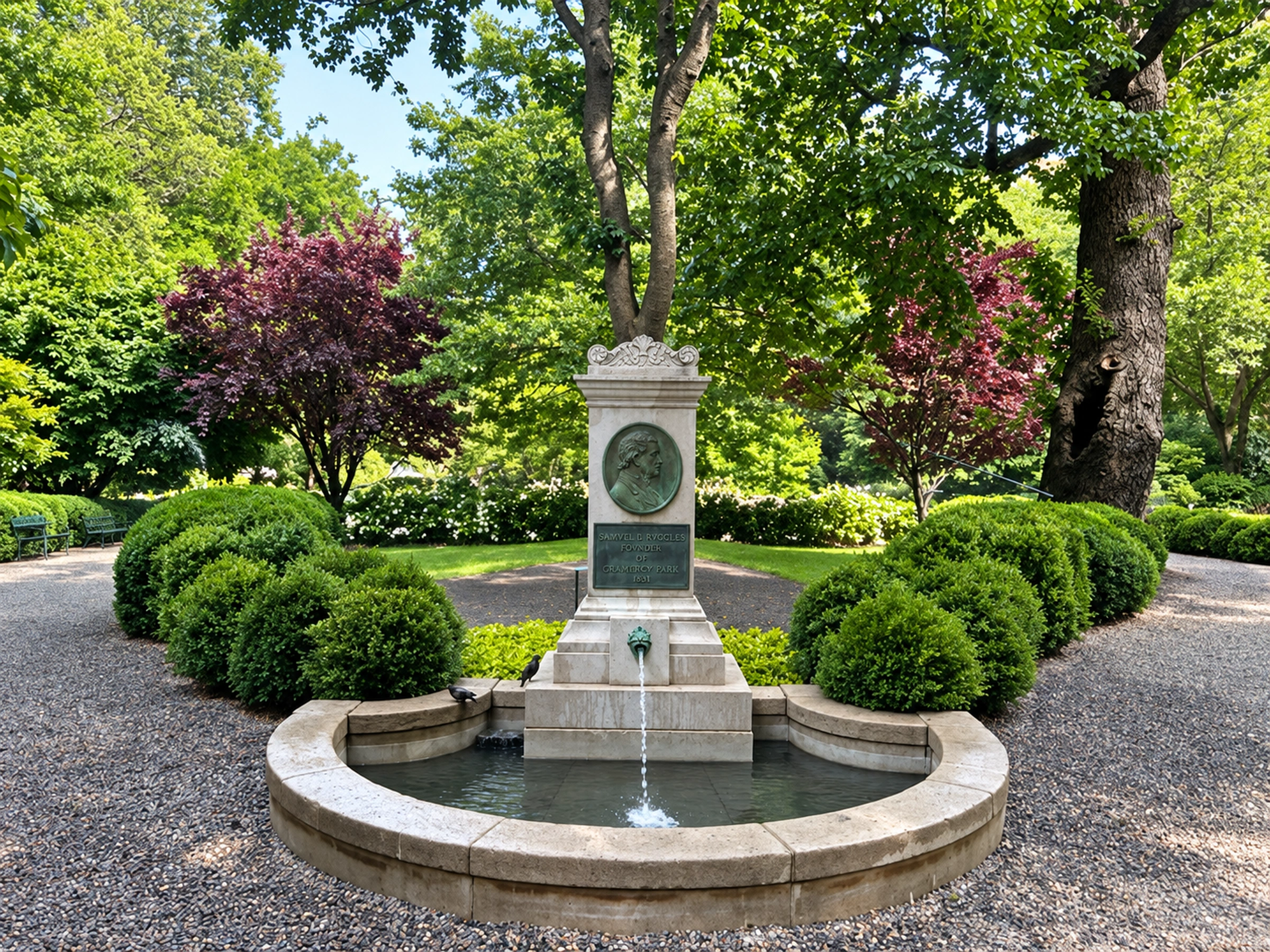
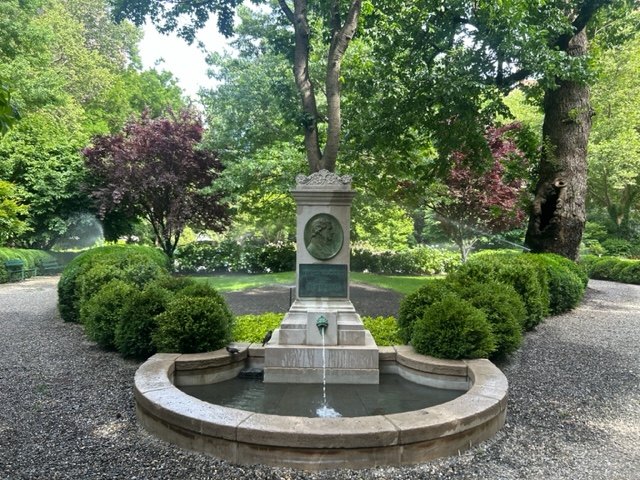
In 2025, the Trustees began taking the Ruggles Fountain apart. By the following spring, water was flowing again.
The restoration renewed a memorial given more than a century earlier by Samuel B. Ruggles’s grandson. Behind its familiar portrait and curved marble basin lies a history of family remembrance, changing gardens and the sustained work of caring for Gramercy Park.
Active stewardship · 2025–2026
Seven and a half inches
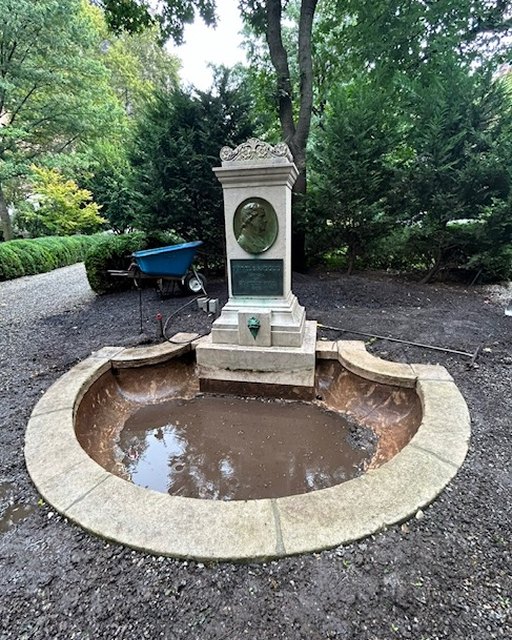
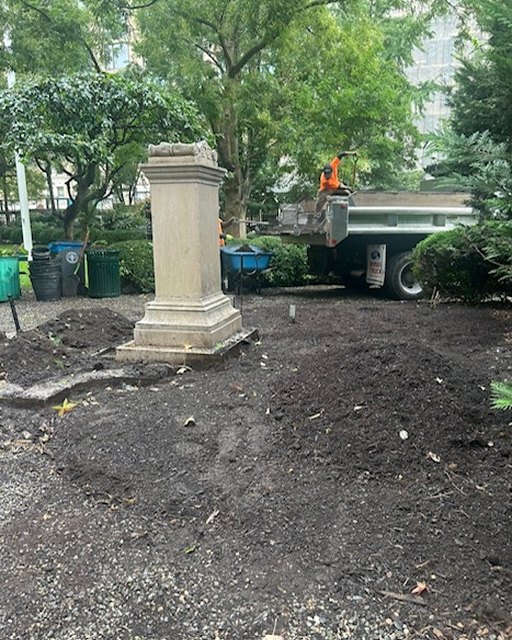
To return water to the Ruggles Fountain, the Trustees of Gramercy Park had to begin by taking the monument apart. Its basin had become a garden bed. Planting crowded the stonework, the rim sat low against the surrounding ground, and repeated pump trouble had made keeping water in the fountain a daily task.
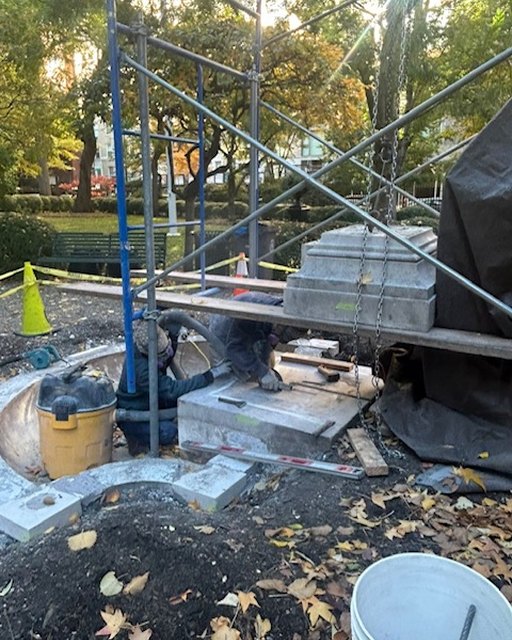
In 2023, the Trustees asked Park caretaker Amando Flores to replenish the basin by hand while they sought a lasting repair. The work that followed reached from the marble crest to the drainage beneath the basin: clearing, dismantling, matching stone, rebuilding the water-holding structure and carefully putting the memorial back together.
Architect Thomas A. Fenniman prepared the restoration design, with B and H Art in Architecture, Ltd. identified as contractor in the project drawings. The Trustees announced the Landmarks Preservation Commission’s approval and the start of rehabilitation in October 2025.
Raising the basin, stone by stone
The change was measured in inches. Fenniman’s design raised the basin edge seven and a half inches, resetting the historic coping—the finished stones along the rim—over a new band of Tennessee marble. A matching plinth would lift the monument itself. The early photographs offered a clear reference: the fountain’s stone rim had once stood visibly above the surrounding path.
Matching the new marble mattered both structurally and visually. The Trustees’ restoration announcement described plans to obtain Tennessee marble from the original quarry and to make new patterns for the required pieces. The new stone had to support and meet the surviving work without changing the fountain’s familiar outline.
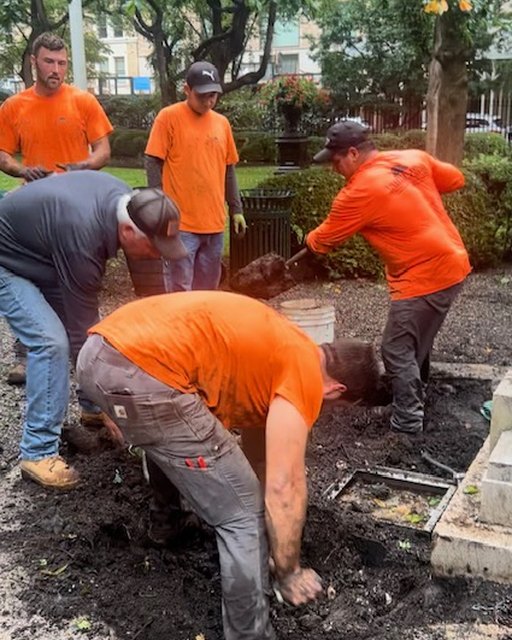
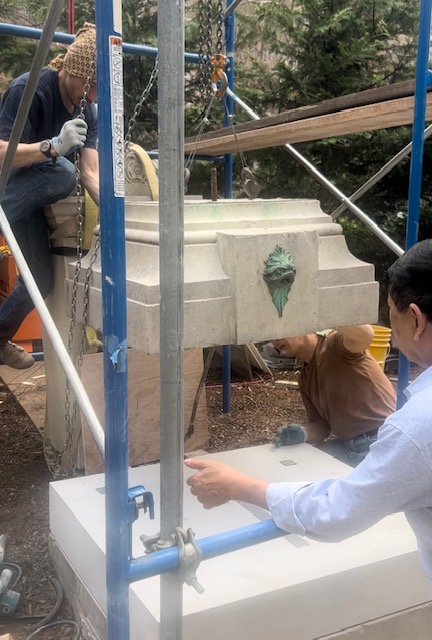
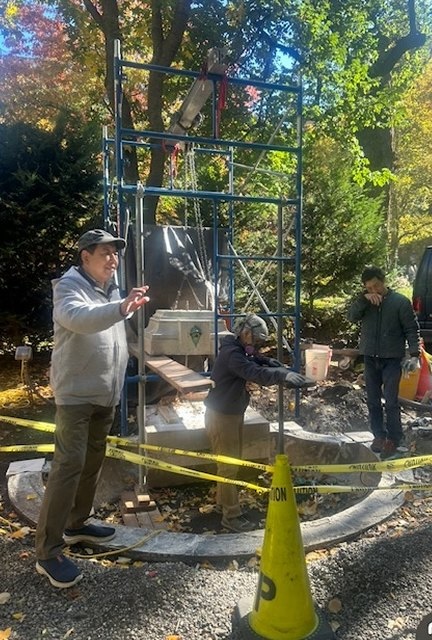
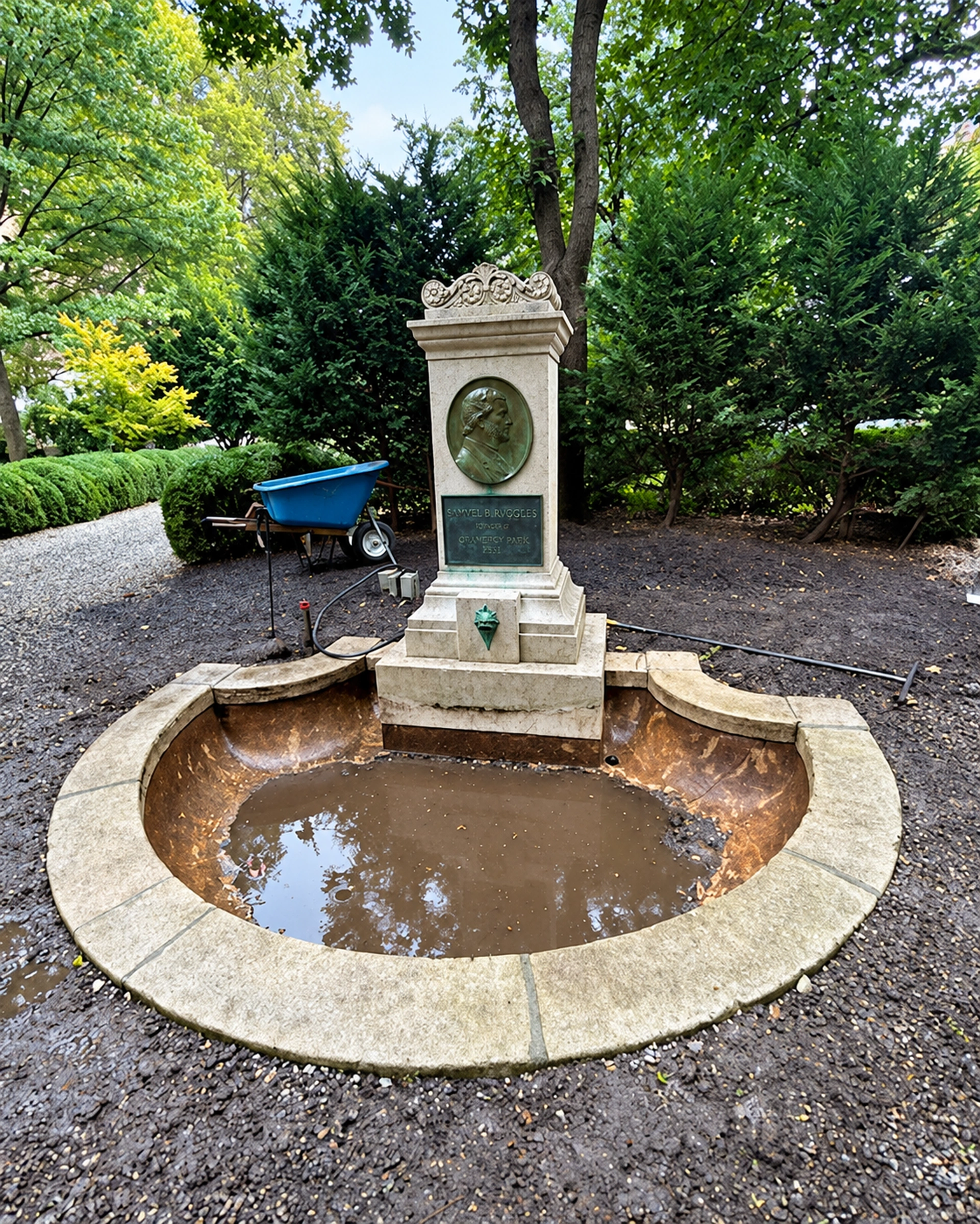
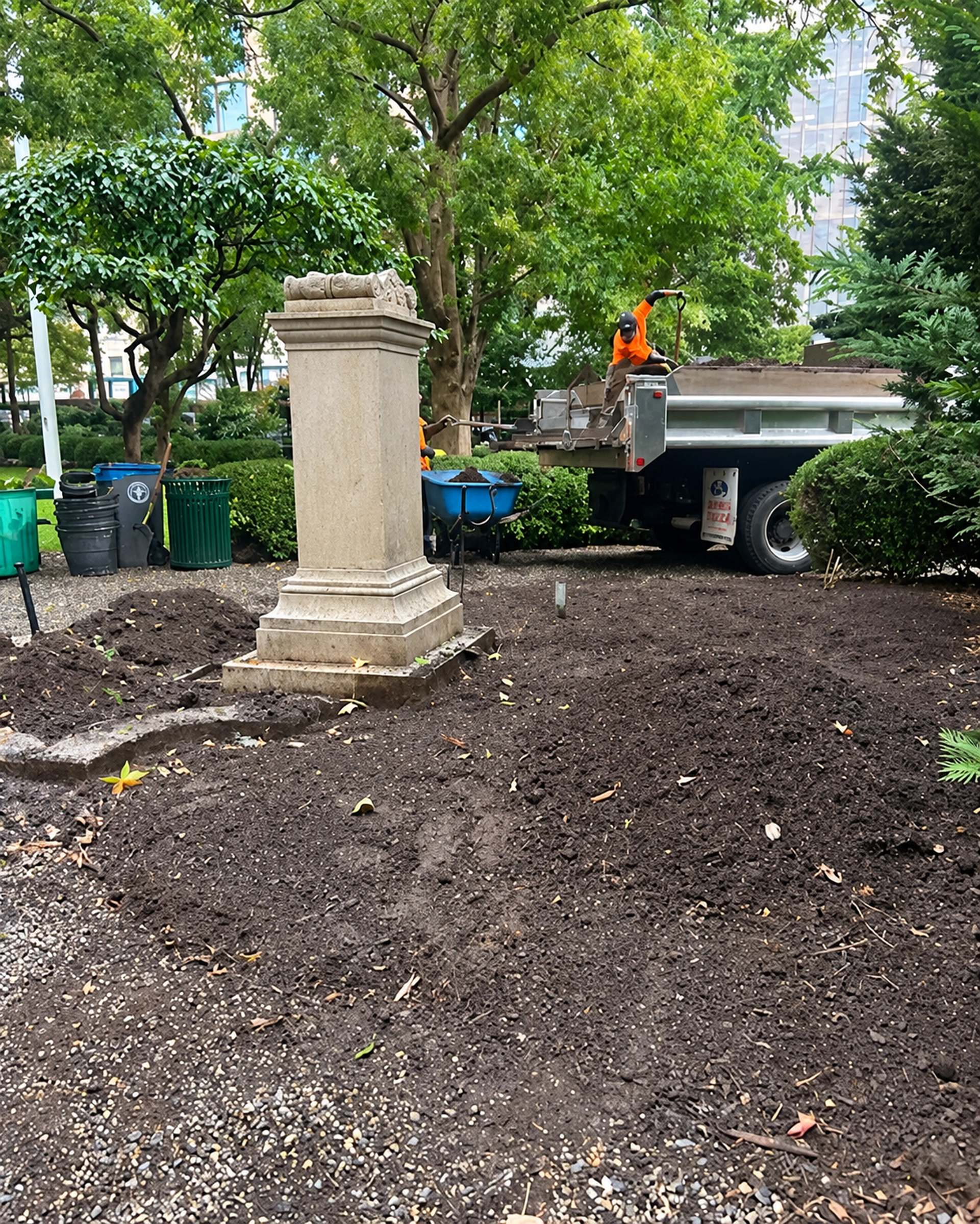
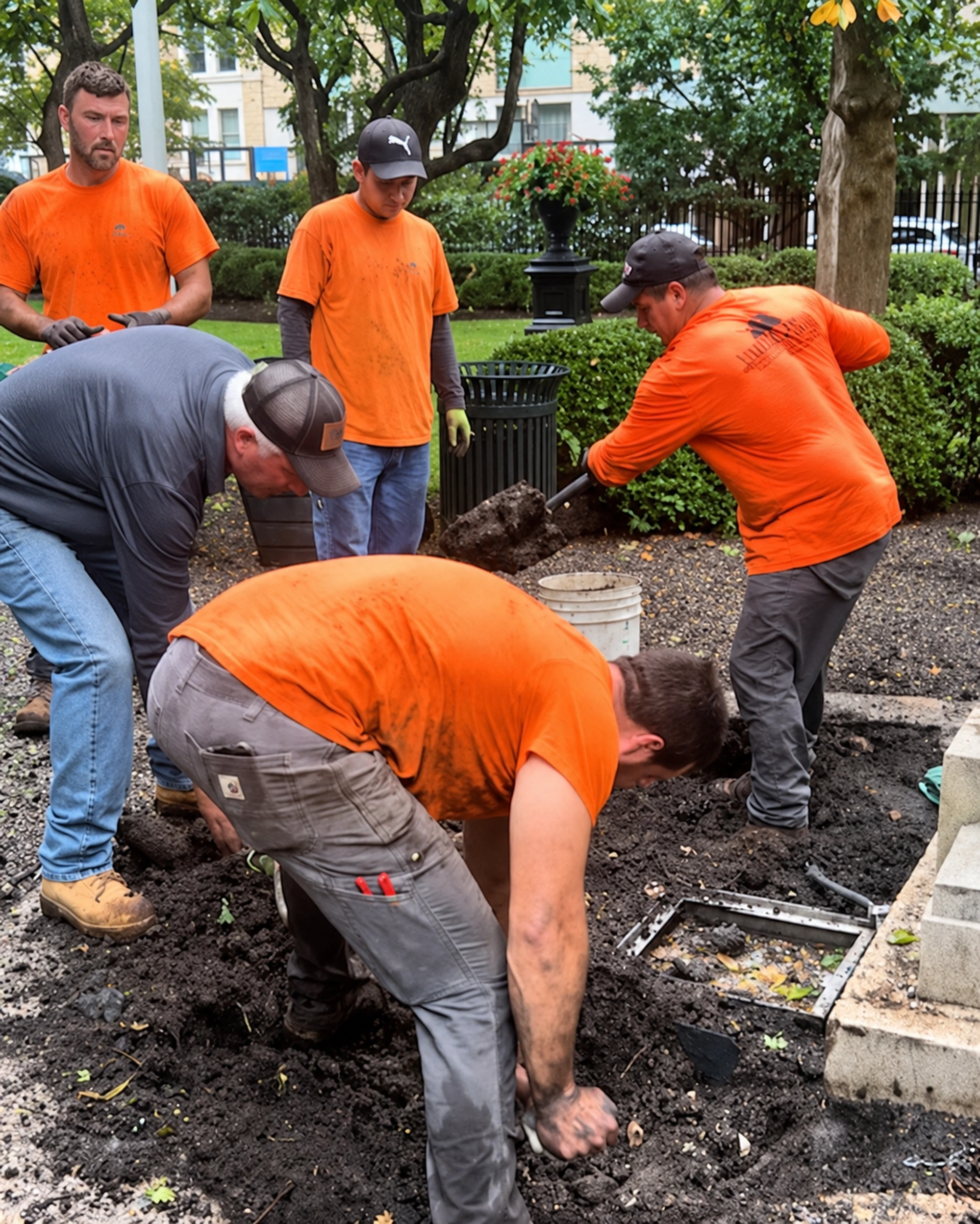
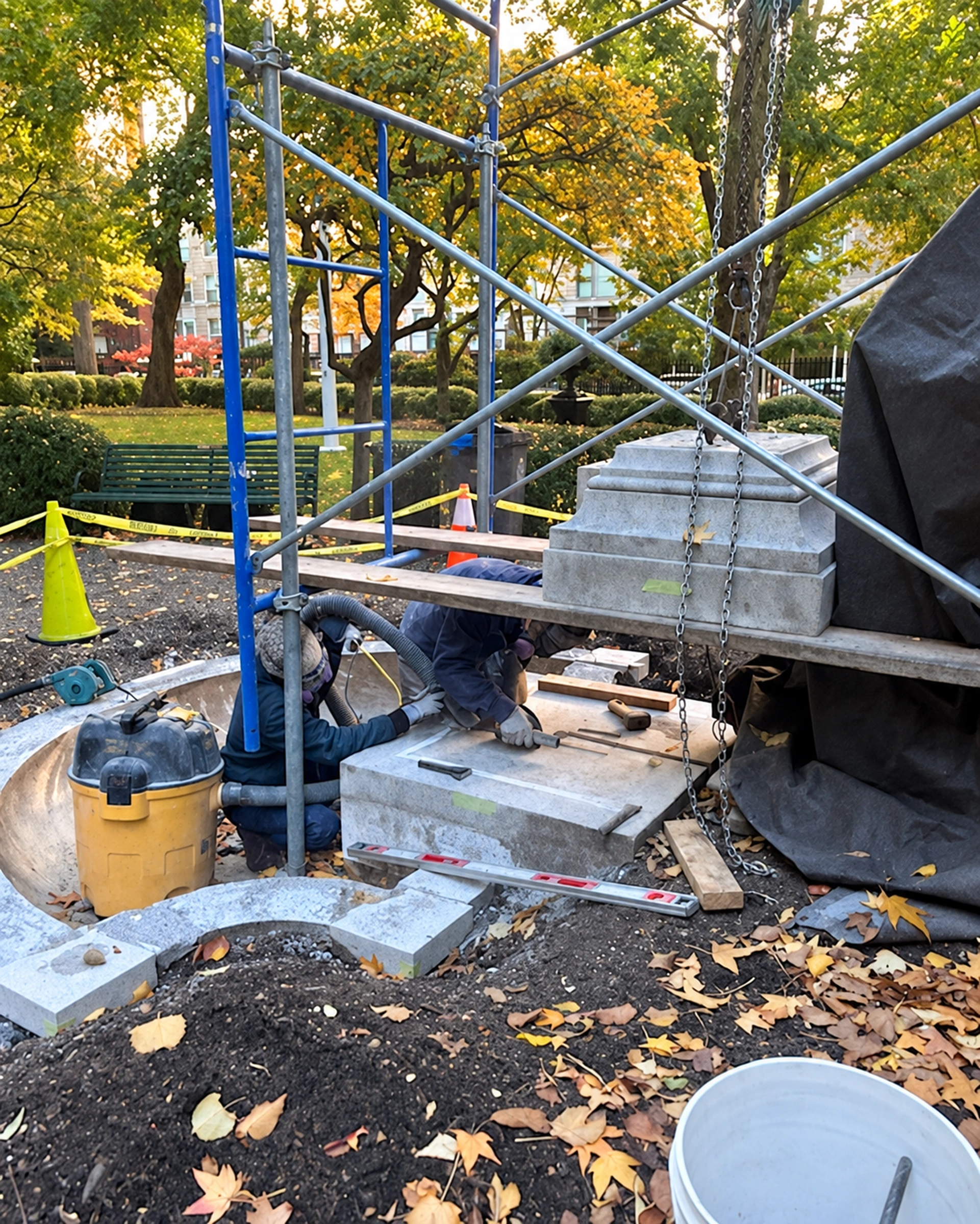
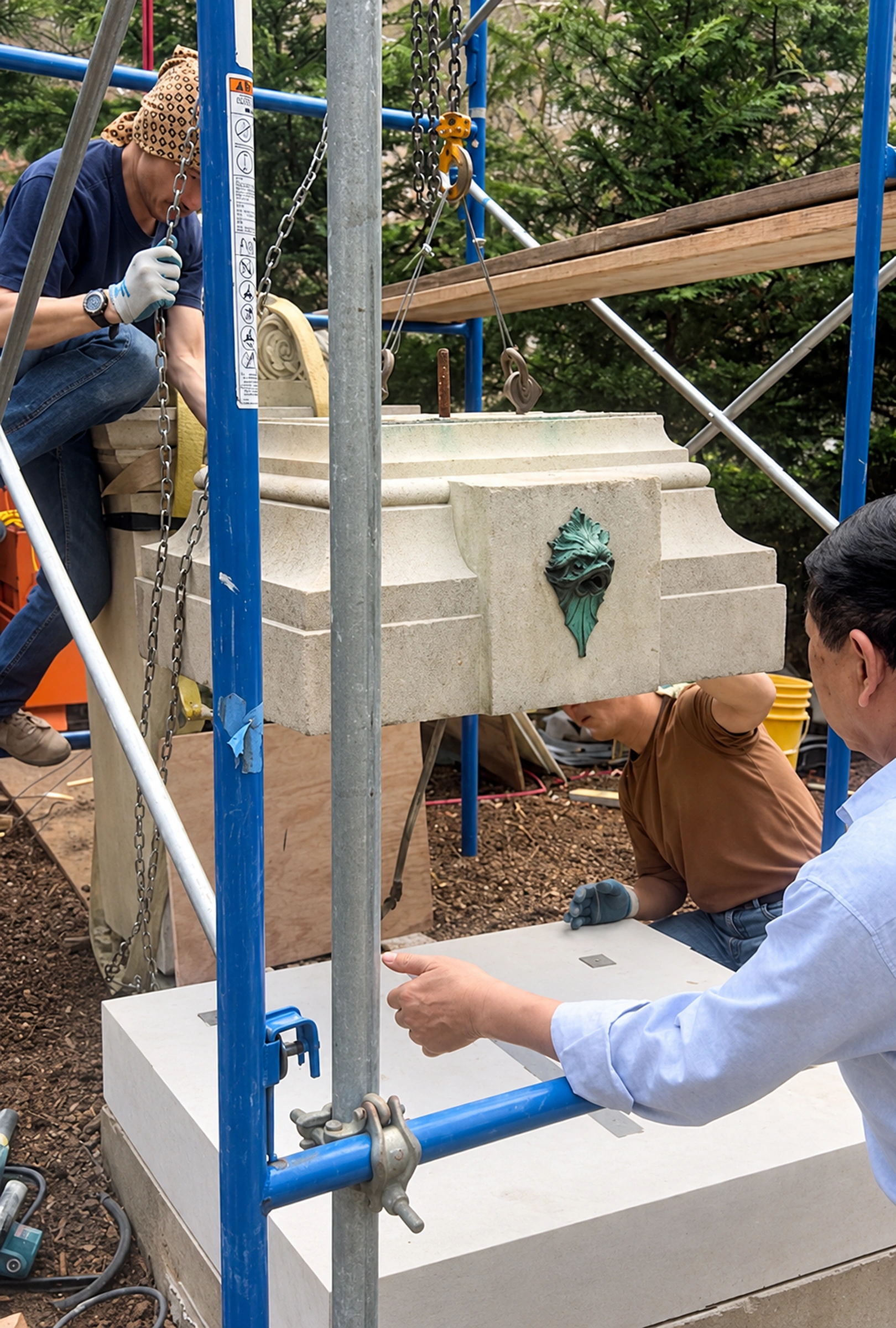
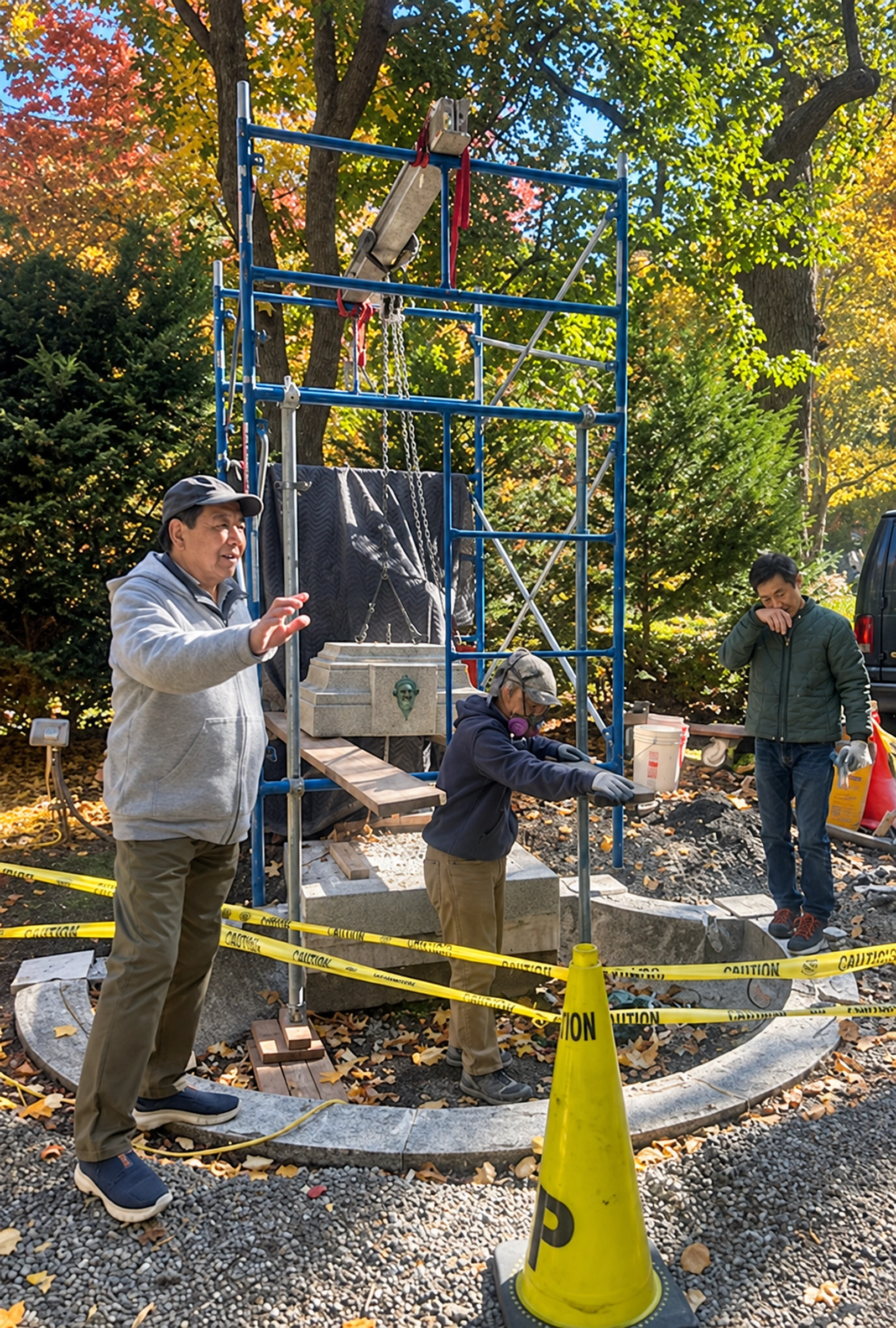
Preparations began in late September 2025, when planting was removed, the basin emptied and the fountain washed. The work photographs show what the finished garden conceals: excavated ground, separated stone sections, scaffolding and lifting equipment. Heavy pieces had to be handled individually before the monument could rise again.
Taking it apart and rebuilding
Six views from the Trustees’ restoration work.
Bringing the water back
The stonework was only part of the restoration. Beneath the water, the design called for a new granite bottom, waterproofing and a floor pitched toward the existing sump. Stainless-steel anchors would hold the reset stones together. The basin, drainage and pumping system had to work as a whole, keeping the water contained and moving through the bronze spout.
Water returned in May 2026. The caretaking team and contractors then adjusted the water level, with final work continuing into early June. GPBA’s seasonal care letter reported the fountain back in working order. The open basin and exposed marble base once again give the monument the proportions visible in its earliest photographs.
The project belongs to the continuing work of the Trustees of Gramercy Park and the Park’s caretaking team. For neighbors looking through the western gate, its most immediate result is also its simplest: water falling from the small bronze mask beneath Ruggles’s portrait.
Restoration documented through June 2026; summer photograph supplied in August. Profile reviewed October 2, 2026.
Historic timeline · 1831–about 1920
Origins & the grandson’s gift
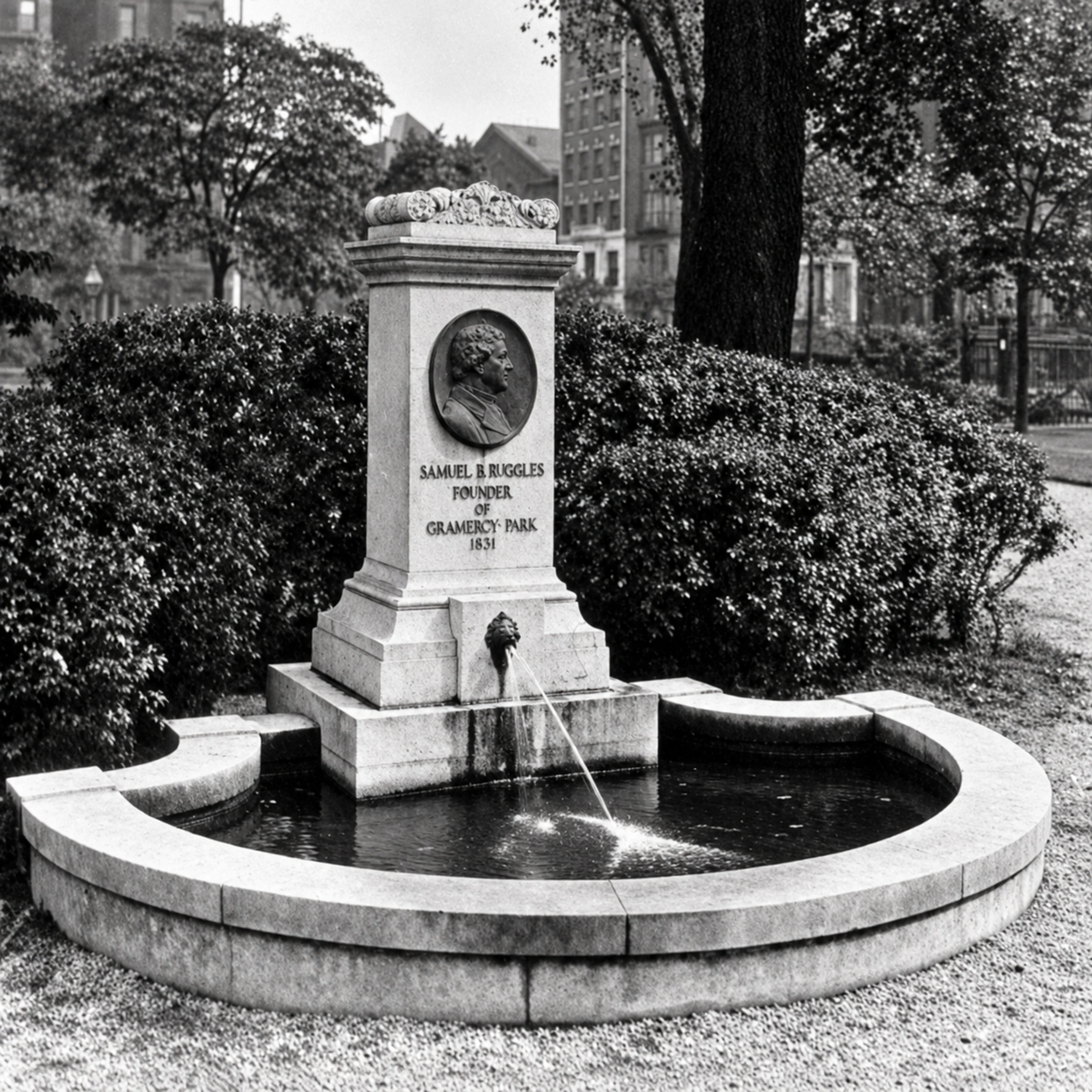
Around 1920, John R. Strong gave Gramercy Park a fountain honoring his grandfather, Samuel B. Ruggles. Architect Charles I. Berg designed the basin and pedestal; Edmond T. Quinn, sculptor of the Park’s Edwin Booth statue, made the founder’s bronze portrait. Their memorial took its place near the western entrance, facing the neighborhood Ruggles had helped create.
Almost ninety years earlier, Ruggles had laid out the private square on land acquired from the heirs of James Duane. In 1831, Samuel and Mary Ruggles conveyed the Park to trustees, linking rights in the garden to the surrounding properties. Ruggles also laid out Irving Place and Lexington Avenue through his land. At Gramercy, the planted enclosure gave the new streets and houses a shared center.
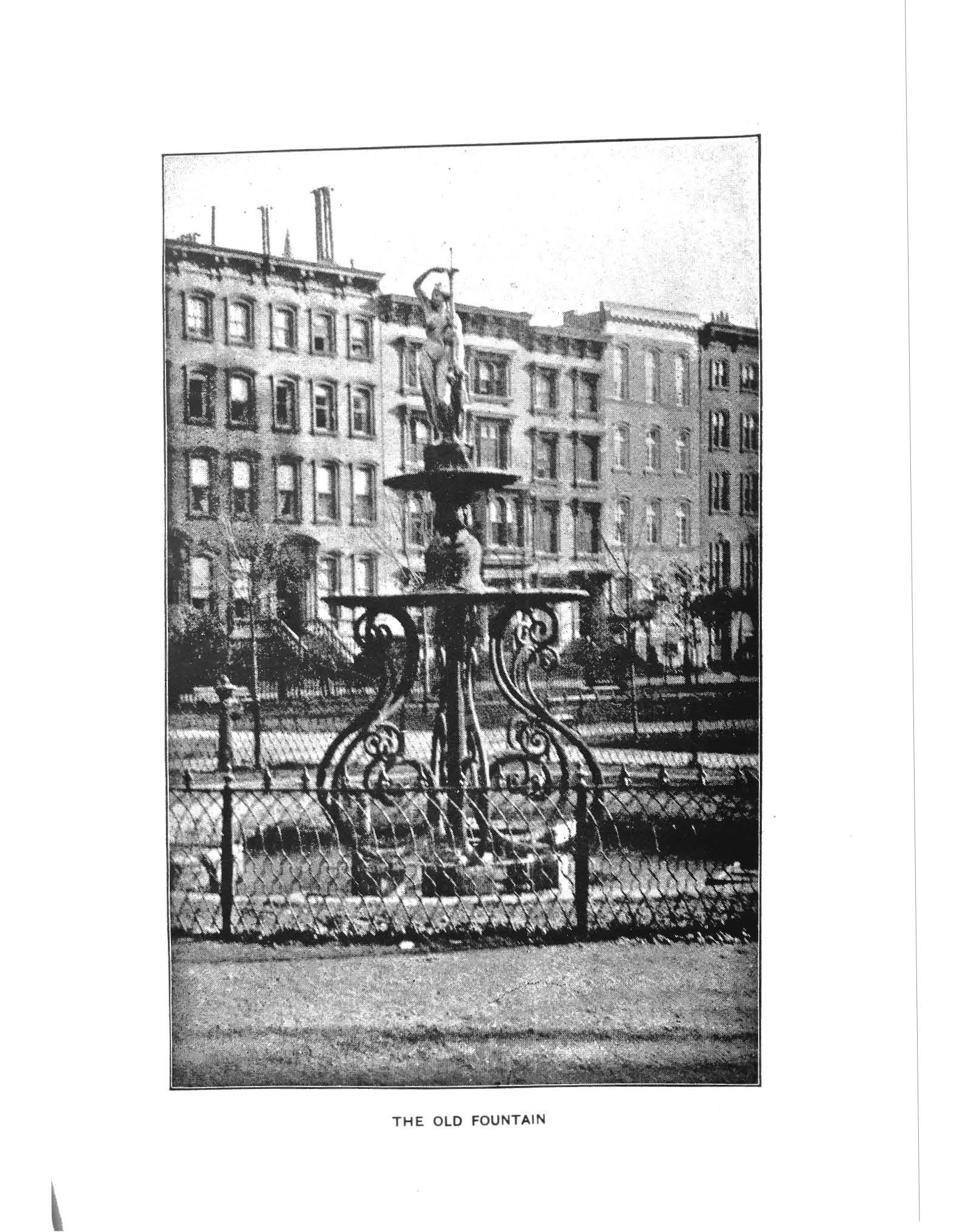
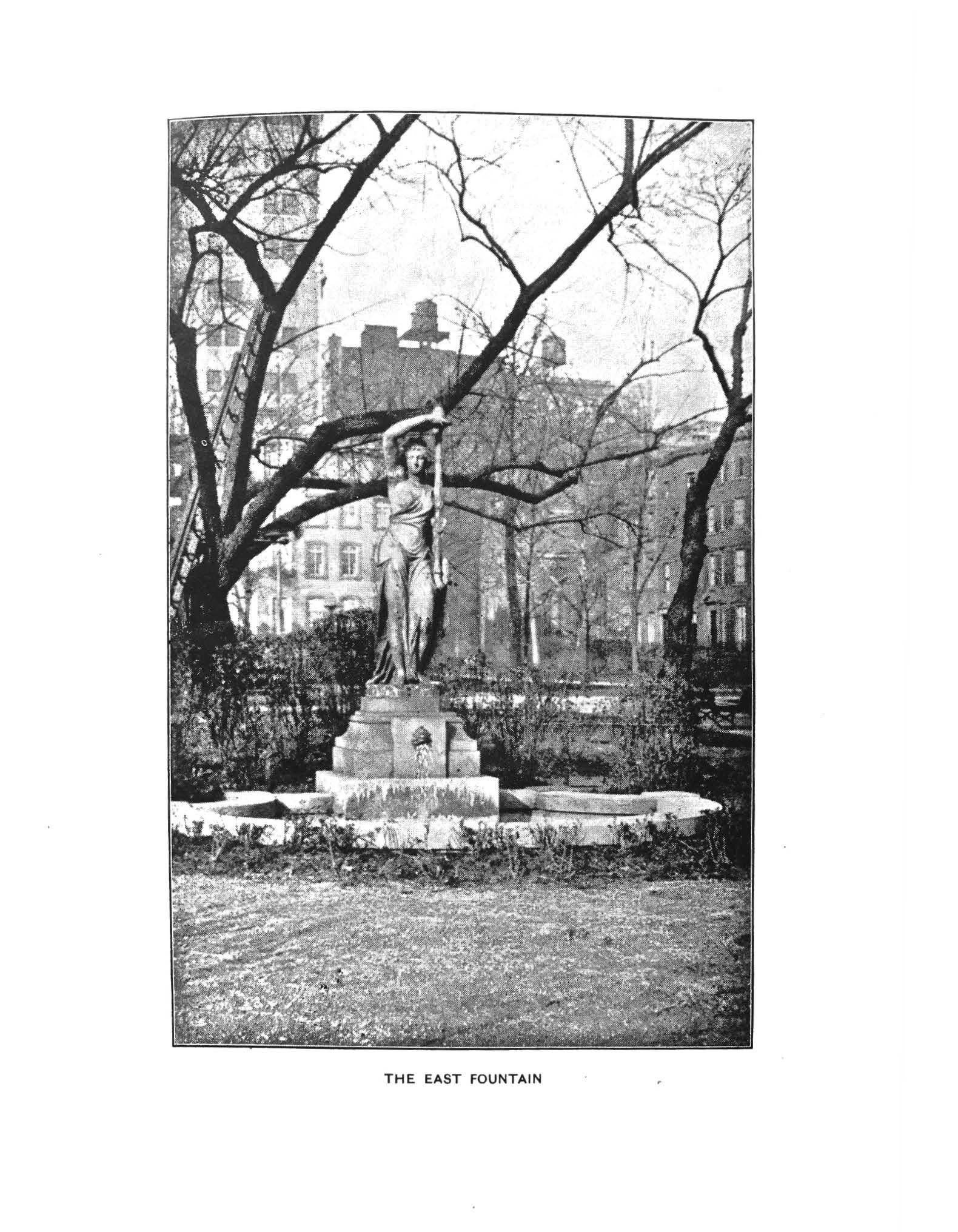
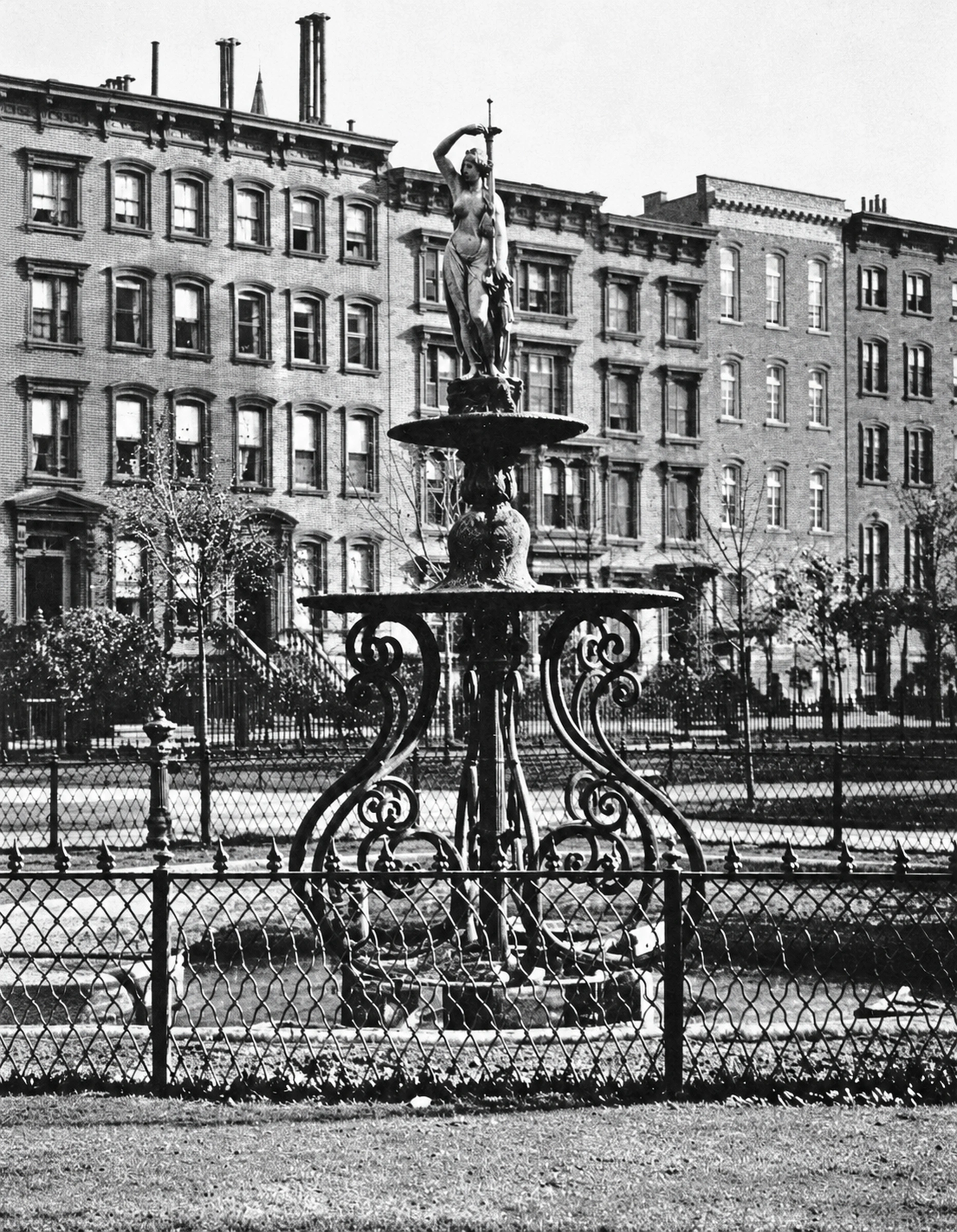
The Park’s first central fountain arrived in 1848, after the Trustees set aside a more ambitious proposal inspired by the fountains at St. Peter’s in Rome. A water nymph eventually crowned the tall, elaborate structure. For generations of residents, she was a familiar figure above the paths.
From the center to the gates
The Edwin Booth memorial, unveiled on November 13, 1918, displaced the old central fountain. The nymph was retained and moved to a smaller fountain toward the eastern entrance. At the western end, Strong’s gift commemorated the Park’s founder.
Berg gave the two fountains a related architectural setting: low, curved basins with pedestals behind them. At one end stood the familiar nymph; at the other, a marble shaft bearing Ruggles’s portrait. Quinn’s contributions linked the new arrangement across the Park—Booth as Hamlet at its center, Ruggles in profile near the western gate.
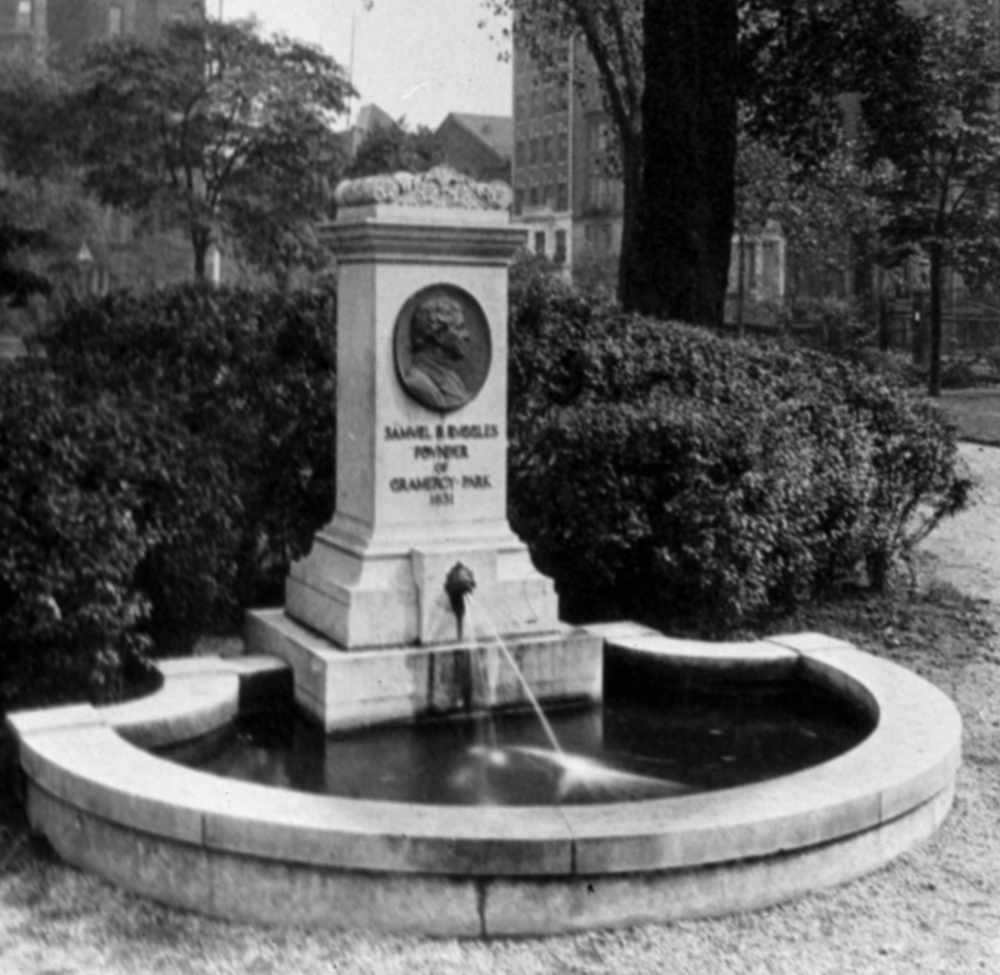
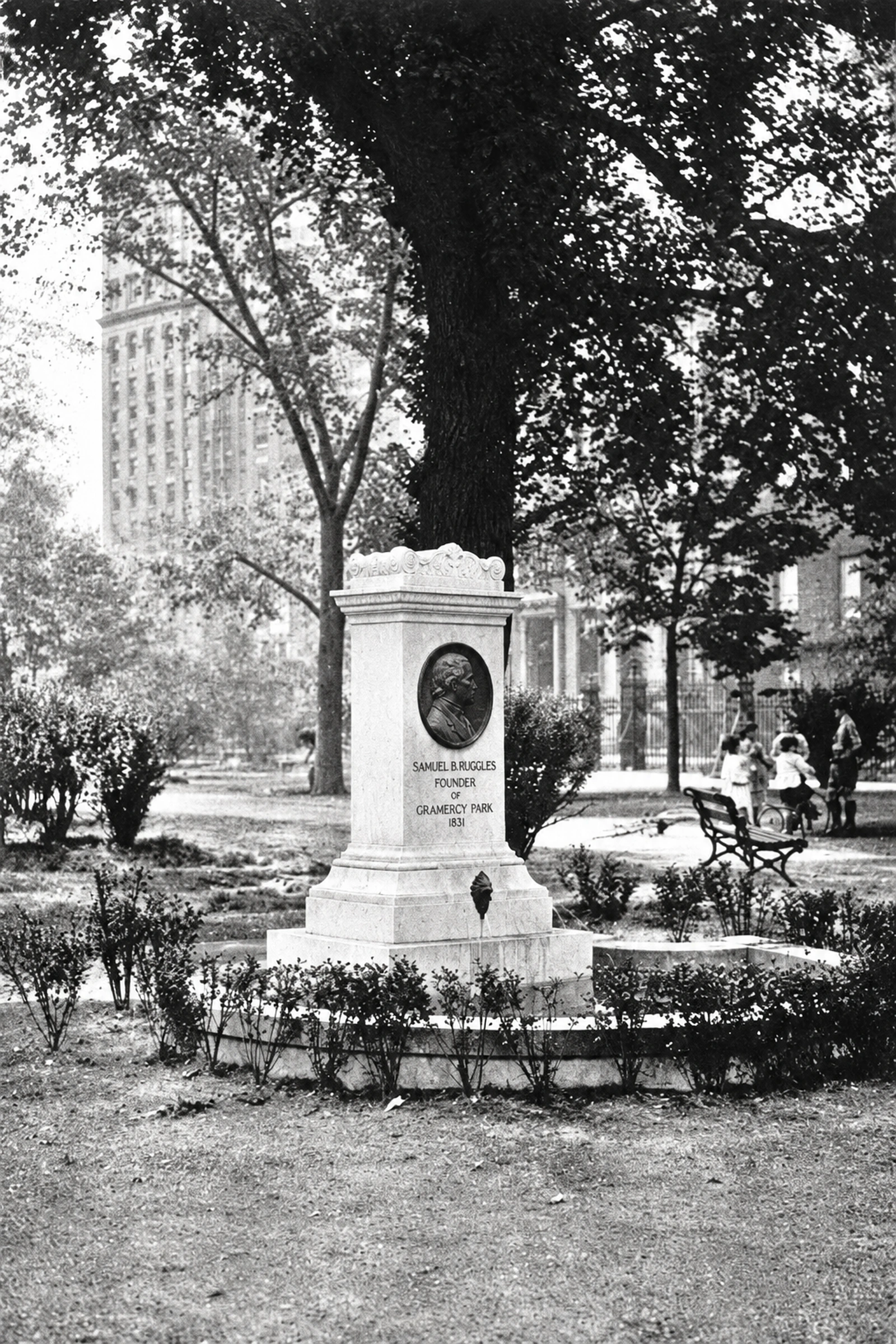
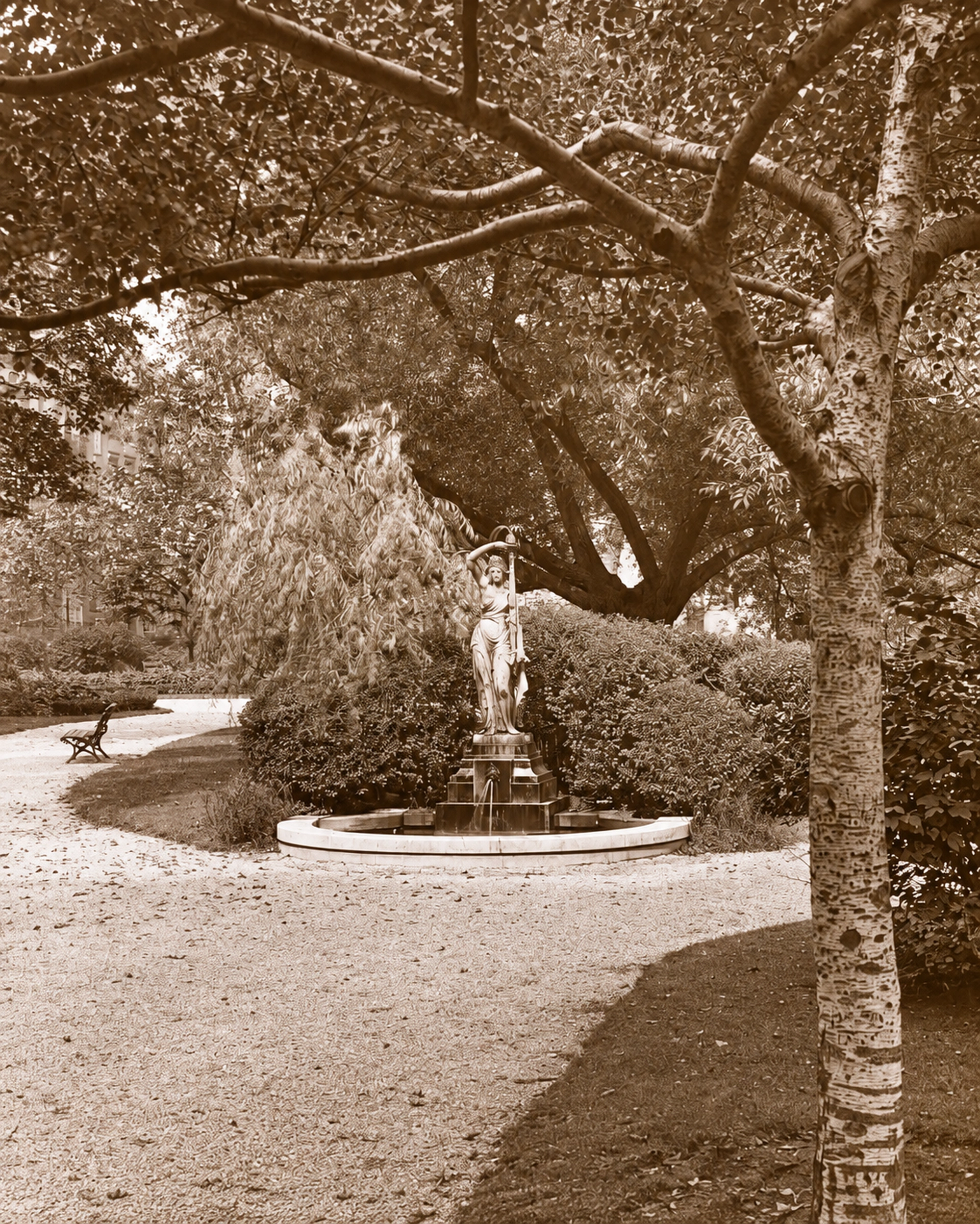
John B. Pine’s 1921 history records the grandson’s gift and reproduces both fountains. The photographs show the new memorial already part of ordinary Park life, with benches, paths, shrubs and neighbors close by.
The Park’s fountains in early photographs
The old central fountain and the smaller eastern and western compositions that followed it.
Marble, bronze & the living garden
The memorial in the garden
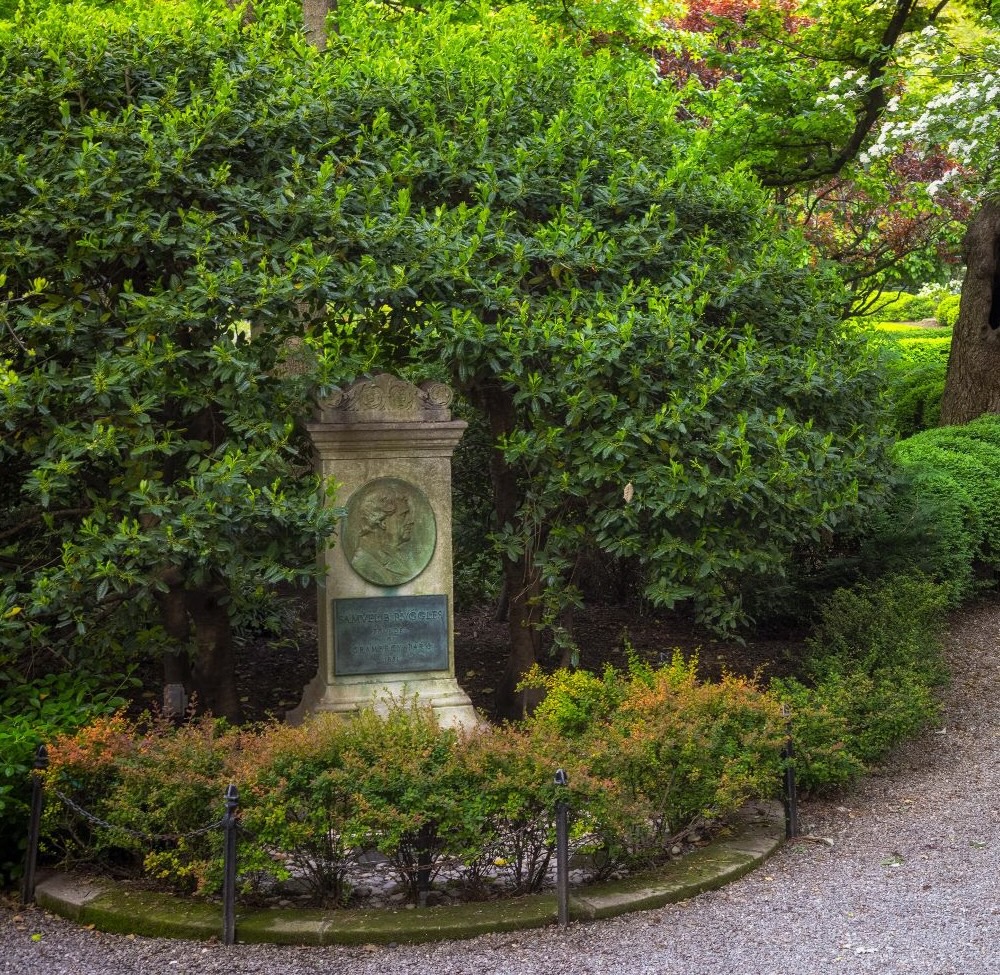
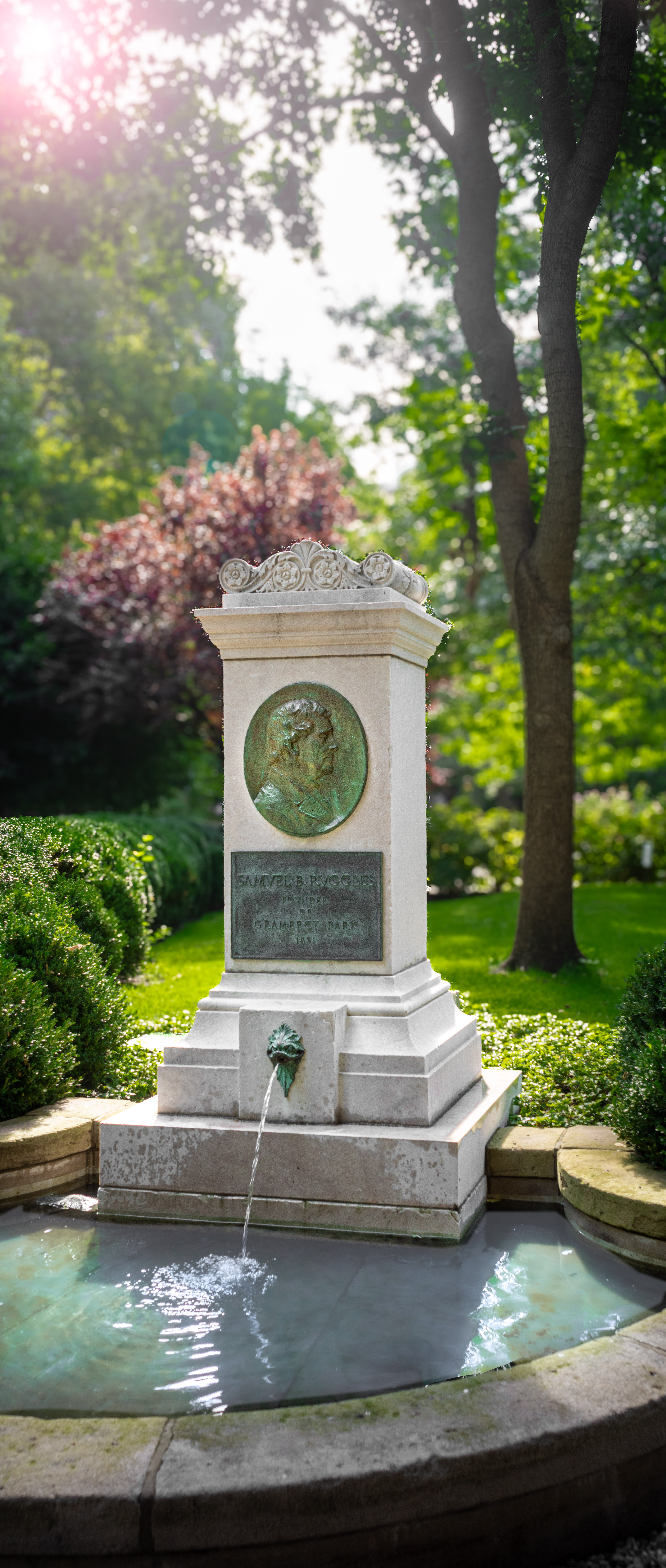
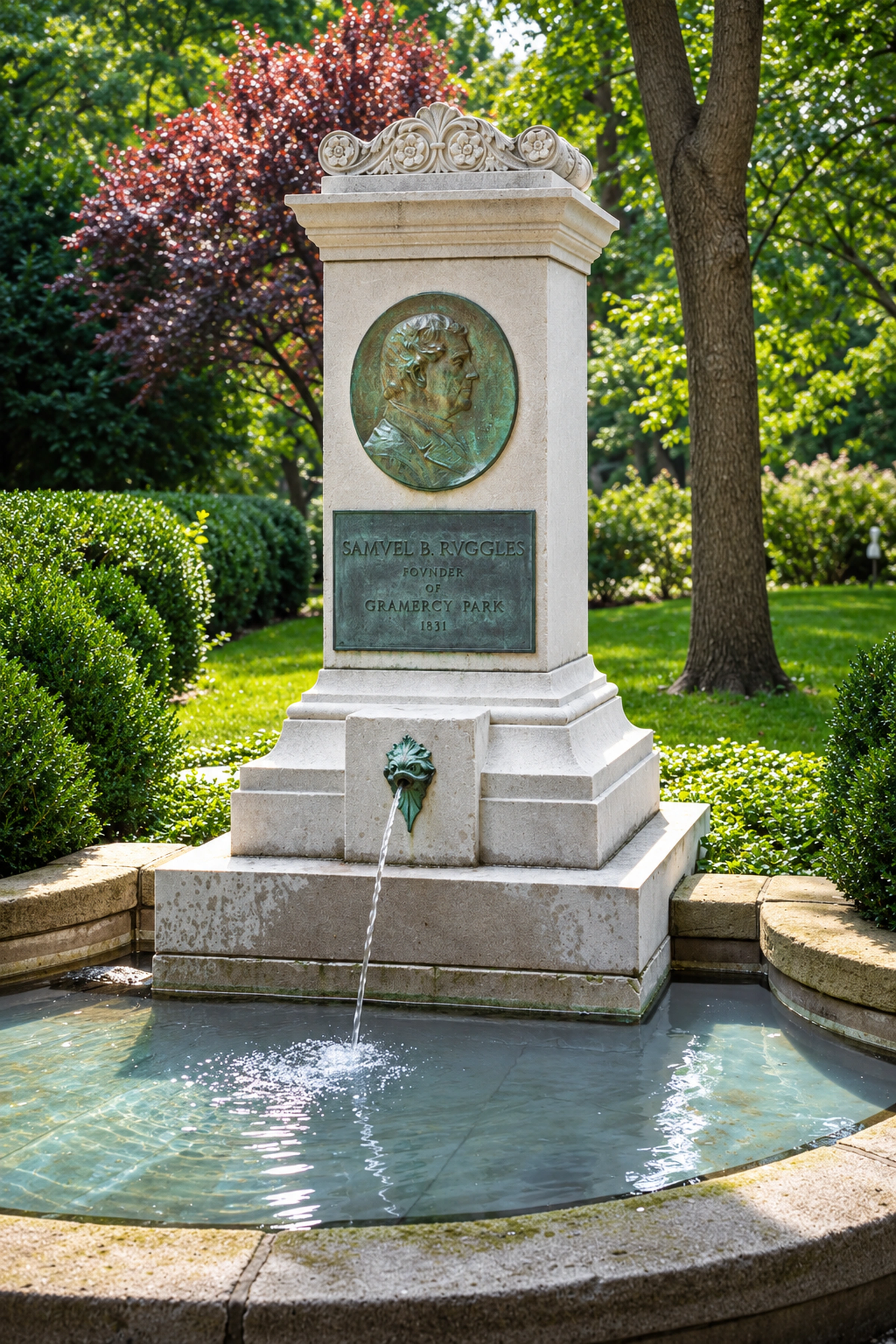
The best place to begin looking is the western gate on Gramercy Park West. The fountain faces the entrance: an oval bronze portrait above a rectangular inscription, framed by a pale marble shaft. A projecting ledge, or cornice, and a crest of carved scrolls and rosettes finish the top. Below, a stepped base leads down to the small bronze mask that releases the water.
Berg used the forms of classical architecture at the scale of a garden monument. The broad, curving basin keeps the composition close to the ground, while Quinn’s portrait gives it a human center. The restoration’s new marble can be seen beneath the older stonework, where the monument and basin now stand more clearly above the path.
Samuel B. Ruggles
The memorial’s founding inscription
Founder of
Gramercy Park
1831
The date recalls the creation of the Park in 1831. The grandson’s memorial, installed around 1920, brought that founding story into the garden itself.
A fountain tended through the seasons
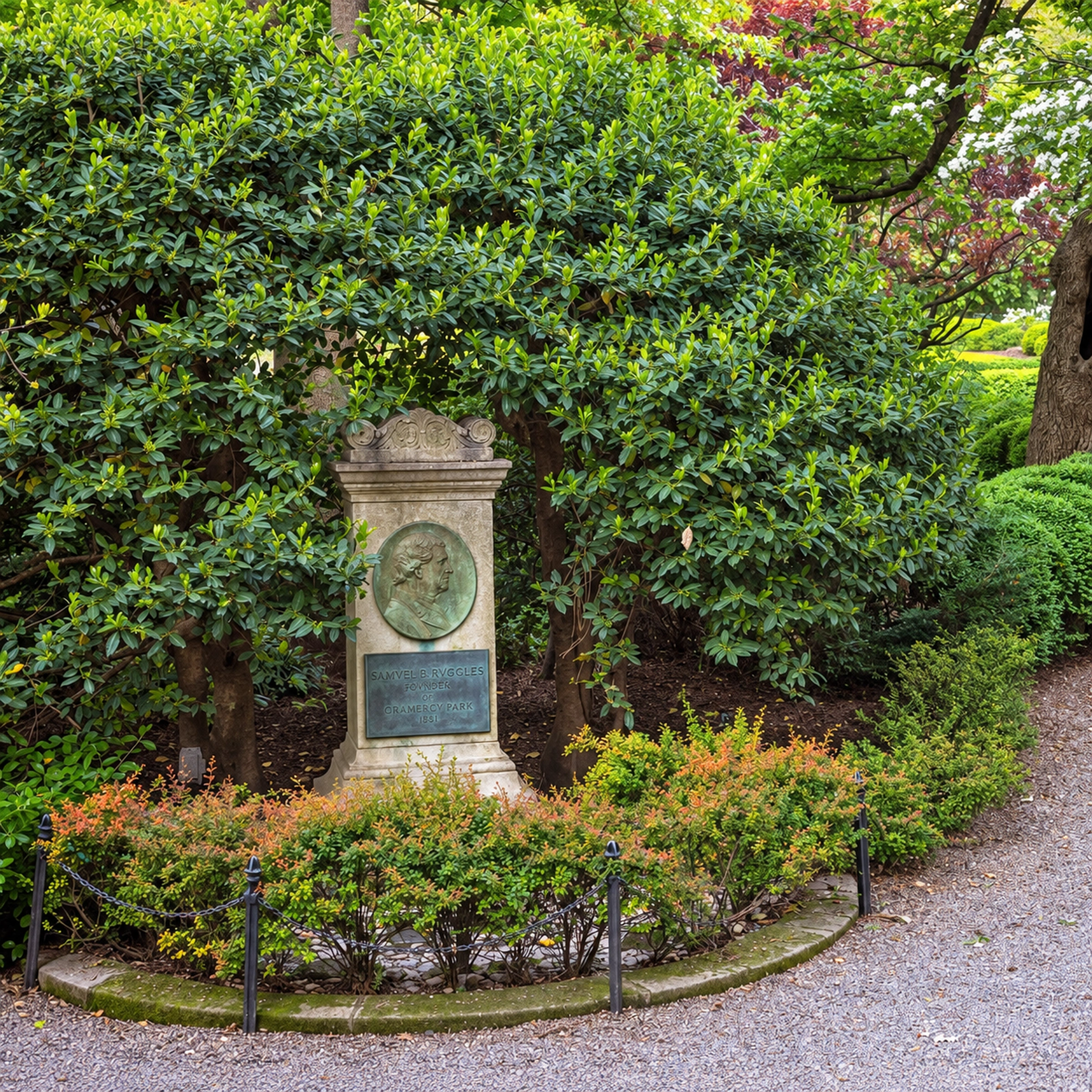
Care of the fountain has always included the garden around it. Trustees’ reports from the late 2000s describe a new pump and timer, river stones in the basin, and stanchions and chains replacing an older fence. Pansies, winter juniper, ferns, miniature roses and coleus appear in the planting records. Birds and squirrels drank at the fountain, which was cleaned daily during the season.
Those changing plantings explain how different the memorial can look from one photograph to another. The basin became densely planted, and by the time of the recent restoration much of its shape was obscured. The 2025–2026 work recovered the relationship between monument, water and path while retaining its setting within a living garden.
The Park and its surroundings became part of the Gramercy Park Historic District in 1966. Today the Trustees maintain the private garden and its monuments, while the Block Association cares for the surrounding public streetscape.
The fountain at a glance & timeline
- Name
- Ruggles Fountain; Samuel B. Ruggles Memorial Fountain; historically, the West Fountain
- Location
- Inside the western end of Gramercy Park, facing the Gramercy Park West entrance, Manhattan. No separate street number.
- Date
- Around 1920. The plaque’s 1831 date commemorates the founding of the Park.
- Architect / sculptor
- Charles I. Berg, fountain basins and pedestals; Edmond T. Quinn, Ruggles portrait medallion.
- Original gift
- John R. Strong, grandson of Samuel B. Ruggles.
- Materials
- Marble monument and basin stonework; bronze medallion, inscription plaque and spout. Existing marble identified as Tennessee marble in the 2025 drawings.
- Stewardship
- Trustees of Gramercy Park. The Park is private.
- Landmark status
- Within the Gramercy Park Historic District, designated September 20, 1966; no separate individual designation.
- Recent restoration
- 2025–2026. Architect Thomas A. Fenniman; contractor B and H Art in Architecture, Ltd. Reported back in working order in June 2026.
Historic timeline
- 1831Samuel and Mary Ruggles convey the Park to trustees.
- 1848The first central fountain is installed.
- 1918The Booth memorial is unveiled at the Park’s center on November 13.
- About 1920Strong’s gift establishes the western memorial, designed by Berg with a portrait by Quinn.
- 1966The Gramercy Park Historic District is designated on September 20.
- 2006–2009Trustees’ reports record renewed equipment, basin work and changing plantings.
- 2025Restoration drawings are prepared; work begins in the fall.
- 2026Water returns in May, with adjustments and completion reports through early June.
Historical Notes & Sources
The profile combines Pine’s 1921 history, archival finding aids, landmark records, Trustees’ project files, annual reports and GPBA correspondence. Printed page numbers below refer to the book, not the PDF viewer. Private project records are identified without exposing the correspondence itself.
Origins and the grandson’s gift
- John B. Pine, The Story of Gramercy Park, 1831–1921 (New York: Gramercy Park Association, 1921), printed pp. 7–15. Land development and Ruggles’s streets: pp. 7–10; the western-gate stone: pp. 11–12; the 1844 planting orders and the 1846, 1848 and 1866 fountain records: pp. 12–15. Pine quotes earlier records and writes retrospectively about the nineteenth century. Old fountain plate. Pine also records a separate western-gate commemorative stone dated 1875; it is distinct from the later fountain.
- Gramercy Neighborhood Associates records, PR 370, Patricia D. Klingenstein Library, New-York Historical Society: Series III, box 11, deed of December 17, 1831, described as from Samuel B. and Mary Ruggles to trustees. The finding aid was reviewed; the original deed was not examined for this profile. For Ruggles’s wider development work, see also the Samuel B. Ruggles papers, Manuscripts and Archives Division, NYPL.
- Pine, pp. 14–15 and 46–48: replacement of the central fountain, relocation of the nymph, and the Booth unveiling on November 13, 1918. The source does not establish an exact relocation day for the nymph. See the GPBA Booth profile for that memorial’s separate history.
The gift and the architecture
- Pine, pp. 15–16, is the near-contemporary source naming architect Charles I. Berg, sculptor Edmond T. Quinn and donor John R. Strong, and transcribing the fountain inscription. See the West Fountain plate and East Fountain plate. Descriptions of visible ornament in this profile were checked against photographs.
- Thomas A. Fenniman, Samuel B. Ruggles Memorial Fountain Restoration, project 65200, three-sheet review set circulated July 14, 2025; sheets dated July 14–15. Page 1: historical outline and scope; page 2: condition photographs; page 3: existing and proposed axonometric views and section details. Trustees’ project records, supplied for review. This was a review set, not an independently verified final as-built record; specifications are described as proposals. Its historical outline gives 1920 for installation, while Pine establishes that the memorial existed by 1921. The accepted installation date is stated as “around 1920” in the narrative. An original dedication notice or dated construction contract has not yet been located.
- Library of Congress, “Gramercy Park, New York, New York. Fountain”, about 1922, Frances Benjamin Johnston Collection, LC-DIG-ppmsca-16153, LCCN 2007685078. The catalogue gives the creator as possibly Charles I. Berg. It shows the eastern nymph fountain.
Active stewardship and the living garden
- NYC Landmarks Preservation Commission, Gramercy Park Historic District, LP-0251, September 20, 1966. The designation and boundary description establish the Park’s district status.
- Trustees of Gramercy Park annual-report files: March 29, 2007, “Draft five,” p. 2 (reporting the preceding year’s fountain work); May 13, 2008, pp. 1–3; June 17, 2009, pp. 1–4. These records document equipment, seasonal planting and care. The 2007 item is identified as a draft, rather than presented as a published final report.
- Trustees’ correspondence retained in the GPBA project archive: Kathleen Scupp, September 21, 2023 (pump difficulties and interim care); April 30, 2024 (newly mossed bed); and the GPBA restoration draft and work photographs assembled in June 2026. Personal correspondence is cited by author/date or project context without publishing private email addresses. Photograph dates are approximate unless independently recorded.
- Kathleen Scupp’s September 27, 2025 preparation report; Trustees of Gramercy Park, “The Ruggles Fountain: A Landmark Renewed,” October 16, 2025. The public announcement reports LPC approval, Fenniman’s involvement, disassembly and planned marble sourcing. The underlying approval letter and quarry invoices were not available; the announcement is the authority for those reported details.
- Project correspondence: May 14, 2026 (first working-water report); May 26 (water-level adjustment); June 4 (Amando Flores’s photographs); June 5 (completion update). Compare GPBA’s published “In the Park & Around the Neighborhood” seasonal care letter, June 2026, which reports the fountain back in working order. These dated records establish the condition described here; they are not a claim of continuous year-round operation.
The exact dedication date, original construction accounts and a continuous maintenance history for the middle decades of the twentieth century remain to be established. The Gramercy Neighborhood Associates’ 1911–1926 record book and the Trustees’ surviving files are the most promising next sources.