
Edwin Booth
Hamlet Comes Home
1833–1893 · Actor, father & founder of The Players
After a lifetime on the road, America’s celebrated Shakespearean actor made his home at 16 Gramercy Park South—with his friends downstairs and the Park outside his window.
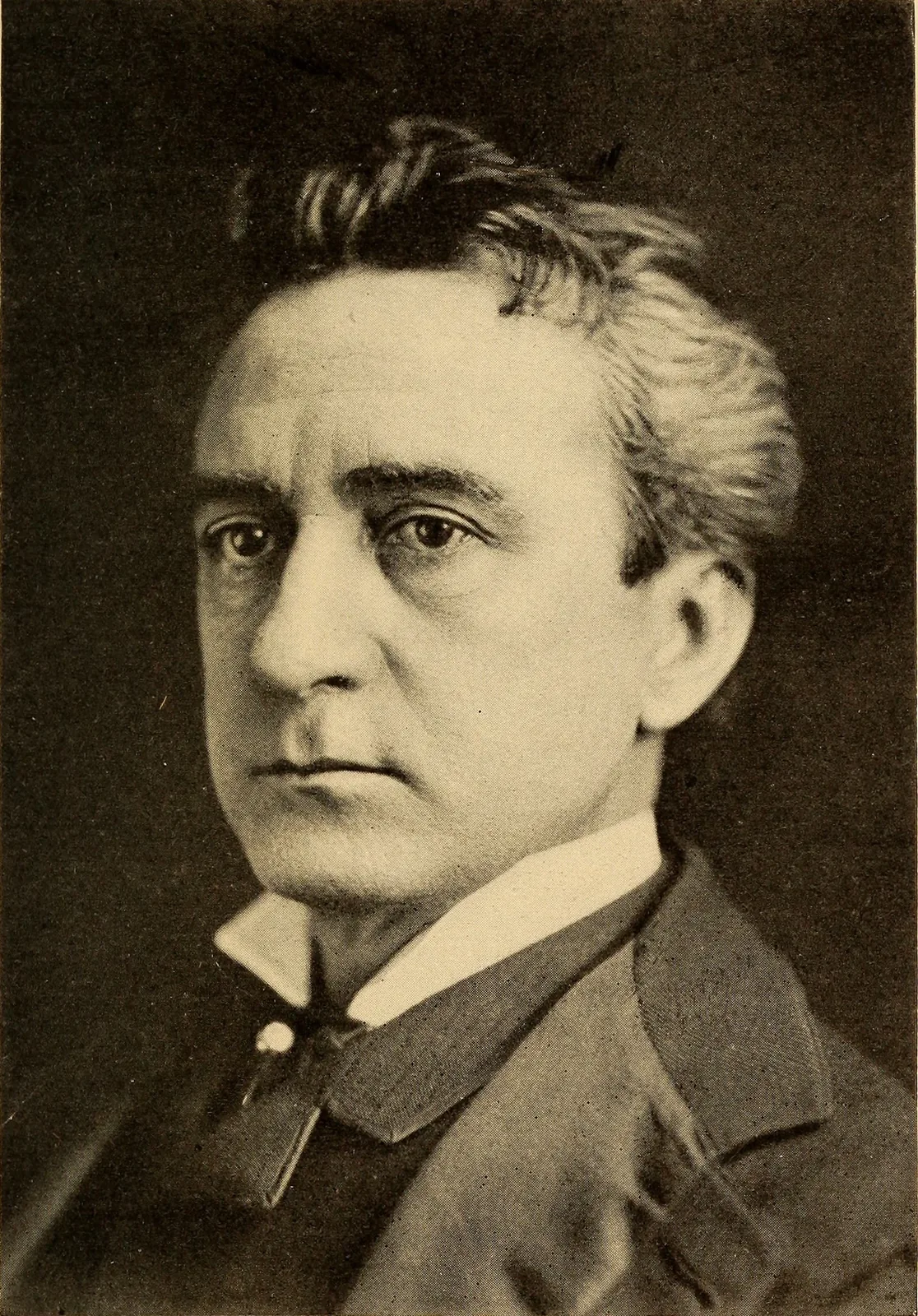
At home with the actor
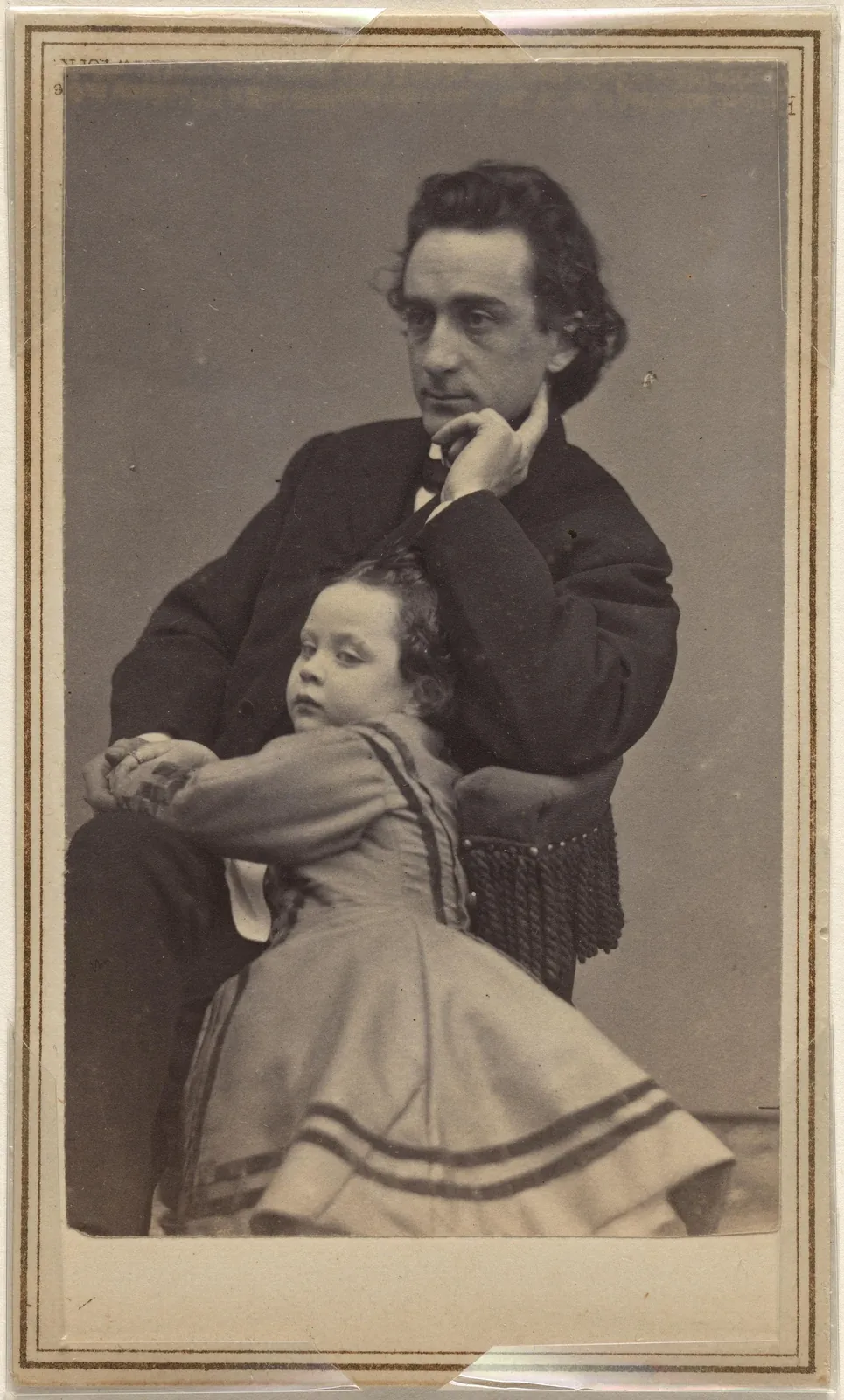
In Edwin Booth’s rooms at The Players, a small bronze cast preserves his hand holding his daughter’s.
There are grander things in the house: theatrical portraits, Shakespearean treasures, reminders of an actor whom audiences came to see again and again. Before he became the bronze Hamlet in Gramercy Park, Booth was a devoted, anxious, occasionally very funny father.
His letters to Edwina contain travel arrangements, advice, extravagant affection and messages supposedly written by the family pets. They also trace a working life spent moving from theatre to theatre, with long separations from the people he loved.
In 1888, he gave a house on the south side of Gramercy Park to a new club called The Players, keeping rooms upstairs for himself. The actor who had spent decades living out of trunks could finally come downstairs to a roomful of friends. Twenty-five years after his death, his daughter would stand in the Park before his bronze likeness and recognize her father.
A childhood on the road
Edwin Thomas Booth was born near Bel Air, Maryland, on November 13, 1833, into a family in which Shakespeare was both literature and a living. His father, Junius Brutus Booth, was a celebrated actor with a formidable repertory, an unpredictable temperament and a drinking problem. Edwin’s early education included watching him perform—and learning to look after him.
As a boy, Edwin accompanied his father on tour, learning the plays while helping to keep their leading actor safe and ready to work. There was little time to be a child himself. In a letter to Edwina years later, he recalled trying to learn to skate at thirty-eight: “I make a poor ‘foot’ at it.”
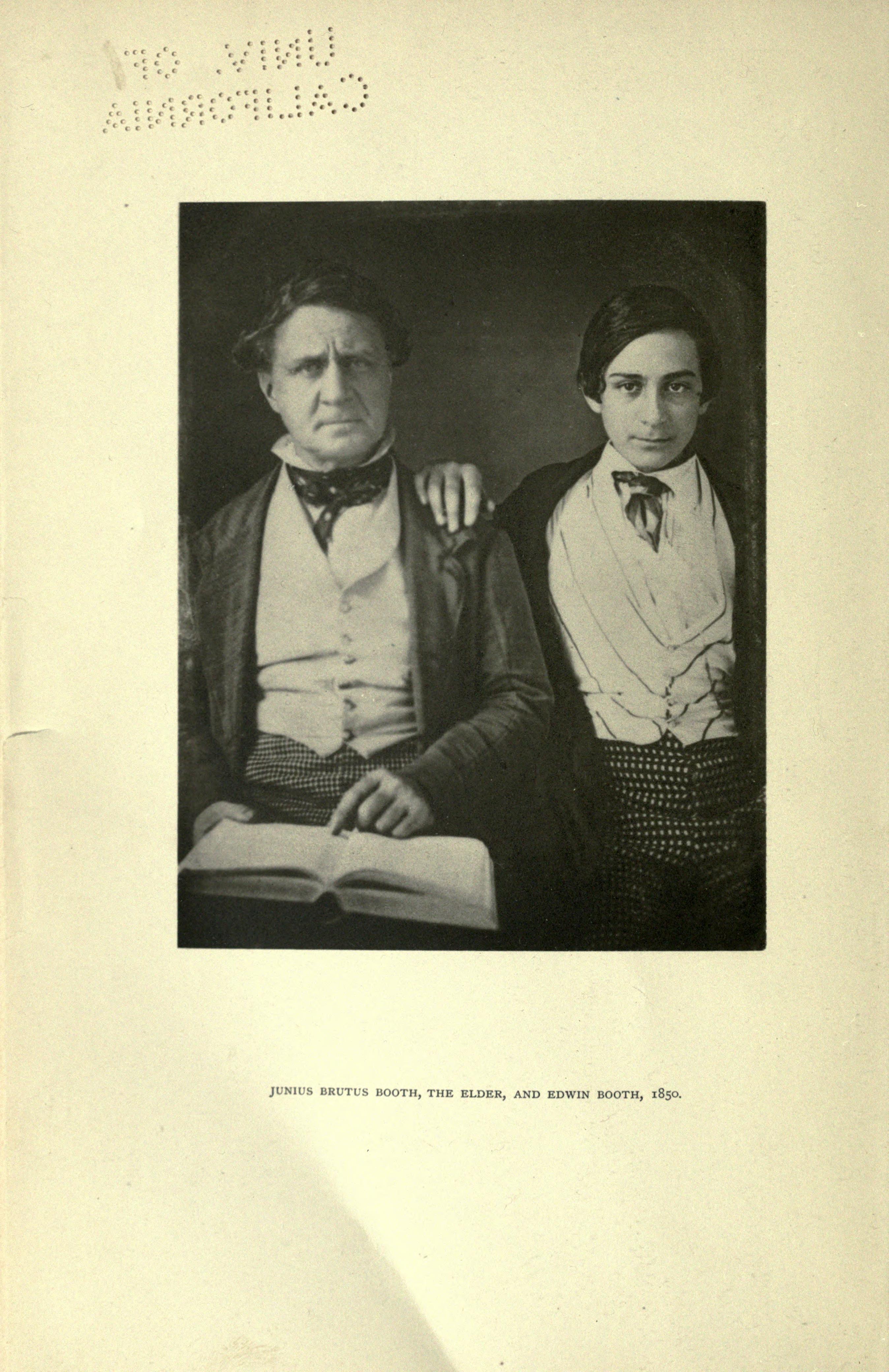
His first professional appearance came in Boston in 1849, as Tressel in Colley Cibber’s version of Richard III, with his father in the title role. The boy who had watched from the wings now had a part of his own. He learned by taking whatever roles were available, including comedy.
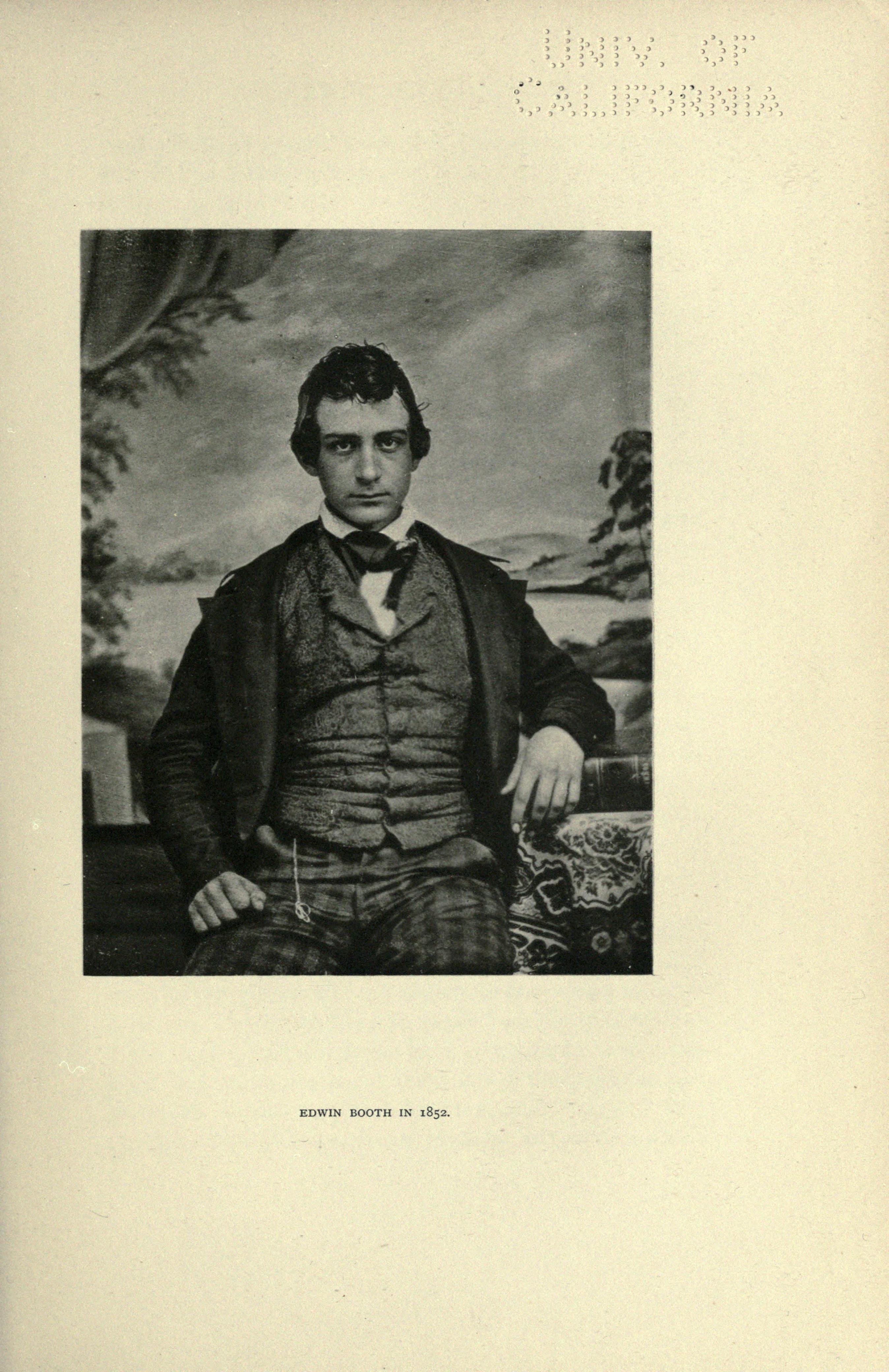
California offered a more demanding education. He went west with his father in 1852 and stayed after Junius returned east and died that November. In the theatres of Gold Rush California, Edwin played a wide range of characters, accumulated experience and began to emerge from his father’s reputation. A tour to Australia followed. The work was uneven; the distance from home was enormous.
When he returned to the eastern United States in 1856, he was still in his early twenties, but already a seasoned travelling actor. Successful appearances in Boston and New York in 1857 helped establish that the name Booth now belonged to a second accomplished performer.
The prince New York came to see
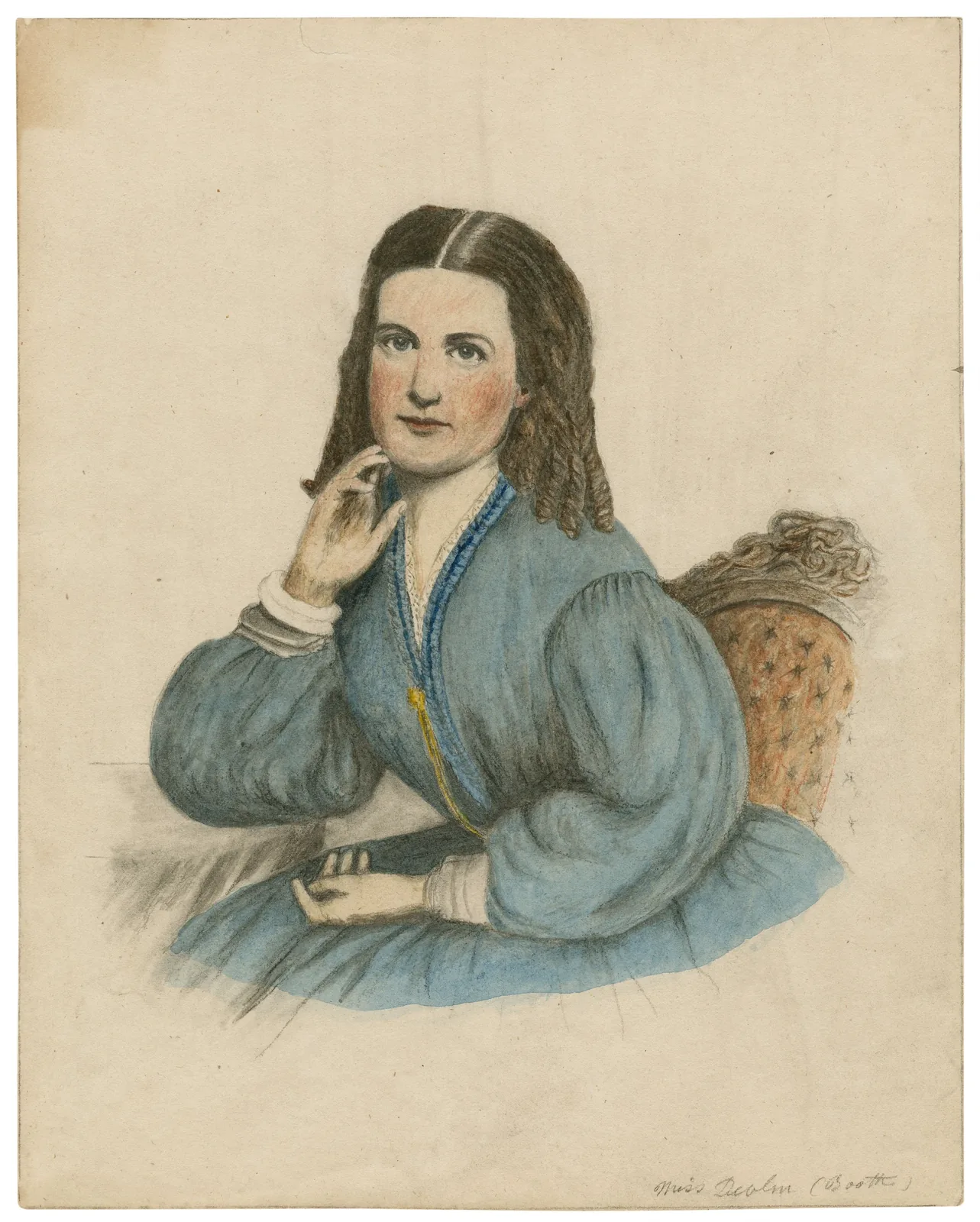
Booth met the actress Mary Devlin while working in Richmond. She had a career of her own: in 1858 she played Juliet at Niblo’s Garden opposite Charlotte Cushman’s Romeo. She and Booth married in 1860; their daughter, Edwina, was born the following year.
Mary died in February 1863, while Booth was performing in New York. He reached her too late. The loss stayed with him for the rest of his life. Edwina, still a very small child, became the recipient of letters that could move in a few lines from practical instruction to an almost overwhelming tenderness.
He saved things she made him. In one letter, he explained that a little handmade present was dearer to him than anything money could buy. Years later, a portrait of Mary would hang in his rooms at The Players.
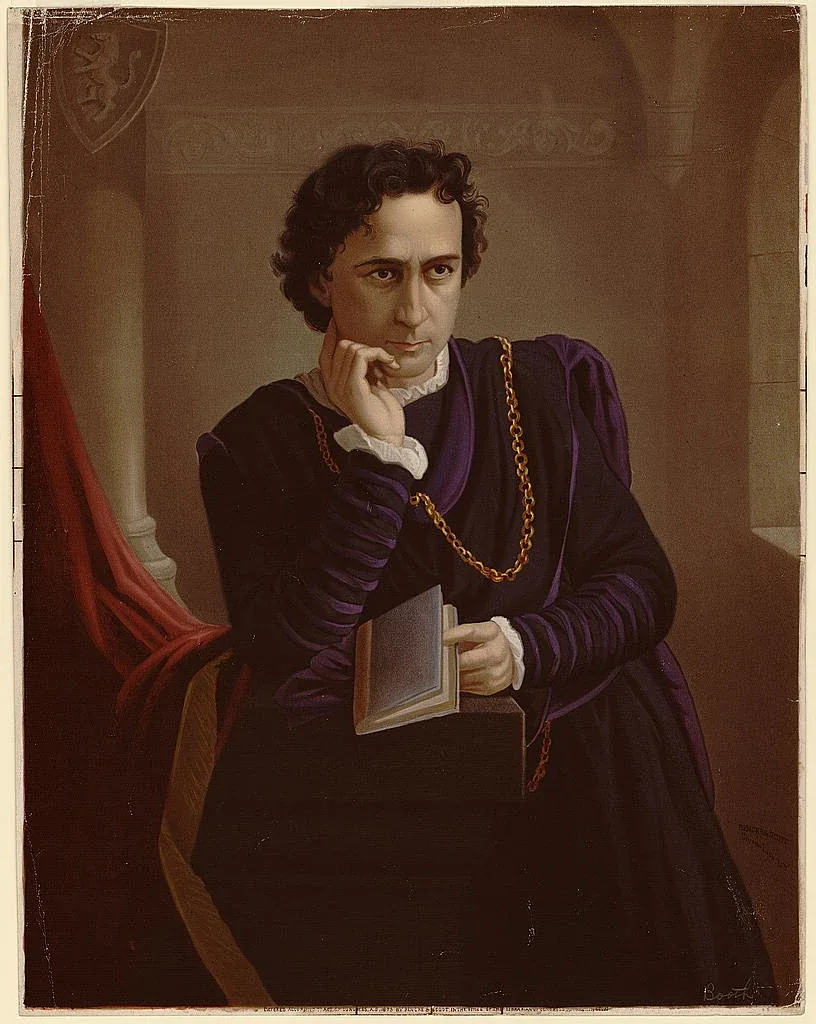
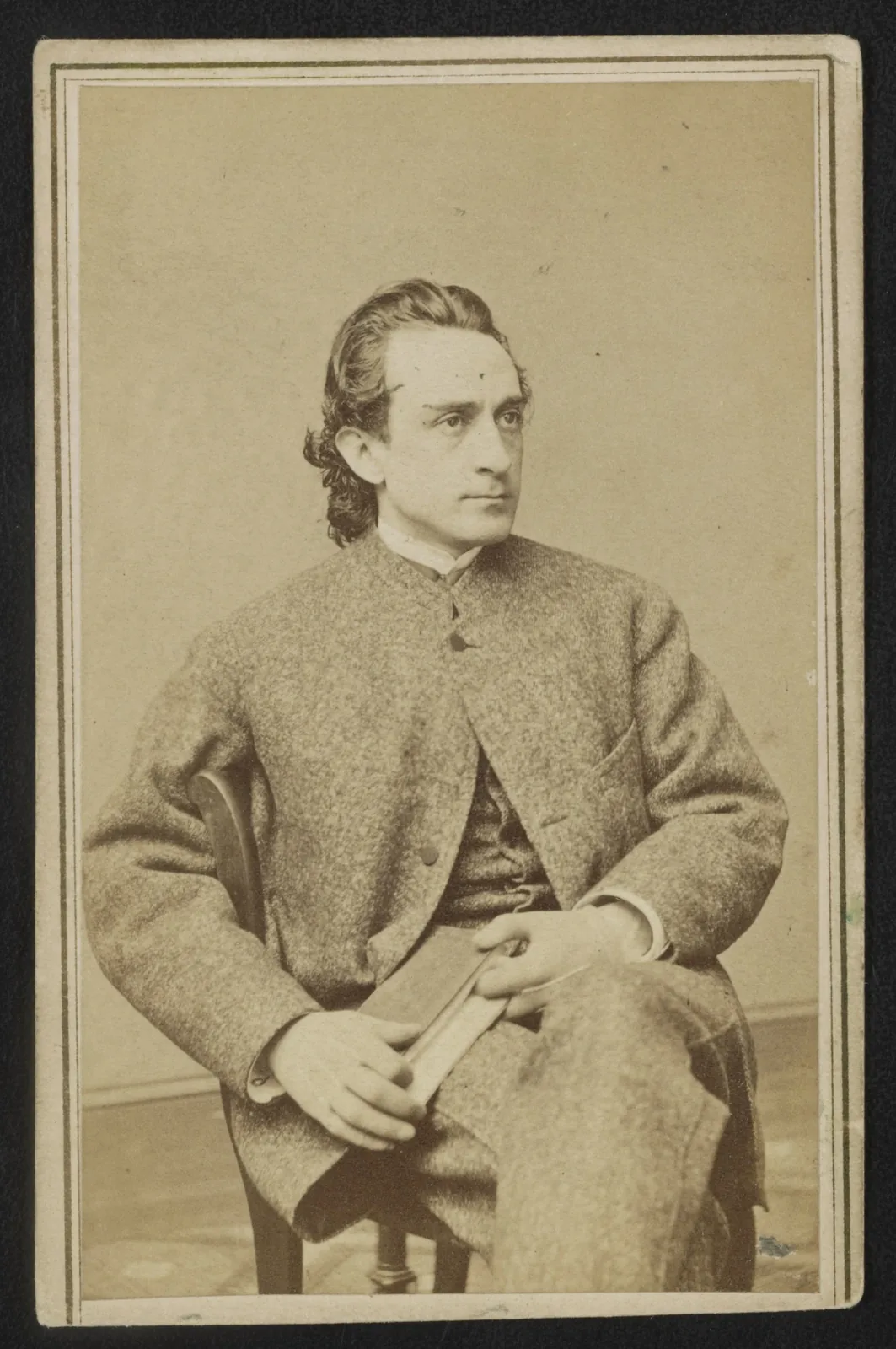
On stage, Booth’s great part was Hamlet. His admirers described a prince who seemed to think as he spoke: the pauses, the close attention to a word, the sudden force that could break through stillness. His friend and biographer William Winter remembered the eyes and the changes of expression as much as the voice. An audience had to watch him closely.
No film preserves that Hamlet. Photographs show the slim, dark-haired prince in black; promptbooks record how Booth prepared the text. What happened between a gesture and the audience’s response survives in the recollections of people who were there.
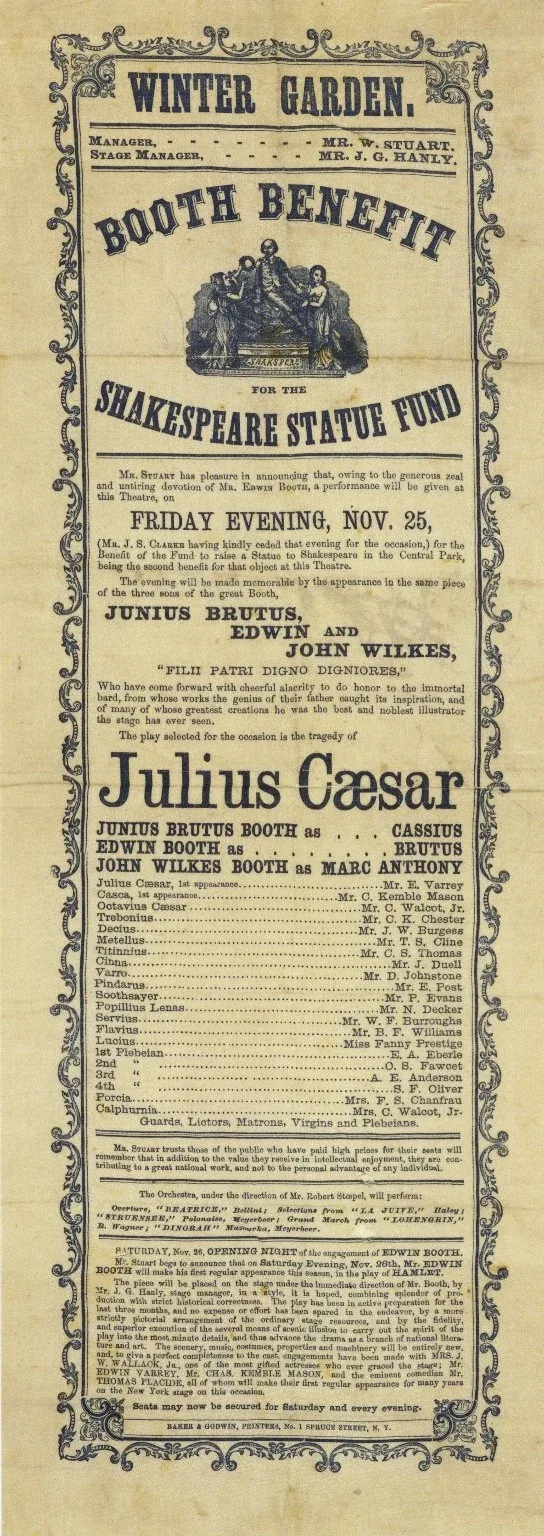
At New York’s Winter Garden, Booth’s Hamlet reached its hundredth performance on March 22, 1865. The program for that night survives at the Folger. Theatres ordinarily changed their repertory frequently; here, one actor in one Shakespearean role kept bringing people back. Less than a month later, his brother would assassinate the president.
The success could be exhausting. While the run was still underway, Booth wrote to a friend that his mind was occupied day and night by scenery, costumes and preparations for the next production.
“It’s an awful thing to be somebody else all the while.”
Edwin Booth to Emma F. Cary, January 10, 1865
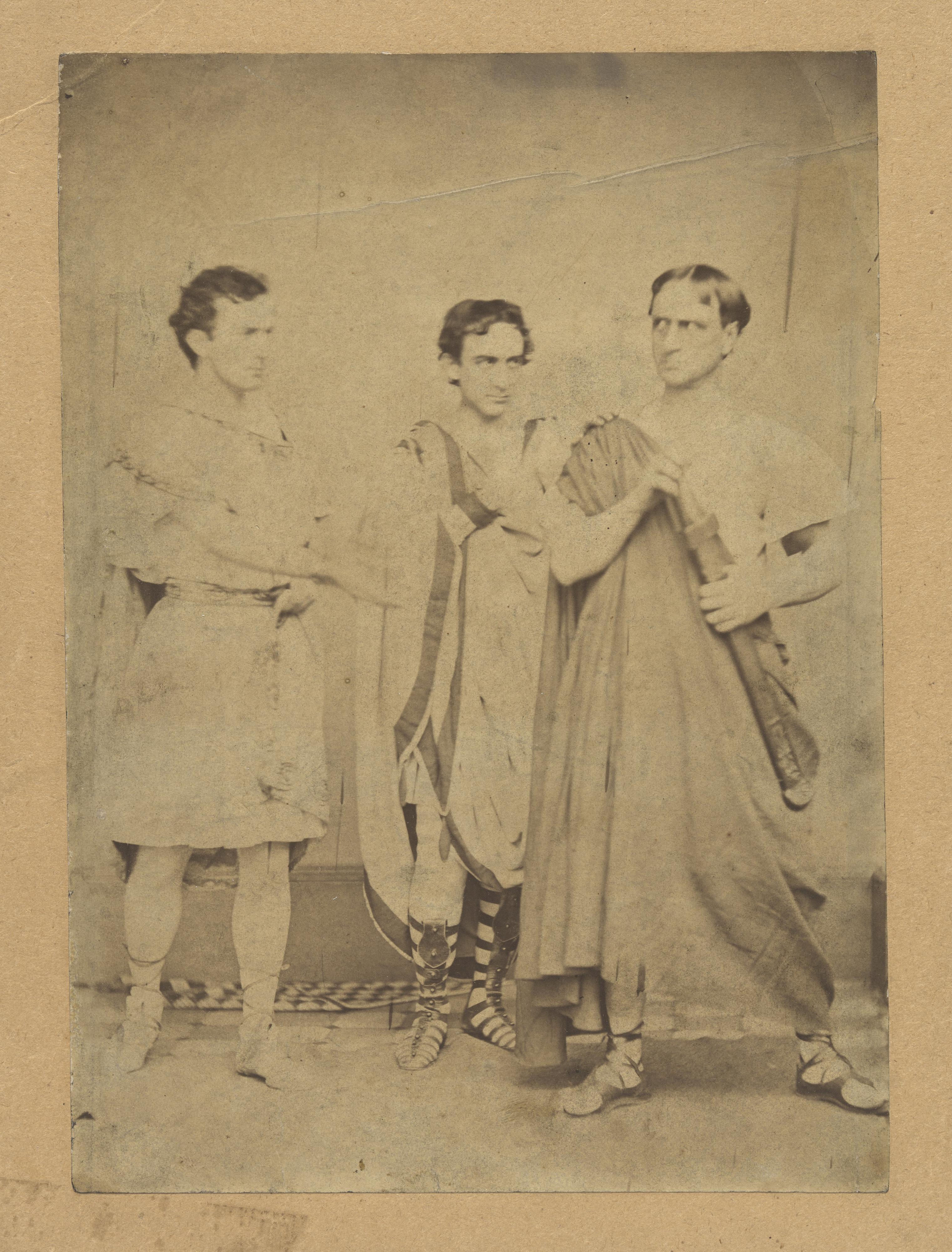
Only months earlier, on November 25, 1864, Edwin and his brothers Junius Brutus Jr. and John Wilkes had appeared together in a benefit performance of Julius Caesar. Edwin was Brutus, Junius was Cassius and John Wilkes was Mark Antony. The proceeds supported a Shakespeare monument for Central Park. Their joint appearance survives in a photograph: three brothers in Roman costume, briefly assembled for the same purpose.
Returning to the stage
Edwin’s politics were very different from his younger brother’s. He supported the Union and Abraham Lincoln. In an October 1864 letter to Adam Badeau, an officer on Ulysses S. Grant’s staff, he wrote of his enthusiasm for Lincoln’s reelection. He also performed to raise money for Union causes.
When John Wilkes Booth assassinated the president in April 1865, Edwin withdrew from the stage. The family name was suddenly inseparable from the murder. He feared that his profession, and the public life he had made for himself, were over. He would never again accept an engagement in Washington, D.C.
He had no part in his brother’s crime. Nevertheless, he had to decide whether he could face an audience again—and whether an audience would allow him to. Friends urged him to return. His own explanation was also practical: he had debts to pay, a family to support and a love of his art.
On January 3, 1866, he reappeared as Hamlet at the Winter Garden. Laurence Hutton described nine cheers as he entered and flowers falling onto the stage. The audience had answered the question Booth could not settle for himself. He could go on acting.
Public absolution did not end his private reckoning. His property man, Garrie Davidson, later told the actor Otis Skinner of a night early in 1873 when Booth took him to the furnace room beneath Booth’s Theatre and opened a trunk of his brother’s costumes and effects. He handed the garments to Davidson to burn, sometimes taking the iron himself to turn the burning mass. The trunk went into the furnace too.
The other Lincoln story
Before the assassination, Edwin had saved the life of the president’s son Robert at a railway station in Jersey City.
In Robert Lincoln’s own account, published in The Century in 1909, a crowd pressed him against a railway car. When the train began to move, he twisted into the narrow space between the car and the platform. Someone caught the collar of his coat and pulled him to safety. Turning to thank his rescuer, he recognized Edwin Booth.
The exact date is uncertain. Robert knew who had rescued him, but Booth learned only afterward whose son he had pulled to safety.
Building his own stage
The Winter Garden burned in 1867, destroying much of Booth’s theatrical property. He answered with a grand Second Empire theatre of his own, on the southeast corner of 23rd Street and Sixth Avenue.
Booth’s Theatre opened on February 3, 1869, with Romeo and Juliet. He played Romeo opposite Mary McVicker, whom he married later that year. He paid close attention to what an audience would see. The orchestra sat in a pit below the main floor; machinery allowed scenery to rise from below the stage or descend from above. His ambition extended from the acting to the way a whole production moved.
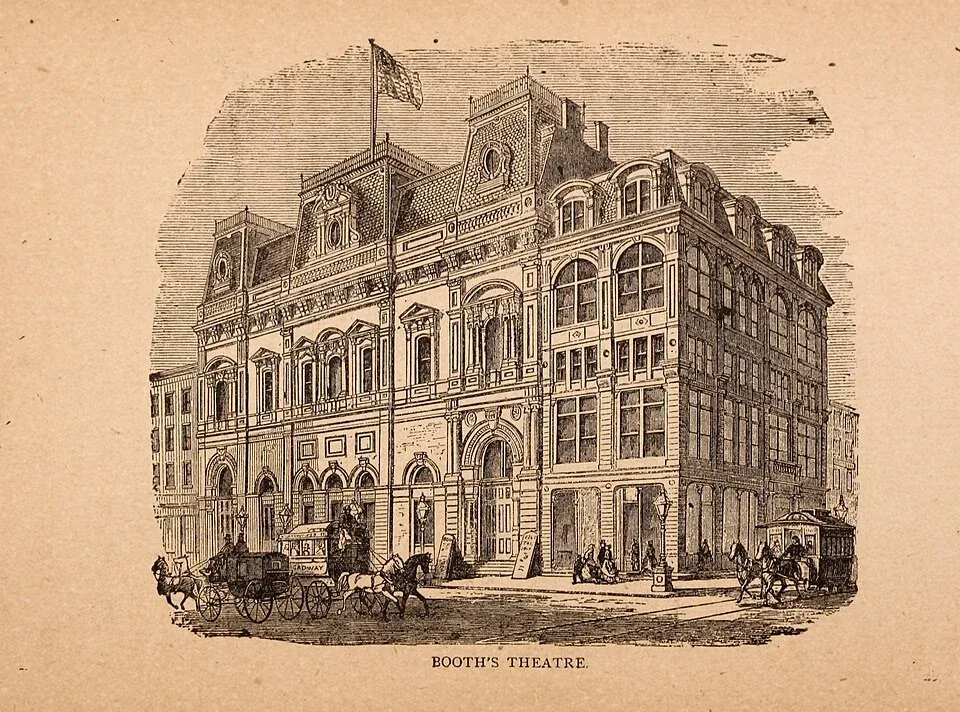
It was a costly ideal. Successful seasons could not overcome the debts of building and running the theatre. Booth withdrew from management in 1873; the financial panic that year deepened his difficulties, and he filed for bankruptcy in January 1874. To rebuild his finances, he returned to touring. The theatre continued under other managers until 1883, when, after fourteen years as a playhouse, it closed and was converted into the James McCreery & Co. dry goods store.
His repertory extended well beyond Hamlet. He played Iago and Othello, Richard III, Macbeth, Shylock and Richelieu; audiences could see different facets of his acting over the course of an engagement. His surviving Richard III costume, with its padded shoulder and embroidered heraldry, shows how carefully he considered a character’s appearance. Later European engagements enlarged his reputation, and a partnership with Lawrence Barrett brought another period of successful touring.
His second marriage brought further losses. A son, Edgar, died shortly after birth in 1870. Mary McVicker, who suffered from ill health, died in 1881. Edwina remained his only surviving child.
Across these unsettled years, Booth kept writing to Edwina about her lessons, manners and health. He could also be wonderfully silly. In 1873 he reported that Pip the dog and St. Valentine the bird wanted to write, but that he would have to hold the pen for them. The following year he supplied letters in their voices.
He explained the purpose of the nonsense quite seriously. Comic parts had helped him avoid stiffness as a tragedian; playfulness, he thought, would improve her letters and conversation too. Then he caught himself: “Well, I declare, I’ve dropped into a sermon, after all, haven’t I?”
Writing as St. Valentine in one of these family letters, he announced: “I have the nicest seed you ever seed!”
Friends downstairs
By the late 1880s, Booth could afford to give his profession something more durable than another production. Actors travelled constantly, worked while other people were at leisure and still encountered social prejudice. He wanted a place where they could meet writers, painters, musicians and people in other professions on easy, equal terms.
The idea became The Players. Its founding circle included Mark Twain, the actor Joseph Jefferson, the writer Laurence Hutton and General William Tecumseh Sherman. Actors would sit down with people whose working lives were very different from their own.
Booth bought 16 Gramercy Park South in 1888. Stanford White adapted the mid-1840s townhouse for its new use, adding the two-story columned porch across its front. Just before midnight on December 31, 1888, Booth stood before the Great Hall fireplace and presented the title-deeds to his gathered friends. The ceremony began the club’s Founders’ Night tradition, still observed each New Year’s Eve with a midnight loving-cup toast. He reserved an apartment on the third floor. The gift provided meeting rooms, a home for theatrical collections and a home for the giver.
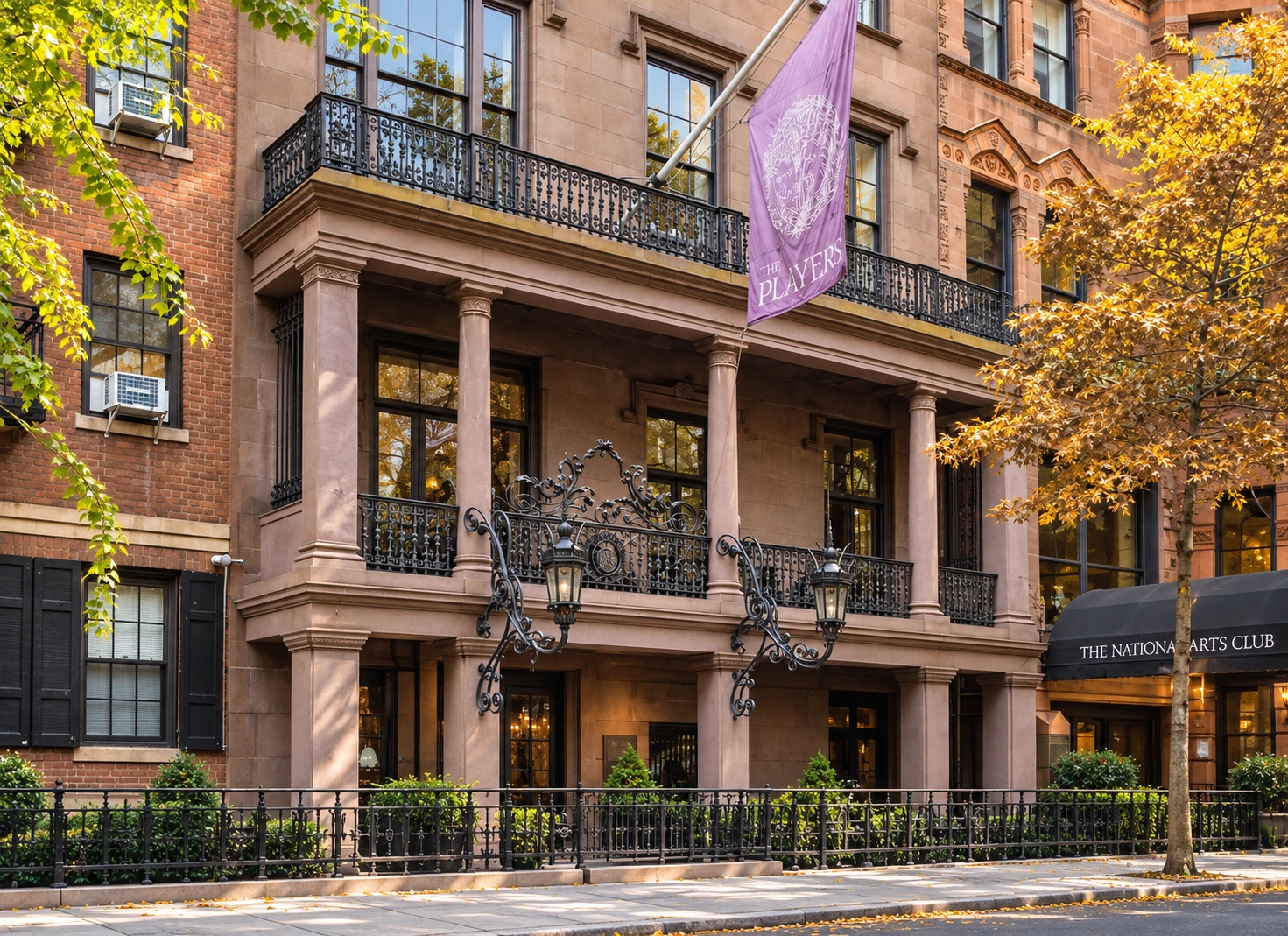
After years of hotels, dressing rooms and railway journeys, Booth could be private upstairs and sociable below. In mild weather, neighbors could see him seated on the second-story loggia looking out into the trees; upstairs in his rooms, portraits, books and memorabilia kept familiar faces and performances around him.
He hoped to work there with William Winter on a history of the American theatre, drawing on the club’s library. The plan foundered when the directors excluded practising theatre reviewers from membership. Winter would have had to give up his work as a critic to stay. The friendship continued, but their proposed book was never written.
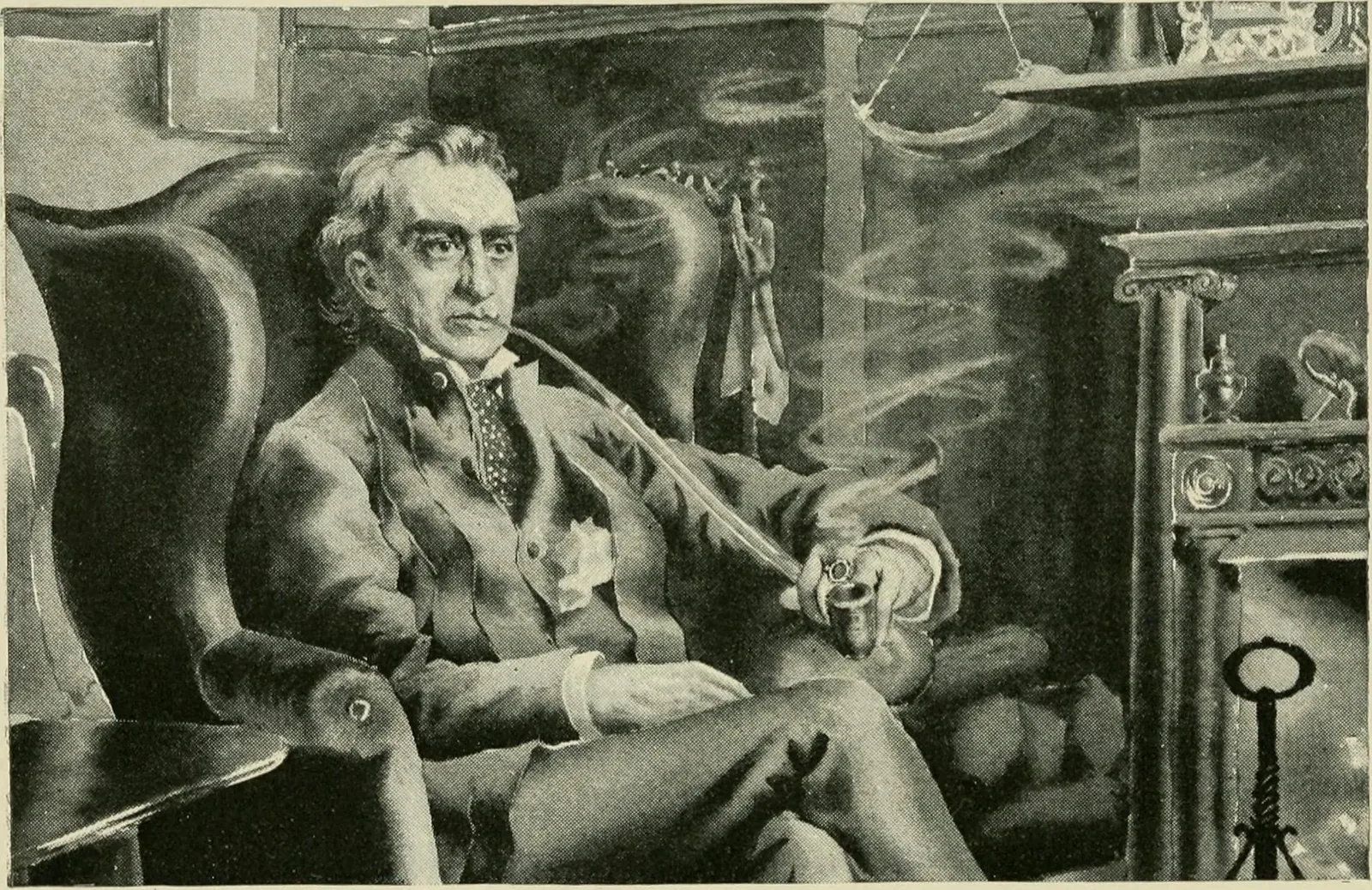
Edwina remembered how much her father liked to arrange his home himself, attending to the smallest details. A portrait of Mary Devlin, books and theatrical keepsakes shared his rooms with ordinary furniture. The bronze cast of his hand holding Edwina’s was among the things he kept close.
Above the roll-top desk, a bust of Shakespeare sits among the portraits, with a rubbing of the inscription on his grave overhead. Booth’s brass bed and dressing table remain, along with the cap he wore as Hamlet. An early illustration shows him seated amid these possessions, at home.
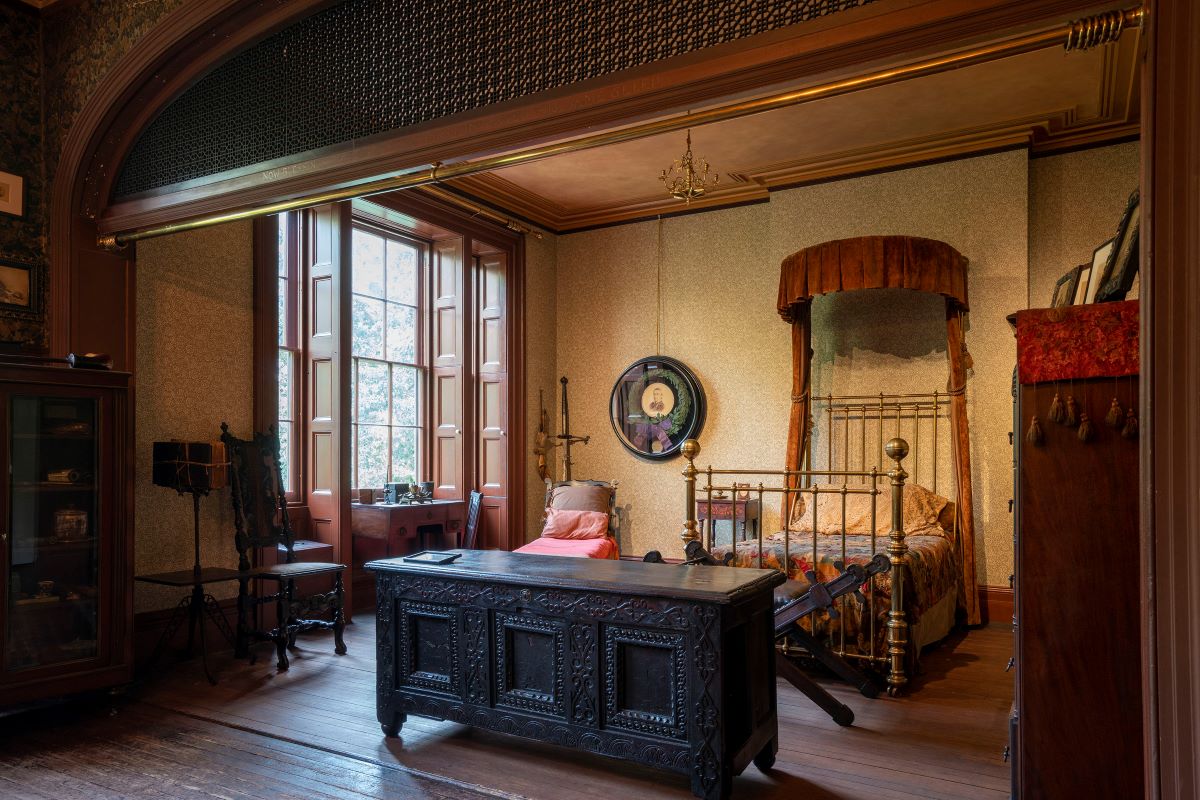
Bringing daylight back
For years, the rooms were kept dim to protect their contents. In 2023 and 2024, The Players Foundation for Theatre Education brought in conservators and craftspeople to recover colors, repair furnishings and make daylight possible again.
A fragment of wallpaper beneath a light fitting helped unlock the bedroom’s earlier appearance. EverGreene Architectural Arts’ work in 2023 used that evidence to reproduce the historic pattern. In the sitting room, the original paper could be retained, stabilized and carefully retouched. The team also repaired plaster, refinished woodwork and recovered the wainscot’s decorative colors and patterns.
Femenella & Associates repaired the 1845 window sashes, keeping original material and glass where possible. Additional UV glazing now admits daylight while protecting the furnishings. The shutters recovered the color of Stanford White’s 1888 scheme; their original hardware was cleaned and put back, including the distinctive “teapot” window locks.
The Foundation’s 2024 project report describes the care given to each object: dressing table, walnut daybed, chandelier, paintings and mantel mirror. Paper salvaged from behind the mirror supplied patches for gaps in the sitting room wallpaper. A cabinet beside the fireplace had long been assumed to be merely decorative. When architect Thomas Fenniman opened it, Booth’s death mask was inside.
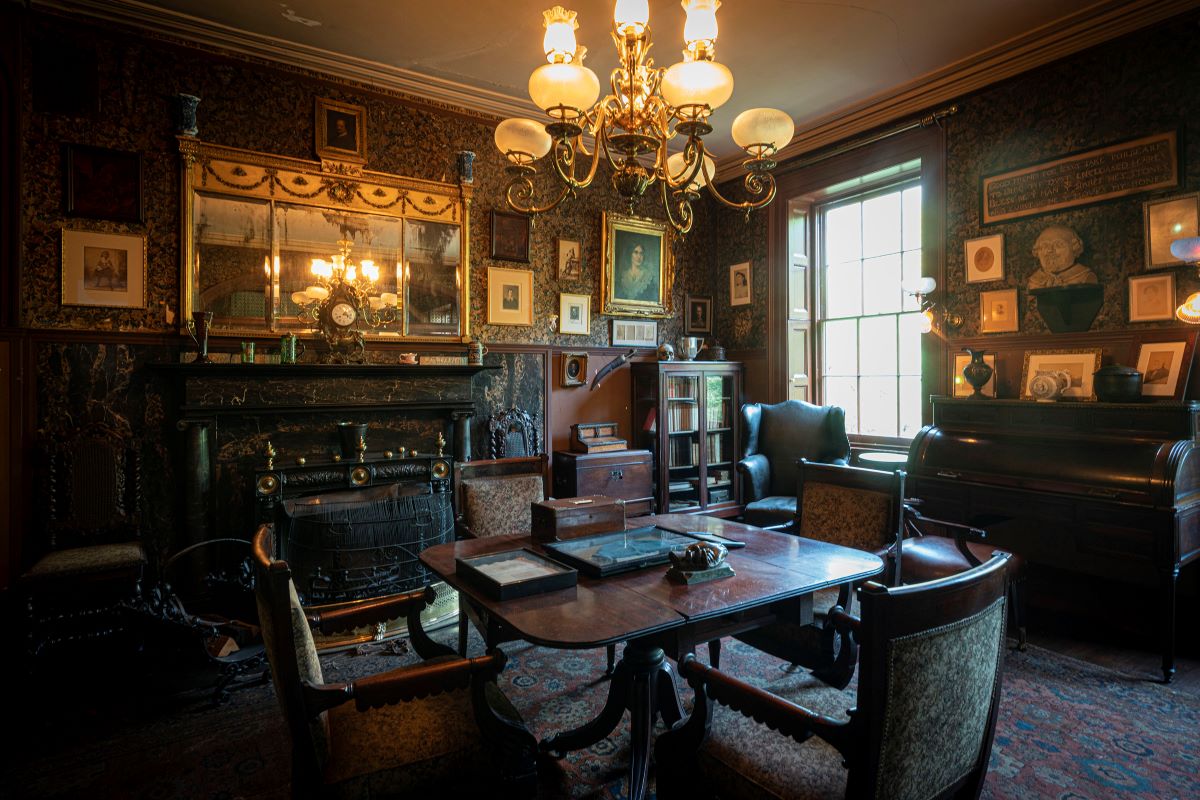
The Foundation’s collections preserve the working actor through books, marked scripts, letters and playbills. Booth left another trace of his acting: a recording made for Edwina, on which his voice can still be heard.
“I recited … for you”
In March 1890, while he was in Chicago, a phonograph expert arrived with a machine. Booth recorded speeches from Othello and Hamlet for Edwina. He described the experiment in a letter, pleased with the clarity of the result but warning that he could not summon the full feeling of a performance “in cold blood.”
The surviving Othello recording begins with the general addressing the Venetian senators: “Most potent, grave, and reverend signiors.” Listen for the phrasing and the changing weight Booth gives the words, even in this private recitation.
Othello’s speech to the Senate
Othello, Act I, Scene 3 · About 3½ minutes
The historic recording contains hiss and crackle. Read Othello’s speech.
On April 4, 1891, Booth played Hamlet at the Brooklyn Academy of Music. He did not intend it as a farewell. “I hope that this is not the last time I shall have the honour of appearing before you,” he told the audience. He wanted to return with renewed health and strength. Illness prevented it.
His remaining years were spent largely at The Players. He died in his third-floor bedroom in the early hours of June 7, 1893, aged fifty-nine. Winter recorded that the electric lights in the clubhouse and the neighborhood briefly went out just before his death. The Players kept his bedroom and parlor as he had left them—preserving his slippers, his pipes and the volume of Charles Dickens’s letters lying beside his bed—through the century that followed. He was buried at Mount Auburn Cemetery in Cambridge, Massachusetts, beside Mary Devlin.
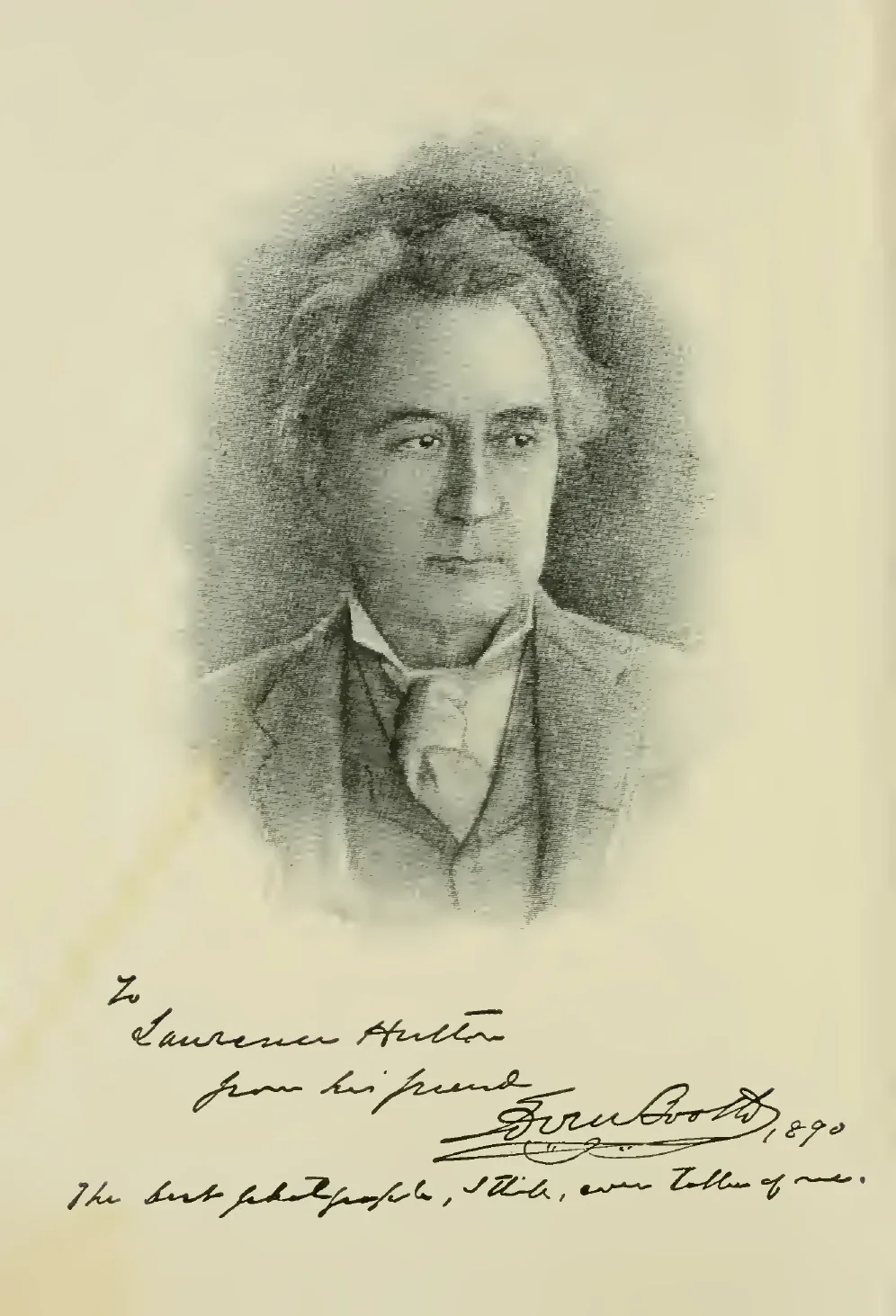
His letter about the phonograph had moved easily from the experiment to family news, friends, the weather and affection for the grandchildren. The actor whose voice had filled so many theatres signed it simply, “Pop.”
Making Hamlet in bronze
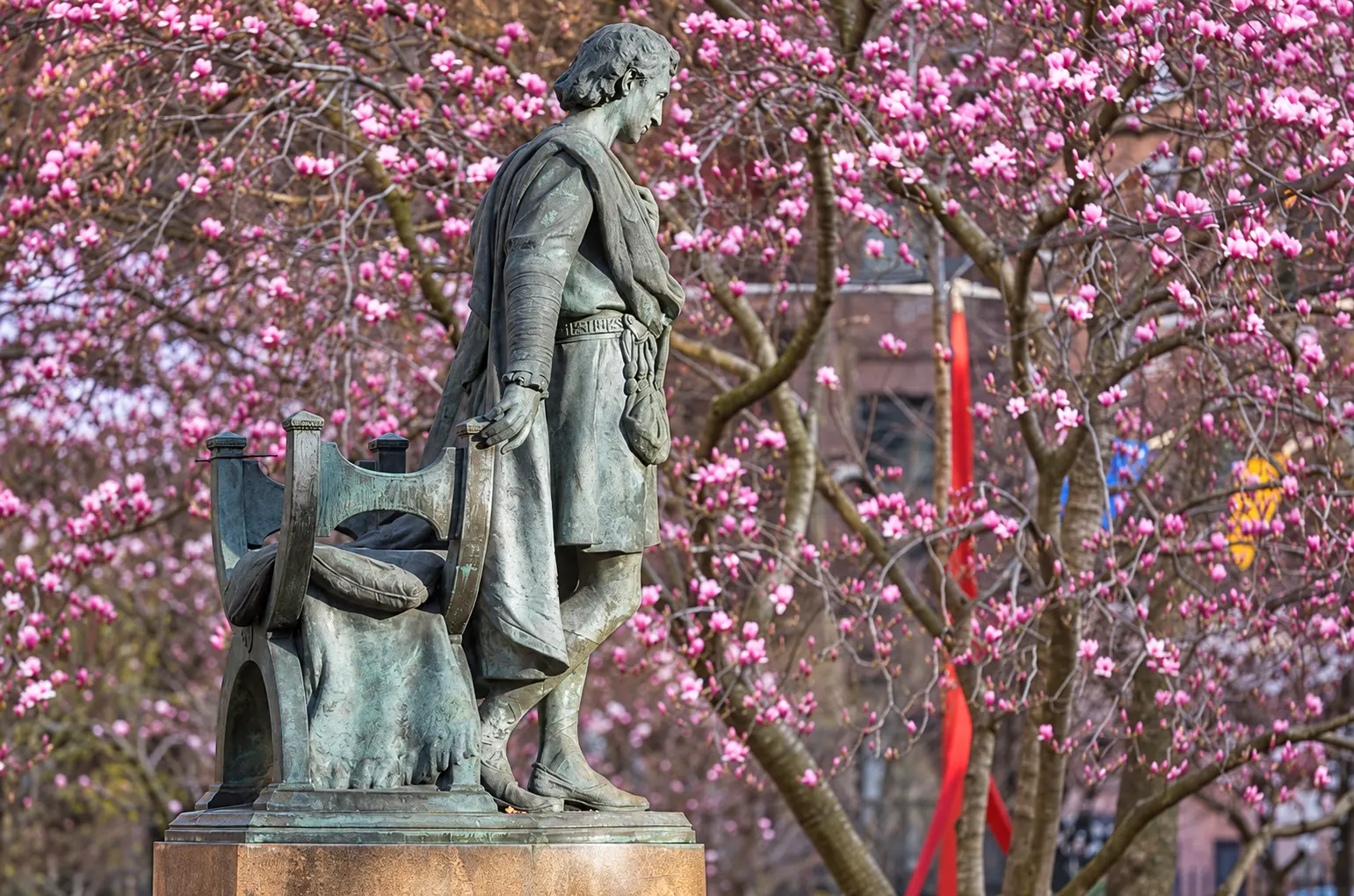
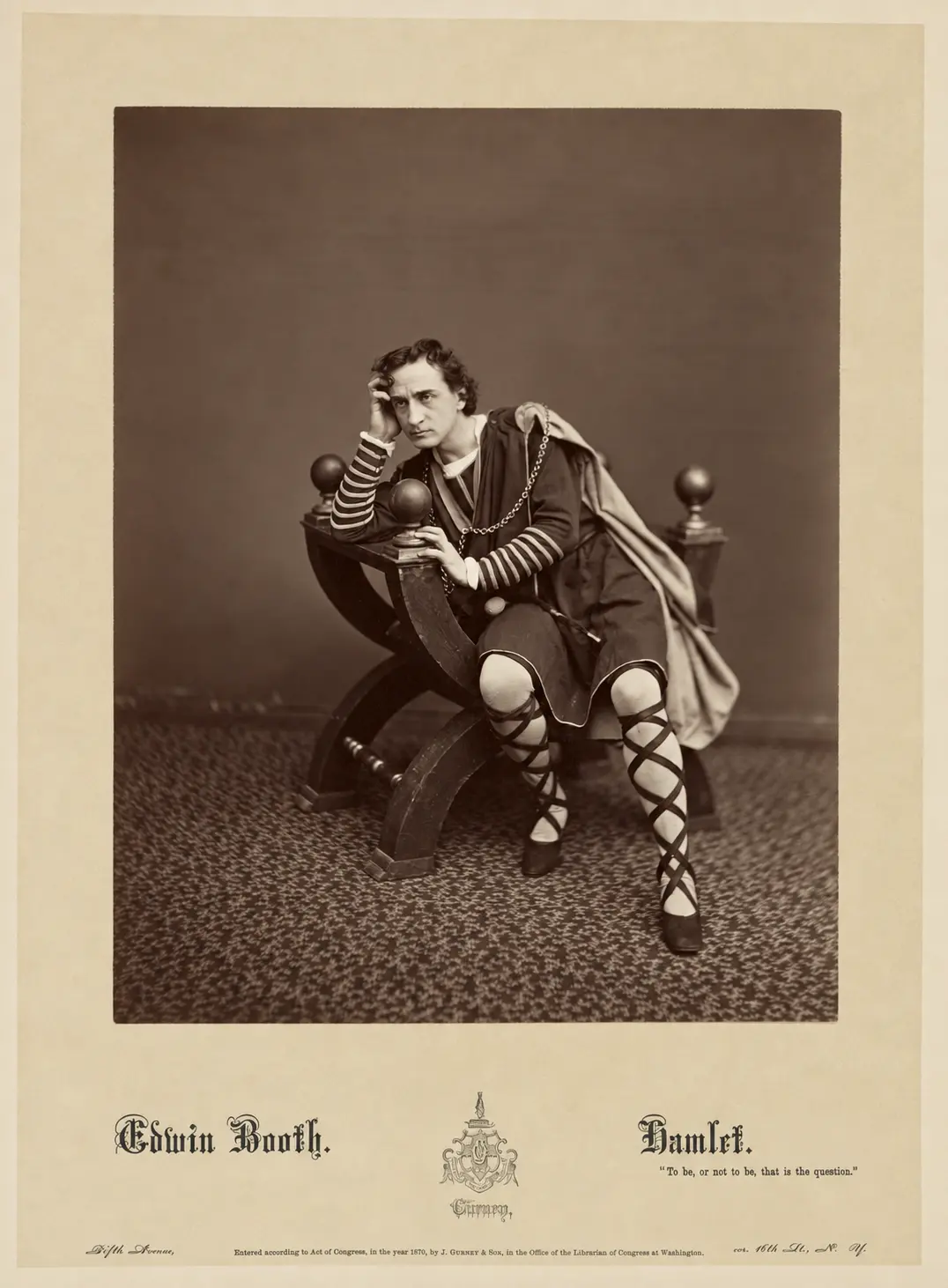
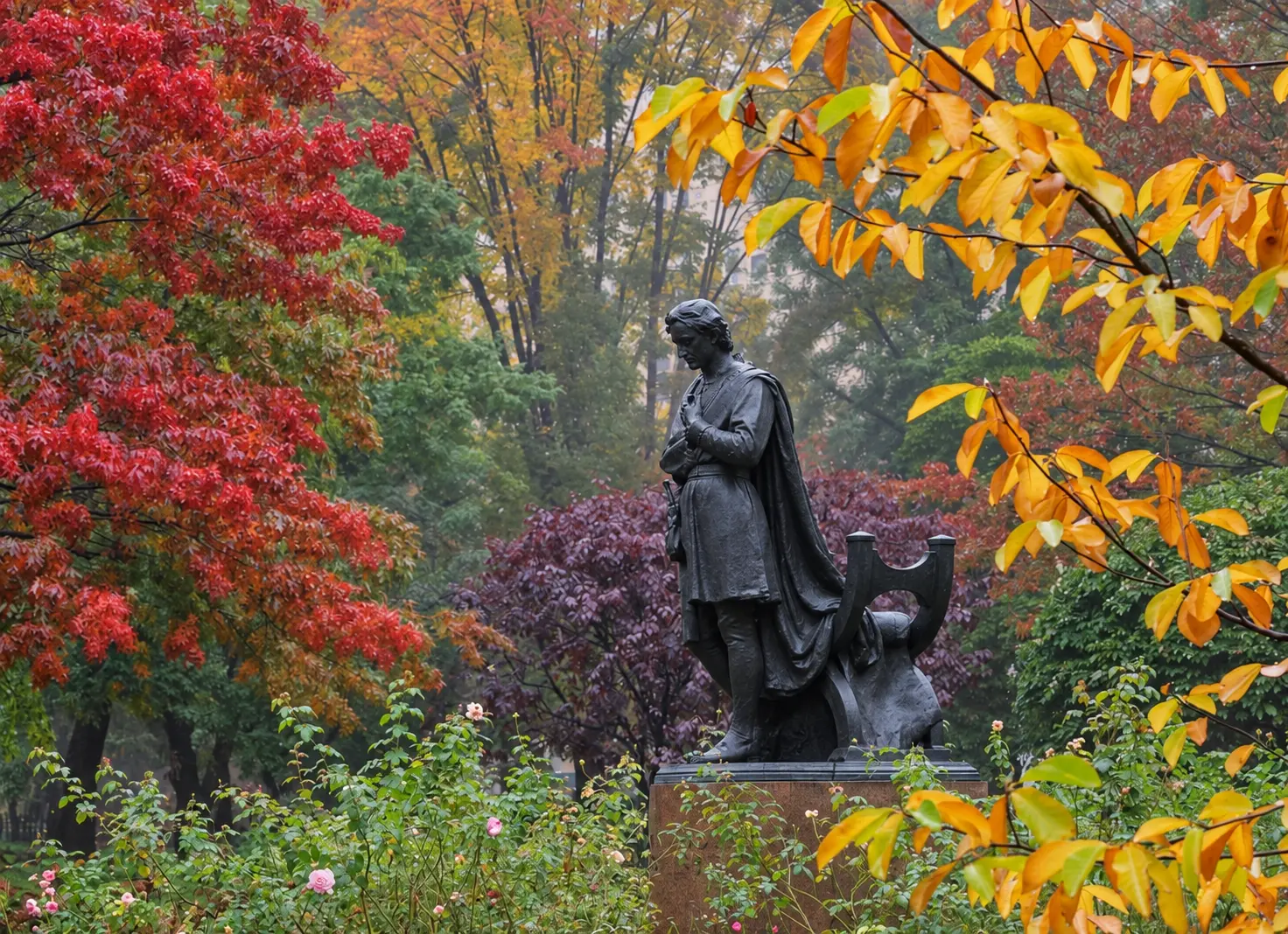
The monument catches Booth’s Hamlet just before “To be, or not to be.” Howard Kyle, secretary of the memorial committee, described him as “about to utter the soul-searching soliloquy on life and death.” A photograph taken at Gurney’s studio about 1870 shows Booth beside a chair in the role, with the same line as its title.
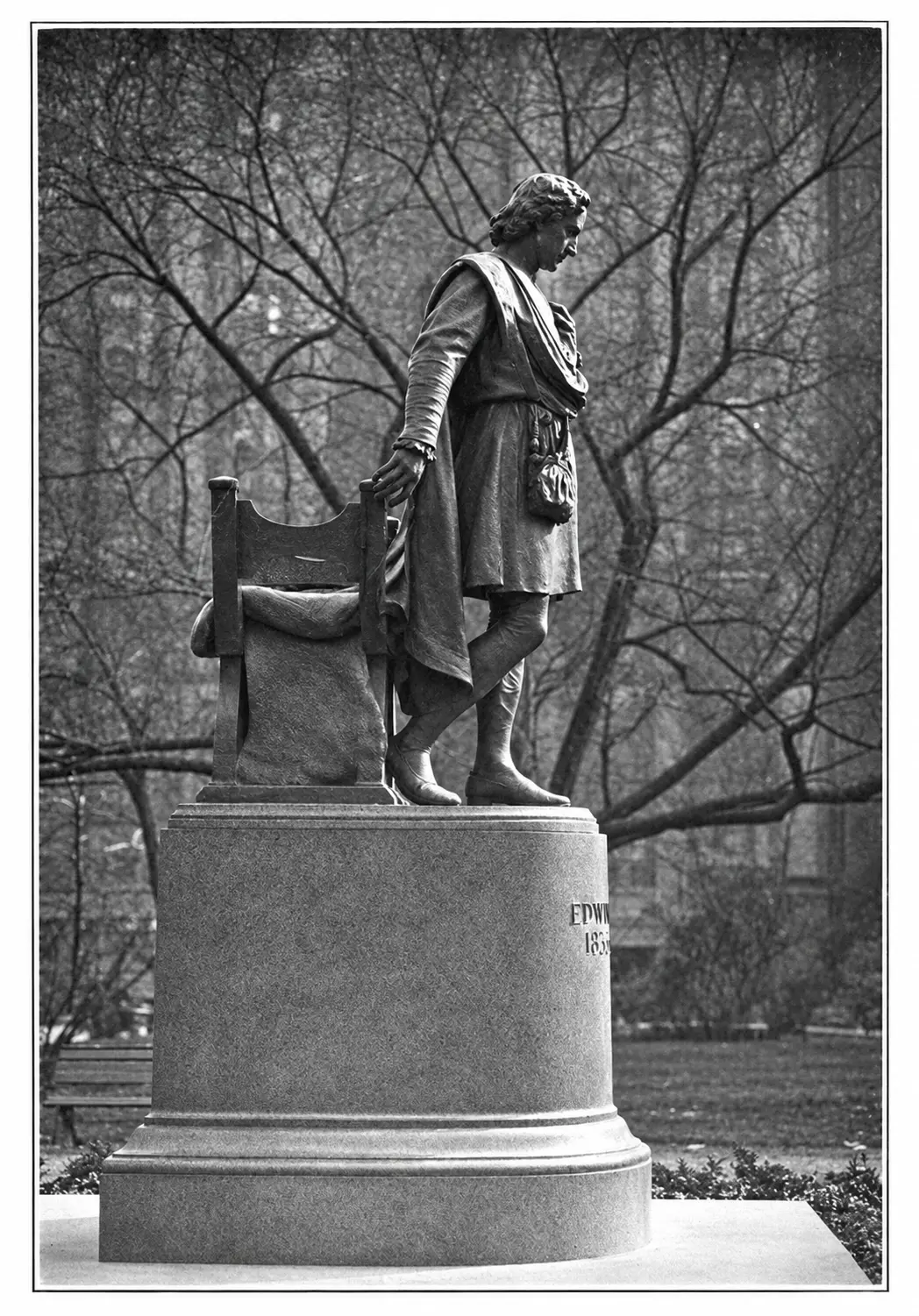
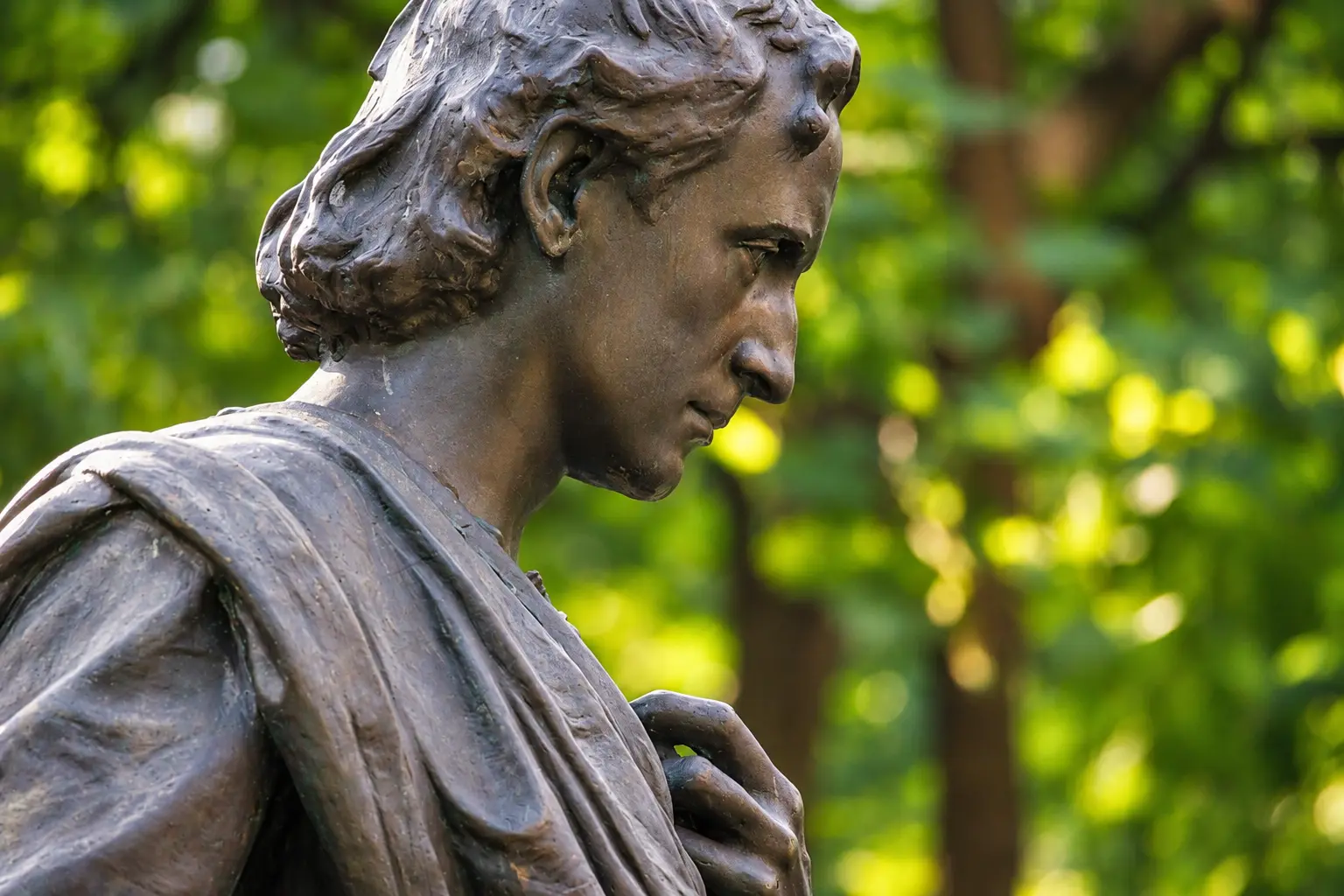
The sculptor, Edmond T. Quinn, gave Hamlet a belted tunic under a long cloak, a chain and medallion at the chest, and a sheathed dagger at the hip. The project’s reference material included a replica of Booth’s stage costume and copies of its accessories. The likeness extended to the clothes in which audiences had known him.
Unveiled on November 13, 1918, the memorial faces south toward The Players, the club Booth founded and the house in which he spent his last years. The bronze actor looks toward his old home; the windows of his rooms look back into the Park.
First a bust. Then an arch.
The idea began modestly. In March 1906 William Bispham asked the Trustees of Gramercy Park to let The Players place its Launt Thompson bust of Booth as Hamlet on a pedestal opposite the clubhouse. The Trustees approved it that May, with conditions: the club would bear the expense, risk and responsibility, and remove the bust if reasonably asked to do so.
By July, the committee was discussing a full bronze figure with Augustus Saint-Gaudens. The painter Francis D. Millet chaired the art committee; Saint-Gaudens offered to make Booth as Hamlet for $50,000. He was already ill and died in 1907 before a contract could be signed.
The committee turned next to Frederick MacMonnies, whose Nathan Hale stood in City Hall Park. It signed with him in September 1909 for $25,000. He had offered to undertake the commission for $20,000; the committee, convinced that he could not afford to do it for that sum, insisted on paying more.
MacMonnies wanted the center of the Park rather than a position by the fence. There, he argued, the monument could honor the theater itself as well as the founder of a particular club. That choice of site preceded his design, which reached the committee in March 1910: Booth beneath an arch recalling a theater’s proscenium, with Comedy and Tragedy incorporated into the architecture.
The arch divided The Players. Some admired it; others found it too baroque; still others objected to any arch at all. From Giverny, MacMonnies defended the theatrical setting in a letter to the painter Thomas Dewing. To put Hamlet on a bare pedestal without the suggestion of a proscenium, he wrote, would be as incongruous as “a statue of an admiral seated in a Morris chair.”
The disagreement lasted years. In February 1913 the committee asked for a version without the arch. MacMonnies resigned that June, returned the reference materials and settled the financial account. Booth’s daughter, Edwina Booth Grossman, remained an admirer of his design. Writing from Lucerne that August, she called it “beautiful and harmonious.” Seven years had passed, and there was still no statue.
“He was a man”
Even holding a competition proved contentious. At a September 1913 meeting in the club library, the sculptors divided four to four over whether it was the right way to choose an artist. Gutzon Borglum, later the sculptor of Mount Rushmore, agreed to participate but withdrew before the judging. Eight sculptor-members ultimately entered.
Each entrant received $150 toward a model; the winning contract would be $25,000. They submitted three-foot figures and scale drawings of the pedestals anonymously, with their names sealed in envelopes. Even the models’ positions in the exhibition were assigned by lot.
The decision came on October 2, 1914, in the National Arts Club’s gallery, a few doors from Booth’s house. Twenty-one jurors were present. They included Stuyvesant Fish, whose former home stood at No. 19, and three outside sculptors chosen by the competitors: Lorado Taft, Charles Henry Niehaus and Albert Jaegers.
All three outside sculptors preferred J. Massey Rhind’s more elaborate composition. A majority favored the model marked “HE WAS A MAN.” The words came from Hamlet’s remembrance of his father: “He was a man, take him for all in all, / I shall not look upon his like again.” When the envelope was opened, it named Edmond T. Quinn, working with his chosen architect, Edwin S. Dodge. What carried their design was its likeness: judges who had known Booth felt they recognized him.
Some found the winning design conventional. Its defenders pointed to the lifelike quality of Quinn’s bust of Edgar Allan Poe in The Players’ library and were willing to wait for the finished figure. The models remained on public view at the National Arts Club for a week.
The people who remembered him
Quinn worked at 135 DeKalb Avenue in Brooklyn. As the figure developed, committee members who remembered Booth’s Hamlet crossed the river to see it. Quinn later said that their questions and suggestions had helped him. He was making a portrait of a performance, with living witnesses still available to guide him.
The project had already assembled an unusually intimate body of reference material. During the MacMonnies commission, Howard Kyle himself dressed in the replica of Booth’s Hamlet costume and posed for eighteen photographs. Fellow Players directed each attitude, searching for something characteristic of the actor they remembered. The effort to preserve Booth had briefly required another actor to play him.
Quinn and Dodge wanted “simple dignity of treatment” for a small park. They dispensed with subsidiary figures and elaborate architecture, designing a pedestal to work from every direction and raise the bronze into view above the fence. The committee had rejected MacMonnies’s arch but retained his choice of the Park’s center, making that location a condition of the competition. With the Trustees’ cooperation, the central fountain gave way to the memorial. The simpler pedestal stood at the heart of the lawn, with Booth facing south toward the front doors of No. 16.
The Gorham Manufacturing Company cast the bronze, which the Smithsonian’s sculpture inventory dates to 1917. Getting it unveiled would take another year.
Two names behind the monument
Quinn came to sculpture through painting. Born in Philadelphia in 1868, he studied with Thomas Eakins and later trained in Paris with Jean-Antoine Injalbert. A 1910 Art Institute of Chicago exhibition catalogue lists him as both painter and sculptor, exhibiting a bust of Poe. Portraiture remained central to his work. New Yorkers can also find his Victor Herbert memorial on the Mall in Central Park, dedicated in 1927.
Dodge brought an architect’s training at Harvard, MIT and the École des Beaux-Arts. Before the Booth commission, he and his wife, the future Mabel Dodge Luhan, had spent years transforming the Villa Curonia outside Florence. Mabel would become famous for the artists and writers she gathered around her. Here, Dodge’s task was quieter: to give Quinn’s figure a setting that could be seen from all sides without competing with it.
Twenty-four minutes in the Park
By 1917, the committee hoped to unveil the memorial on April 23, the club’s Ladies’ Day and Shakespeare’s traditional birthday. Then the granite arrived from New Hampshire with a serious flaw. A seam had developed in the stone, making it unusable.
October became the next target. This time the obstacle was the war: restrictions on nonessential freight prevented shipment of the replacement. Another April 23 passed. Only after a special appeal to railroad officials did Quinn report, at the end of May 1918, that the stone had finally been loaded and shipped.
A July ceremony was rejected: too much of the intended audience would be away for the summer. Some wanted to wait until the war ended. The committee eventually chose November 13, Booth’s birthday. The Armistice came two days before the unveiling.
Twenty-four minutes, then the matinees
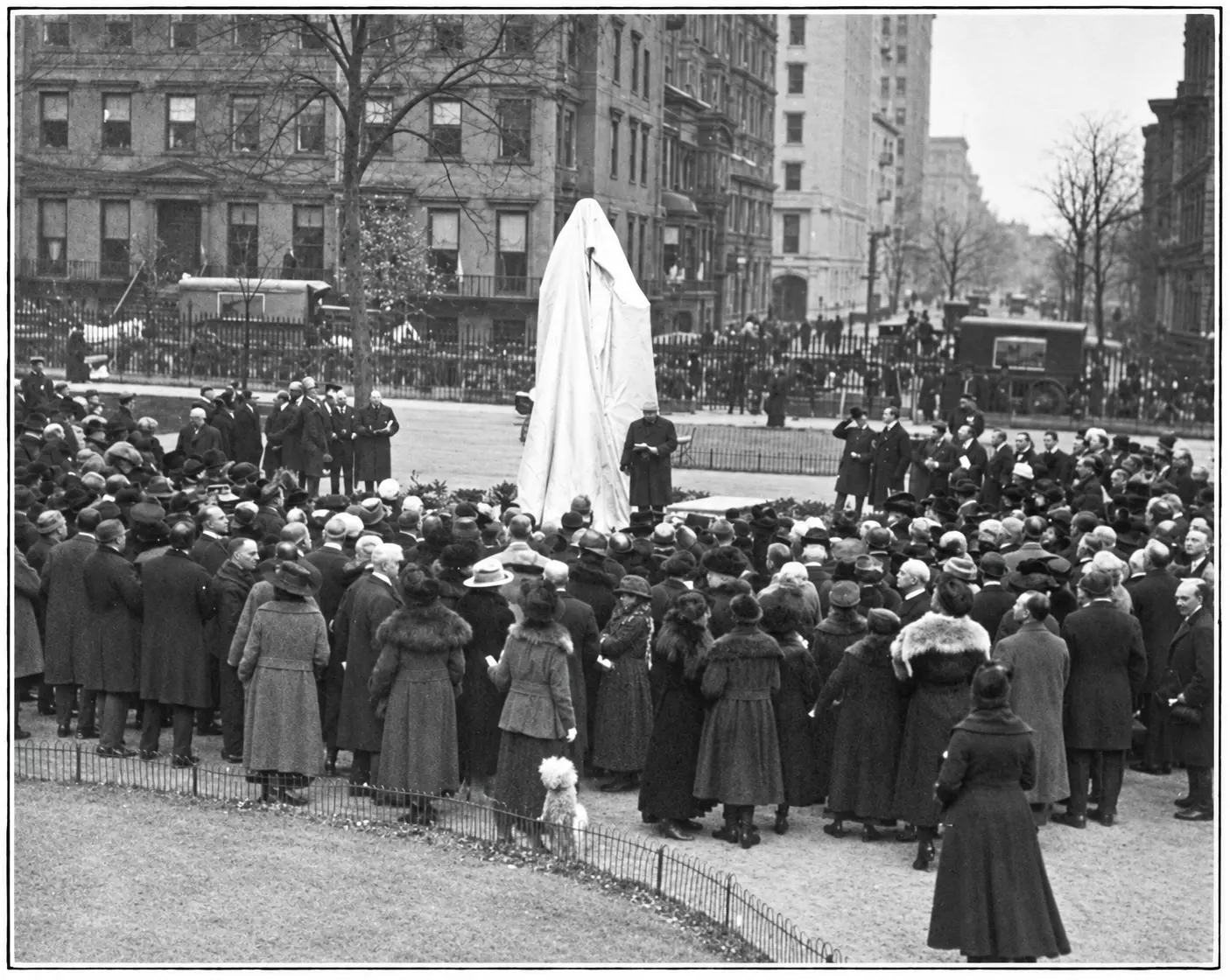
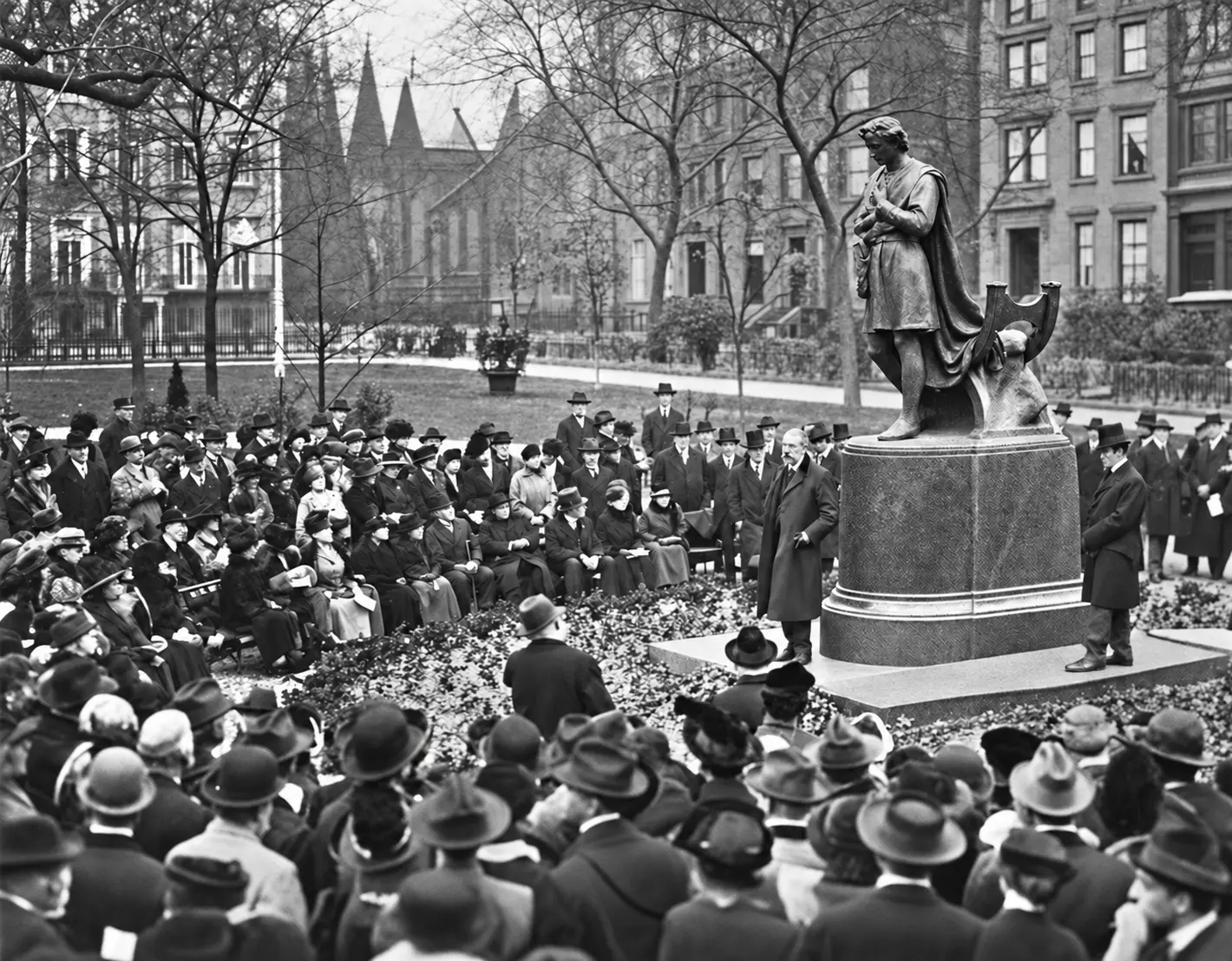
At noon on Wednesday, November 13, 1918, actors, friends, neighbors and Booth’s family gathered around the covered statue. It would have been his eighty-fifth birthday. The hour accommodated the performers’ matinees; the brevity also spared an outdoor audience a long spell in the November cold.
A male quartet directed by C. L. Safford opened with Shakespeare’s “Blow, Blow, Thou Winter Wind.” The Rev. George C. Houghton gave the invocation. His Church of the Transfiguration—the actors’ Little Church Around the Corner—had held Booth’s funeral in 1893 and received The Players’ memorial window by John La Farge in 1898. Howard Kyle then presented the monument, asking the club to accept it “free from encumbrances, and assume the duty of its care and preservation.”
The unveiling had its own small cast. Booth’s grandson, Edwin Booth Grossman, loosened the covering at the front. Guy Nichols, an actor, Booth’s old friend and the club’s librarian, drew it away. Walter Ottel, the steward who had served Booth, carried the cloth from the scene.
John Drew accepted the monument for The Players, remembering Booth as “our leader and our friend” and the trees the actor had loved to look at from his windows. John B. Pine responded for the Trustees of Gramercy Park, welcoming “the distinguished guest you have brought us.” Brander Matthews spoke about Booth’s art and the home he had created for the arts. He found an appropriate companion elsewhere in the city: the statue of Shakespeare in Central Park.
The quartet sang “Who Is Sylvia?” and the ceremony was over. It had taken twenty-four minutes. The Evening Post noticed the babies: noon was their customary hour in the Park, and they had not been turned out for the occasion. Among the youngest guests were Booth’s great-grandchildren. Older actors, who remembered the man as well as the performances, stood looking at their friend.
“It is my father as I knew him”
The most personal verdict came from Booth’s daughter, Edwina Booth Grossman. Kyle recorded her words: “Everything has been just right. The statue is wonderful. It is my father as I knew him. He seems to live again and the more I look at the figure the more deeply I am moved.” The winning model had carried Hamlet’s words about his father; now Booth’s daughter was standing before it.
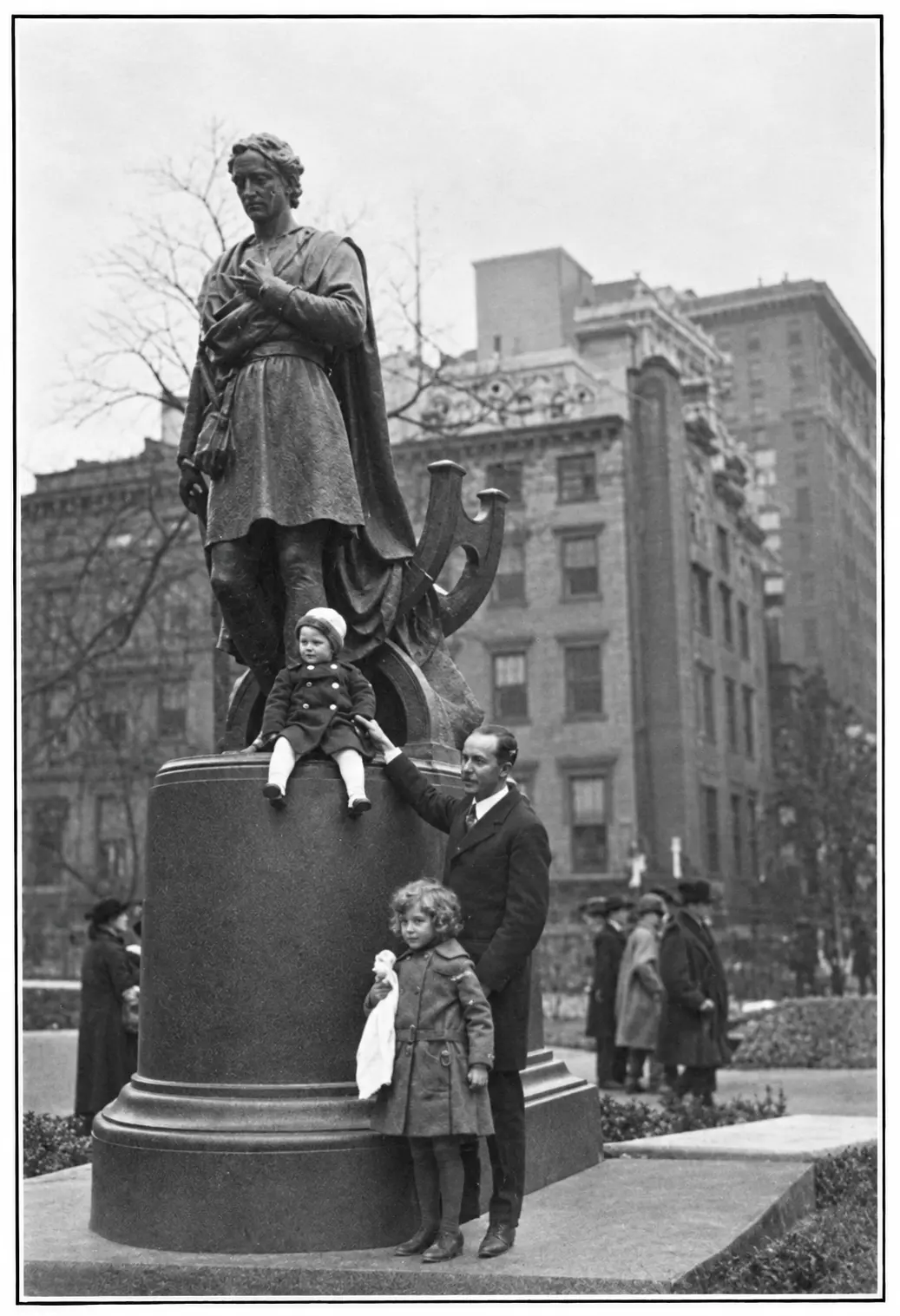
Photographs in the committee’s history show the family at the pedestal. In one, Edwina’s son, Edwin Booth Grossman, stands with two small great-grandchildren of Booth: Lois Fellows Grossman and Livingston Booth Waterbury. The monument already belonged to a generation that had never seen him perform.
As the gathering dispersed, playwright Percy MacKaye looked back from the south gate and supplied a final line for the occasion.
“There he is, Edwin Booth taking his eternal curtain call!”
Percy MacKaye, November 13, 1918 · recorded by Howard Kyle
The company keeps returning
Long before there was a statue to gather around, The Players had marked Booth’s birthday. On November 13, 1893, the first after his death, the club held a memorial evening at Madison Square Garden Concert Hall. Joseph Jefferson gave the introductory address, with tributes from Henry Irving and Tommaso Salvini. Walter Damrosch directed the music, which opened with Handel’s Dead March from Saul—a piece Booth had used in Hamlet.
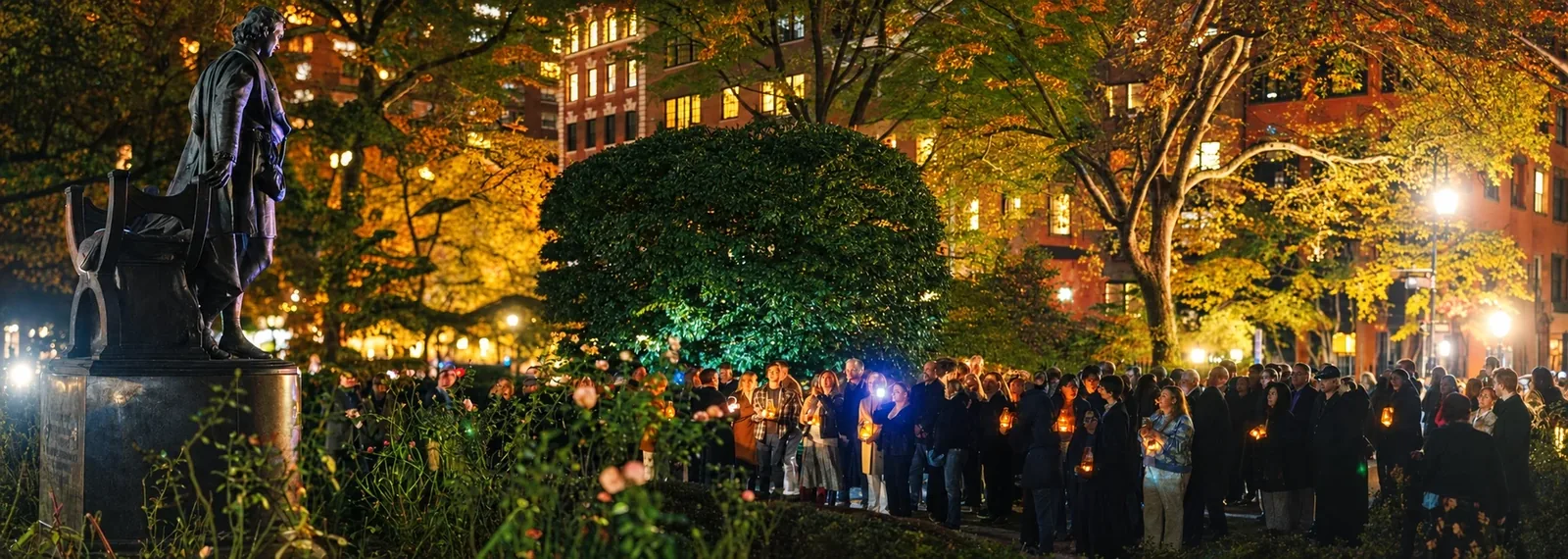
The statue gave the observance a home in the Park. On Booth’s November 13 birthday, The Players’ Founder’s Day gatherings have included a candlelight procession from the clubhouse and a laurel wreath at the pedestal. Members leave the house he gave them and cross the street to his likeness.
The setting has attracted painters as well as actors. Johann Berthelsen, who began his working life as a singer, painted Gramercy Park, Edwin Booth Statue, Looking from the Players Club. The title describes the other half of the relationship: Booth seen from the home he left behind.
A midnight conversation
In 1928, E. B. White gave the silent actor a speaking part. His poem “Gramercy Park” follows a visitor over the fence and into a conversation with Booth. The bronze guardian begins by demanding a key. Then he notices the visitor’s companion.
Gramercy Park
The New Yorker · March 3, 1928
On a night that was cold, a night all dark,
I climbed the fence of Gramercy Park,
Read the full poemClose the poem
On a night that was cold, a night all dark,
I climbed the fence of Gramercy Park,
To the top of the pickets, cold and high,
Up went my hand and up went I,
Then down came my foot, followed by me,
And there was I who hadn’t a key—
Alone was I in a private park
On a night that was cold, a night all dark.
Said I to the statue of Edwin Booth:
“I climbed in here to look for truth.”
Said the statue of Edwin Booth to me:
“This park is administered privately;
“You may be in search of truth and beauty,
“But where is your sense of civic duty?
“You haven’t a pass and you haven’t a key,
“So get out,” said Edwin Booth to me.
The night stood still as he ceased to talk,
And I scuffed away on the scuffy walk;
A small blue star in the crotch of a tree
Lit the dark way through Gramercy.
“Listen,” called Booth, “come back!” he cried,
“Who is the girl that I see at your side?
“Are you her lover, is she your bride?
“And how in the world did she get inside?”
“Maybe you’re seeing things,” I said,
“You’re cold and bronze, and you’re fairly dead.”
“It isn’t that,” he replied, “it’s only
“That nights in a private park are lonely.
“She’s awfully sweet, I admire your taste,
“I notice your arm is around her waist—
“You haven’t a pass and you haven’t a key,
“But give her a little kiss for me.”
Said I to the statue of Edwin Booth:
“I climbed in here to look for truth.”
“Then here is a truth I know,” he said,
“It’s fun to be living and dull to be dead,
“And people are burdened with too much sense,
“And almost nobody climbs a fence.
“You haven’t a pass and you haven’t a key,
“But give her the tiniest kiss for me!”
On a night that was cold, a night all dark,
I climbed back out of Gramercy Park,
To the top of the pickets, cold and high,
And down to the street ‘neath the public sky.
And I don’t know where nor I don’t know when
I’ll ever go climbing a fence again.
A century of care
For the memorial’s centenary in 2018, the Trustees of Gramercy Park undertook its restoration with preservation specialist Gabriel Popian, funded by The Players Foundation for Theatre Education—lifting a century of weather from the bronze and renewing its patina so the quiet expression Quinn modeled can be read clearly in the Park light.
Across the street, Booth’s restored rooms still look into the Park. Outside, the bronze Hamlet remains beside his chair, still just about to speak.
Life at a glance
- Full name
- Edwin Thomas Booth
- Life
- November 13, 1833 – June 7, 1893
- Gramercy home
- Third-floor apartment, The Players, 16 Gramercy Park South
- Profession
- Actor and theatrical manager; particularly celebrated as Hamlet
- Family
- Married Mary Devlin (1860) and Mary McVicker (1869); Edwina was his only surviving child
- The Players
- Founded in 1888; Booth presented the house to the club on New Year’s Eve
- Last performance
- Hamlet, Brooklyn Academy of Music, April 4, 1891
- Burial
- Mount Auburn Cemetery, Cambridge, Massachusetts
- The Park memorial
- Booth as Hamlet, by Edmond T. Quinn with architect Edwin S. Dodge; bronze cast by Gorham
- Unveiling
- November 13, 1918, his eighty-fifth birthday; restored in 2018
- His rooms today
- Two phases of conservation, 2023–2024, led by The Players Foundation for Theatre Education
Sources cited
This account draws chiefly on Booth’s letters, his daughter’s recollections and William Winter’s contemporary biography, checked against surviving programs and institutional collections. The memoirs preserve close personal knowledge as well as the loyalties of their authors. The memorial chapters draw on Howard Kyle’s 1918 committee history, with its correspondence, dedication speeches and family photographs.
- The club’s first circle. Princeton University Library, “Edwin Booth and Laurence Hutton” (2013), on Hutton as The Players’ first secretary. Winter’s Life and Art, pp. 135–136, explains the rule excluding practising theatre reviewers and the abandoned plan for a history of the American theatre. Laurence Hutton, Edwin Booth (1893), pp. 46–47, describes the reception at Booth’s 1866 return.
- The private aftermath. American National Biography, via Dickinson College, on Booth’s refusal to perform again in Washington; Otis Skinner, “The Last of John Wilkes Booth”, a recollection from the property man Garrie Davidson. The account, discussed in the Indiana History Bulletin, “Booth in Terre Haute,” pp. 73–74, places the burning early in 1873.
- The theatre’s later use. The Broadway League’s Internet Broadway Database entry for Booth’s Theatre records its 1883 closure and conversion to McCreery’s department store.
- The house and its traditions. National Historic Landmark nomination for The Players (1975), on the circa-1845 townhouse, White’s two-story loggia and the preserved apartment; Michael Gerbino, “William Warren Loving Cup” (2025), on the 1888 deed ceremony and annual Founders’ Night observance; Gerbino, “The Mourners Came” (2020), on Booth’s death and personal belongings.
- The central fountain. John B. Pine, The Story of Gramercy Park, 1831–1921 (1921), pp. 14–15, records the fountain’s removal to provide the site for the Booth memorial. Kyle’s memorial history records MacMonnies’s choice of the center and its retention in the competition terms.
- The life and the acting. William Winter, Life and Art of Edwin Booth (1893), especially pp. 3–24, 33–57, 75–78, 128–136, 154–155 and 161–177. Winter knew Booth and witnessed his performances; his admiring judgments are identified as such in the story.
- Family and letters. Edwina Booth Grossmann, Edwin Booth: Recollections by His Daughter, and Letters to Her and to His Friends (1894), especially pp. 1–11, 32–38, 106–107 and 167–175. The skating letter is dated February 5, 1872; the pet letters March 2, 1873, and February 14, 1874; the recording letter March 19, 1890.
- The Booth name and the Lincoln rescue. “Edwin Booth and Lincoln,” The Century, April 1909, reproducing Booth’s April 16, 1865, letter to Adam Badeau and Robert Todd Lincoln’s own account of the railway rescue. The rescue’s exact date is uncertain.
- A hundred Hamlets and Union loyalties. Folger Shakespeare Library, Nora Titone’s selection from the Booth collection, including the original March 22, 1865, program and October 14, 1864, letter to Badeau.
- The working actor. Folger Shakespeare Library, Booth’s Richard III costume; “Shakespeare in California,” an interview with curator Stephen Dickey (2017), on his western apprenticeship and the surviving recording.
- The Players and its founder. Joseph Jefferson, “In Memory of Edwin Booth,” delivered December 30, 1893, reprinted in Modern Eloquence; Albert Bigelow Paine, Mark Twain: A Biography (1912), chapter “A ‘Player’ and a Master of Arts”; Laurence Hutton, Edwin Booth (1893).
- The rooms and their contents. The Players Foundation, the collection and the Booth Room conservation project; Lansing Moore Jr., “Edwin Booth’s Curtain Call,” The Magazine Antiques (2024), on the rooms and personal objects.
- The final performance and burial. Brooklyn Academy of Music, 150-year institutional timeline; Winter’s eyewitness account, pp. 128–130; Mount Auburn Cemetery’s biography of Booth.
- The surviving voice. Booth’s letter of March 19, 1890, in Grossmann, pp. 106–107; the Folger interview above; Edwin Booth Family Collection, California State University, Northridge; digital transfer of the 1890 Othello recording, Internet Archive. The recording is in the public domain in the United States. It is a private recitation, not a recording of a stage performance.
- The Park memorial. GPBA, The Edwin Booth Statue, for the memorial’s commission, 1918 unveiling and birthday observances. Photographic sources and rights are listed separately below.
- E. B. White, “Gramercy Park” The poem appeared in the March 3, 1928 print issue of The New Yorker.
- Howard Kyle, The History of the Edwin Booth Memorial The committee’s firsthand account, including the initial bust proposal (pp. 1–2), Saint-Gaudens and MacMonnies (pp. 6–25), competition (pp. 33–46), delays (pp. 47–48) and dedication (pp. 49–61).
- Edwin Booth as Hamlet — sculpture inventory Quinn, Gorham, the bronze and granite materials, physical description and dedication date. The inventory dates the sculpture to 1917; the unveiling was in 1918.
- Booth-Grossman family papers Family history, theatrical records and photographs of the 1918 unveiling in the Billy Rose Theatre Division.
- The Players’ Founder’s Day observance A dated account of the candlelight procession and laurel wreath tradition.
- Which monument in Gramercy Park is being restored? The neighborhood report documents the Trustees’ restoration and funding by The Players Foundation for Theatre Education.
- Johann Berthelsen’s view from The Players Gallery record for the oil painting, 12 × 16 inches, signed and titled on the reverse.
- The Players’ first birthday memorial The program and addresses for the memorial evening at Madison Square Garden Concert Hall on November 13, 1893.
- Art Institute of Chicago sculpture catalogue A contemporary entry records Quinn’s study with Eakins and Injalbert and his work as both painter and sculptor.
- Edwin Dodge and the Villa Curonia The Mabel Dodge Luhan House’s account of Dodge’s training and the couple’s work on their home outside Florence.
- Victor Herbert memorial The Central Park Conservancy’s history of Quinn’s later memorial, dedicated in 1927.
- Church of the Transfiguration tour guide The parish guide records Booth’s 1893 funeral and the memorial window The Players gave in 1898.
- Conserving the historic finishes. EverGreene Architectural Arts, “The Booth Room at The Players Club”, the conservation team’s account of its 2023 treatment, wallpaper discovery and reconstruction. The Foundation’s project report above describes the windows, furnishings and second phase in 2024.