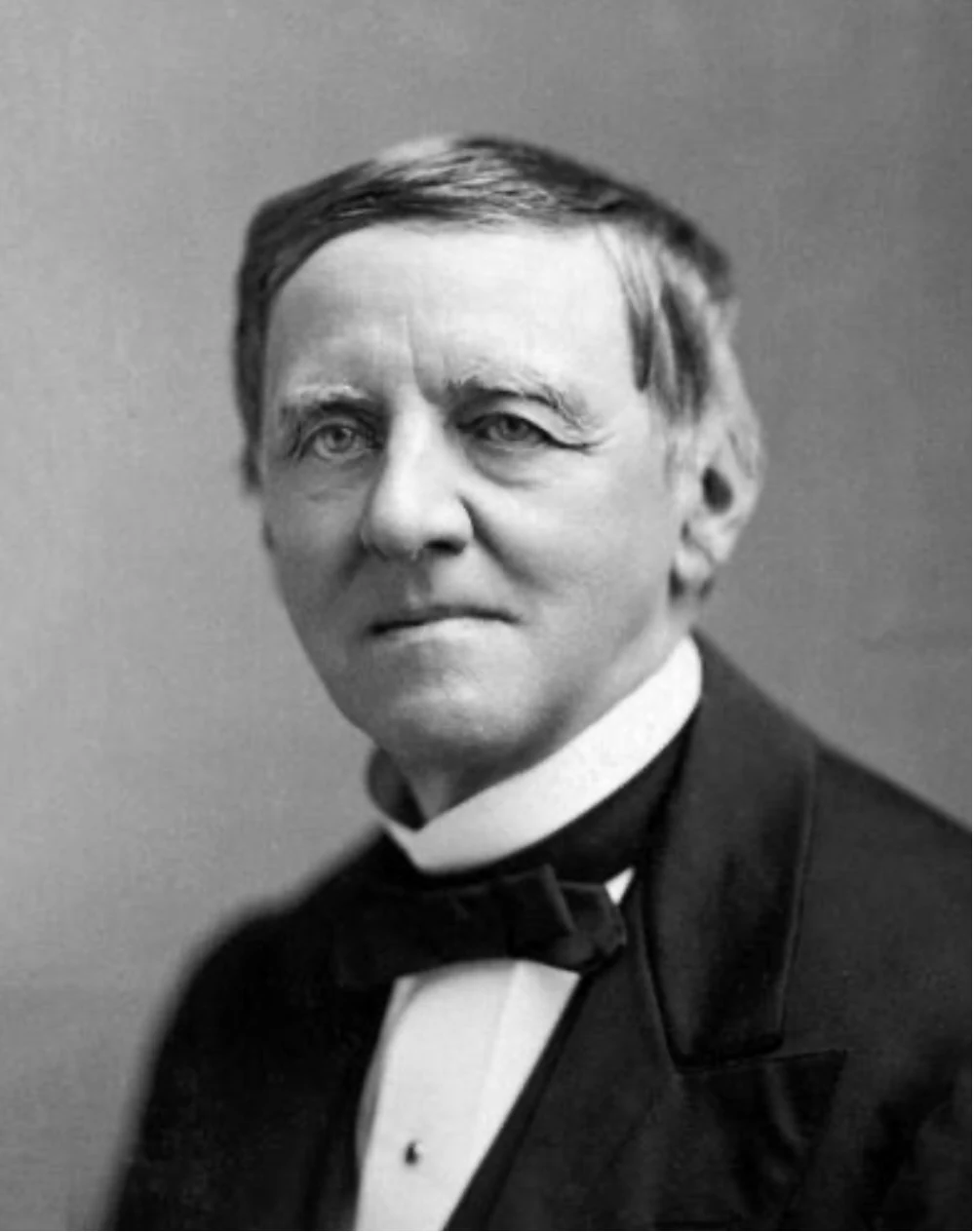
Samuel J. Tilden
A Life Beyond the Lost Presidency
1814–1886 · Lawyer, reform governor & bibliophile
From the money trail behind Boss Tweed to a library for all New Yorkers, the story of the man at 15 Gramercy Park.
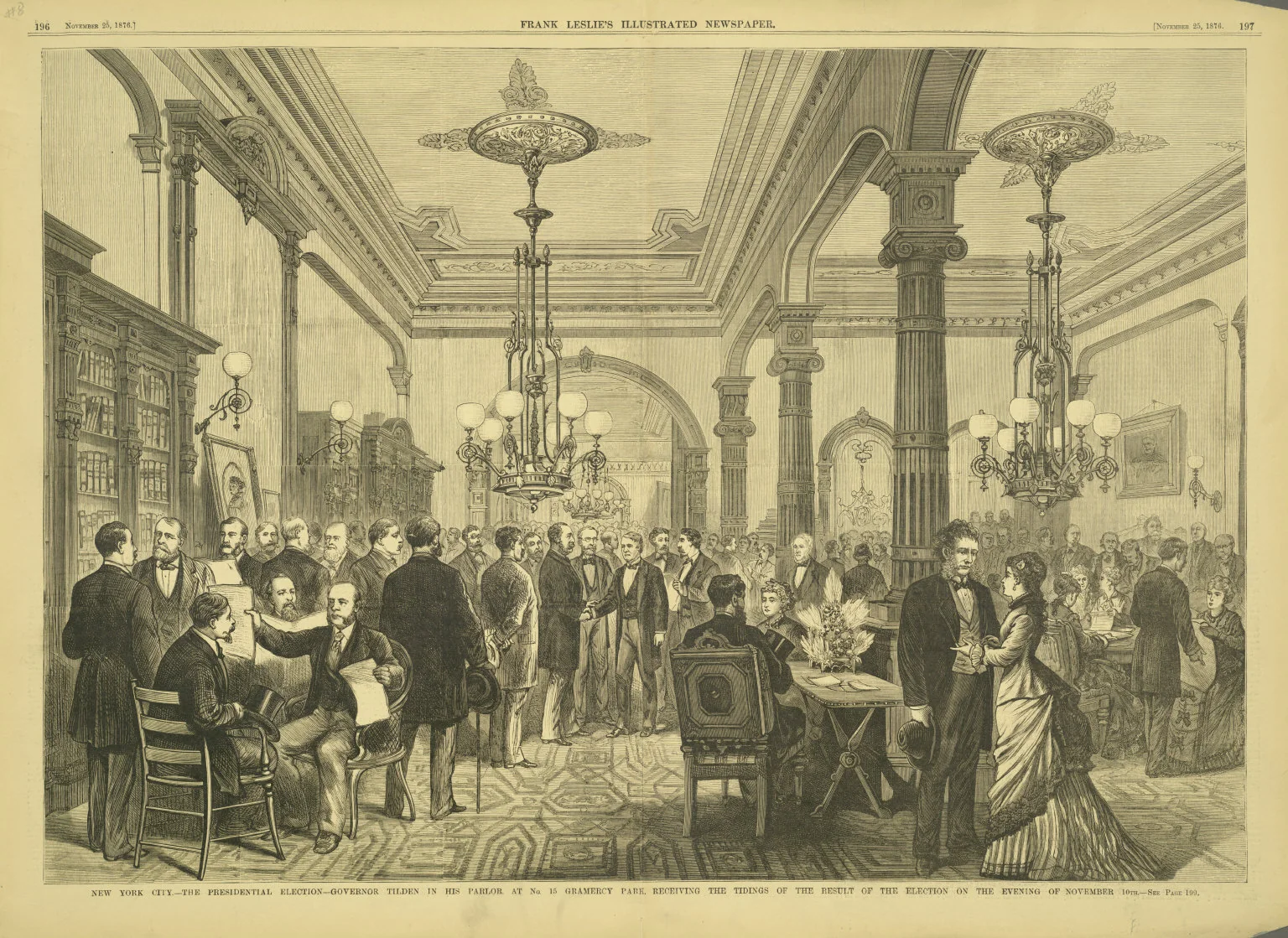
Election night on Gramercy Park
At midnight on election night in 1876, Francis Lynde Stetson went from Democratic headquarters to Samuel J. Tilden’s house on Gramercy Park with the latest returns.
In a 1914 address, he recalled friends gathered “in gay spirits to congratulate him.” The numbers appeared to put New York’s governor safely on his way to the White House.
The congratulations proved premature. Four months later, Rutherford B. Hayes became president. Tilden, who had won the recorded popular vote, finished one electoral vote short.
He had made his reputation by reading things other people hoped no one would read: bank deposits, public accounts, the fine print of contracts. His patient investigations helped break Boss Tweed’s hold on New York and carried him from a prosperous law practice to the governorship.
Here on Gramercy Park, another part of that life remains close at hand. His house became the National Arts Club. His love of books helped give the city the New York Public Library.
The lawyer and the missing tally
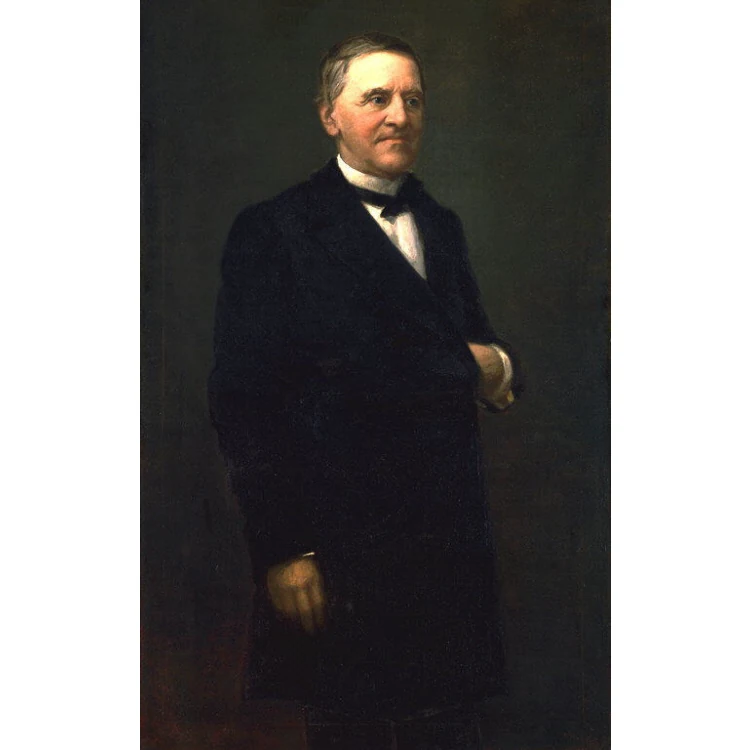
Samuel Jones Tilden was born in New Lebanon, New York, on February 9, 1814. His father’s friendship with Martin Van Buren, the future president, brought Democratic politics into his early life. Before Tilden had a profession, he was writing about government.
His studies were interrupted by poor health. He spent a short time at Yale, continued his education at the University of the City of New York (now New York University), and was admitted to the bar in 1841. The law suited a mind that liked to take complicated arrangements apart. Railroad reorganizations became a specialty: sorting out failed companies, competing creditors and securities whose value depended on whether a business could be made to work again. Legal fees and investments made him wealthy.
In 1856, Tilden defended Azariah C. Flagg’s election as New York City comptroller. Flagg’s opponents claimed that a district’s totals had been reversed: the votes credited to Flagg, they said, really belonged to his challenger. The original tally of the regular party tickets was missing.
As fellow lawyer James C. Carter later described the case, Tilden worked backward through the surviving returns. Candidates appeared in different combinations on different tickets. By comparing their totals, he could reconstruct the missing count and expose the inconsistencies in the opposing evidence. He gave the jurors sheets of figures so they could follow the calculation themselves.
“It is an honest ghost,” he said of the tally he proposed to bring back from the grave. “It will disturb no true man.” Flagg prevailed.
Following Tweed’s money
By the time the Tweed scandal broke open in 1871, Tilden was chairman of New York’s Democratic State Committee. He was a cautious party insider who had held a senior position in Tammany Hall, with years of experience in its organizations and rivalries. He had publicly opposed William M. “Boss” Tweed’s concentration of power in 1870, but avoided an outright political rupture. The disclosures of 1871 made the Ring vulnerable, and that September he moved decisively against men whose power helped sustain his own party.
Tweed and his associates had made municipal government enormously profitable for themselves. Contractors submitted inflated bills; the city paid; the proceeds were divided among the participants. The New York Times published devastating accounts, and Thomas Nast’s cartoons supplied faces and symbols for the public anger. Tilden’s contribution was to establish where the money had actually gone.
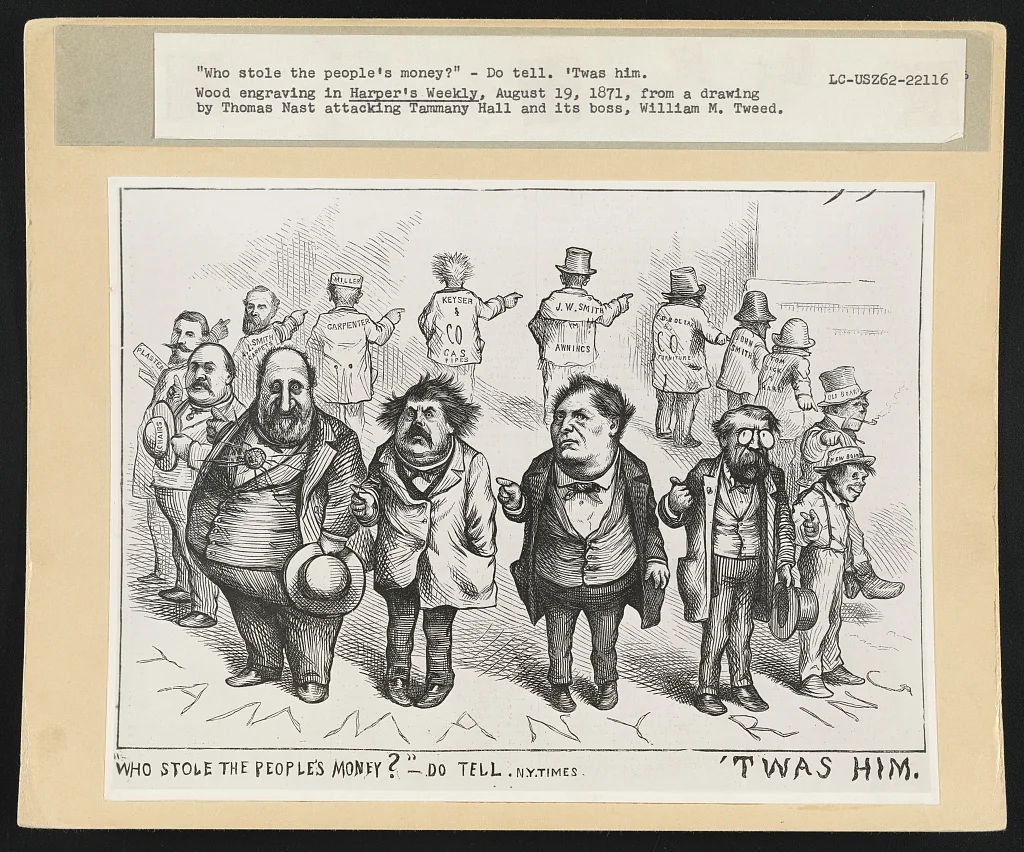
The problem was more difficult than showing that a bill was outrageous. A successful prosecution needed to connect particular payments to particular people. For the fraud known as the Six Million Audit, Tilden examined the accounts of the men involved, tracing deposits back to the individual items recorded on bank deposit slips.
Carter’s account of the investigation describes how Tilden found a recurring division of the proceeds. Knowing those proportions, he could calculate each conspirator’s share of a city payment. The bank records then supplied the check: deposits in the corresponding amounts, made on the very day the city paid.
Small discrepancies still troubled him, even though they scarcely weakened the case. Eventually, Carter recalled, the figures matched to the penny. The participants had left a record of their arrangement in the ordinary paperwork of their banking.
Tilden was one of several people who helped bring down the Ring. Reporters, political opponents, lawyers and investigators all mattered. Back in the State Assembly, he also pursued the removal of corrupt judges. Courts that protected the Ring could frustrate even the best-documented case.
He testified at Tweed’s trials. The first ended in a hung jury in January 1873. At the second, that November, Tweed was convicted.
A governor with the accounts open
Tilden won the governorship in 1874 and took office on New Year’s Day, 1875. He soon turned to another expensive arrangement: the network of contractors and political allies profiting from New York’s canals.
The canals carried goods across the state. Their repair contracts also provided cover for theft. Tilden’s investigating commission found that the state was paying for earth that had never been dug out, then paying again to fill the supposed holes. The Canal Ring crossed party lines; challenging it meant confronting established interests in Albany, including members of his own party.
He investigated expenditures, pressed for changes in administration and made the argument in public. On a speaking tour along the canal route, the lawyer known for careful calculation could become an angry prosecutor. At Syracuse he contrasted the treatment of ordinary prisoners with that of socially prominent men responsible for repeated thefts from the public. The inequality, he said, appalled him.
Economy in government was a consuming subject for Tilden. It also made a useful national platform in an era of political scandal and economic distress. In June 1876, the Democrats nominated him for president.
Carter, then working with him on a lawsuit in Albany, recalled nomination day. Telegrams arrived from the convention in St. Louis, but Tilden remained absorbed in the complicated facts of the case. Late that afternoon, he took Carter for a drive and talked energetically about expenditure, taxes and tariffs. The convention scarcely entered the conversation.
Carter admired the intensity, though he was less comfortable with its effect on the driving. As Tilden warmed to his subject, his attention to the horse wandered. Carter also acknowledged his friend’s vanity: Tilden had an unfortunate fondness for reminding people that he had predicted events correctly.
The long count of 1876
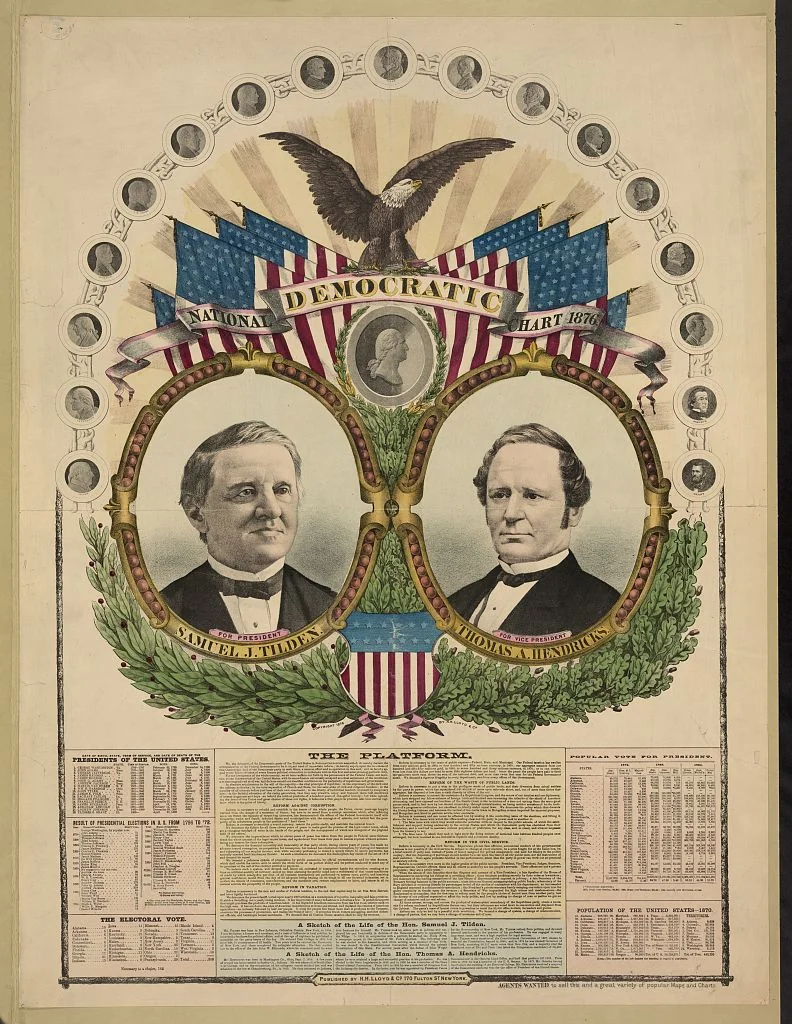
The cheerful gathering on Gramercy Park was followed by months of uncertainty. Tilden’s recorded popular-vote lead exceeded a quarter of a million. In the Electoral College, he had 184 undisputed votes; 185 were needed to win. Hayes had 165, with twenty votes contested in Florida, Louisiana, South Carolina and Oregon. Tilden needed one of those votes. Hayes needed all twenty.
Those figures cannot be separated from the conditions in which Americans voted. White supremacist violence and intimidation had kept Black citizens from the polls in parts of the South. Black voters overwhelmingly supported the Republicans. Both parties charged fraud, and competing authorities claimed the right to certify results. A national popular-vote total could not account for people prevented from casting a ballot.
Nor was Tilden’s opposition to corruption a promise to continue federal Reconstruction. He had opposed slavery’s extension and favored preserving the Union while opposing Lincoln’s wartime policies. He remained a Democrat committed to limiting federal intervention in the South. His party’s demand for “home rule” served Southern white Democrats seeking to recover control of state governments. The rights of Black citizens were at stake alongside the candidates’ fortunes.
Congress created a fifteen-member Electoral Commission to settle the disputed returns: five senators, five representatives and five Supreme Court justices. The plan depended on an independent justice, David Davis, holding the balance between the parties. But after his election to the Senate, Davis declined to serve. Republican justice Joseph Bradley took his place, giving the Republicans an eight-to-seven majority.
The commission awarded all twenty contested votes to Hayes, each decision dividing along party lines. When Congress completed the count on March 2, 1877, the result was Hayes 185, Tilden 184.
Tilden and his supporters regarded the result as a grave injustice. He did not, however, try to establish a rival presidency. In a later newspaper interview, he said that once the electoral process had been completed, taking an independent oath of office would have been ridiculous: he lacked the formal authority to do it. He continued to believe he had been elected.
Political negotiations accompanied the final count; historians differ over how neatly those understandings can be described as a single bargain. After taking office, Hayes withdrew the troops protecting the remaining Republican state governments in Louisiana and South Carolina. Southern promises to respect Black civil and voting rights were broken.
As historian Eric Foner explains in his account of Reconstruction, the collapse of federal protection helped clear the way for disenfranchisement, segregation and racial terror. Tilden lost the presidency; Black Southerners faced the loss of the political rights they had fought to secure.
A house arranged around books
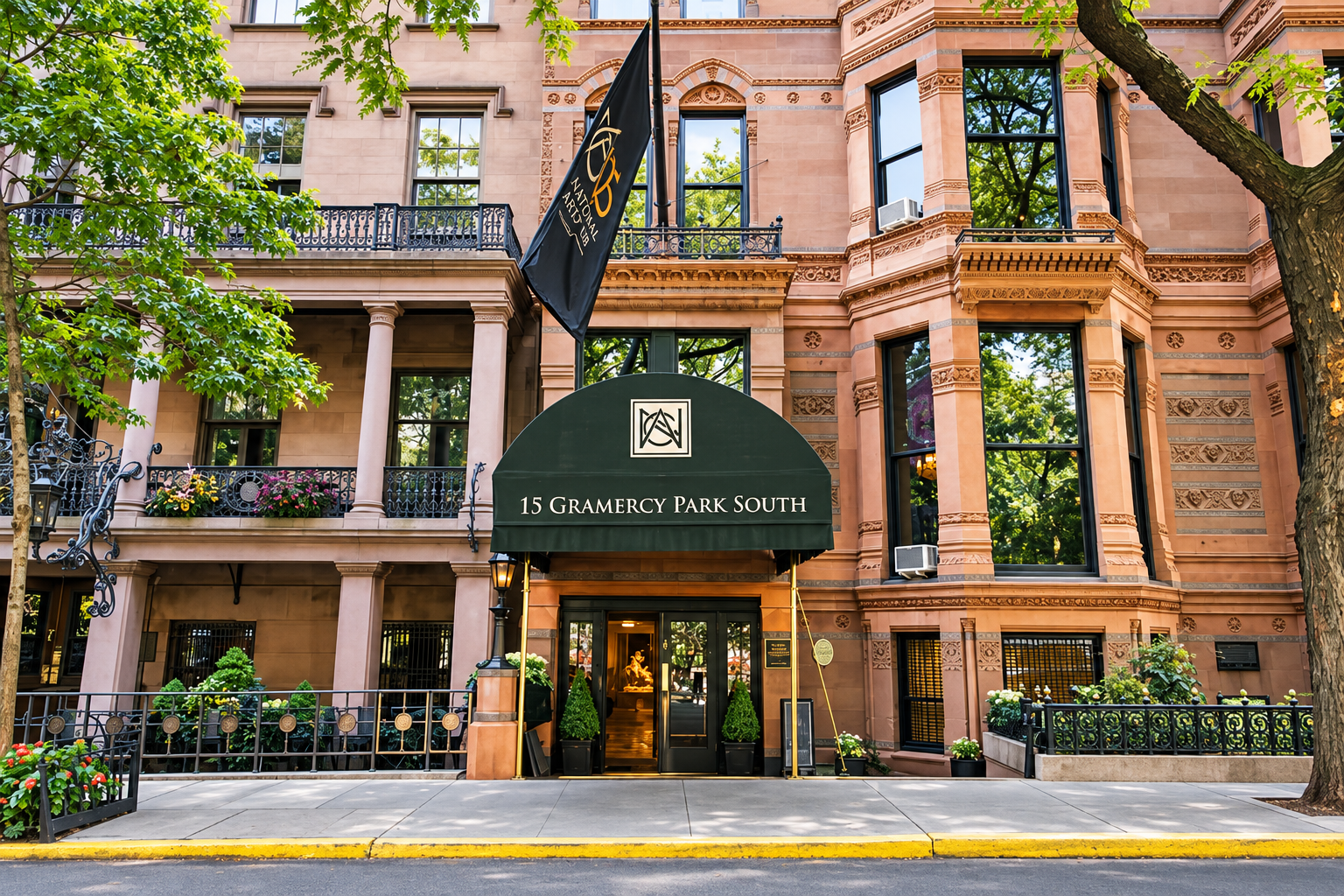
Tilden had bought No. 15 Gramercy Park South in 1863 and later acquired No. 14 next door. The elaborate façade familiar today belongs to his remodeling in the early 1880s, undertaken after the presidential contest.
Calvert Vaux, co-designer of Central Park, and his partner George Kent Radford combined the two houses in a richly ornamented Victorian Gothic style, setting carved stone medallions of Shakespeare, Milton, Dante, Goethe and Benjamin Franklin into the brownstone and sandstone exterior. Mindful of urban unrest and the threats of his political years, Tilden also had the parlor windows fitted with heavy rolling steel shutters.
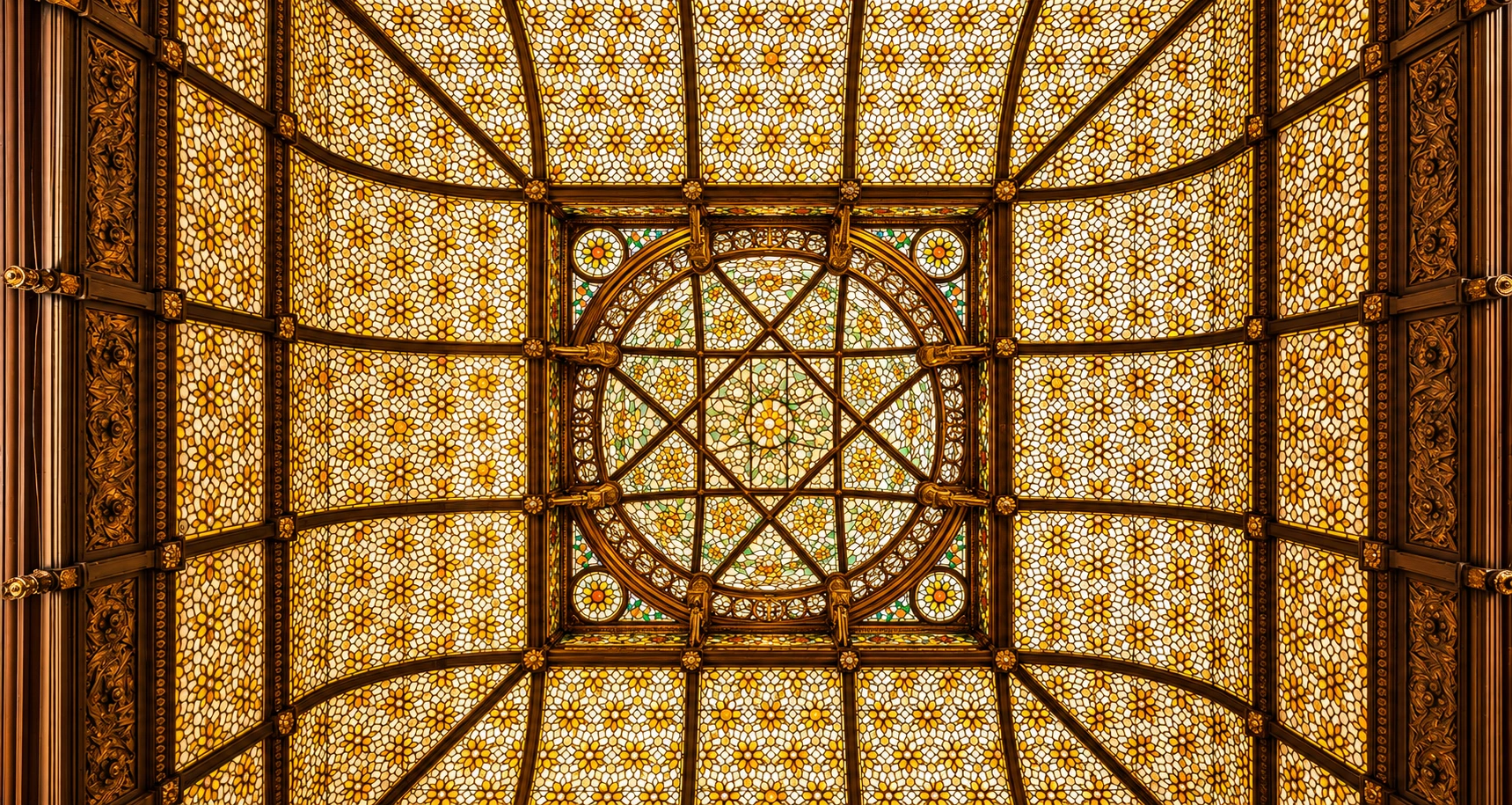
Inside, the house now occupied by the National Arts Club was fitted to a serious reader with ample means. John La Farge supplied stained-glass panels. The firm of Ellin and Kitson carved fireplace surrounds, doors and bookcases. Donald MacDonald made the stained-glass dome for the library, the room now used as the club’s bar.
The books—eventually numbering some twenty thousand volumes—were an occupation in themselves. Tilden collected works of history, law and literature. In 1885, a Senate reporter named Theodore Shuey wrote after hearing that Tilden had acquired a financial diary of Thomas Jefferson. Shuey owned another, from Jefferson’s years as a young lawyer, and wondered whether Tilden would like that one too.
It was an apt object to offer a man so interested in the relationship between public affairs and private accounts. But collecting also gave him pleasures independent of politics. His later letters return to reading as other activities became harder. In February 1886, he told a friend that his eyesight still allowed him to spend most of his time with books, even as difficulties with his hands and voice limited conversation.
He never married. His correspondence records a busy exchange of invitations, family greetings and news from old friends.
The last years at Greystone
Gramercy Park was not his only home. In 1879, Tilden rented Greystone, a country property in Yonkers overlooking the Hudson. He later bought it and added neighboring land.
Retirement was incomplete. Admirers continued to hope that he would run for president again. His name remained powerful in Democratic politics, but his health increasingly limited what he could undertake. He did not run again in 1880 or 1884.
Grover Cleveland’s election in 1884 brought a Democrat to the White House at last. Tilden remained interested in appointments, financial policy and the practical problems of governing. In January 1885, he invited the president-elect to rest at Greystone after leaving the governorship.
He died at Greystone on August 4, 1886, aged seventy-two. His will directed the bulk of his fortune—roughly five million dollars—to establish the Tilden Trust for a free library and reading room in New York City. The collector who had furnished his own houses with books wanted to provide a place where other people could read them.
Relatives challenged the bequest. In 1891, the New York Court of Appeals declared the charitable provision invalid. The will allowed the executors to choose among charitable purposes, leaving no definite beneficiary with the right to demand that they carry it out. The lawyer’s own instructions had almost defeated his purpose.
But his friend and executor John Bigelow and his fellow trustees had already secured an important agreement. That May, before the court’s final ruling, Tilden’s grandniece Laura Pelton Hazard surrendered her claim to half the residuary estate in return for a payment. That agreement and the final settlement in 1892 preserved more than two million dollars and Tilden’s personal library for the public.
A place for the reader
New York already had the Astor and Lenox libraries, with substantial collections but separate organizations. Bigelow helped bring them together with the Tilden Trust. On May 23, 1895, the three institutions consolidated as The New York Public Library, Astor, Lenox and Tilden Foundations.
Tilden’s money and books supplied part of what the new institution needed. Other donors, the city and generations of librarians would build on it. The New York Free Circulating Library joined in 1901, and Andrew Carnegie’s gift helped provide neighborhood branches. The main building on Fifth Avenue opened in 1911, a quarter of a century after Tilden’s death.
The Library’s 1916 handbook described a reading room with seats for 768 people. Readers could take books from the reference shelves themselves or request others from the stacks. The instructions were practical: fill out a slip, receive a number, collect the book. Afterward, leave it on the table so it could be returned to its proper place.
On Gramercy Park, Tilden’s former home had already begun its life as the National Arts Club, which acquired it in 1906. On Fifth Avenue, his name joined Astor’s and Lenox’s above the entrance to the new library.
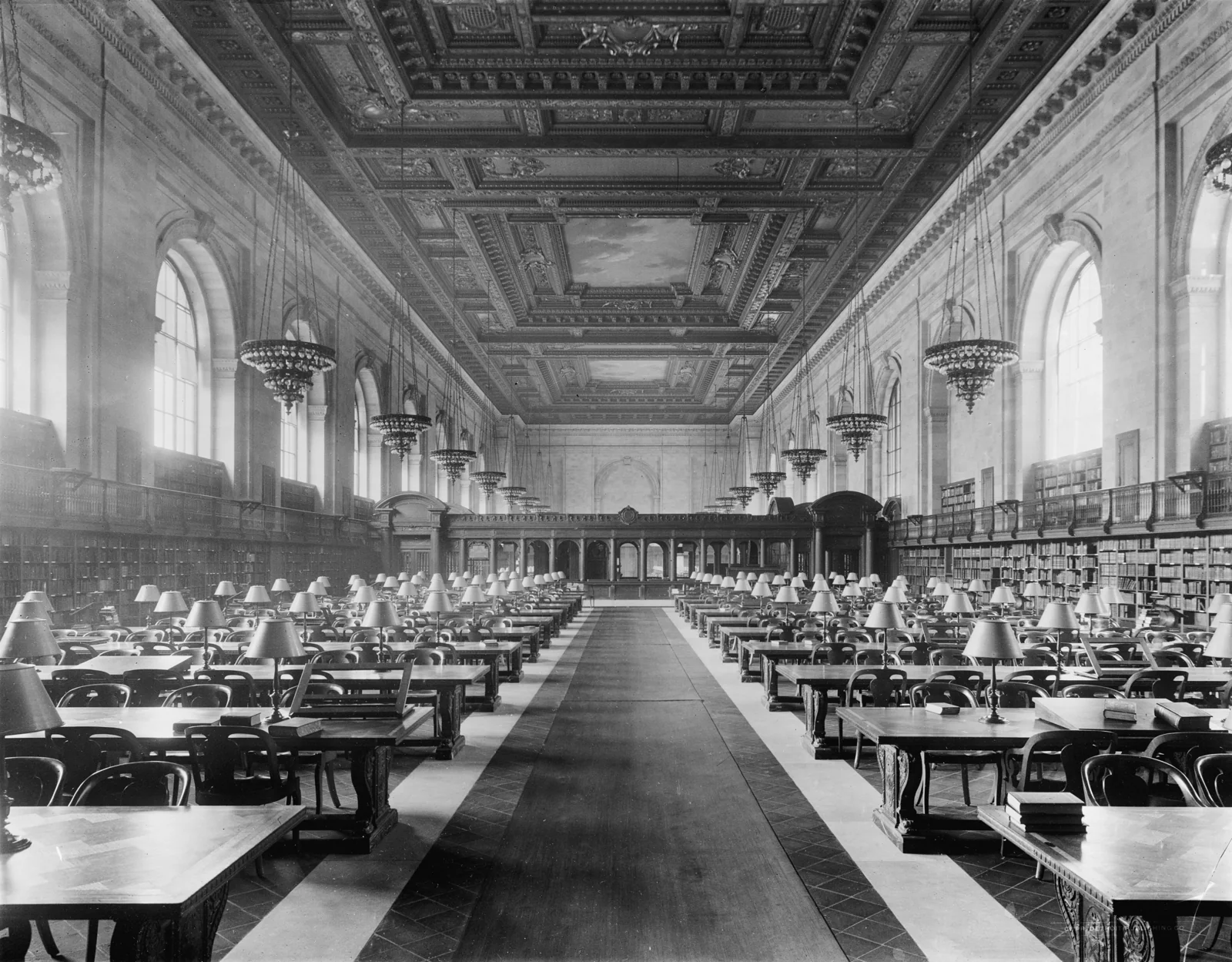
The words beneath Tilden’s name gave the purpose of the Tilden Trust: “To serve the interests of science and popular education.” Upstairs, the reading tables were ready.
Life at a glance
- Life
- February 9, 1814 – August 4, 1886
- Gramercy home
- 15 Gramercy Park South, acquired in 1863; later joined to No. 14
- Profession
- Lawyer, with a specialty in corporate and railroad reorganizations
- Governor of New York
- 1875–1876
- Presidential election
- Democratic nominee in 1876; won the recorded popular vote; lost the final electoral count, 185–184
- Enduring gift
- The Tilden Trust joined the Astor and Lenox libraries in 1895 to form the New York Public Library
Sources cited
- Historical Society of the New York Courts, “Samuel J. Tilden”: legal career, Tammany Hall, wartime politics, reform campaigns and the contested will.
- Francis Lynde Stetson, Samuel J. Tilden, the Great Democrat (1914), p. 12: his retrospective account of the election-night gathering at Tilden’s home.
- James C. Carter, “Mr. Tilden: An Appreciation” (1892), reprinted in John Bigelow, ed., Letters and Literary Memorials of Samuel J. Tilden, volume I (1908): the Flagg election case, Tweed investigation, governorship and nomination-day recollections.
- John Bigelow, ed., Letters and Literary Memorials of Samuel J. Tilden, volume II (1908): the canal investigating commission’s report (pp. 411–413), Tilden’s later interview on the presidency, Greystone, Theodore Shuey’s letter of February 1, 1885, and Tilden’s letter to Hiram Sibley of February 27, 1886.
- U.S. Senate, “The Florida Case”; and Sheila Blackford, University of Virginia Miller Center, “Disputed Election of 1876”: disputed returns, the Electoral Commission and the final count; “Rutherford B. Hayes: Campaigns and Elections,” University of Virginia Miller Center: the commission’s composition.
- Eric Foner, “Reconstruction”, National Park Service: Black political participation, white supremacist violence and the withdrawal of federal protection.
- The National Arts Club, “Mission + History”: Tilden’s Gramercy Park home, its artists and the Club’s acquisition in 1906.
- The New York Public Library, Handbook of The New York Public Library (1916): consolidation, the main building, inscriptions and arrangements for readers.
- The New York Public Library, Tilden Trust records: the library provision in Tilden’s will and the Trust’s role in the founding of the Library.
- Historic Districts Council, “Samuel Tilden House”: Vaux & Radford’s 1881–84 remodeling and Victorian Gothic design; photographic documentation of the façade: its five named portrait medallions. Kevin Walsh, “20th Street East to West,” Forgotten New York (2020): the rolling steel protection behind the windows.
- Helen E. Freedman, “Samuel Jones Tilden: Lawyer, Statesman, and Victim of Fate,” Judicial Notice 18 (2023): the scale of Tilden’s private library.
- Tilden v. Green, 130 N.Y. 29 (1891): the Court of Appeals ruling on the charitable provision; “The Charitable Corporation and the Charitable Trust”: the approximate five-million-dollar charitable bequest.
- The New York Public Library, Book of Charters, Wills, Deeds and Other Official Documents (1905), pp. 89–99: the May 1891 agreement with Laura P. Hazard and the March 1892 partition; Guide to the Tilden Trust Records: the litigation, settlements and retained collections.