
Gramercy Park Hotel
Writers, musicians, art, and life beside the Park
2 Lexington Avenue
Humphrey Bogart married here. David Bowie’s arrival helped turn it into the “Glamercy.” Debbie Harry posed in its abandoned cocktail bar, and S. J. Perelman made a home in Room 1621. Years before Julian Schnabel transformed the interiors, art dealers filled its bedrooms with contemporary work and launched the fair that became the Armory Show.
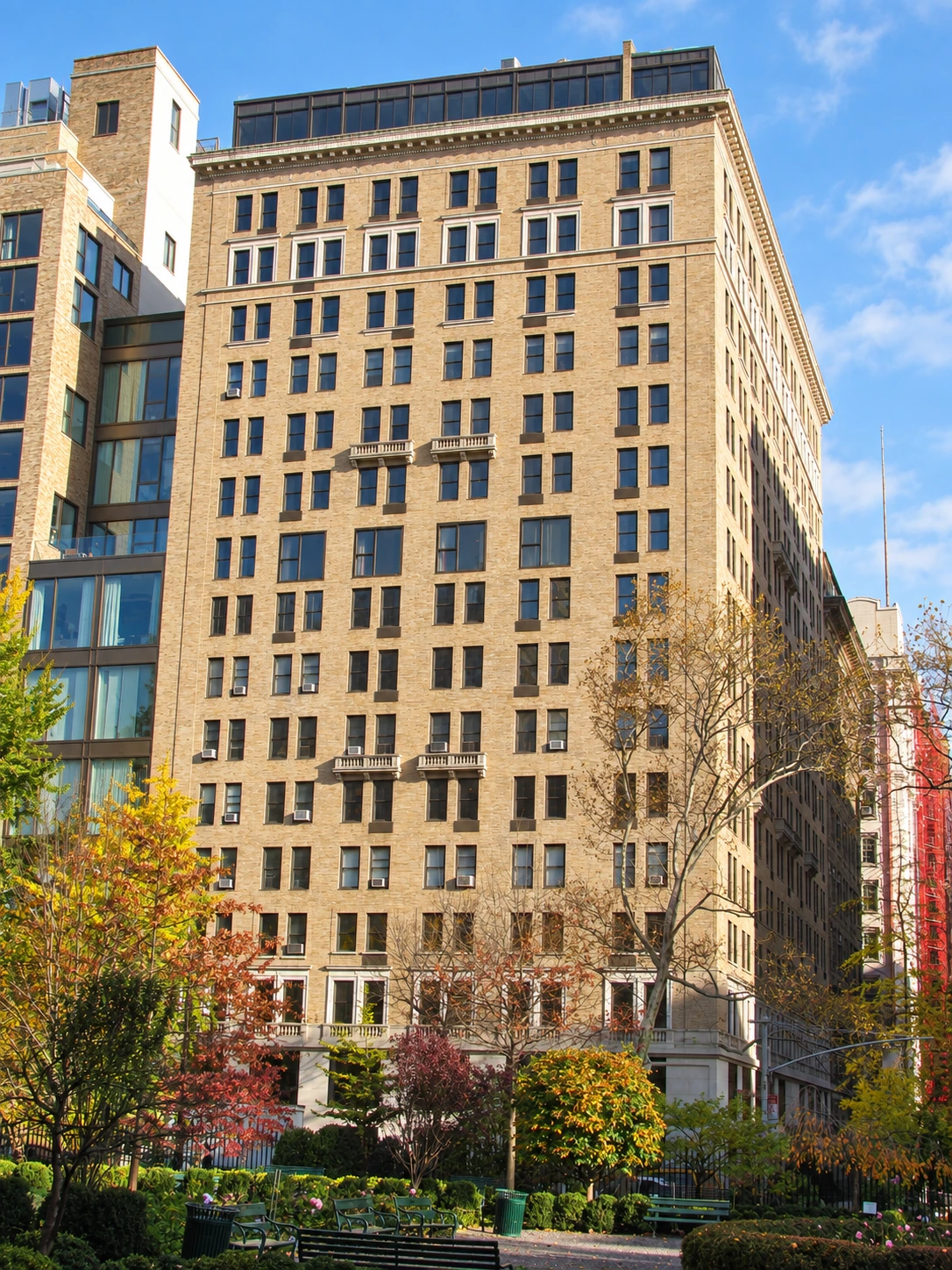
Opened in 1925, the Gramercy Park Hotel accommodated several New Yorks under one roof: families taking up residence, writers settling into a daily routine, touring bands arriving with their equipment, and artists turning an ordinary hotel room into something unexpected. Its appeal changed with the city, from an apartment hotel beside a private park to a rock-and-roll address and, later, an exuberant hotel filled with art.
The stories lead from Stanford White’s house, which stood on the site, to the Weissberg family’s long-running hotel, Blondie and the Clash, the first Gramercy International Art Fair, Schnabel’s Rose Bar, and Danny Meyer’s Maialino. Together they explain how this comparatively restrained brick building became such a distinctive New York institution.
The houses before the hotel
Before the hotel: Stanford White’s house
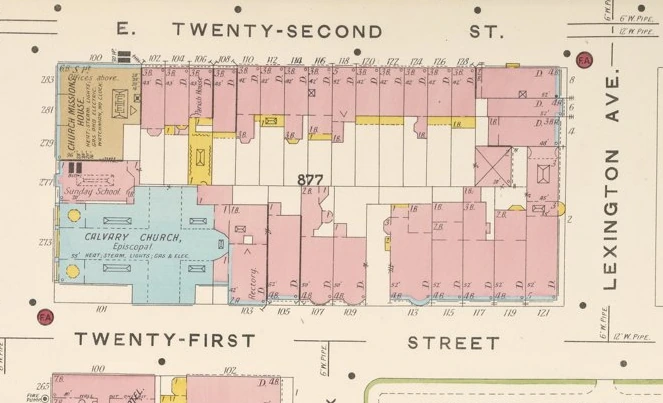
The hotel replaced part of an older residential streetscape on East 21st Street, along the north side of Gramercy Park. Historian Tom Miller’s reconstruction of the lost Stanford White house traces the site to a Greek Revival row built around 1850. White began living there in the 1890s and eventually took over the house at 121 East 21st Street.
Behind the conventional row-house exterior, White created elaborate private interiors. The house was more than a celebrated architect’s address: its rooms recorded his taste as a collector as well as a designer.
After White’s death in 1906, the contents were dispersed. The American Art Association’s 1907 illustrated auction catalogue, with room photographs by William H. Crocker, preserves a visual record of the furnishings and interiors that did not survive the later redevelopment. Those photographs offer an especially useful companion to images of the hotel’s subsequent interiors: two very different moments when personal taste transformed this address.
The house also had a life between White and the hotel. Miller’s chronology follows its use by the Princeton Club from 1907 to 1918, followed by War Camp Community Service and the YWCA. Alexander M. Bing acquired the property in the spring of 1924. By the time the hotel was proposed, the former private residence had already accommodated several different kinds of institutional life.
Another predecessor associated with the development site was the home of the orator and freethinker Robert G. Ingersoll. The December 5, 1924 announcement in The New York Times described its impending demolition for an apartment hotel. The wording captures the scale of the change: houses associated with particular individuals were giving way to a building designed to accommodate hundreds of separate lives.
An apartment hotel beside the Park
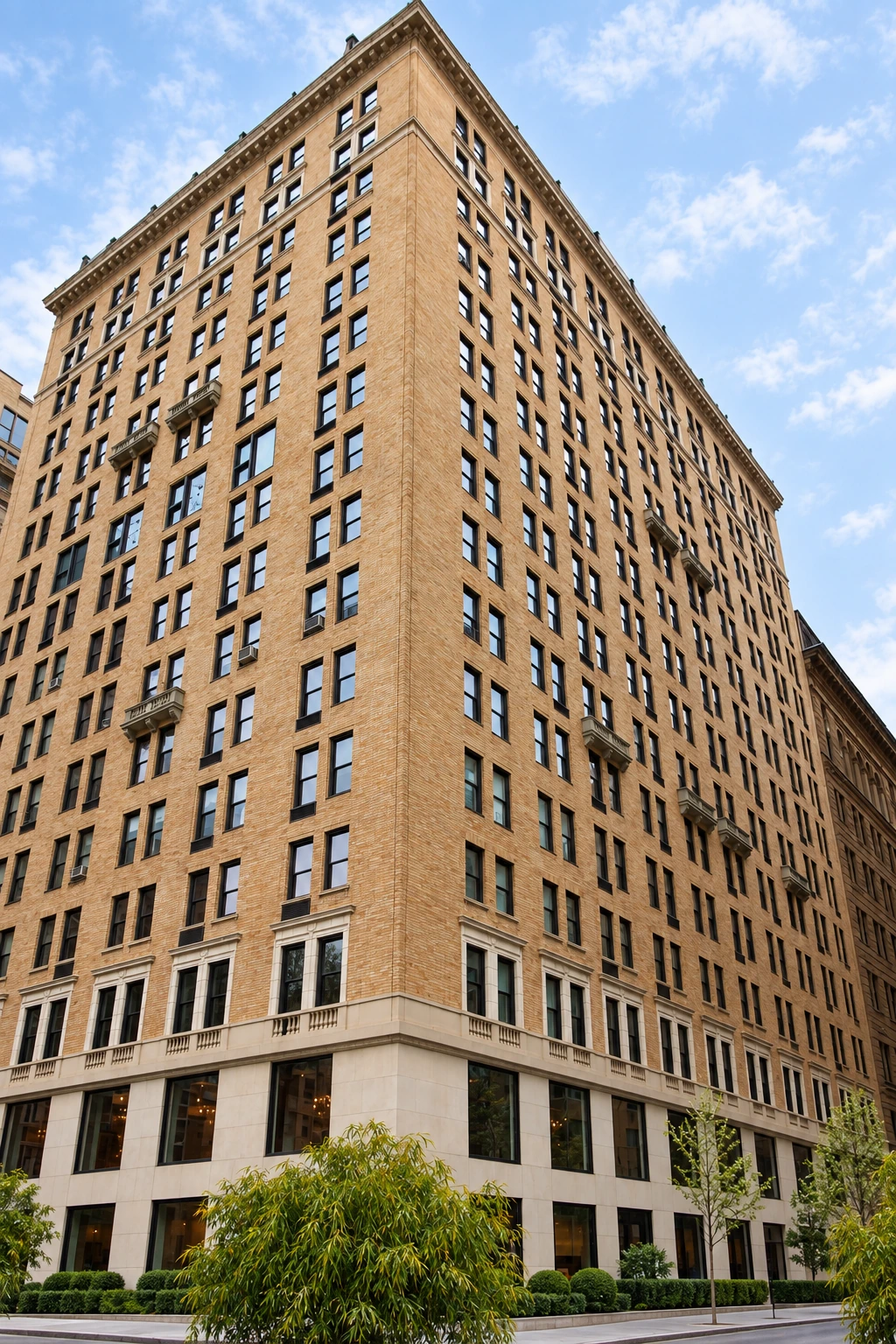
Bing & Bing’s hotel opened in 1925. Its architect, Robert T. Lyons, gave the property a Renaissance Revival character, with a brown-brick exterior above a limestone base. Carter Horsley’s architectural account records the original commission and the subsequent expansion. Whatever happened inside, the building presented a substantial, comparatively restrained face to the Park.
“Apartment hotel” is an important part of its original identity. The phrase suggests more than a place for an overnight visit: rooms could also be a way of living in the city, combining an individual’s private space with the services and shared rooms of a hotel. That residential function helps explain why the Gramercy’s later history includes people who stayed for years, not simply guests who passed through on tour.
The property grew westward in 1929–30 with an addition designed by Thompson & Churchill, not Lyons. This former annex is now associated with the separate residential address 50 Gramercy Park North. John Pawson’s project account identifies the 1930 building and explains how it was later remodeled.
The first years brought their own memorable arrivals. Humphrey Bogart married the actress Helen Menken at the hotel in 1926. A young John F. Kennedy stayed here, and Babe Ruth became a familiar figure at the bar. Max Weissberg’s history of the hotel places these figures in an establishment that, long before its rock-and-roll years, already drew people from the stage, sports, and public life.
Rooms, residents, and everyday life
Three-dollar rooms and Mother’s Day dinner
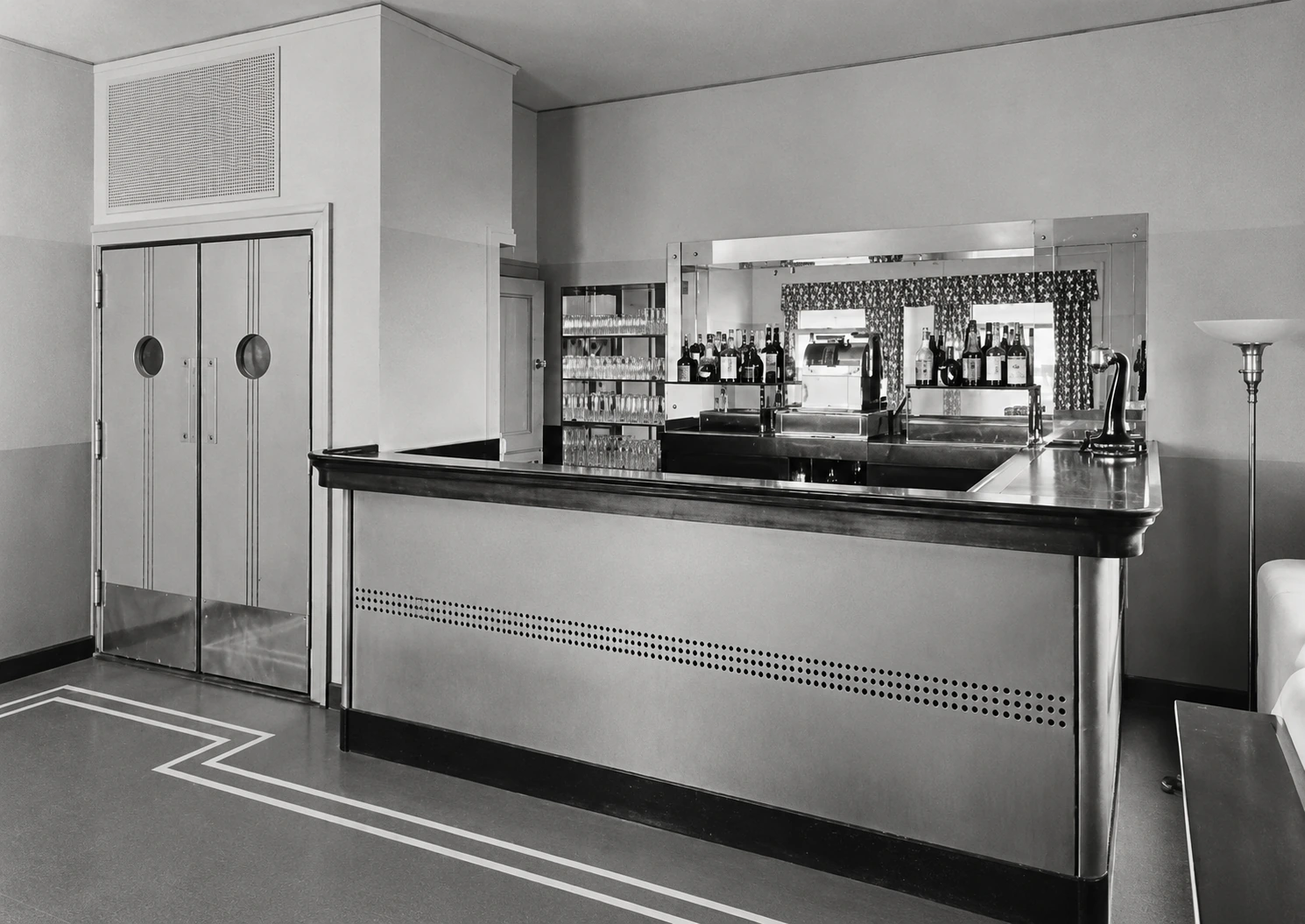
Surviving everyday records provide a useful counterweight to celebrity history. The Federal Writers’ Project’s 1939 New York City Guide lists the hotel with a three-dollar room rate. A June 1941 photograph in the Library of Congress records its eighteenth-floor bar.
The menus are equally evocative. A Mother’s Day menu dated May 8, 1955 offered dinner from noon, with choices including stuffed celery hearts, seafood cocktail, and Lobster Newburgh. Dessert could mean layer cake or stewed prunes. The menu belongs to a hotel that expected families to sit down to a proper holiday meal, not just musicians to arrive after a performance.
Its setting offered another attraction. Hotel guests historically had a route into Gramercy Park through the hotel’s keys, an unusual privilege for visitors staying beside a private residential park. Published accounts of that arrangement describe staff-assisted access. Historical arrangements should not be mistaken for a statement of the reopened hotel’s future guest-access policy, which remains a separate question.
The Weissberg hotel
The Weissberg family became closely identified with the property in the second half of the twentieth century. A contemporary Times notice records Herbert R. Weissberg’s contract to buy it in 1958. In 1964, the property was sold to Wellington Associates, associated with Sol Goldman and Alex DiLorenzo, while Weissberg retained a long-term operating lease.
Ownership of the real estate and operation of the hotel were therefore different things. That distinction would become decisive decades later, when disputes between a hotel operator and its ground landlord determined the property’s future.
Nor was the family’s operation uninterrupted: Sarah Bernard’s 2002 account reports that the Weissbergs left in 1967 and returned in 1976 after the intervening operator defaulted. A simple 1958–2003 ownership line conceals that break.
The family history is inseparable from the hotel’s cultural history, but it is not simply a triumphal account of famous customers. Max Weissberg, Herbert’s grandson, later made the property and his family the subject of The Gramercy Park Hotel: A New York Icon. The book’s published review describes both the glittering guest history and the losses behind the business. The hotel could be an institution to outsiders while remaining a family’s livelihood, responsibility, and source of strain.
A writer’s room
Perelman’s late-life residence offers one of the clearest accounts of what the Gramercy could provide beyond glamour. In her recollection for The New York Review of Books, Prudence Crowther describes a modest room with a view toward the Park and a useful location near libraries, delicatessens, and The Players. The attraction was practical as well as atmospheric: a private room and a familiar city within walking distance.
Even the price of a Danish at the nearby Gramercy Pastry Shop became one of Perelman’s personal measures of the cost of living. The hotel was part of a settled neighborhood routine, not an escape from it.
Perelman is not the only writer associated with the property. Architectural histories also list Edmund Wilson and Mary McCarthy among its residents. But his room is particularly well documented because Crowther gives us something more valuable than a name on a guest list: an account of how the place fitted into one person’s day.
The musicians’ hotel, on screen and off
The musicians’ hotel
By the 1970s and early 1980s, the Gramercy had acquired the musical associations that would become central to its reputation. David Bowie, Bob Dylan, Lou Reed, Blondie, the Clash, U2, and Madonna appear in the hotel’s published histories. Photographs and recollections put those names back into the hotel’s rooms, showing where people met, stayed, and worked.
David Bowie’s two-week stay in 1973 helped give the hotel its “Glamercy” nickname. The building became a base for touring musicians: an established hotel with comparatively affordable rooms, an accommodating atmosphere, and other performers down the hall.
Blondie provides unusually tangible evidence. Photographer Martyn Goddard’s 1978 picture of Debbie Harry in the abandoned cocktail bar shows how an aging hotel room could become the setting for a new cultural image. In the account accompanying his rooftop portrait from May of that year, Goddard recalls cold, wind, and rain. The weather was not glamorous; the photograph was.
The hotel was also where producer Mike Chapman first met Blondie before making Parallel Lines. In his recollection of their meeting, the band and producer came together at the Gramercy; their work continued at the Record Plant. A hotel meeting had helped set a major pop record in motion.
The Clash’s New York story is similarly specific. In a recollection of the band’s 1981 visit, Joe Ely places most of the group at the Gramercy during the period of their Bond’s concerts, while Joe Strummer stayed at the Chelsea. The city’s musical geography was a collection of hotels, clubs, and friendships, not a single address that contained every encounter.
Weissberg’s family history records Dylan’s Rolling Thunder rehearsals and Scorsese’s editing of Raging Bull at the hotel.
The old hotel on screen—and in memory
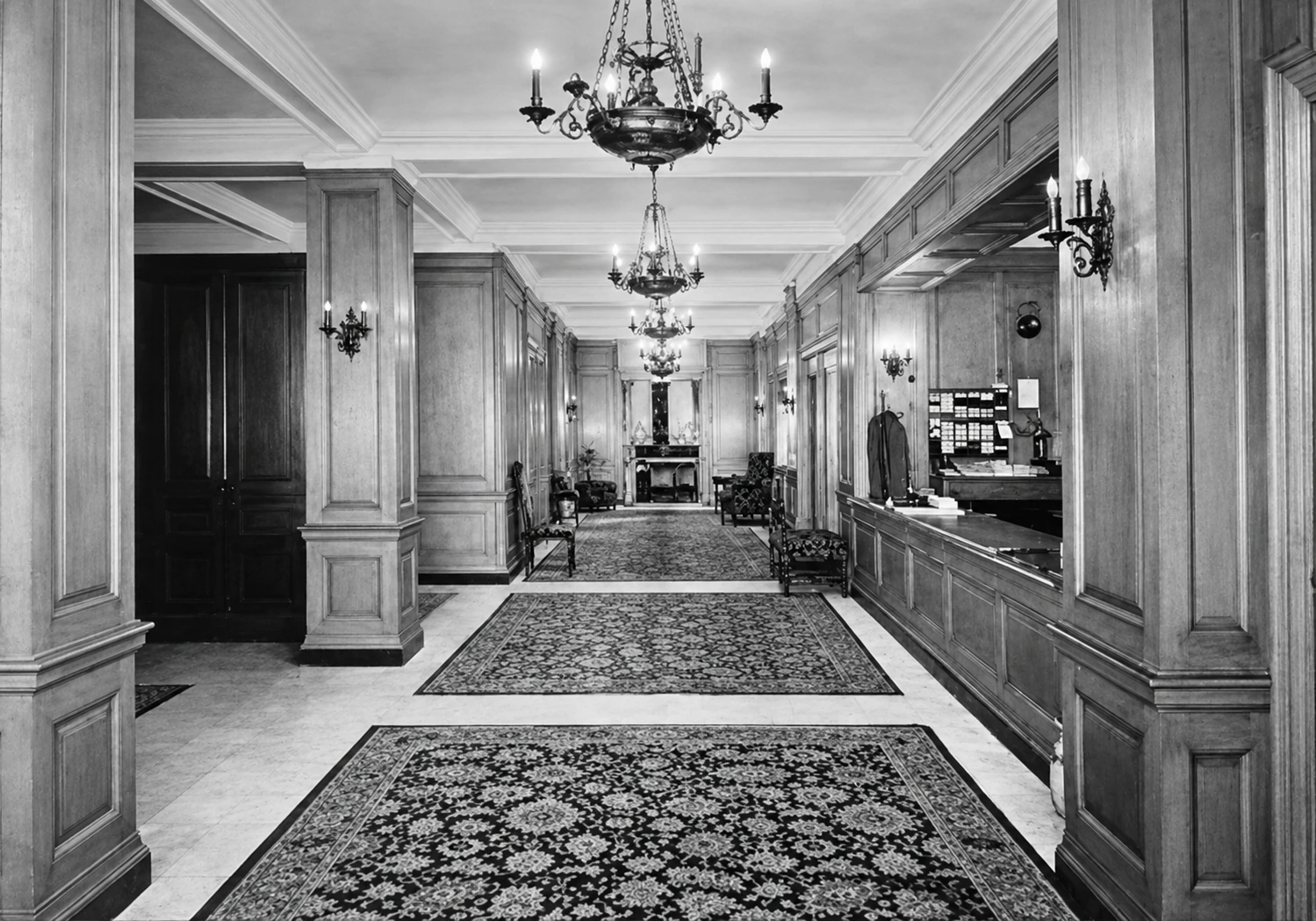
In Cameron Crowe’s Almost Famous (2000), the fictional band Stillwater checks into the Gramercy. The film’s New York locations include the hotel at 2 Lexington Avenue. Its appearance preserves a glimpse of the establishment before the extensive renovation of the following decade, when the old lobby could still stand convincingly for an earlier rock-and-roll world.
For some returning guests, affection for the hotel was more personal than its mythology. Musician Stephen Duffy’s “Blues Fell This Morning”, published in 2011, recalls his September 2001 stay. He describes learning of the attacks on television and the altered city outside. The familiar hotel became his base in a city suddenly transformed.
The transition to the next hotel became the subject of a film in its own right. Douglas Keeve’s Hotel Gramercy Park (2008) followed the Weissberg family, the redevelopment, and residents who remained as the property changed around them. Contemporary coverage of the documentary emphasizes the tension between the new hotel being created and the old one that people still inhabited.
For the people who remained, the hotel was still home, even as it was being remade for a different clientele. The transformation of the Gramercy involved not only the replacement of furniture but a change in the kind of life the building was intended to support.
An art fair in the bedrooms, then an art-filled hotel
1994: the hotel becomes an art fair
The Gramercy’s place in contemporary art began before the Schnabel renovation. In 1994, dealers Pat Hearn, Colin de Land, Matthew Marks, and Paul Morris launched the Gramercy International Art Fair inside the hotel. Bedrooms became exhibition spaces, and visitors went from room to room to see the work.
The setting shaped the event. Dealers worked around the beds and furniture; some slept in the rooms where they exhibited. In a twenty-fifth-anniversary retrospective, participants recalled Tracey Emin reclining on a narrative quilt, Nayland Blake inviting visitors into bed while wearing a bunny suit, and a Tony Oursler head speaking from a cupboard. The hotel’s elevators struggled with the crowds.
It was an inexpensive, improvised alternative to the established fairs: galleries paid for a room and a small administration fee. The fair outgrew the hotel and moved to the 69th Regiment Armory in 1999, taking the name the Armory Show. An international art-world institution had begun in the Gramercy’s bedrooms.
2003–2006: a different kind of hotel
The arrival of Ian Schrager and Aby Rosen in 2003 began a fundamental redevelopment, rather than a modest refurbishment. The hotel that reopened in August 2006 retained its familiar name while acquiring a new design identity, a different accommodation program, and a close relationship with the newly created residences next door.
Schrager enlisted the painter and filmmaker Julian Schnabel for the hotel’s interiors. HS2 Architecture documents its work on the gut renovation in a project account encompassing the public spaces and custom furnishings. Rugs, furniture, beds, sofas, and window treatments formed part of an unusually comprehensive interior conception. The rooms were not intended to look neutral.
Designer Tim Girvin’s firsthand account of a 2006 stay records the effect: darkness, substantial furniture, rougher materials, a monumental chandelier, and the smell of firewood. His descriptions of cypress overhead and large pine columns convey the weight and texture of the new interior. This was not an attempt to make the old building disappear behind smooth, anonymous surfaces.
The engineering was just as substantial as the decorative change. GACE’s project record describes the renovation of approximately 190,000 square feet and a residential addition of roughly 59,000 square feet. Work included new room layouts, restaurants, a roof garden, and the removal of columns to reshape the lobby.
Even the entrance joined old and new. Architectural Metal Fabricators describes using original 1924 panels as a guide for a modern bronze canopy and custom lighting. The familiar act of walking under the hotel’s name was being given a carefully remade architectural setting.
The result invited strong reactions. James Gardner’s opening-week headline in The New York Sun was “The Boutique Hotel Gone Wrong”; Francis Morrone’s later assessment appeared under “Julian Schnabel’s Bold and Beautiful Designs”. Even the titles suggest how far the hotel stood from a consensus idea of discreet luxury.
Next door: John Pawson and 50 Gramercy Park North
The quieter architecture of the residential conversion belonged to a different commission. John Pawson’s account of 50 Gramercy Park North distinguishes the remodeling of Thompson & Churchill’s 1930 annex from the new glass-and-bronze infill connecting the older structures. On the existing façade, brick verticals and redesigned windows introduced a disciplined rhythm; the new work emphasized light and generous proportions.
This distinction is useful when looking at the complex from the Park. Schnabel’s hotel and Pawson’s residences were related parts of the same redevelopment, but not one undifferentiated design. One sought richness and visual density; the other relied on reduction and clarity. The addresses shared a history while moving toward different forms of occupancy.
There is an intriguing echo of Stanford White here, though not a documented line of influence: the site again became associated with a strong individual vision of interiors. What differed was the purpose. White arranged a private home. The twenty-first-century project used design to define a hotel’s public identity and the appeal of residences beside it.
Art, the Rose Bar, and a new musical life
Art was part of the hotel’s identity rather than incidental decoration. Schrager’s own account of the project names works by artists including Andy Warhol, Jean-Michel Basquiat, Cy Twombly, Damien Hirst, and Schnabel. Paintings could be encountered while sitting in a bar rather than visiting a gallery. The juxtaposition of art, furniture, drinks, and people was integral to the experience being sold.
The Rose Bar and Jade Bar became the principal names attached to this version of the hotel’s nightlife. Music returned in a more deliberately programmed form through the Rose Bar Sessions, associated with Schrager and Nur Khan. A March 2010 account of Rufus Wainwright’s appearance describes an intimate performance of material from his forthcoming album, with Lou Reed among the audience.
There was continuity in the presence of musicians, but also a change in the hotel’s relationship to them. Earlier stories often concern performers lodging in the building or meeting there in the course of their work. Here, the performance itself had become an event within the hotel’s carefully arranged social world. The old reputation was not simply preserved; it was being interpreted for a different audience.
Around the table at the Gramercy
From Wakiya to Maialino
The restaurants make the contrast between the hotel’s different ambitions especially clear. In 2007, Yuji Wakiya brought an elaborate interpretation of Chinese cooking to the hotel. Danyelle Freeman’s contemporary review describes a dark, highly dressed interior, red carpeting, silk-covered windows, and attentive service. She admired some dishes but found the experience uneven. Wakiya was a restaurant conceived as a destination within the new hotel’s fashionable world.
Maialino, Danny Meyer’s Roman-inspired trattoria, brought a different character to the same space in November 2009. Gothamist’s report on the eve of opening describes a 70-seat dining room, a 55-seat front bar, and chef Nick Anderer’s menu of pasta, oxtail, lamb’s neck, and roast suckling pig. Pastries, sandwiches, and smaller plates gave the front room a different use from the dining room behind it.
Recalling the project in a 2026 interview with Surface, Meyer described initially declining Schrager’s invitations because their approaches to hospitality differed. The eventual restaurant brought a more openly welcoming, neighborhood-oriented idea into a hotel associated with exclusivity.
The terrace and the Rosen years
Schrager announced the sale of his hotel interests in December 2010. The establishment continued under the RFR/Rosen chapter, retaining the design and art associations established by the renovation. A change in the business partnership did not mean that the hotel closed or its public identity was immediately replaced.
The roof acquired its own changing pattern of use. In 2012, Union Square Hospitality Group revamped the Gramercy Terrace. Gothamist’s visit that May found daytime breakfast, lunch, and weekend brunch open to the public, with evenings reserved for private hotel events. Greenery, views, and rotating art—including Warhol and Hirst—made a different setting from the darker rooms below.
The distinction between daytime dining, private events, and a late-night bar matters. “The rooftop” was not one fixed operation across the hotel’s history. A 1941 bar photograph, the post-renovation roof club, the 2012 terrace, and the proposals of the 2020s describe related spaces with different programs and different effects on their surroundings.
The building also continued to require ordinary architectural care. SUPERSTRUCTURES’ façade-restoration record lists work on brickwork, terra cotta, copings, lintels, railings, and window details. Behind the hotel’s highly visible interiors was an aging masonry building whose survival depended on repair as much as reinvention.
An ending, and another beginning
2020–2022: closure and dispersal
The hotel closed in March 2020. Two years later, its rooms opened for a very different purpose: a liquidation sale. Beds, desks, lamps, robes, and furnishings from the Schnabel-era hotel were sold. Former guests and employees returned to walk through the rooms and take pieces of the place away with them.
The paintings had a separate fate. Reporting on the sale confirmed that Rosen’s fine-art collection was excluded. The dispersal nevertheless marked the end of a hotel interior that had become a destination in its own right.
A new operator, and a new chapter
In 2023, MCR/MORSE Development announced a new renovation under a 99-year ground lease. As of September 30, 2026, the operator’s property page describes the planned hotel but gives no firm reopening date. That next chapter remains unwritten.
A New York institution
The Gramercy Park Hotel’s history lives in its rooms: a writer’s long-term home, a meeting between a band and a producer, an art exhibition arranged around a bed, a late-night performance, a table at Maialino. Successive generations found different uses for the same address.
Its 1925 apartment-hotel origins, the Weissberg years, the musicians who made it famous, the fair born upstairs, and Schnabel’s dramatic reinvention all belong to the institution’s story. The building’s next incarnation will inherit that unusually varied past.
Selected chronology
c. 1850–1924 — Earlier houses, including Stanford White’s residence, occupy the development site; organizational uses follow White’s death.
1924–1925 — Bing & Bing develops the original Robert T. Lyons hotel; it opens in 1925.
1929–1930 — Thompson & Churchill designs the westward expansion, later associated with 50 Gramercy Park North.
1958 / 1964 — Herbert Weissberg contracts to buy the hotel; the subsequent property sale to Wellington Associates separates the real-estate ownership from the family’s operating interest.
1970s–early 1980s — The hotel’s literary and musical associations become central to its reputation.
1994 — The Gramercy International Art Fair opens in the hotel’s rooms; it becomes the Armory Show in 1999.
2003–2006 — The Schrager–Rosen redevelopment leads to the August 2006 reopening, Schnabel’s hotel interiors, and Pawson’s residential conversion.
2009–2012 — Maialino opens; Schrager exits the partnership; Union Square Hospitality Group later revamps the rooftop terrace.
2020–2022 — Pandemic closure, the ground-lease dispute, court orders ending the old operating arrangement, and the furnishings liquidation.
Further reading and original records
The site before the hotel. Tom Miller’s history of the Stanford White house; the American Art Association’s 1907 auction catalogue; and the 1924 apartment-hotel announcement.
The hotel as a place to live. Prudence Crowther’s “Knowing S. J. Perelman”; Max Weissberg’s The Gramercy Park Hotel: A New York Icon (The History Press, 2026); and Douglas Keeve’s documentary Hotel Gramercy Park.
Music, photographs, and memory. Martyn Goddard’s cocktail-bar photograph and rooftop portrait of Debbie Harry; the Mike Chapman and Blondie interviews; and Stephen Duffy’s September 2001 recollection.
The architecture of reinvention. Project records from HS2 Architecture, John Pawson, GACE, and Architectural Metal Fabricators, together with Tim Girvin’s 2006 visit.
Restaurants and public rooms. Contemporary accounts of Wakiya, Maialino’s opening, and the 2012 terrace.
For additional photographs of the earlier hotel and its later interiors, see Max Weissberg’s historical image collection, HS2 Architecture’s project gallery and John Pawson’s 50 Gramercy Park North gallery.
The Armory Show’s history and The Art Newspaper’s interviews with participants document the fair’s beginnings in the hotel.
Illustration sources & credits
- Hotel across Gramercy Park, November 17, 2009. Photograph by Eden, Janine and Jim. CC BY 2.0. Digitally restored for clarity and color; foreground branches removed. Resized and converted to WebP.
- The block before the hotel. Sanborn Map Company, 1903; NYPL / GPBA map archive. Source record · Public domain.
- The hotel’s earlier lobby. Photograph from Max Weissberg, published by Untapped New York. Date not specified in the source. Restored from the published halftone reproduction, with print screening removed and tonal clarity improved. Original photograph.
- Hotel at Lexington Avenue and East 21st Street, April 4, 2008. Photograph by Tony, Wikipedia Takes Manhattan. CC BY-SA 3.0. Digitally restored for clarity and color; foreground branches, vehicles and traffic signals removed. Converted to WebP; this version is shared under the same license.
- Eighteenth-floor bar, June 26, 1941. Gottscho-Schleisner Collection, Library of Congress, Prints and Photographs Division. No known restrictions on publication. Source record. Digitally restored from the small archival scan; original linked above.