
Nathanael West
The Night Manager of Gramercy
1903–1940 · Kenmore Hall Hotel, 145 East 23rd Street · 1927–1930
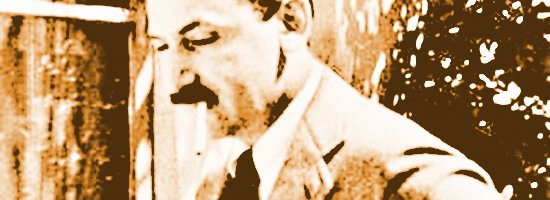
A life in Gramercy
A room, a book, and time to write
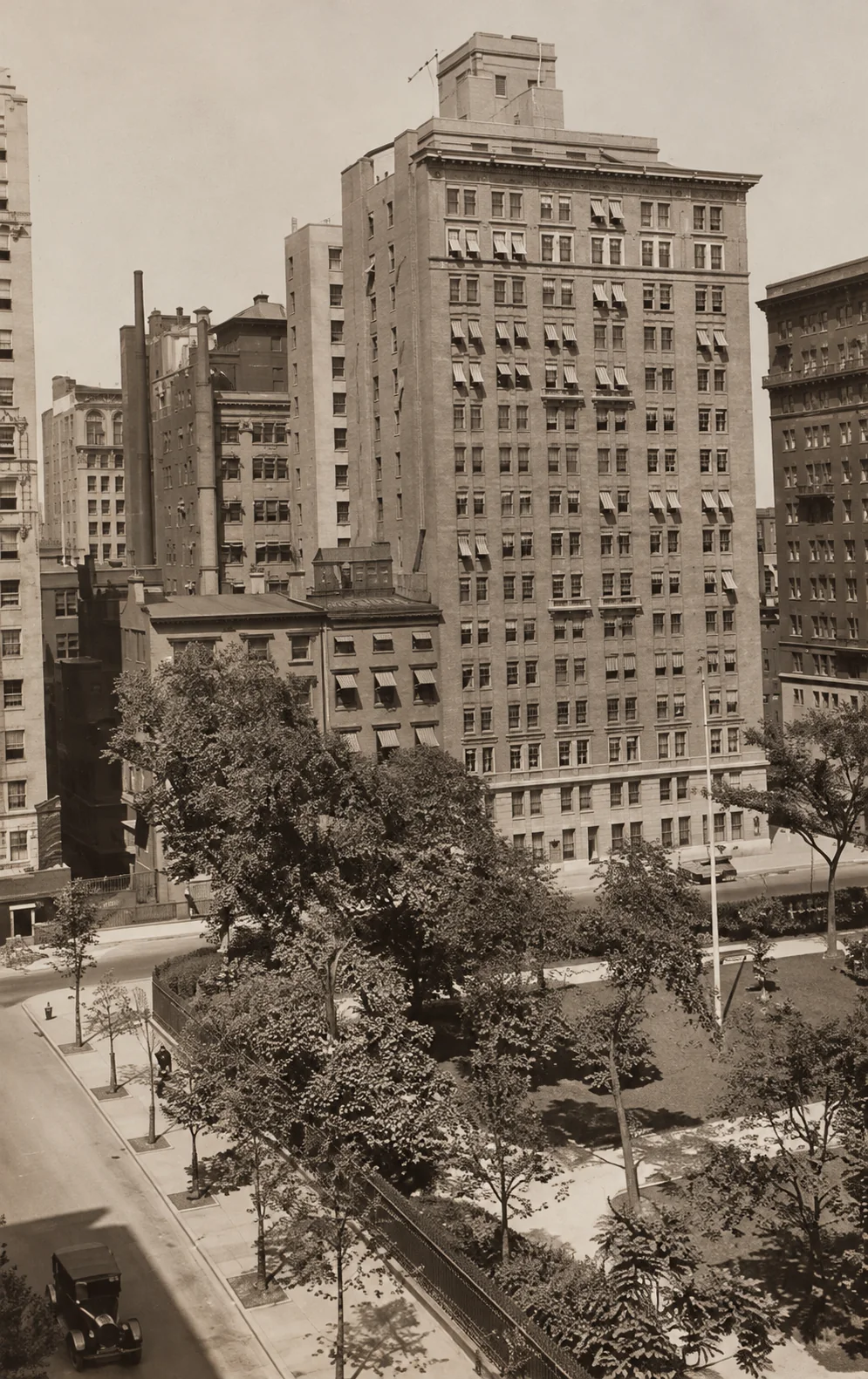
At the Kenmore Hall Hotel, 145 East 23rd Street, the night manager had a library of five hundred volumes and a novel of his own under way. Nathanael West used the quiet stretches of his shift to read and write, fitting literature around the business of looking after a hotel. The job paid thirty-five dollars a week, with room and board. For a young writer whose family’s construction business was failing, those were useful terms: an income, a place to live, and hours in which a manuscript might grow.
His friends found other advantages in the arrangement. S. J. Perelman, Quentin Reynolds, and Maxwell Bodenheim made the Kenmore an informal clubhouse. When Dashiell Hammett needed somewhere to stay after an eviction, West installed him in the best suite under the magnificently unhelpful alias “T. Victrola Blueberry.” There was bootleg gin, too. Behind that comic disguise was a practical kindness: Hammett had work to finish, and West could put a roof over it.
West’s own most enduring discovery began with an outing from the hotel office. A newspaper advice columnist showed him the desperate letters her readers sent, and the encounter became the starting point for Miss Lonelyhearts. The route from this Gramercy night desk would eventually lead to Hollywood and The Day of the Locust. Along the way, the man who wrote such unsettling fiction kept finding rooms for other writers. His hotel years belong to the history of their books as well as his own.
A Reader Behind a Guarded Door
Books in the family apartment
He began as Nathan Weinstein, born in New York on October 17, 1903, to Max Weinstein and Anna Wallerstein Weinstein. His Lithuanian-Jewish father built apartment houses, providing the family with a comfortable place in the city. The boy’s most memorable domestic arrangement, however, concerned the doorway to his own bedroom. He trained his bull terrier to guard it while he read Dickens, Tolstoy, and Chekhov. A room protected from interruption mattered to him long before he had a hotel at his disposal.
The books suggest an education pursued on his own terms. School offered a less satisfactory fit. He left DeWitt Clinton High School without graduating; at summer camp he acquired the nickname “Pep,” which followed him into the recollections of friends. The reading boy and the troublesome student were the same person. Literary appetite did not translate into a conventional academic record, and his eventual arrival at Brown University depended on a piece of paperwork that belonged to someone else.
A borrowed transcript, lasting friends
After attending Tufts, he transferred to Brown using another Nathan Weinstein’s transcript. It was an audacious way of exploiting a shared name. At Brown he formed two of the friendships that would later give the Kenmore Hall its particular character: with S. J. “Sid” Perelman and with Quentin Reynolds. The Perelman papers at the New York Public Library preserve a copy of the 1924 Brown yearbook, with the young writer appearing under the elaborate name Nathaniel von Wallenstein Weinstein.
Perelman supplied a Goethe bookplate for his friend’s library, an apt gift for someone so intent on books. He would also marry West’s sister Laura, making the friendship a family connection. Reynolds’s bond with West had its own comic adventures. West helped save him from expulsion for bootlegging and wrote his Class Day speech, introducing the figure of St. Puce into a university occasion. The future novelist could already turn an institution’s ceremonies and rules into material for a joke.
These college friendships help explain the later hotel story. Perelman and Reynolds did not first appear at the Kenmore as literary names on a guest list; they had known its night manager before he called himself Nathanael West. Their history included books, evasions, favors, and shared amusement. When the friends gathered again on East 23rd Street, West was able to offer something less ephemeral than a clever speech: rooms in which people could stay and work.
A New Name, a Night Job
Nathanael West goes to Paris
In October 1926, Nathan Weinstein legally became Nathanael West. The change preceded his departure for Paris, where he grew a beard and lived in Montparnasse. After the borrowed transcript and the expansive name printed in his yearbook, this was an identity that would last. He took it with him into a literary life whose practical shape was still unsettled. There was no successful book behind the new name, and no certainty that writing would provide an income.
In Paris he worked on “The Impostor.” The title sits neatly beside the stories of his earlier reinventions, though it would be too simple to treat every fictional impostor as a confession. West was making literature, experimenting with what a story could do. The freedom to pursue it abroad depended on money from home. Montparnasse might offer the setting for a young American writer’s apprenticeship, but it could not insulate him from the state of his father’s business.
Thirty-five dollars and a room
The summons came in January 1927. Max Weinstein’s construction business was foundering, and West returned to New York. The reversal brought the material conditions of authorship into sharp focus. Someone who had been able to go to Paris now needed a job. Apartment building had supported the family; a different kind of building, with rooms let to temporary residents, would support the son. At the Kenmore Hall Hotel on East 23rd Street, he became the night manager.
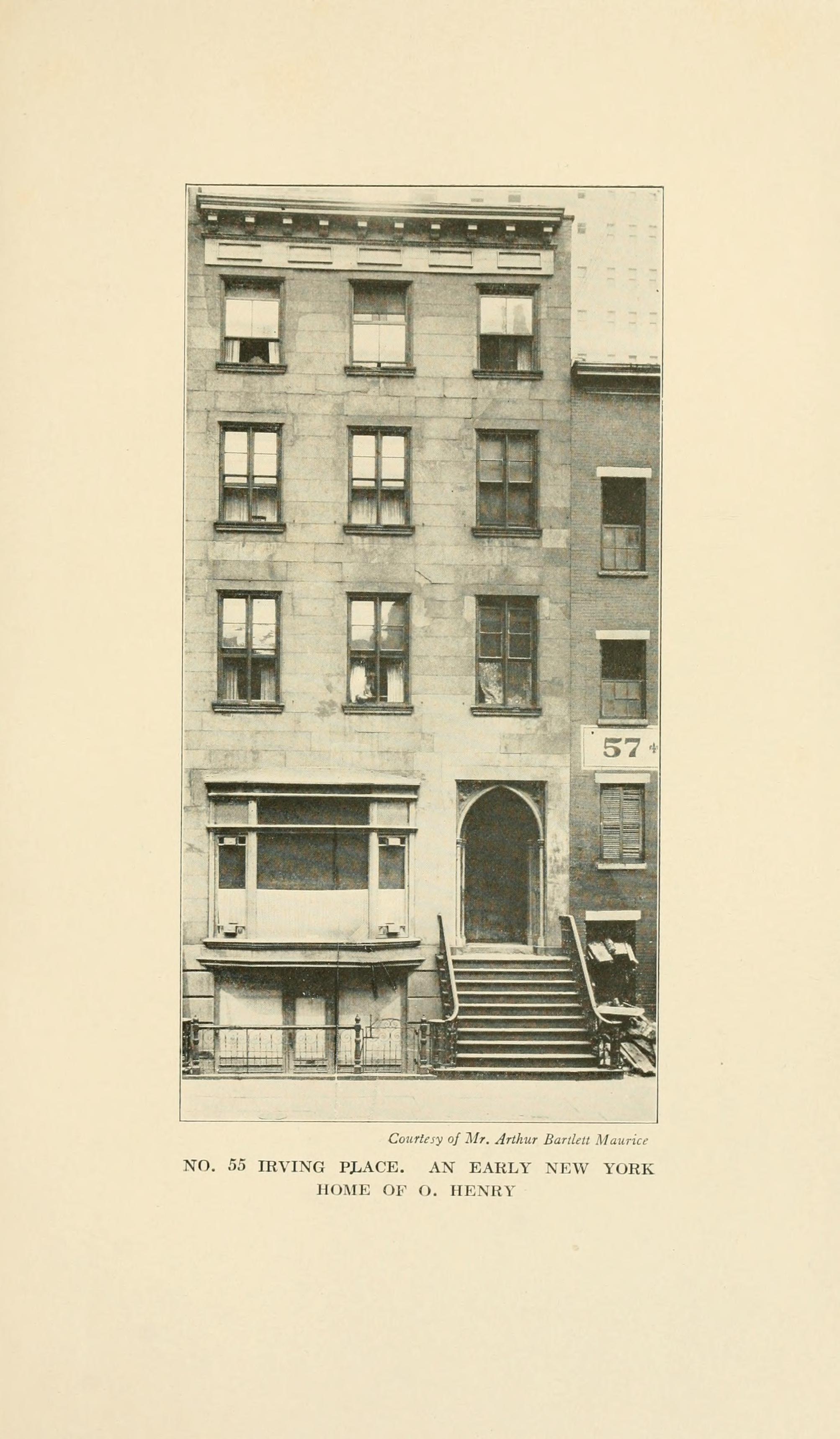
The salary was thirty-five dollars a week, with room and board included. Those details matter because they explain how the arrangement worked for an unpublished novelist. West did not have to earn his rent from fiction before he could write it. The hotel supplied lodging and meals, while the quiet periods overnight left room for reading and composition. At 145 East 23rd Street, close to the older literary addresses around Gramercy and Irving Place, he found a daily routine into which a writing life could fit.
The Guest Called T. Victrola Blueberry
Five hundred volumes after hours
West brought a serious reader’s resources to the Kenmore: a library of about five hundred volumes. During the quiet overnight hours he read and worked on The Dream Life of Balso Snell, the strange, satirical book that would become his first published novel in 1931. Its composition belonged to the hotel years even though its publication came afterward. The desk job provided a framework for work that had little in common with the orderly transactions expected of a hotel manager.
The Kenmore also became a meeting place. Perelman and Reynolds were joined by the poet and novelist Maxwell Bodenheim, and West’s workplace acquired the sociability of a clubhouse. For these writers, literary conversation could take place in the premises where a friend earned his living. The setting was less formal than a club dining room and less private than an apartment salon. It depended on West’s presence and on his willingness to make the hotel useful to the people he knew.
A suite for Hammett
The most memorable beneficiary was Dashiell Hammett. After an eviction, he needed lodging while completing The Maltese Falcon. West gave him the hotel’s best suite and concealed his identity behind “T. Victrola Blueberry,” a name with more comic flourish than discretion. A bottle of bootleg gin completed the hospitality. The anecdote has survived because the alias is irresistible, but its substance is straightforward: one writer had access to a room, and another writer needed it.
There is a useful distinction between what West supplied and what Hammett accomplished. West did not write his guest’s novel, and the Kenmore was not a literary institution with a program or an endowment. Its contribution was immediate and domestic. Hammett could stay there and finish his work. In a neighborhood remembered for imposing houses and celebrated hosts, this small act of shelter deserves its place beside the grander occasions. The night manager’s authority, exercised generously, bought another writer some time.
The Letters Behind Miss Lonelyhearts
Dinner with an advice columnist
An invitation took West and Perelman from the Kenmore office to dinner with a Brooklyn Eagle advice columnist who wrote as “Susan Chester.” She showed them letters from readers asking for help. Their distress became the starting point for Miss Lonelyhearts, a book on which West would work for four years. An encounter outside the hotel had given him a subject that would outlast the job: the suffering delivered to a stranger through the ordinary machinery of a newspaper.
The circumstances carried an uncomfortable mismatch. An advice column promised a response in a few inches of type; the people writing to it brought troubles that could not be made manageable so easily. West’s novel would explore that gap through its fictional columnist. The letters offered more than curious copy or a collection of eccentric voices. They confronted a writer accustomed to absurdity with human need, and made the act of answering—seriously, glibly, or not at all—the center of a story.
Hospitality in the Depression
Late in 1930, West moved uptown to manage the Sutton Club Hotel on East 56th Street. The work on Miss Lonelyhearts continued as the Depression deepened. Hotel life exposed him to distress outside the pages of a letter, including suicides. His fiction’s darkness should not be reduced to a list of incidents, but the circumstances in which he wrote it were far from abstract. He was earning his living in places where people’s private difficulties could become a manager’s immediate concern.
He continued to provide lodging for writers. Perelman, Lillian Hellman, Edmund Wilson, Erskine Caldwell, and Hammett belonged to the Sutton circle. Hellman was working toward The Children’s Hour; Hammett’s work included The Thin Man. The pattern established at the Kenmore persisted at another address: West used a hotel to support literary work, including his own. By the time Miss Lonelyhearts appeared in 1933, its author had spent years combining composition with paid duties and hospitality. Publication ought to have opened a more secure interval.
Good Reviews, Impounded Books
The publisher fails
The reviews of Miss Lonelyhearts were enthusiastic. The timing of its publication was disastrous. In the spring of 1933, the Liveright publishing house went bankrupt, and the printer impounded the books. Favorable notices could not help readers buy copies that were unavailable. For a writer who had spent four years bringing the novel into shape, the failure was brutally practical. The book could be admired and still fail to provide the income or readership that might have followed a successful launch.
West’s experience makes the familiar phrase “critical success” sound especially incomplete. A review, however perceptive, is not a royalty payment, and a reputation requires books to reach readers. The hotel years had already taught him how closely writing depended on material arrangements. Now a publisher’s collapse interrupted the passage from manuscript to audience. He continued to write, but earning a living remained a separate problem. Hollywood offered another way to be paid for words.
Studio work and a novel of his own
By 1936, West was in Hollywood writing low-budget scripts for Republic Pictures. It was professional work inside a business with its own demands, quite different from the solitary labor of a novel. He also found literary company at the Stanley Rose Bookshop, a gathering place associated with F. Scott Fitzgerald and Dorothy Parker. Once again, a commercial address supplied a setting for writers’ friendships. The bookshop was neither a hotel nor a studio, but it offered a place where the writing life could be discussed among people living it.
Alongside his screenwriting, West worked on The Day of the Locust, published in 1939. Hollywood gave him the setting for a novel whose vision extended beyond the production of movies to the desires and disappointments surrounding them. The author of Miss Lonelyhearts had moved from the newspaper’s promise of advice to the screen’s promise of fulfillment. These were different worlds, but each offered a public language of hope against which private unhappiness could register with terrible force. The studio salary sustained the writer; the novel remained his own.
The Books Outlive the Night Manager
West and Eileen McKenney
In April 1940, West married Eileen McKenney. Readers already knew a literary version of her through her sister Ruth McKenney’s My Sister Eileen. The marriage joined two people whose lives had entered print in very different ways: his through the fiction he composed, hers through another writer’s affectionate and comic accounts. They had less than a year together as husband and wife. On December 22, 1940, both died in a car crash near El Centro, California. West was thirty-seven.
F. Scott Fitzgerald had died the day before. The closeness of the dates has bound the two writers’ endings together in literary memory, but it should not obscure Eileen’s place in the loss. Two lives ended in the collision. West’s books were left to find the larger audience that had eluded him, without their author present to see it. His career had produced a small body of fiction under difficult conditions, with years of hotel and studio work around it.
A later room beside the Park
The publication of The Complete Works of Nathanael West in 1957 helped bring that body of fiction before a new generation of readers. Collected together, the books could be considered beyond the accidents of their original publication. The printer’s impounded copies of Miss Lonelyhearts no longer determined its prospects. West’s reputation grew after his death, as readers discovered how much his brief novels contained and how resistant their troubling humor was to the passage of time.
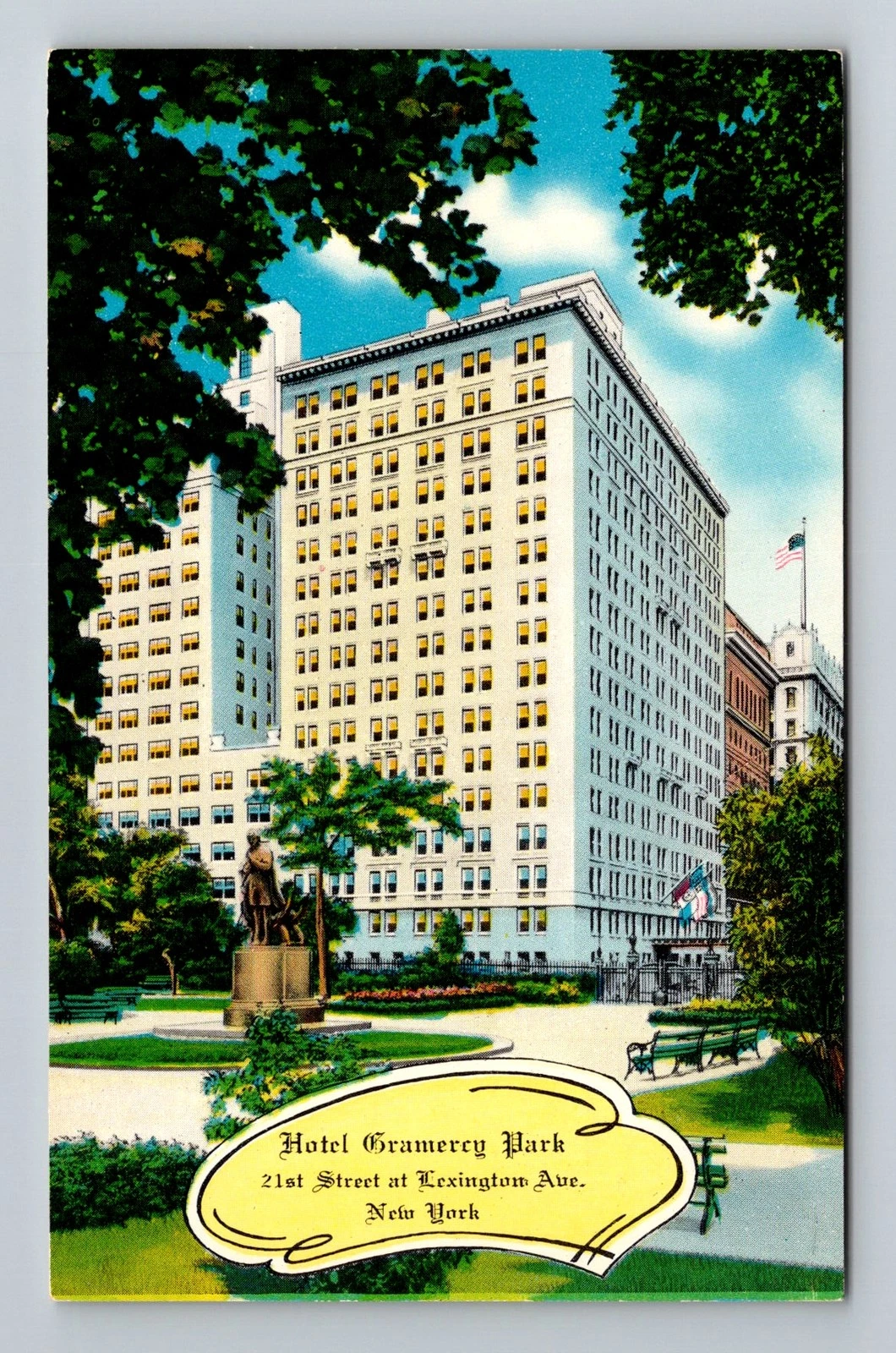
There was also a later return to this neighborhood, though it was Perelman’s. From 1972 to 1979, West’s old Brown friend and brother-in-law lived at the Gramercy Park Hotel at 2 Lexington Avenue. It was a different establishment from the Kenmore Hall on East 23rd Street, and West had been dead for more than thirty years. Yet Perelman’s address brings the story back within a short walk of the place where the two had gathered as young men. The friend who once visited the night manager had become a hotel resident beside the Park.
Places, people & connections
Around the Park
Gramercy Park Hotel
S. J. Perelman’s home from 1972 to 1979, decades after his visits to West at the Kenmore Hall.
Carl Van Vechten
Another writer and generous host in the neighborhood, whose later portraits included F. Scott Fitzgerald.
O. Henry
An earlier New York storyteller whose Irving Place years connect lodgings, working routines, and fiction.
19 Gramercy Park South
The Fish house offers a different scale of neighborhood hospitality: formal rooms and celebrated entertainments.
Benjamin Sonnenberg
A Gramercy host whose house became a meeting place for people from the arts and public life.
Ludwig Bemelmans
A writer and artist whose experience of hotel work fed a distinctive literary imagination.
Life at a glance
The biographical record
| Born | October 17, 1903 · New York City · Nathan Weinstein |
|---|---|
| Died | December 22, 1940 · near El Centro, California · age 37 |
| Parents | Max Weinstein and Anna Wallerstein Weinstein |
| Gramercy address | Kenmore Hall Hotel, 145 East 23rd Street · night manager, 1927–1930 |
| Later New York workplace | Sutton Club Hotel, East 56th Street · from late 1930 |
| Name change | Nathanael West · legally adopted October 1926 |
| Spouse | Eileen McKenney · married April 1940 |
| Selected novels | The Dream Life of Balso Snell (1931); Miss Lonelyhearts (1933); The Day of the Locust (1939) |
| Collected edition | The Complete Works of Nathanael West (1957) |
Over time
Born in New York
Nathan Weinstein is born on October 17 to Max and Anna Weinstein.
The Brown circle
His college friendships include S. J. Perelman and Quentin Reynolds.
A new name and Paris
He legally adopts Nathanael West in October and travels to Montparnasse.
Home to a hotel job
The family business falters; West returns and becomes night manager at the Kenmore Hall Hotel.
Writing and hospitality
At the Kenmore, he works on The Dream Life of Balso Snell and gives lodging to Hammett.
The advice-column letters
An encounter with “Susan Chester” supplies the starting point for Miss Lonelyhearts.
The Sutton Club Hotel
West moves to an East 56th Street management job and continues to shelter fellow writers.
First novel published
The Dream Life of Balso Snell appears.
Praise and a publishing collapse
The Liveright bankruptcy interrupts the launch of Miss Lonelyhearts.
Hollywood
Republic Pictures screenwriting helps support him; The Day of the Locust appears in 1939.
Marriage and tragedy
West marries Eileen McKenney in April; both die in a car crash on December 22.
The collected works
A collected edition helps establish West’s posthumous readership.
Perelman beside the Park
West’s friend and brother-in-law lives at the Gramercy Park Hotel.
Sources cited
- Carole Klein, Gramercy Park: An American Bloomsbury (Boston: Houghton Mifflin, 1987), for the neighborhood’s writers and their social connections.
- Jay Martin, Nathanael West: The Art of His Life (New York: Farrar, Straus and Giroux, 1970).
- New York Public Library, S. J. Perelman collection of papers, 1924–1970, Berg Collection; the finding aid describes the 1924 Brown yearbook and its entries for West and Perelman.
- Nathanael West, The Dream Life of Balso Snell (1931), Miss Lonelyhearts (1933), and The Day of the Locust (1939).
- Nathanael West, The Complete Works of Nathanael West (New York: New Directions, 1957).
- Ruth McKenney, My Sister Eileen (New York: Harcourt, Brace and Company, 1938).
- Nathanael West, Novels and Other Writings, edited by Sacvan Bercovitch (Library of America, 1997).
- Gramercy Park Block Association, Gramercy Park Hotel, for S. J. Perelman’s later residence at 2 Lexington Avenue.
Photo credits for this page
- Nathanael West. Historical photograph, photographer and date unidentified; image reproduced in Marion Meade, “In Hollywood with Nathanael West,” The Public Domain Review, January 1, 2011. Source’s reuse information.
- Gramercy Park Hotel and Gramercy Park, late 1920s. The New York Public Library, Irma and Paul Milstein Division of United States History, Local History and Genealogy, image 720039F. Existing GPBA archival image; also reproduced in the hotel profile.
- Snow in New York, 1902. Robert Henri, oil on canvas. National Gallery of Art, Washington. Collection image via Wikimedia Commons. Public domain.
- 55 Irving Place. Plate facing page 200 of C. Alphonso Smith, O. Henry Biography (Garden City, New York: Doubleday, Page & Company, 1916). Image credited in the book to Arthur Bartlett Maurice; photographer unidentified. Digitized volume, Internet Archive. Public domain.
- Gramercy Park, 1922. Exhibition panel from the Frances Benjamin Johnston Collection. Library of Congress, Prints and Photographs Division, LC-DIG-ppmsca-16306. Collection record. No known restrictions on publication.
- Gramercy Park, Nos. 3–5, November 27, 1935. Berenice Abbott, Changing New York. The New York Public Library. Collection image via Wikimedia Commons. Public-domain WPA photograph.
- F. Scott Fitzgerald, June 4, 1937. Photograph by Carl Van Vechten. Library of Congress, Prints and Photographs Division, digital ID van.5a51985, record 2004662882. Collection record; image and rights record. Public domain; no known copyright restrictions.
- Hotel Gramercy Park, vintage color postcard. Gramercy Park Block Association historical archive; date unidentified. Also reproduced in the Gramercy Park Hotel profile.