
Benjamin Sonnenberg
The Pedestal Builder of 19 Gramercy Park South
1901–1978 · Publicist, collector & master of the thirty-seven-room Sonnenberg Mansion
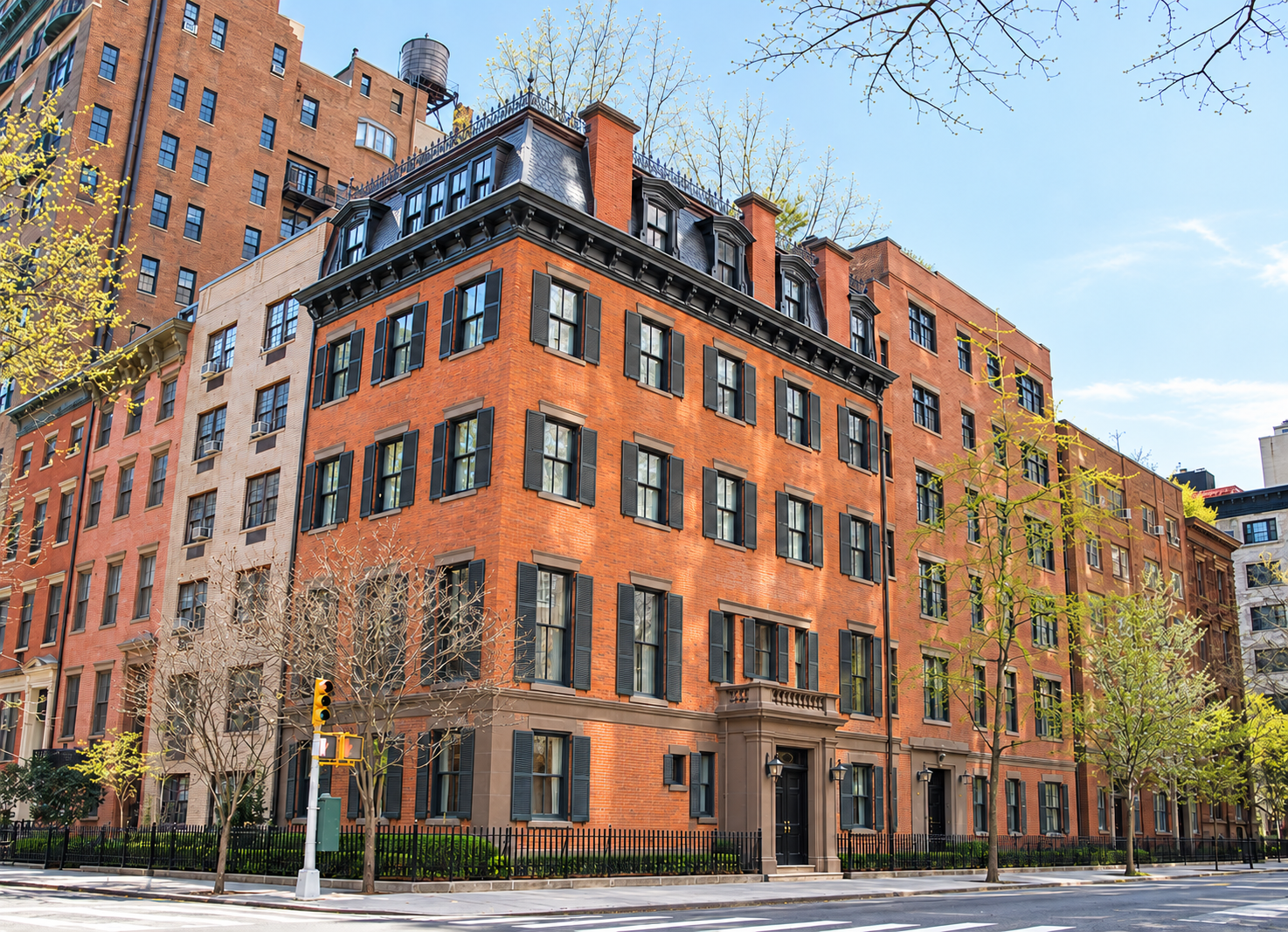
Born near Brest-Litovsk and raised on the Lower East Side, Benjamin Sonnenberg reinvented himself as an Edwardian grandee—and turned the old Stuyvesant Fish mansion at 19 Gramercy Park South into what Brendan Gill called “the greatest private house left in New York.”
A house equal to the part
Benjamin Sonnenberg dressed as though he had stepped out of Edwardian London.
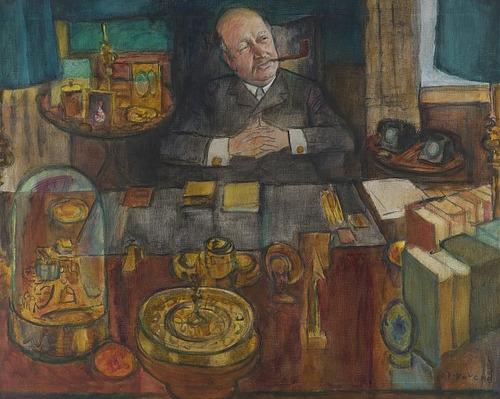
His bowler hat, sweeping walrus mustache, detachable starched white collar, and tightly rolled umbrella were as much a part of his public identity as the black-lacquered front door of 19 Gramercy Park South. His bespoke Savile Row suits were tailored without an outside breast pocket, where clippings or spectacles might spoil the effect.
It was a conscious piece of theater, and Sonnenberg was the first to admit it. He had arrived in New York from Brest-Litovsk as a boy speaking not a word of English, the son of a Lower East Side pushcart peddler and a mother who scrubbed floors at the Henry Street Settlement. By the time The New Yorker profiled him in 1950 under the title "A House on Gramercy Park," he was the most celebrated public relations strategist in America—master of an art he described as "building plinths for other men to stand on"—and the proprietor of a thirty-seven-room mansion that Brendan Gill called "unquestionably, the greatest house remaining in private hands in New York."
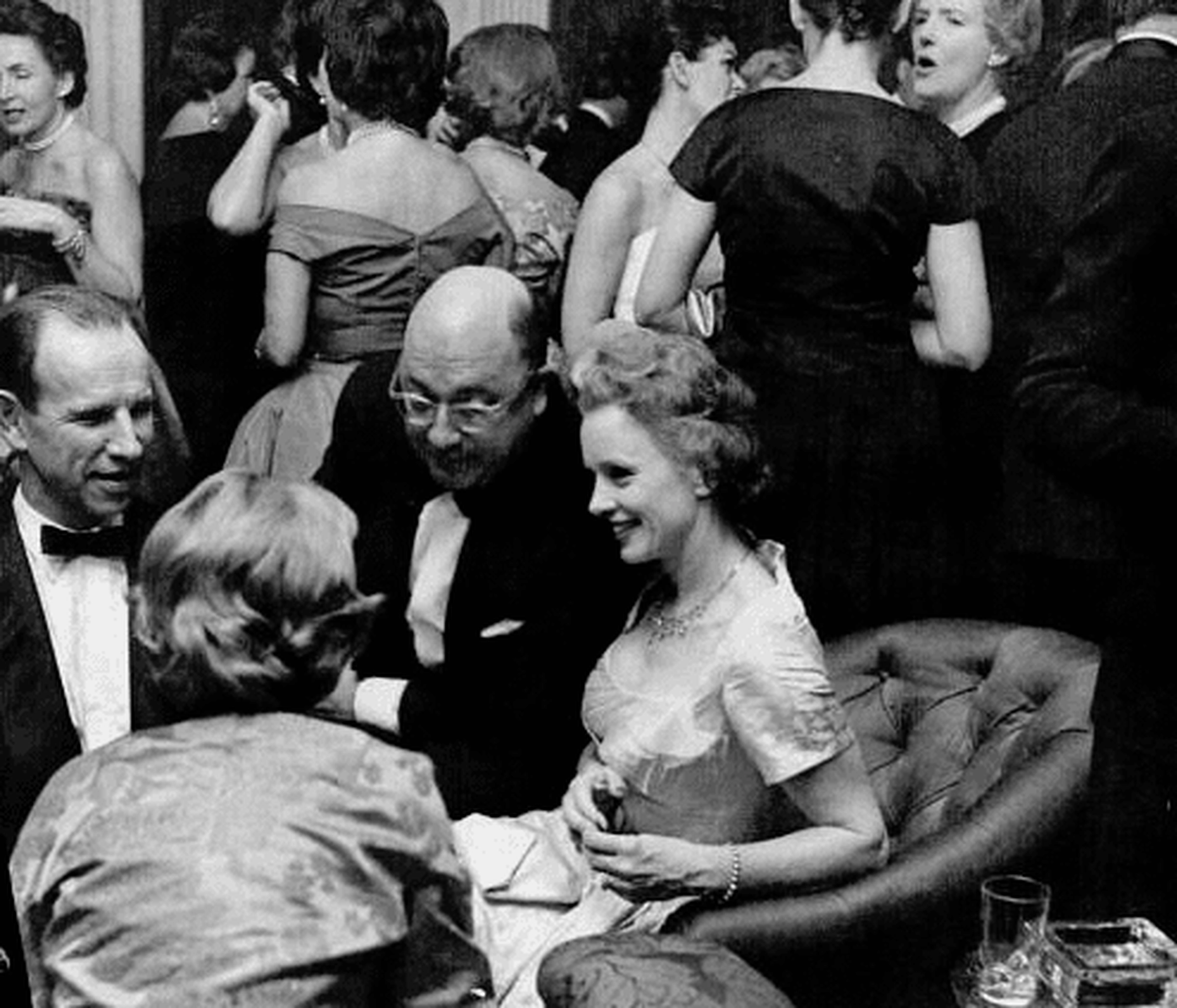
At its height, the household Benjamin and Hilda shaped ran as crisply as a first-class bank, with a live-in staff of six and dinners, teas, and receptions for up to a hundred guests two or three times a week. Even on September 8, 1978—two days after Sonnenberg died at age seventy-seven—passersby spotted his butler, Arthur Horn, out on the stoop with cloth and polish in hand, scrubbing the huge brass door knocker. "It is what he would have wanted," Horn told a visitor. "We want to keep the house going the way it always was."
The boy whom Lillian Wald noticed
From Brest-Litovsk to Henry Street
Benjamin Sonnenberg was born on July 12, 1901, near Brest-Litovsk in the Russian Empire, in present-day Belarus, the eldest child of Harry (Arje) and Ida (Chaya) Sonenberg. His father left for New York in 1905 and sold dry goods from a pushcart on the Lower East Side. Ben, his mother, and his younger sisters, Mary and Belle, moved first to Warsaw before sailing to join him in 1910 aboard the SS Birma.
Growing up in a cold-water tenement, Sonnenberg attended Public School 62 and DeWitt Clinton High School. Another education awaited him at the Henry Street Settlement, where his mother worked as a cleaning woman. He joined dramatic clubs and debating societies and attracted the attention of the settlement’s founder, Lillian D. Wald. At sixteen, after friction at home, he became a boys’ club leader; Wald gave him a room in the settlement so he could finish high school. Two years later, she helped arrange a scholarship to Columbia College.
Finding a profession
Sonnenberg proved restless in lecture halls. He covered Columbia athletics for the Brooklyn Daily Eagle, briefly sold portraits door-to-door in the Midwest, and made his way to Flint, Michigan, where he worked as a reporter and movie reviewer for The Flint Journal. Back in New York in the early 1920s, he again benefited from Wald’s confidence. Lewis L. Strauss, formerly Herbert Hoover’s private secretary at the American Relief Administration, asked her to recommend a young writer for famine-relief publicity. She sent Sonnenberg.
Writing about European and Russian relief efforts and the work of the American Jewish Joint Distribution Committee brought him into the company of philanthropists and bankers. The assignment introduced him to a larger stage: men with money and influence who needed someone to explain their work to the public. It also gave the young writer a close view of how the wealthy lived.
“I build pedestals and put people on them”
Marriage and a first office
In March 1924, Sonnenberg married Hilda Caplan, whose steadiness offered a counterweight to his theatrical exuberance. He rented an office and an apartment in Greenwich Village and began working as a Broadway and hotel press agent. Early clients ranged from the White Horse Tavern and Manhattan hotels to African trader Aloysius “Trader Horn” Smith and bridge impresario Ely Culbertson. His work depended on recognizing a good story—and giving newspaper editors copy they could use.
Publicity for restaurants, hotels, and personalities taught him to command attention. Work with art dealer Sir Joseph Duveen taught him how prestige traveled among wealthy collectors. As the 1920s gave way to the Depression, Sonnenberg shifted toward corporate counsel, established Publicity Consultants, Inc., and took offices at 247 Park Avenue. His carefully chosen clothes distinguished him from both the Broadway press agent and the conventional business executive. Brendan Gill likened his appearance to a cross between Benjamin Disraeli and Max Beerbohm.
The art of reputation
“I build pedestals and put people on them,” Sonnenberg told Hellman. He sought to make a company’s chief executive a recognizable public figure, with interests and authority extending beyond the product being sold. In 1940 he persuaded Texaco to sponsor the Metropolitan Opera’s Saturday afternoon radio broadcasts, beginning an enduring association between the oil company and the arts. For Margaret Rudkin, whose Pepperidge Farm bread was still a local specialty, he arranged a Reader’s Digest profile that brought orders from around the country.
Over the following decades, his clients included Samuel Goldwyn, RCA’s David Sarnoff, Pan American founder Juan Trippe, department-store executive Fred Lazarus Jr., Philip Morris, and Greyhound. He helped shape Charles Luckman’s public image at Lever Brothers, secured a Time cover, and promoted the company’s glass-walled Lever House on Park Avenue. His work also extended to Franklin D. Roosevelt’s Birthday Balls for the fight against polio. The campaigns differed, but the underlying craft was consistent: connect an institution with a person, a cause, or an occasion the public would remember.
Hilda in the rainstorm, the Stuyvesant Fish house, and a feud with Ludwig Bemelmans
Taking rooms at No. 19
Sonnenberg's most enduring creation was not a corporate campaign, but his home on Gramercy Park. Yet it was Hilda Sonnenberg who actually discovered it.
As Brendan Gill later recounted, in 1931, when Sonnenberg was thirty and the couple was living in a small apartment across the Park at 60 Gramercy Park North, Hilda was caught in a sudden rainstorm along the southern perimeter. Dashing into the tall, paneled vestibule of 19 Gramercy Park South for cover, she peered inside and saw that the lower two floors were empty and full of cobwebs. She inquired on the spot whether they could be rented.
The house she had stepped into already carried nearly a century of New York history. Its corner lot had been purchased in 1837 by Whig politician William Samuel Johnson, who built a four-story Greek Revival–Italianate mansion on the northern half around 1845. Sold in 1850 to Horace Brooks—who built a stable on the open land to the south and added a fifth-story French Second Empire mansard roof topped with jaunty painted cast-iron cresting in the mid-1860s—the house was purchased in 1887 by railroad magnate Stuyvesant Fish and his irrepressible wife, Marion Graves Anthon ("Mamie") Fish. The Fishes spent more than $120,000 remodeling the house for lavish entertaining. The alterations have traditionally been attributed to Stanford White, who also transformed 16 Gramercy Park South into The Players; the 1887–1888 building filings name Sidney V. Stratton. After a decade on Gramercy Park—during which Mamie Fish famously staged a formal sit-down dinner for her dogs and her friends' dogs—she succumbed to what Brendan Gill called folie de bâtir and had White build her a new uptown palace at 78th Street and Madison Avenue in 1899.
The Fish family continued to own No. 19, renting it to prominent families until 1909, when a builder leased the property, razed Horace Brooks's southern stable, erected a red-brick studio-apartment building next door (20 Gramercy Park South), and broke open the south wall of No. 19 at several levels to divide the mansion into studio flats. Over the next three decades, the combined buildings drew celebrated artistic tenants, including the portraitist Cecilia Beaux and the writer and illustrator Ludwig Bemelmans.
Joining the two houses
Moving into the lower two floors in 1931, the Sonnenbergs expanded bit by bit as Ben's collections outgrew the duplex. Finally, in 1945, he had the satisfaction of buying both No. 19 and the adjoining studio building at No. 20 from the Fish estate. Leaving the red-brick and mansard exterior intact, he transformed the extension into guest bedrooms, libraries, and quarters for a live-in staff of six, while restoring the old Fish house to its nineteenth-century splendor—and opening up a maze of little top-floor rooms into a single grand ballroom and private motion-picture theater.
A landlord enters a book
Reclaiming that top floor produced one of Gramercy Park's great literary skirmishes. Occupying most of the fifth floor of No. 20 were Ludwig Bemelmans, his wife Madeleine, and their daughter Barbara. Bemelmans had painted chestnut leaves across his walls and views of Edwin Booth's statue in the Park outside. Barbara later recalled that the landlord declined to renew the family's lease because he wanted their rooms for a private screening room. She believed Sonnenberg inspired the landlord in her father's 1950 picture book Sunshine: A Story About the City of New York. In the story, an umbrella-carrying landlord named "Mr. Sunshine" buys a building on Gramercy Park and wages war against a kindly music-school tenant, Miss Moore, whose young pupils retaliate by marching through the house playing the William Tell Overture.
"I would shop on Allen Street while Ben would go to 57th Street"
A house filled with collections
For all its scale—six levels and thirty-seven rooms—No. 19 never felt like a cold museum or an institutional palace. "The house prances, it has a certain lilt to it," architecture critic Paul Goldberger observed in The New York Times, while Brendan Gill wrote in The New Yorker that its rooms sounded at every turn "what Henry James called the incomparable tone of time." That warmth owed everything to its human proportions and to the fact that the house was assembled not by one collector's eye, but by two.
Stepping through the tall paneled vestibule and the black-lacquered front door into the broad, low-ceilinged, oyster-white entrance hall felt, as Gill noted, like being ushered into "some delightful snug cave of a country house, spacious and opulent and yet taking care to be more comfortable than opulent." To the left of the front door sat one of the house's few small rooms: an intimate, oak-paneled den with a comfortably creaking wood floor, deeply embrasured ground-level windows looking directly into the greenery of Gramercy Park, and a fireplace attributed to Stanford White—where Gill recalled the bittersweet scent of woodsmoke even in midsummer. Here the Sonnenbergs dined when they were alone.
From the hall, a heavy-balustraded staircase mounted sumptuously through the house, arriving at a second-floor landing larger than most Manhattan living rooms, anchored by a Regency wine table set with glass decanters and brass candelabras before a fireplace. Lining the stairs and landings were hundreds of Old Master and modern drawings—works by Rembrandt, Watteau, Tiepolo, Ingres, Gainsborough, Goya, Delacroix, Degas, Seurat, Cézanne, Picasso, Matisse, John Singer Sargent, and Augustus John, with a special emphasis on sketches of artists and writers. Off the second-floor landing opened the hushed William and Mary Room, a seventeenth-century English drawing room dropped into midtown Manhattan, lined with elaborate oak paneling from Cassiobury, the historic English country house, eighteenth-century gilt mirrors, and early Georgian marble-topped tables, where a sculpted head by Alberto Giacometti sat beside an Impressionist seascape, Elizabethan portraits, and antique vases.
While Ben hunted on 57th Street, in London, and in Paris—filling the bedrooms with nineteen antique brass and iron beds and commissioning portraits of himself from René Robert Bouché and Sir Jacob Epstein—Hilda shaped the rooms with an equally decisive eye for the offbeat object. "I would shop on Allen Street while Ben would go to 57th Street," Hilda recalled in a passage quoted by Goldberger. She bought much of the house's gleaming brass on the Lower East Side. In 1951, spotting a pair of hollow glass blocks in a French factory, she brought them home and placed them as ashtrays amid the valuable brass antiques on the coffee table in Ben's paneled library—a room that sparkled with books new and old, drawings, and deep, comfortable furniture where Sonnenberg received visitors throughout his later years.
An evening at the mansion
At the top of the house on the fifth floor, a bank of windows looked out over the treetops of Gramercy Park from Sonnenberg's red-and-white confectionary ballroom. With a professional motion-picture projection booth concealed behind one wall, the room looked like a fantasy Victorian ballroom "designed to make its inhabitants feel as if they would not be permitted to drink anything but champagne there." Down at the Irving Place door, butler Arthur Horn stood with a palm-sized mechanical tally counter—"the butler's ticker"—clicking once for each arriving guest as Greta Garbo, Truman Capote, Lillian Hellman, Dorothy Parker, John Steinbeck, Jackie Gleason, S. N. Behrman, Alistair Cooke, and Brendan Gill climbed the stairs beside bank chairmen, publishers, and cabinet ministers.
Saving a neighboring landmark
His attachment to the neighborhood also took practical form. In 1969 he organized a consortium of Gramercy Park neighbors to purchase the former Quaker Meeting House at 28 Gramercy Park South, preserving it after a proposed tower threatened the site. The building remained intact until Brotherhood Synagogue acquired and restored it in 1975. Sonnenberg’s influence could protect a historic building beyond his own front door.
The green morocco album, the two-million-dollar house, and the five-day auction
Putting his affairs in order
After retiring from active corporate practice in the early 1960s, Sonnenberg gradually wound down his large parties, receiving friends in his library and making one last collecting trip to London at age seventy-six. When he learned in late 1977 that he had terminal throat cancer, he made a characteristic decision about his legacy.
"The house on Gramercy Park was Benjamin Sonnenberg's stage," Paul Goldberger reflected in December 1978, "and though he liked to say he spent his professional career assuring the immortality of his clients, he did not seek such permanence for himself. He saw his collection as a set of objects that had come together for his lifetime, and he preferred, once he was gone, to have the stagehands strike the set." It could never have worked, Goldberger noted, in a rigid Beaux-Arts palace uptown; Sonnenberg had chosen a nineteenth-century Gramercy house that he and Hilda could stamp entirely with their own imprint. By the terms of his December 1977 will, he instructed his executors to destroy his confidential client files, sell No. 19, and disperse all of its contents at auction so that his home would never stiffen into an institutional mausoleum.
The rooms recorded
Before the stagehands struck the set, his friend Alistair Cooke arranged for Sonnenberg's grandson, photographer Steven Tucker, to photograph the house exactly as Benjamin and Hilda had lived in it—twenty-eight color views bound into a green morocco leather album stamped in gold "NO. 19" and today preserved at the New-York Historical Society.
The sale and its aftermath
Benjamin Sonnenberg died of a heart attack on September 6, 1978, at age seventy-seven. With the house placed on the market at an asking price of $2 million, Sotheby Parke Bernet staged a landmark five-day auction from June 5 to June 9, 1979, that drew thousands of collectors and realized nearly $5 million. As Brendan Gill wrote in The New Yorker that winter, watching the black-lacquered door of No. 19 prepare to close on the Sonnenberg era: "For nearly a hundred and thirty-five years, it has been a house that families have been happy in and have rejoiced to give parties in—everything happens at parties, Jane Austen said—and now it appears to await with equanimity the adventure of new owners, new parties."
Around the Park · Places in the story
- 19 Gramercy Park South: The 1845 corner house transformed by the Fishes and joined with No. 20 by Benjamin and Hilda Sonnenberg in 1945.
- Ludwig Bemelmans: The fifth-floor tenant at No. 20 whose daughter recalled a lease dispute that she believed inspired Sunshine (1950).
Life at a glance
- Life
- July 12, 1901 – September 6, 1978
- Gramercy address
- 19–20 Gramercy Park South (86 and 84 Irving Place), at the southeast corner of Gramercy Park South and Irving Place
- Years on the Park
- 1931–1978; leased the lower two floors from 1931 and acquired Nos. 19 and 20 in 1945, uniting them into a thirty-seven-room mansion
- Vocation
- Founder and president, Publicity Consultants, Inc.; art and antiques collector
- Signature maxim
- “Always live better than your clients.”
- Family
- Married Hilda Caplan (1902–1979) in 1924; children Helen Sonnenberg Tucker (1925–2022) and Ben Sonnenberg Jr. (1936–2010)
A life over time
- 1901 · Born near Brest-Litovsk
Born July 12 to Harry and Ida Sonenberg; joins his father in New York in 1910 aboard the SS Birma and grows up on the Lower East Side. - 1917–1919 · Henry Street Settlement
Lillian D. Wald gives him a room at the settlement, employs him as a boys’ club leader, and helps secure a scholarship to Columbia College. - 1922–1924 · Relief work and marriage
Writes publicity for famine relief and the American Jewish Joint Distribution Committee. Marries Hilda Caplan in March 1924 and begins his career as a press agent. - 1931 · A rainstorm on Gramercy Park
Caught in a sudden downpour while living across the Park at 60 Gramercy Park North, Hilda Sonnenberg dashes into the vestibule of 19 Gramercy Park South, discovers the cobwebbed lower two floors are vacant, and arranges to lease the duplex. - 1940 · Texaco and the Met broadcasts
Persuades Texaco to sponsor the Metropolitan Opera’s Saturday afternoon radio broadcasts. - 1945 · The thirty-seven-room mansion
Buys Nos. 19 and 20 from the Fish family and joins the buildings into one residence. - 1950 · The New Yorker and Sunshine
Geoffrey T. Hellman profiles his Gramercy home. Bemelmans publishes Sunshine, whose landlord Barbara Bemelmans believed was inspired by Sonnenberg. - 1955 · The Bouché portrait
René Robert Bouché paints his portrait, later acquired by the Smithsonian’s National Portrait Gallery. - 1969 · Preserving the meetinghouse
Organizes neighbors to purchase the former Quaker Meeting House, protecting the building later acquired by Brotherhood Synagogue. - 1978–1979 · A farewell to the house
Dies September 6, 1978. Steven Tucker’s photographs preserve the furnished interiors; Sotheby Parke Bernet disperses the collections in June 1979.
Sources cited
- Brendan Gill, "No. 19," The New Yorker, February 5, 1979; reprinted as the introductory essay in The Benjamin Sonnenberg Collection (2 vols., Sotheby Parke Bernet Inc., New York, June 5–9, 1979).
- Paul Goldberger, "First Visit to a Grand New York House," The New York Times, December 21, 1978, Section C, p. 1; and The New York Times obituary, "Benjamin Sonnenberg, 77, Dies; Press Agent and Collector of Art," September 7, 1978.
- Geoffrey T. Hellman, "Profiles: Close to the Chest / A House on Gramercy Park," The New Yorker, April 8, 1950; reprinted in David Remnick, ed., Life Stories: Profiles from The New Yorker (Random House, 2000).
- Isadore Barmash, Always Live Better Than Your Clients: The Fabulous Life and Times of Benjamin Sonnenberg, America's Greatest Publicist (Dodd, Mead & Co., 1983).
- Ben Sonnenberg Jr., Lost Property: Memoirs and Confessions of a Bad Boy (Summit Books, 1991).
- Scott M. Cutlip, "Chapter 13: Ben Sonnenberg: Sui Generis," in The Unseen Power: Public Relations, A History (Lawrence Erlbaum Associates, 1994), pp. 343–371.
- Steven Tucker (photographer), Sonnenberg Mansion Interior Photographs, 19 Gramercy Park South (ca. 1978, bound album "NO. 19" from the library of Alistair Cooke), Collection PR-465, Department of Prints, Photographs, and Architectural Collections, The New-York Historical Society.
- René Robert Bouché, Benjamin Sonnenberg (1955), oil on canvas, National Portrait Gallery, Smithsonian Institution.
Photo credits
- Exterior view of 19 Gramercy Park South: Photograph © Steven Tucker, Gramercy Park Block Association archive.
- Portrait of Benjamin Sonnenberg (1955 oil on canvas by René Robert Bouché): National Portrait Gallery, Smithsonian Institution (Gift of Denise Bouché Fitch).
- Evening party at 19 Gramercy Park South with Benjamin Sonnenberg: Gramercy Park Block Association historical archive.