
Samuel J. Tilden
A Life Beyond the Lost Presidency
1814–1886 · Lawyer, reform governor & bibliophile
From the money trail behind Boss Tweed to a library for all New Yorkers, the story of the man at 15 Gramercy Park.
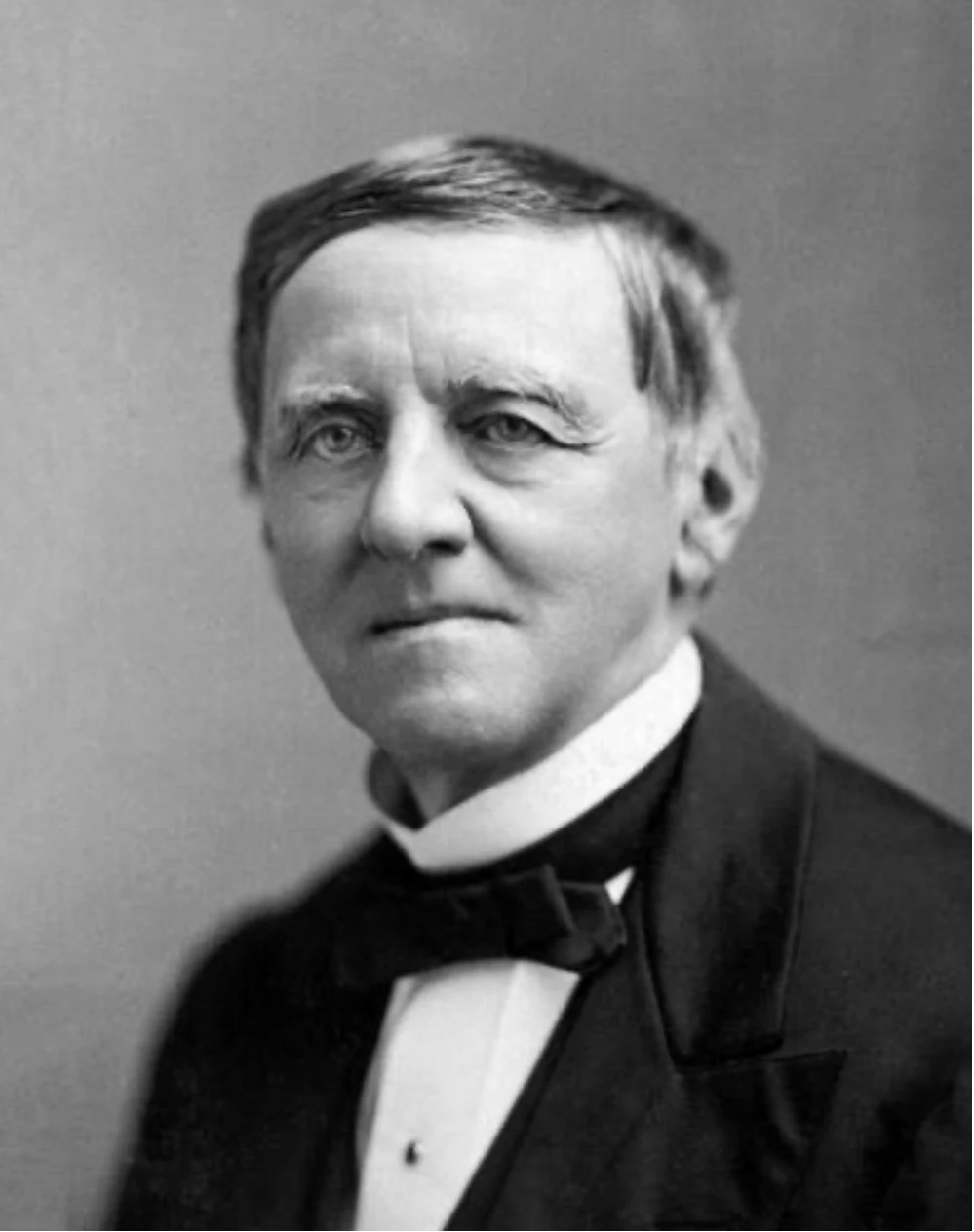
Election night on Gramercy Park
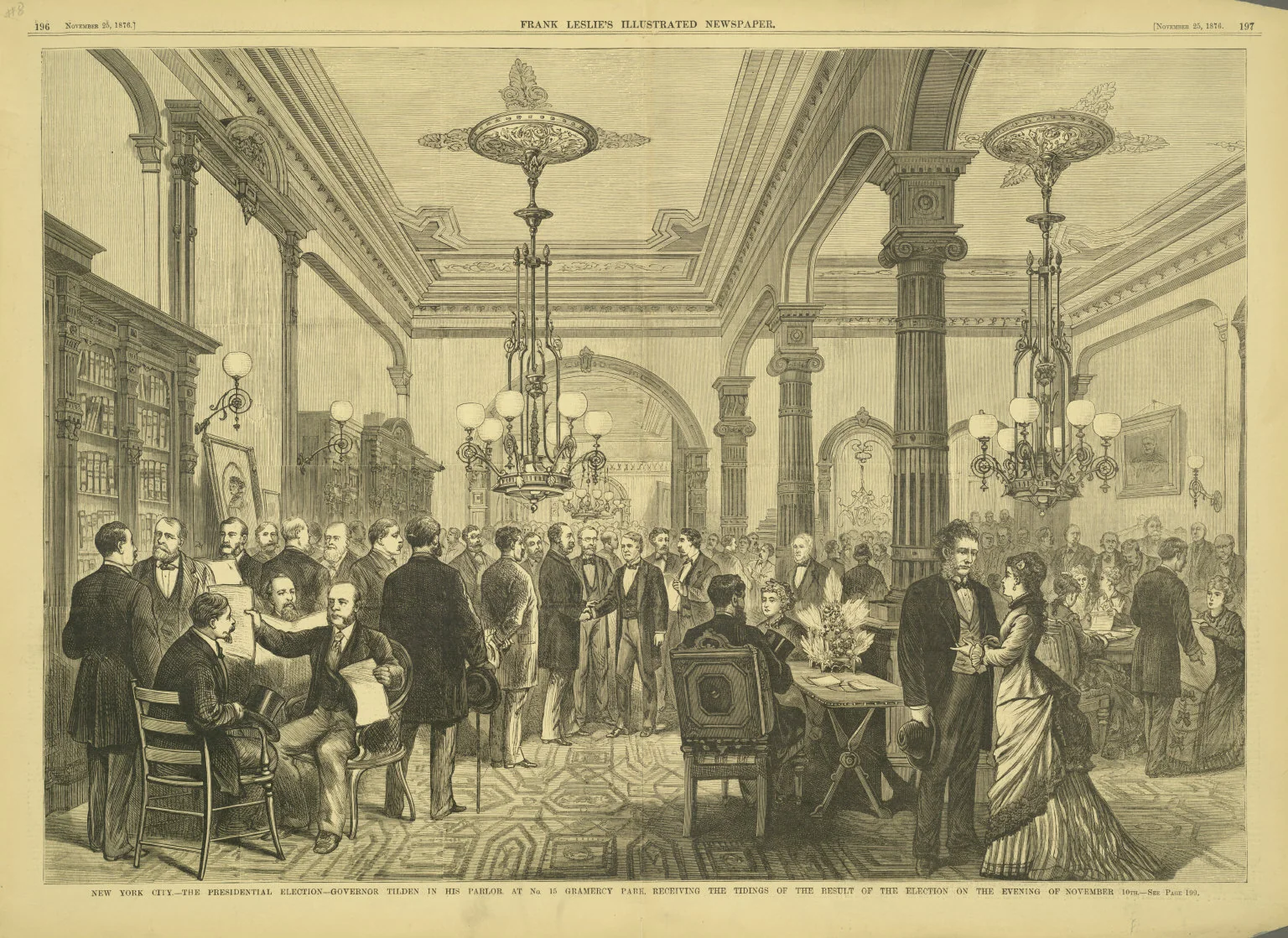
Late on election night, November 7, 1876, Governor Samuel J. Tilden returned to his house at 15 Gramercy Park South after tracking early telegraph dispatches at a Union Square hotel with his close friend, Gramercy neighbor, and Democratic National Committee chairman Abram S. Hewitt. At midnight, attorney Francis Lynde Stetson hurried down from Democratic headquarters with the latest state tallies, finding a crowd of friends and neighbors gathered in the parlor “in gay spirits to congratulate him.” Every sign indicated that New York’s reform governor had just been elected President of the United States.
Only the New York Times held back from declaring a victory the next morning. Four months later, after a prolonged constitutional standoff, Rutherford B. Hayes was inaugurated president. Tilden, who had carried the national popular vote by more than a quarter of a million ballots, finished one electoral vote short—a decision he quietly referred to for the rest of his life as “the crime of 1876.”
He had built his fortune and his public reputation by reading things other people hoped no one would read: bank deposit slips, padded canal contracts, and the fine print of railroad mortgages. Here on Gramercy Park, where he united Nos. 14 and 15 into a forty-room Victorian Gothic palace for his twenty thousand books, the enduring fruits of that life remain in plain sight: his mansion became the home of the National Arts Club, and his bequest helped give the city the New York Public Library.
The lawyer’s eye
From Martin Van Buren’s parlor to Wall Street railroad reorganizations
Samuel Jones Tilden was born in New Lebanon, Columbia County, New York, on February 9, 1814. His father, Elam Tilden, was an intimate friend and political ally of future president Martin Van Buren, bringing national Democratic politics into the household from Samuel’s childhood. Before Tilden had chosen a profession, he was already writing political essays on currency, banking, and constitutional government.
Delicate health interrupted his formal schooling. After a brief term at Yale College, he continued his education at the University of the City of New York (now New York University), read law under Attorney General Willis Hall, and was admitted to the bar in 1841. Corporate and financial law suited a mind that delighted in taking complex structures apart. During the railroad boom of the 1850s, Tilden became the nation’s pre-eminent specialist in railroad reorganizations—sorting out insolvent lines, competing bondholders, and tangled leases so that bankrupt roads could be put back on a paying footing. Legal fees and shrewd iron and railway investments made him a millionaire many times over, enabling him in February 1863 to pay $37,500 to William and Charles Belden for the Gothic Revival townhouse at 15 Gramercy Park South.
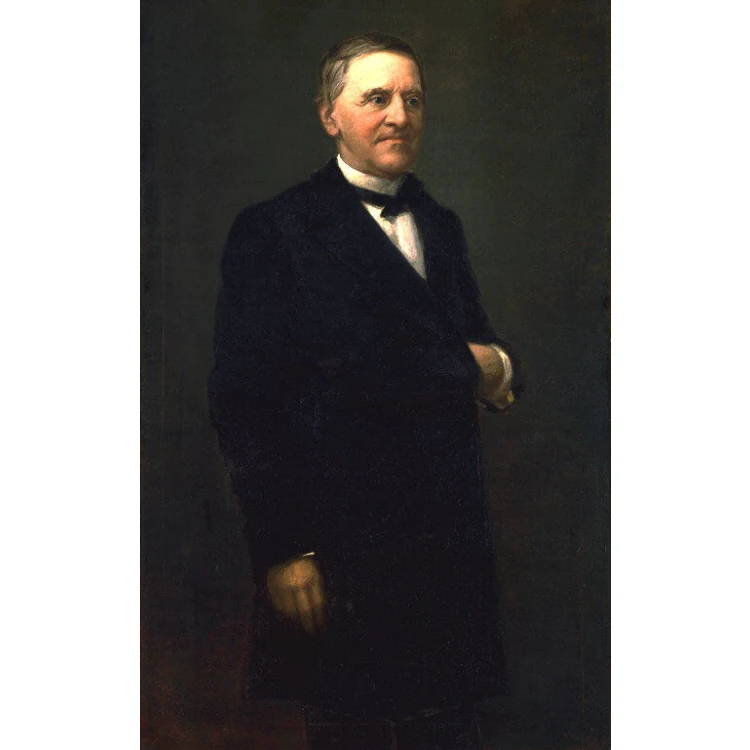
The lawyer and the missing tally: “It is an honest ghost”
Long before the presidential recount of 1876, Tilden demonstrated his uncanny gift for forensic arithmetic in a disputed New York City election. In 1856, he served as counsel defending the election of Azariah C. Flagg as City Comptroller. Flagg’s opponents claimed that an election district’s returns had been accidentally transposed—insisting that the votes credited to Flagg actually belonged to his challenger—and the original tally sheet for the regular party tickets had vanished.
Working backward through the surviving poll lists over a single night, Tilden noticed that candidates for different offices appeared in shifting combinations across split tickets. By cross-comparing the totals for every combination, he mathematically reconstructed the missing tally sheet and proved that the opposition’s claimed transposition was impossible. Handing printed sheets of his tables to the jurors so they could test every column of figures for themselves, Tilden pointed to the reconstructed count: “It is an honest ghost. It will disturb no true man.” The jury returned a verdict for Flagg in minutes.
Following the money
Following Tweed’s money
By the summer of 1871, when the corruption of William M. “Boss” Tweed’s Tammany Hall ring burst into public view, Tilden had served for five years as chairman of the Democratic State Committee. A cautious party strategist who had opposed Tweed’s charter revisions in 1870 without risking an open split, Tilden recognized in the summer of 1871 that the survival of constitutional government—and of his own party—required destroying the Ring from within. Joining forces with fellow Gramercy Park residents Peter Cooper (of 9 Lexington Avenue, now 7 Lexington Avenue) and piano manufacturer William Steinway (of 26 Gramercy Park South) on the reform Committee of Seventy, Tilden took charge of the legal and financial offensive that September.
Tweed and his inner circle had turned municipal government into a private treasury: favored contractors submitted wildly inflated bills for the new County Courthouse and city upkeep, the Comptroller paid them without audit, and the conspirators split the overcharges. While the New York Times published leaked ledger pages and Thomas Nast’s cartoons in Harper’s Weekly gave public outrage its unforgettable visual emblems, Tilden took on the task that mattered in a courtroom: proving beyond a reasonable doubt where each stolen dollar had gone.
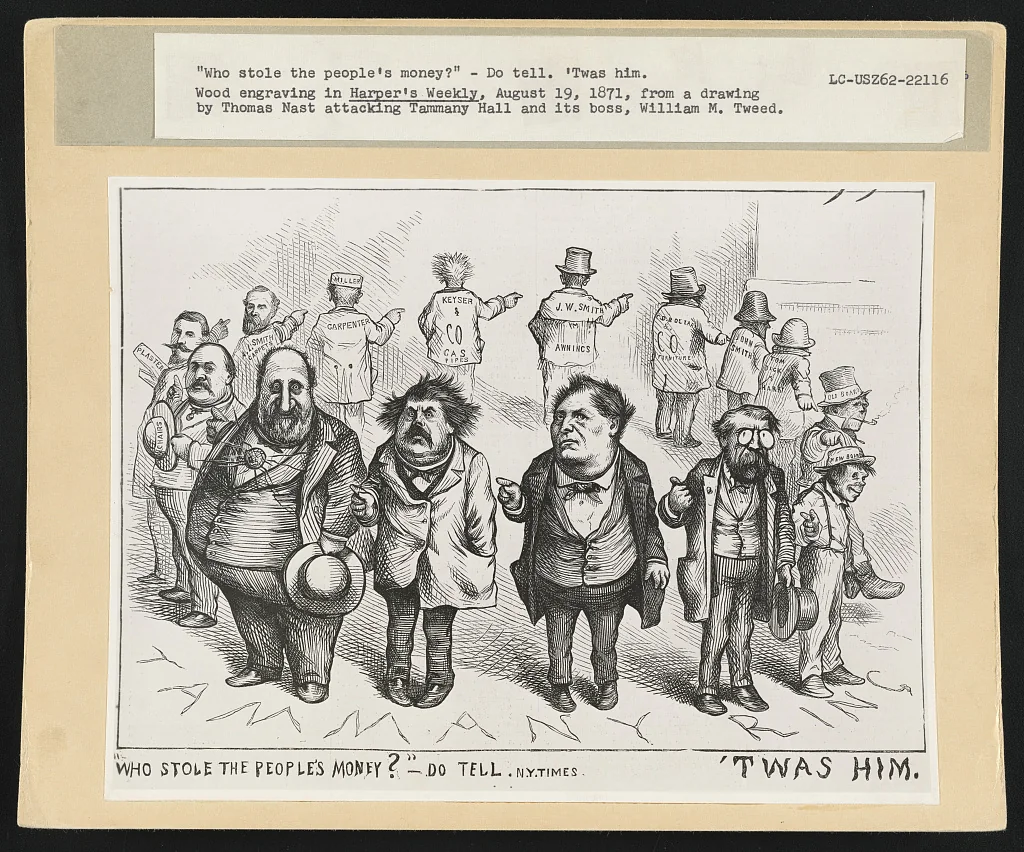
The Six Million Audit: matching the kickbacks to the penny
Showing that a plastering or carpentry bill was fraudulent was not enough to convict the officials who approved it; prosecutors needed legal proof linking specific city warrants to Tweed’s personal bank accounts. Focusing on the fraud known as the Six Million Audit, Tilden obtained a judicial order to examine the books and individual deposit slips of the Broadway Bank.
Poring over thousands of slips, Tilden discovered a recurring mathematical ratio by which the Ring’s middleman, E. A. Woodward, divided each fraudulent warrant among the conspirators. Armed with that multiplier, Tilden calculated the exact dollar-and-cent share that Tweed should have received from each city payment—and then matched those figures to the penny against deposits made into Tweed’s personal account on the very day the city warrants were cashed.
To ensure that Tammany-controlled judges could not shield the conspirators on the bench, Tilden won election to the State Assembly in November 1871 and led the campaign to remove corrupt judges, including Albert Cardozo and George G. Barnard. Taking the witness stand himself to lay out his banking tables at Tweed’s trials in 1873, Tilden helped secure the November 1873 conviction that sent the Boss of Tammany Hall to prison.
The reform governor
A governor with the accounts open
Tilden’s triumph over the Tweed Ring carried him to the governorship in November 1874—the same year he paid $50,000 for the adjoining townhouse at 14 Gramercy Park South to expand his home. Taking office in Albany on New Year’s Day 1875, he immediately turned his forensic eye on another entrenched network of plunder: the bipartisan “Canal Ring” of contractors and politicians siphoning millions from the maintenance of New York’s Erie and lateral canals.
Examining the state’s repair ledgers, Tilden’s investigating commission uncovered systematic fraud: contractors were billing the state for excavating earth and rock that had never been dug, and then billing a second time to refill the imaginary holes. Challenging the Canal Ring meant confronting powerful legislators across both parties. Taking his case directly to the public on a speaking tour along the canal corridor, the soft-spoken corporate lawyer became a fiery prosecutor—declaring at Syracuse that it appalled him to see petty thieves locked in state prisons while socially prominent contractors who plundered the public treasury went unpunished.
Nomination day in Albany (June 1876)
With the nation mired in the depression that followed the Panic of 1873 and the Grant administration battered by federal corruption scandals, Tilden’s record of fiscal retrenchment and administrative reform made him the leading contender for the Democratic presidential nomination at the St. Louis convention in June 1876.
On the day the convention balloted, Tilden was in Albany working with attorney James C. Carter on the intricate accounting of an old corporate lawsuit. Even as telegrams arrived from St. Louis reporting his rising vote totals, Tilden remained absorbed in his legal papers. Late that afternoon, he took Carter out for a carriage drive around Albany and launched into an animated discourse on federal taxation, public expenditure, and tariff reform without once mentioning the presidency—growing so absorbed in his economic figures that, to Carter’s alarm, his attention to the horse and reins wandered along the road.
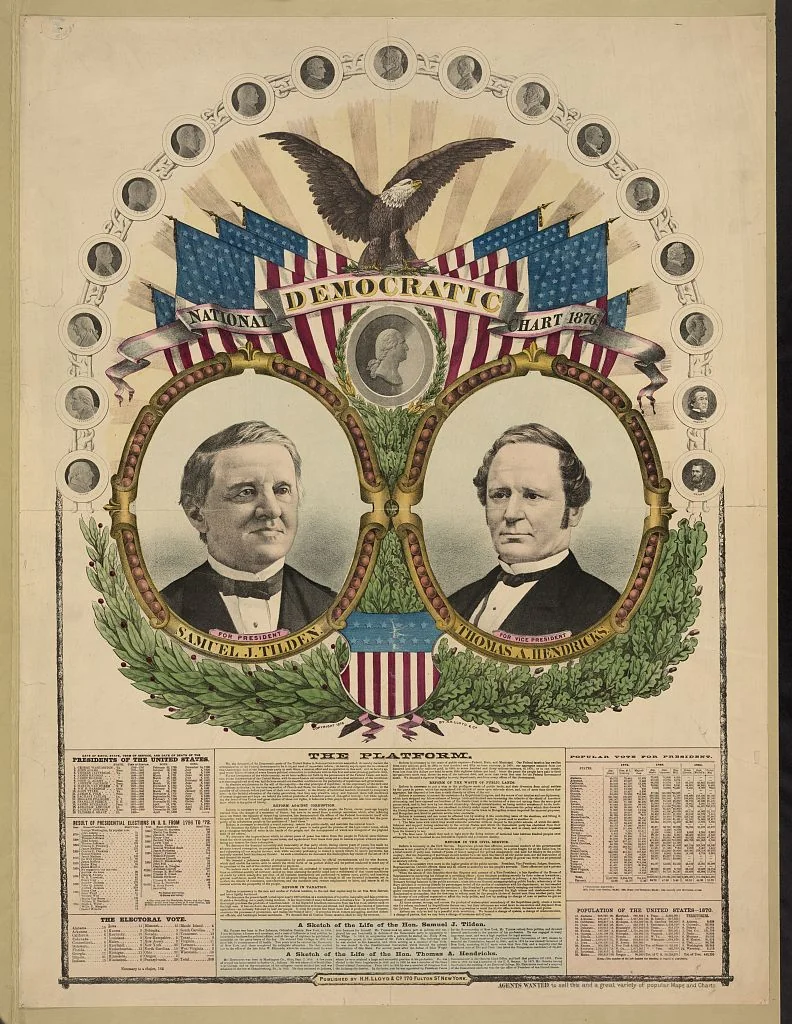
One vote short
The long count of 1876 and three contenders on Gramercy Park
The celebratory gathering in Tilden’s parlor at 15 Gramercy Park South on the night of November 7, 1876, gave way to four months of unprecedented constitutional crisis. Nationally, Tilden’s popular-vote margin exceeded 250,000 ballots, and in the Electoral College he held 184 undisputed votes—just one short of the 185 required for election. Republican nominee Rutherford B. Hayes held 165 undisputed votes, while twenty electoral votes from Florida, Louisiana, South Carolina, and Oregon were claimed by competing state returning boards. Tilden needed a single disputed vote; Hayes needed all twenty.
Remarkably, Gramercy Park was home to three central figures in that contest: Tilden at 14–15 Gramercy Park South; his Democratic National Committee chairman, Representative Abram S. Hewitt, around the corner at 9 Lexington Avenue (today’s 7 Lexington Avenue); and Hewitt’s father-in-law in the same house, Greenback Party presidential nominee Peter Cooper. Tilden’s close adviser John Bigelow would join him on the Park in 1880, moving to 21 Gramercy Park South.
Those disputed southern returns were inseparable from the violent struggle over Reconstruction. Across parts of the Deep South, white supremacist rifle clubs and intimidation had barred Black citizens—who overwhelmingly supported the Republican ticket—from the polls, while Republican-controlled returning boards threw out thousands of Democratic ballots on charges of fraud and coercion. A national popular-vote tally could not measure ballots that Black southerners had been prevented by terror from casting.
The Electoral Commission, the “Indian Corn Speech,” and the Potter Committee next door
Nor was Tilden’s campaign against municipal corruption a pledge to uphold federal Reconstruction. A War Democrat who had supported preserving the Union while criticizing Lincoln’s wartime centralization of power, Tilden championed “home rule” and the curtailment of federal intervention in the South—a platform that aligned with white Southern Democrats seeking to reclaim control of state governments.
To break the deadlock before inauguration day, Congress created a fifteen-member Electoral Commission composed of five senators, five representatives, and five Supreme Court justices. Its architects expected independent Justice David Davis to cast the deciding vote, but when the Illinois legislature elected Davis to the U.S. Senate, he declined to serve and was replaced by Republican Justice Joseph P. Bradley. Voting 8 to 7 along strict party lines on every contested state, the Commission awarded all twenty disputed electoral votes to Hayes, and on March 2, 1877, Congress declared Hayes elected, 185 to 184. After taking office, Hayes withdrew the remaining federal troops from the statehouses in Louisiana and South Carolina, clearing the way for the dismantling of Reconstruction and the disenfranchisement of Black southerners.
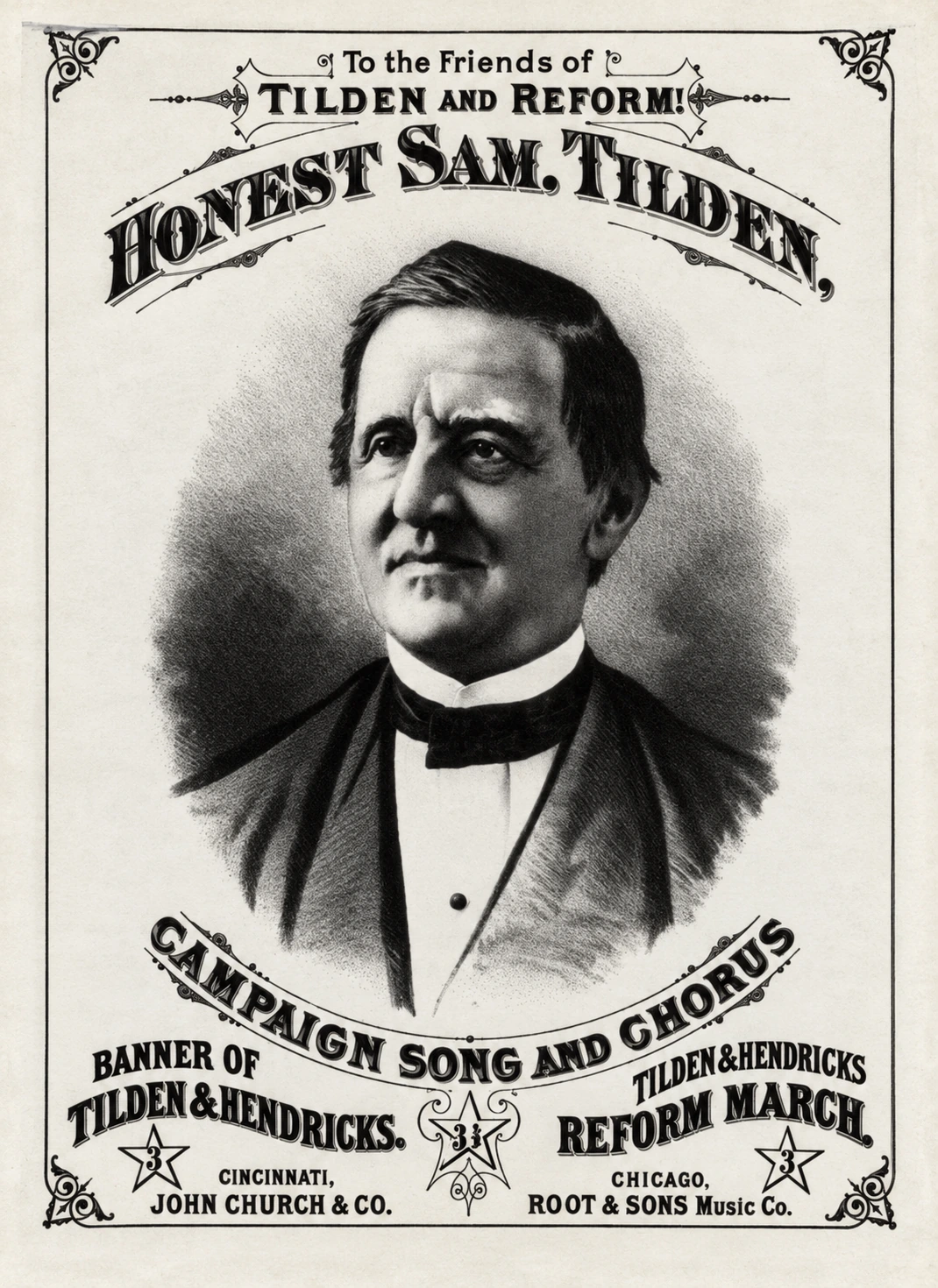
Although Tilden forever referred to the decision as “the crime of 1876,” he refused to countenance violent resistance or a rival presidency. When a New York World reporter visited his library at 15 Gramercy Park South in 1878–1879 and asked whether he had ever considered taking an independent oath of office, Tilden replied that once Congress completed the formal count, swearing himself in without legal authority “would have been ridiculous.” On October 27, 1877, two days after returning from an extended European trip, Tilden stepped onto the stoop of No. 15 before a torchlight crowd of the Young Men’s Democratic Club and delivered his famous “Indian Corn Speech”—condemning the electoral theft before pivoting unexpectedly into an argument for expanding British markets for American grain. Even the 1878–1879 congressional investigation into the “cipher dispatches”—coded telegrams sent by Tilden’s nephew Colonel William T. Pelton from 15 Gramercy Park South during the recount—had a neighborhood twist: the special House committee that subpoenaed the telegrams (where Tilden testified under oath that he had never seen or authorized any corrupt bargain) was chaired by Tilden’s immediate next-door neighbor at 16 Gramercy Park South, Democratic Congressman Clarkson Nott Potter.
A house full of books
A house arranged around books
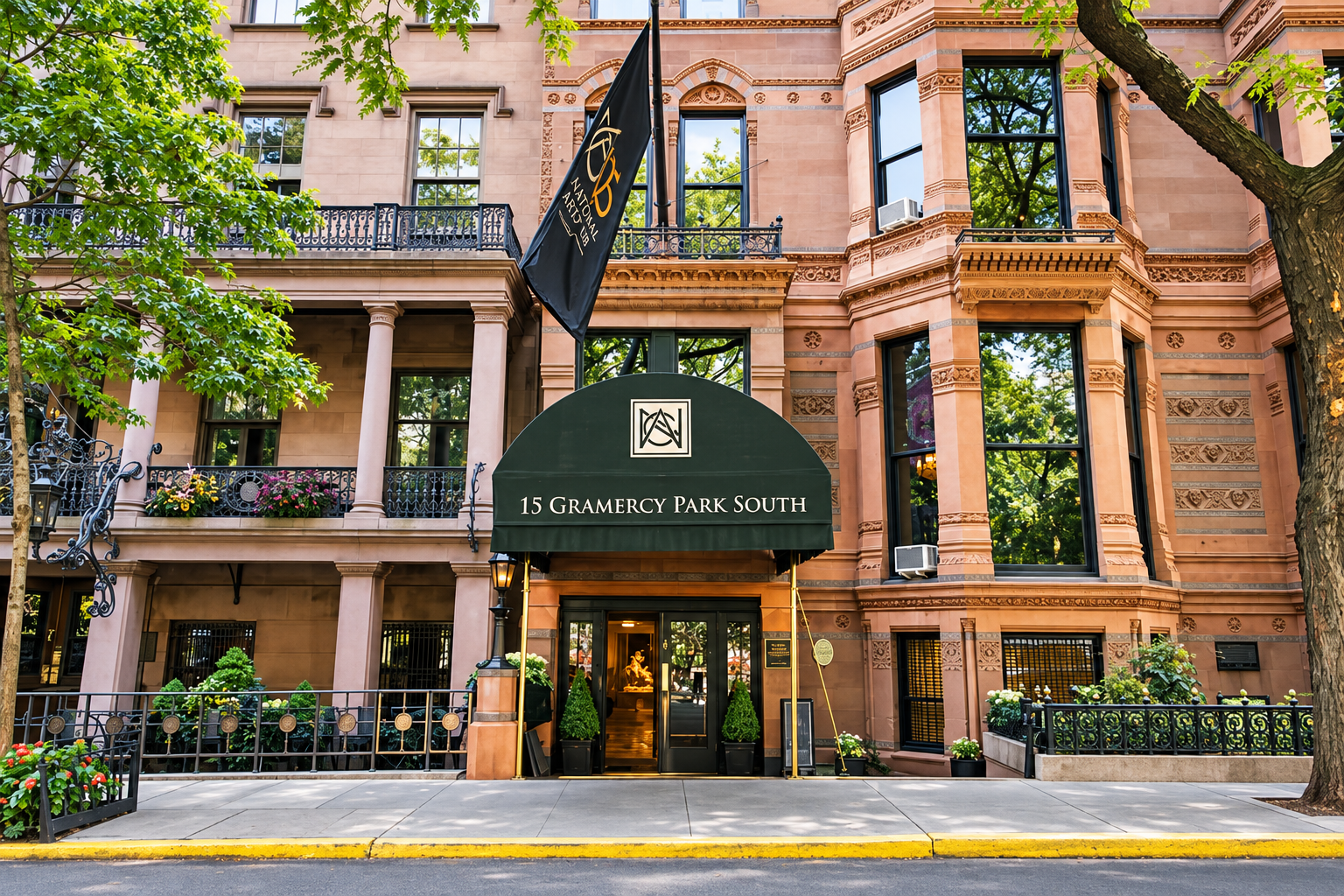
Having bought 15 Gramercy Park South in 1863 (where, on the night of December 15, 1868, burglar Thomas F. Barton was caught inside the house wearing a pair of shoes he had stolen six nights earlier from attorney Edward M. Willett next door at No. 13) and added 14 Gramercy Park South in 1874, Tilden commissioned Central Park co-designer Calvert Vaux and engineer George Kent Radford in the spring of 1881 to unite the two properties into a forty-room Victorian Gothic mansion.
Across the fifty-three-foot frontage, Vaux and Radford projected two double-story angled bay windows framed in russet Carlisle and Belleville sandstone, narrow bands of polished dark granite, Passamaquoddy marble colonnettes, and blue-green glazed ceramic tiles. In 1882, English-born sculptor Samuel James Kitson carved the façade’s famous literary pantheon: portrait medallions of Shakespeare, Milton, Benjamin Franklin, Goethe, and Dante on the western pier, a bust of Michelangelo in the gable above the eastern business entrance at No. 14, and heads of the Four Seasons on the main portico at No. 15. Behind the parlor windows, Tilden installed heavy rolling corrugated steel shutters, while inside—debunking later rumors of a “secret escape tunnel,” as his private secretary George W. Smith explained in 1905—an enclosed stair linked his bathroom to his valet’s quarters, a garden vault held coal and wine, and a four-foot subterranean brick duct fed fresh air to the furnace.
Twenty thousand volumes and four hundred books read aloud
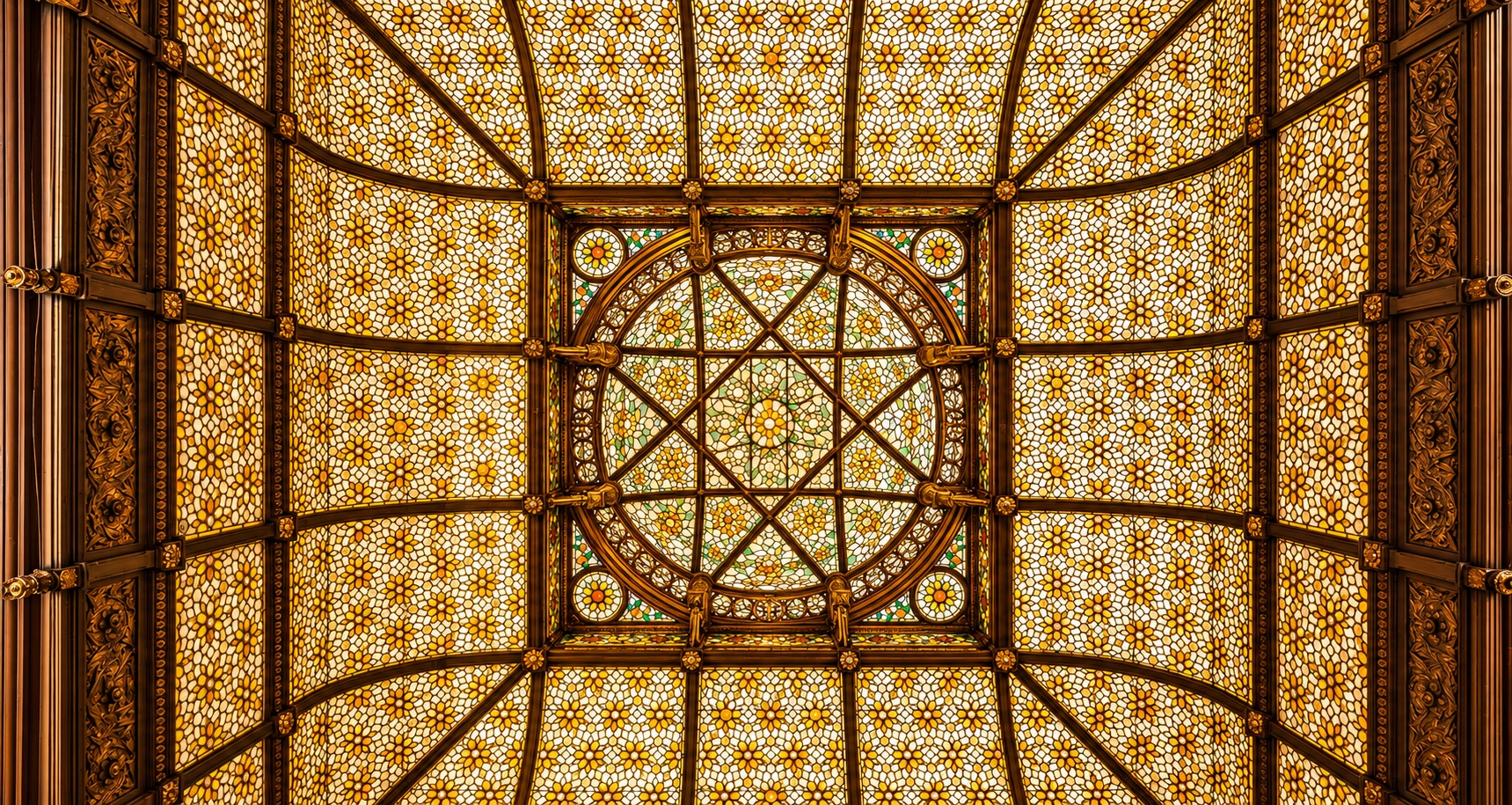
Inside, Tilden’s double mansion was designed around the pleasures of a great private library. Visitors passed through opalescent stained-glass doors by John La Farge into parlors and a thirty-one-foot-square dining room enriched with carved satinwood and mahogany panels by Ellin & Kitson and turquoise relief ceiling tiles by J. & J. G. Low, while the front library in No. 14—now the bar of the National Arts Club—was crowned by Boston stained-glass master Donald MacDonald’s vaulted dome of faceted amber jewels.
Stretching from the Gramercy Park front through to the rear garden, Tilden’s library grew to some twenty thousand volumes of law, history, economics, and English and European literature, alongside prized original manuscripts. In February 1885, learning that Tilden had acquired an original financial diary kept by Thomas Jefferson, Senate reporter Theodore Shuey wrote to offer him a second Jefferson account book from the Virginian’s years as a young lawyer. Even as palsy weakened Tilden’s hands and reduced his voice to a whisper in his seventies, books remained his constant companions: during the last four years of his life, he took pride in reading, or having read aloud to him in his library, more than four hundred volumes.
Greystone & the bequest
The last years at Greystone
Gramercy Park shared Tilden’s final years with Greystone, the stone mansion overlooking the Hudson River and the Palisades in Yonkers that he first rented in 1879 and soon purchased, expanding its grounds into a country estate with greenhouses and terraced gardens.
Although failing health led him to decline renomination for the presidency in both 1880 and 1884, his counsel remained sought by party leaders across the nation. When fellow New York reform governor Grover Cleveland won the presidency in November 1884—putting a Democrat in the White House for the first time since before the Civil War—Tilden advised the president-elect on cabinet appointments and fiscal policy and invited Cleveland to rest at Greystone in January 1885.
On August 4, 1886, Tilden died at Greystone at the age of seventy-two. The thirty-fifth clause of his will directed the bulk of his fortune—roughly $5 million—to establish the “Tilden Trust,” charged with founding and maintaining a free library and reading room in New York City so that the public might share the lifelong solace he had found among books.
The contested will and John Bigelow’s rescue of the Trust (1891–1892)
Relatives challenged the will. In October 1891, in Tilden v. Green, a divided New York Court of Appeals declared the charitable clause invalid for indefiniteness: because the will authorized the executors to convey the funds to the Tilden Trust or to such other educational objects as they might deem expedient, the court ruled that there was no single beneficiary legally empowered to compel enforcement of the trust. The master drafter of corporate contracts had nearly had his greatest public gift undone by a technicality in his own will.
Fortunately, Tilden’s chief executor—his Gramercy Park neighbor John Bigelow of 21 Gramercy Park South—and co-trustees Andrew Haswell Green and George W. Smith had anticipated the danger. Five months before the Court of Appeals handed down its ruling, in May 1891, the trustees reached a settlement with Tilden’s grandniece Laura Pelton Hazard, who generously surrendered her contested claim to half the residuary estate in exchange for a fixed payment. That foresight, followed by a March 1892 partition agreement with the remaining heirs, salvaged roughly $2.25 million and Tilden’s entire twenty-thousand-volume Gramercy Park library for the people of New York.
A library for New York
A place for the reader
Conducting their work directly from 15 Gramercy Park South, John Bigelow and his fellow Tilden Trust trustees looked for the most effective way to multiply the impact of Tilden’s reduced endowment. New York already possessed two endowed reference libraries—John Jacob Astor’s Astor Library on Lafayette Place and James Lenox’s Lenox Library on Fifth Avenue—both rich in collections but struggling with limited operating funds and restricted daytime hours.
Bigelow conceived the plan of uniting all three endowments into a single metropolitan institution. On May 23, 1895, the trustees signed the articles of consolidation creating The New York Public Library, Astor, Lenox and Tilden Foundations, with John Bigelow elected its founding president four days later. That August, Tilden’s twenty thousand books and rare folios were crated at 14–15 Gramercy Park South and transferred to the new library. Joined by the New York Free Circulating Library and Andrew Carnegie’s branch-library gift in 1901, the consolidated institution rose on the site of the demolished Forty-second Street Croton Reservoir on Fifth Avenue, where Bigelow stood beside President William Howard Taft to dedicate the marble building on May 23, 1911.
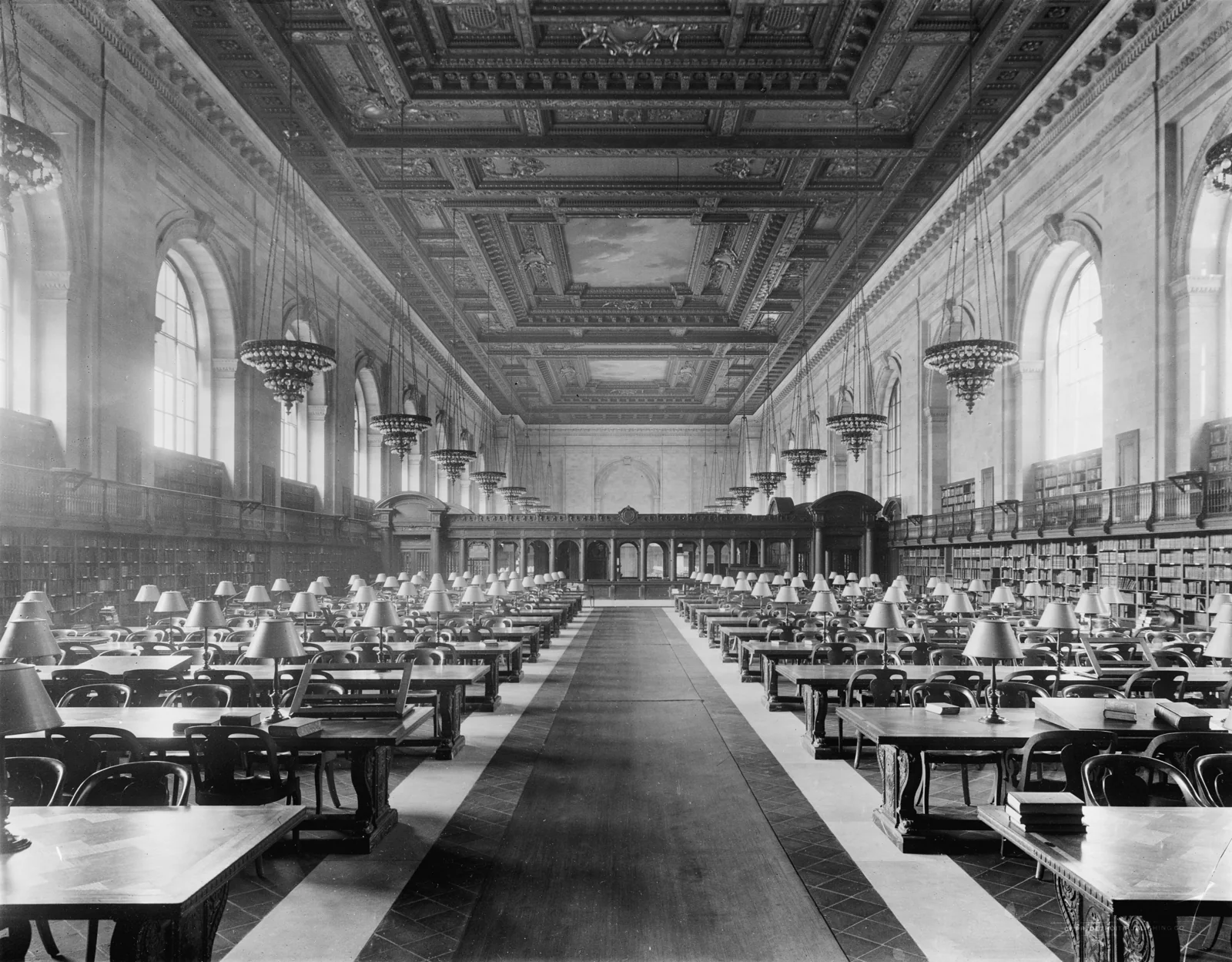
Two monuments to a reader’s life
Inside the Fifth Avenue library, the vast third-floor Main Reading Room offered seats at long oak tables for 768 readers, open free of charge to any citizen who filled out a call slip. Carved into the marble entablature high above the Fifth Avenue portico, Tilden’s name took its permanent place beside Astor’s and Lenox’s, accompanied inside by the words of his will dedicating the Tilden Trust: “To serve the interests of science and popular education.”
Down on Gramercy Park, Tilden’s home had already entered its second public life. Sold at estate auction in 1899 to his niece’s husband, Charles D. Sabin, and operated for six years as an upscale residential hotel known as “The Tilden,” the mansion at 14–15 Gramercy Park South was purchased in March 1905 by the National Arts Club—founded by New York Times critic Charles de Kay with architect George B. Post as president—and opened as its permanent clubhouse and gallery in November 1906. Today, whether beneath Donald MacDonald’s jeweled dome in Tilden’s former Gramercy library or beneath the clouds painted on the ceiling of the Fifth Avenue reading room, New Yorkers still gather inside the world that Samuel J. Tilden built.
Life at a glance
- Life
- February 9, 1814 – August 4, 1886
- Gramercy home
- 15 Gramercy Park South, acquired in 1863; later joined to No. 14
- Profession
- Lawyer, with a specialty in corporate and railroad reorganizations
- Governor of New York
- 1875–1876
- Presidential election
- Democratic nominee in 1876; won the recorded popular vote; lost the final electoral count, 185–184
- Enduring gift
- The Tilden Trust joined the Astor and Lenox libraries in 1895 to form the New York Public Library
Sources cited
- Legal career and reform. Historical Society of the New York Courts, “Samuel J. Tilden”: legal career, Tammany Hall, wartime politics, reform campaigns and the contested will.
- Election night on Gramercy Park. Francis Lynde Stetson, Samuel J. Tilden, the Great Democrat (1914), p. 12: his retrospective account of the election-night gathering at Tilden’s home.
- The Flagg case and the reformer at work. James C. Carter, “Mr. Tilden: An Appreciation” (1892), reprinted in John Bigelow, ed., Letters and Literary Memorials of Samuel J. Tilden, volume I (1908): the Flagg election case, Tweed investigation, governorship and nomination-day recollections.
- Letters, public affairs, and the last years. John Bigelow, ed., Letters and Literary Memorials of Samuel J. Tilden, volume II (1908): the canal investigating commission’s report (pp. 411–413), Tilden’s later interview on the presidency, Greystone, Theodore Shuey’s letter of February 1, 1885, and Tilden’s letter to Hiram Sibley of February 27, 1886.
- The disputed election and Electoral Commission. U.S. Senate, “The Florida Case”; and Sheila Blackford, University of Virginia Miller Center, “Disputed Election of 1876”: disputed returns, the Electoral Commission and the final count; “Rutherford B. Hayes: Campaigns and Elections,” University of Virginia Miller Center: the commission’s composition.
- Reconstruction and voting rights. Eric Foner, “Reconstruction”, National Park Service: Black political participation, white supremacist violence and the withdrawal of federal protection.
- The National Arts Club and Tilden’s house. The National Arts Club, “Mission + History”: Tilden’s Gramercy Park home, its artists and the Club’s move in 1906.
- The public library and its readers. The New York Public Library, Handbook of The New York Public Library (1916): consolidation, the main building, inscriptions and arrangements for readers.
- The Tilden Trust records. The New York Public Library, Tilden Trust records: the library provision in Tilden’s will and the Trust’s role in the founding of the Library.
- Architecture and the façade. Historic Districts Council, “Samuel Tilden House”: Vaux & Radford’s 1881–84 remodeling and Victorian Gothic design; photographic documentation of the façade: its five named portrait medallions. Kevin Walsh, “20th Street East to West,” Forgotten New York (2020): the rolling steel protection behind the windows.
- Tilden’s private library. Helen E. Freedman, “Samuel Jones Tilden: Lawyer, Statesman, and Victim of Fate,” Judicial Notice 18 (2023): the scale of Tilden’s private library.
- The contested will. Tilden v. Green, 130 N.Y. 29 (1891): the Court of Appeals ruling on the charitable provision; “The Charitable Corporation and the Charitable Trust”: the approximate five-million-dollar charitable bequest.
- The settlements and surviving bequest. The New York Public Library, Book of Charters, Wills, Deeds and Other Official Documents (1905), pp. 89–99: the May 1891 agreement with Laura P. Hazard and the March 1892 partition; Guide to the Tilden Trust Records: the litigation, settlements and retained collections.
- Building notices and Gramercy Park history. Real Estate Record and Builders’ Guide, May 28, 1881 (p. 564, Plan No. 744) and July 9, 1881 (p. 694, Plan No. 945, Vaux & Radford’s $50,000 unification of 14–15 Gramercy Park South); The New York Times, December 17, 1868 (burglary at Nos. 13 and 15 Gramercy Park) and August 6, 1905 (George W. Smith’s letter explaining the house’s interior stair and furnace duct); and John B. Pine, The Story of Gramercy Park, 1831–1921 (New York: Gramercy Park Association, 1921).
- Gramercy Park’s cultural and literary context. Carole Klein, Gramercy Park: An American Bloomsbury (Boston: Houghton Mifflin Company, 1987), pages 159–162, documenting Tilden’s 1876 election night with Abram S. Hewitt, his private library of rare books and Jefferson manuscripts, his reading of more than four hundred books in his final four years, and the National Arts Club’s 1906 move into his mansion.
Image credits
- Samuel J. Tilden, about 1870 (hero portrait). Photograph by José María Mora; collection of The New-York Historical Society / Wikimedia Commons. Public domain.
- Painted portrait of Samuel J. Tilden, c. 1870. Oil on canvas by Thomas Hicks (1823–1890); National Portrait Gallery, Smithsonian Institution (NPG.76.1). Public domain.
- “Who Stole the People’s Money?” (August 19, 1871). Wood engraving after Thomas Nast, Harper’s Weekly, August 19, 1871; Library of Congress, Prints and Photographs Division (LC-DIG-ds-16081). Public domain.
- National Democratic Chart for Tilden and Hendricks (1876). Lithograph by H. H. Lloyd & Co.; Library of Congress, Prints and Photographs Division (LC-DIG-pga-02044). Public domain.
- Tilden receiving election returns in his parlor at 15 Gramercy Park (November 1876). Wood engraving in Frank Leslie’s Illustrated Newspaper, November 25, 1876; Susan H. Douglas Political Americana Collection, Cornell University Library. Public domain.
- “Honest Sam. Tilden” Campaign Song and Chorus (1876). Sheet music cover published by John Church & Co. and Root & Sons; Library of Congress, Prints and Photographs Division (LC-USZ62-89311). Public domain.
- The National Arts Club at 14–15 Gramercy Park South. Gramercy Park Block Association archive.
- Donald MacDonald’s 1883 stained-glass dome above Tilden’s former library. Courtesy of The National Arts Club.
- Main Reading Room of the New York Public Library, c. 1911. Photograph by Detroit Publishing Company; Library of Congress, Prints and Photographs Division (LC-DIG-det-4a24347). Public domain.