
The Irving
26 Gramercy Park South · The hotel that had to prove it was a home
Before the Irving welcomed its guests, its neighbors had a question for the courts: was a hotel a house?
It was a consequential question on Gramercy Park. Samuel Ruggles had protected his residential square with restrictions on what could be built around it. A hotel threatened to test those protections. The neighbors called meetings, subscribed money and went to law. On this particular square, even the definition of a dwelling required counsel.
The building survived the objection. Its later occupants included a radical cartoonist, a Cuban painter and a veteran of burlesque.
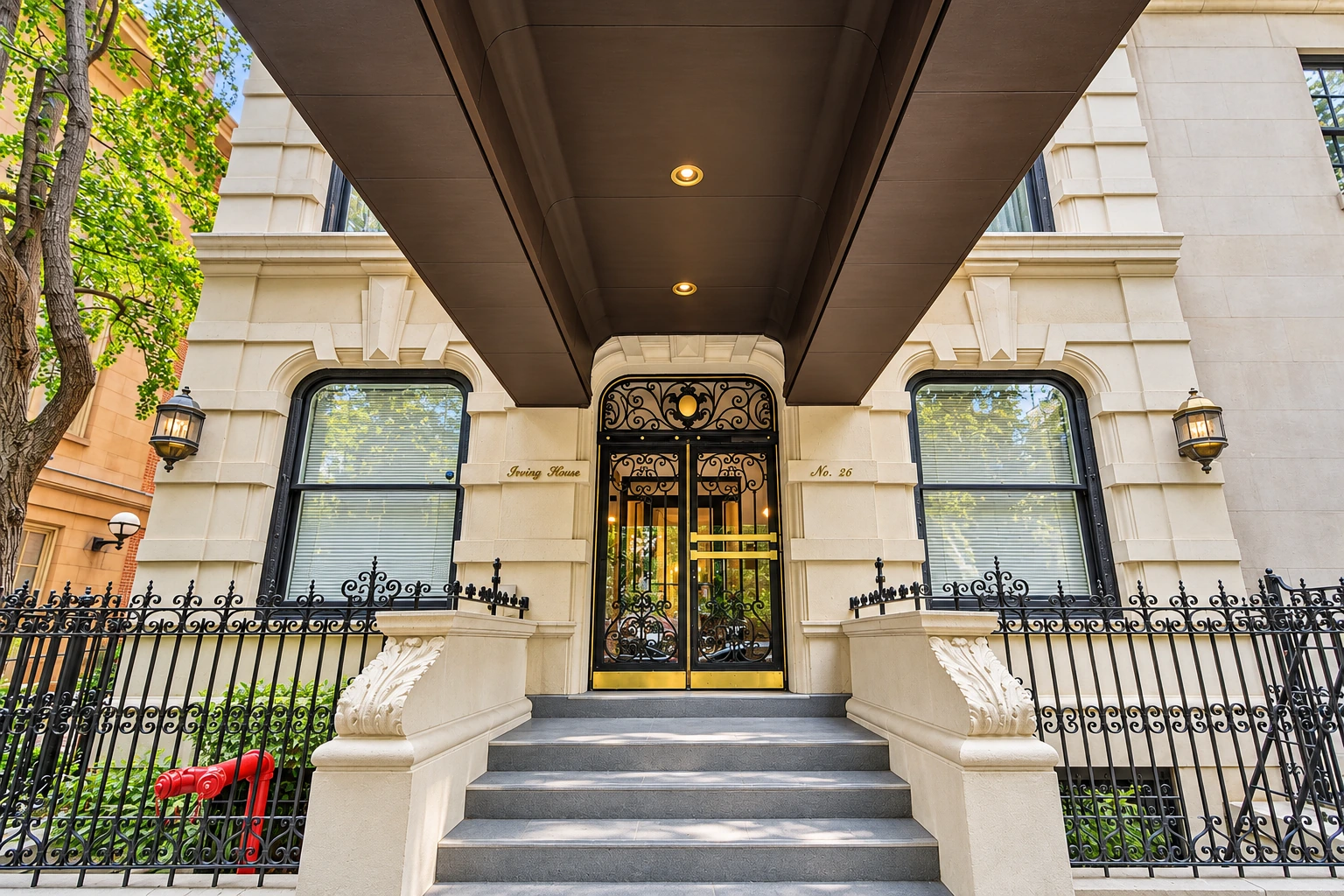
A hotel, or a dwelling house?
Ruggles’s deed required the buildings within forty feet of the fronts of the surrounding lots to be brick or stone dwelling houses, at least three stories high. It also restricted business and offensive uses. The Trustees and adjacent lot owners could take legal proceedings to enforce the covenant.
That last provision mattered. The protection of the neighborhood did not depend solely on the Trustees deciding what they would permit. An individual owner could bring a case.
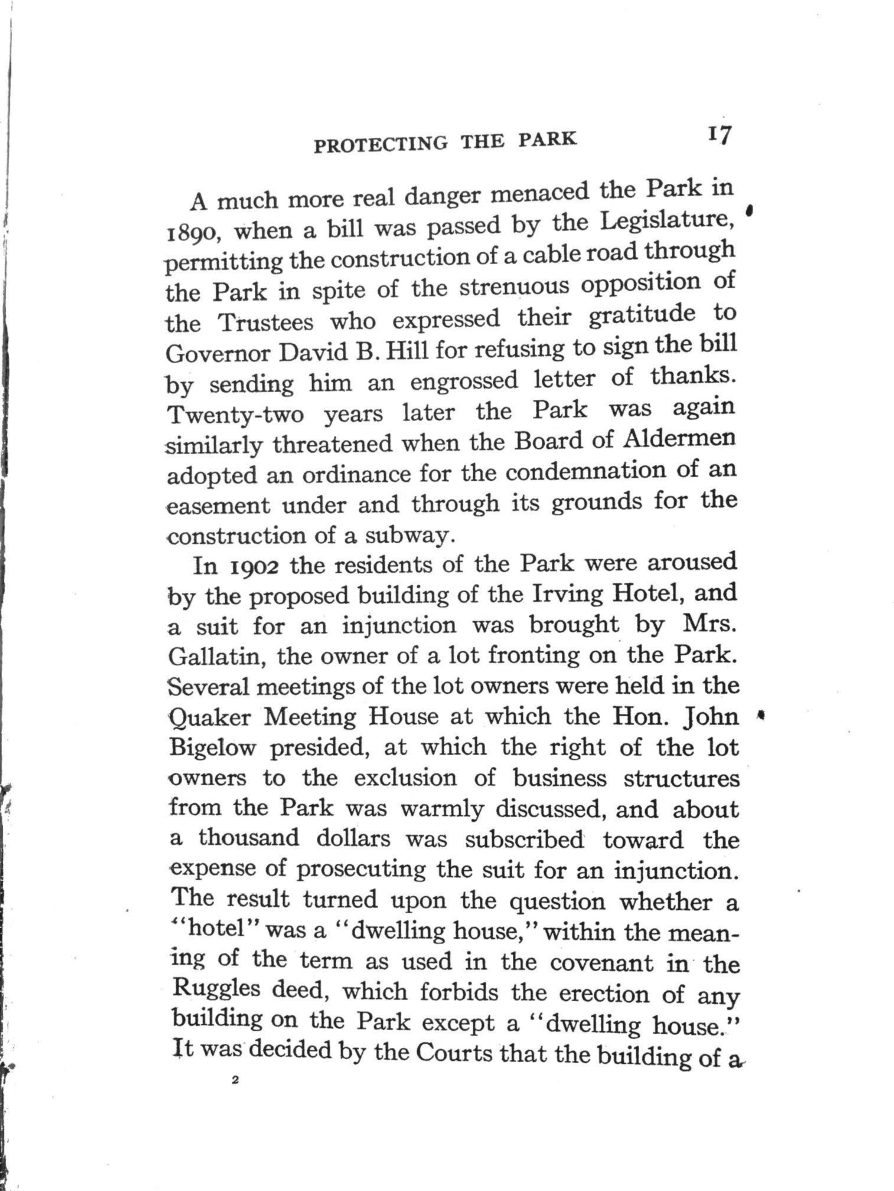
In his 1921 history of the Park, John B. Pine dates the challenge to 1902. Mrs. Gallatin, who owned a lot facing the Park, sought an injunction against the proposed Irving Hotel.
Other owners rallied behind the suit. They met several times at the Quaker Meeting House, the building now occupied by the Brotherhood Synagogue. John Bigelow presided. About $1,000 was subscribed toward the legal expenses, and the question of keeping business structures off the Park was, in Pine’s tactful phrase, “warmly discussed.”
The case turned on the meaning of “dwelling house.” A hotel was a business, certainly. But a private family hotel divided into residential apartments was also a place where people lived. According to Pine, the courts accepted that distinction: this kind of hotel did not violate the covenant.
The right to exclude business occupation remained recognized. The neighbors had lost their effort to stop the Irving without losing the underlying protection altogether.
The distinction outlived the immediate dispute. In a 1915 decision concerning restrictions in Murray Hill, New York’s Court of Appeals cited Gallatin v. Blake Building Realty Co., the Gramercy case, while explaining why “dwelling house” need not mean a house occupied by only one family.
The Irving could have residents, a management and a hotel name. Legally, it could still be a dwelling.
A family hotel, with characters
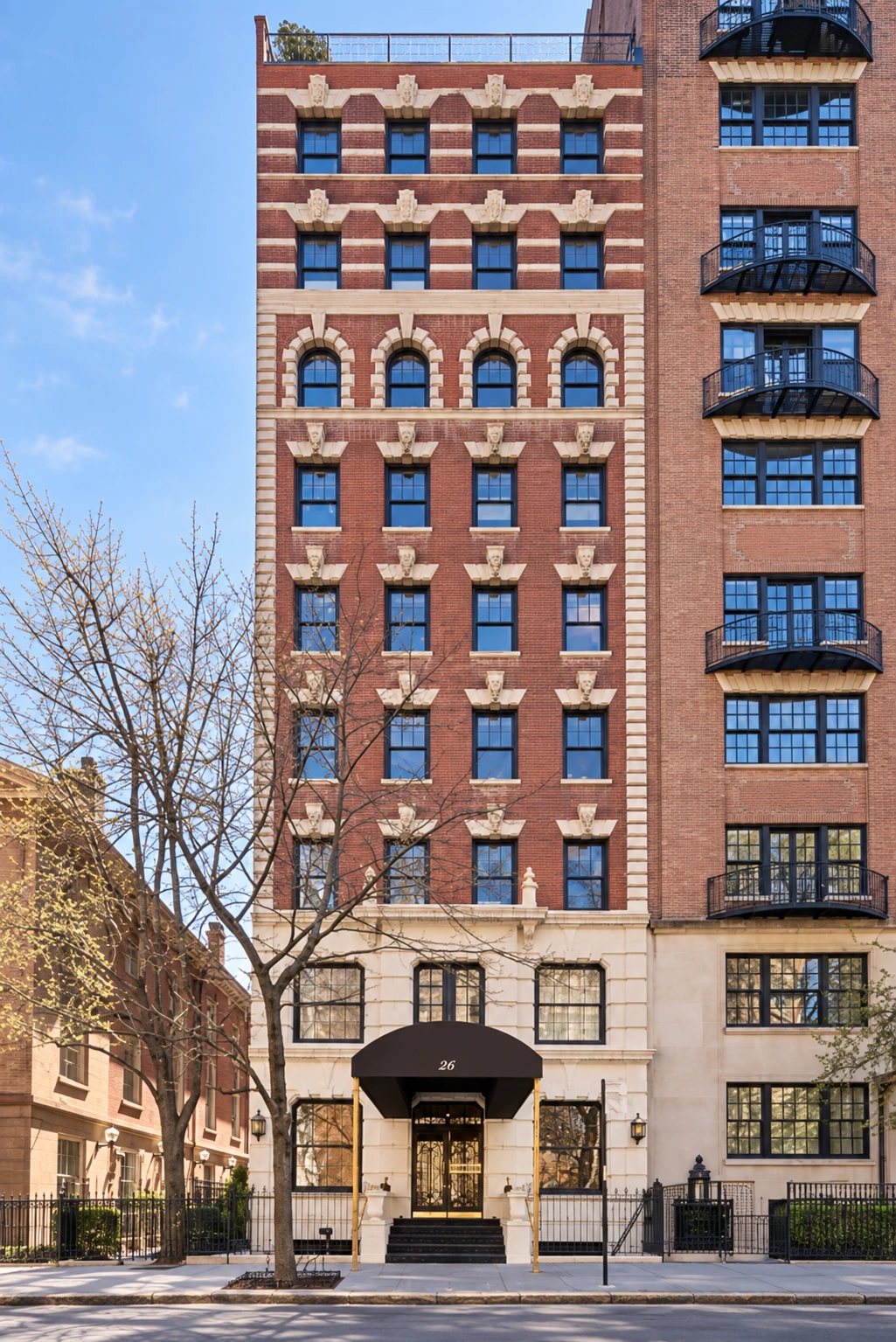
The ten-story building, generally dated to 1903, reaches through the block to East 19th Street. It offered the Park on one side and the quieter residential street on the other.
A 1915 advertisement in the New-York Tribune called it a “high class family hotel” and offered a parlor, bedroom and bath. Blake Brothers were listed as managers. The emphasis was on a suite in which to settle, rather than simply a bed for the night. Those words in the advertisement also explain the distinction that had mattered in court.
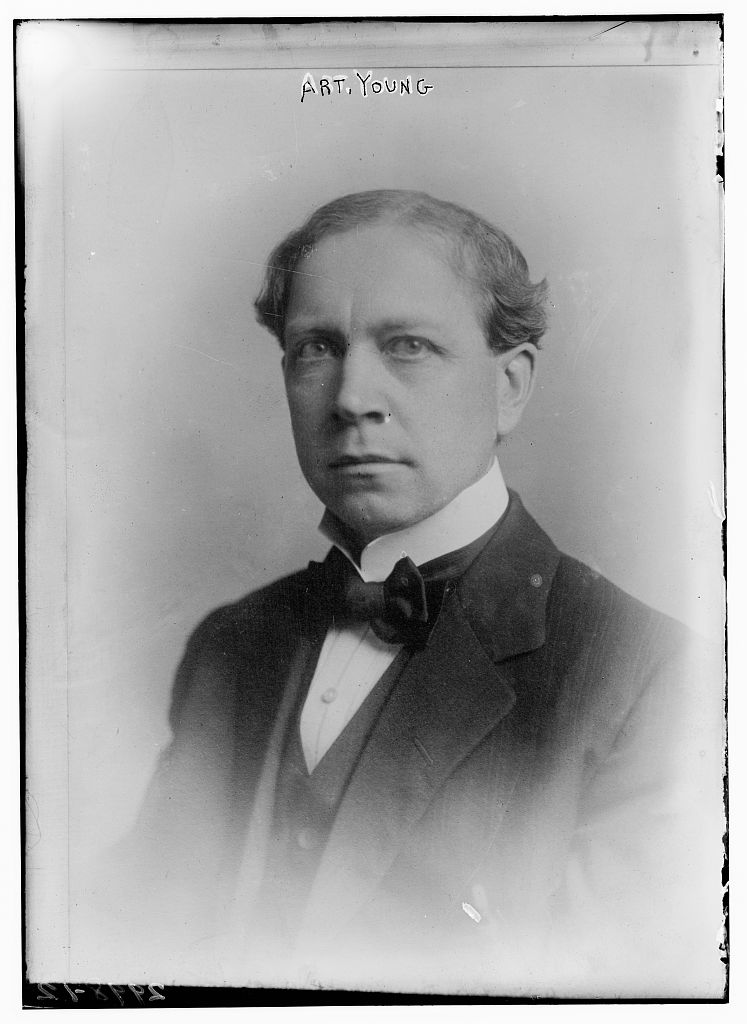
Art Young’s last round of postcards
Political cartoonist Art Young spent his final years here. A 1944 New Yorker remembrance describes his last evening: distributing New Year’s cards among several mailboxes, sparing any single postman the burden. His mailing list ran to 1,200 friends.
Young returned to the hotel and died that night, December 29, 1943. A considerate final errand for a famously combative cartoonist.
Headlines and ordinary lives
In August 1958, a killing brought the Irving into the newspapers. Cartoonist Bob Wood killed Violette Phillips, a 45-year-old advertising-agency secretary, in the hotel. Wood had helped create Crime Does Not Pay, a title the press repeatedly invoked in its coverage. He was subsequently sentenced to three years in prison.
A painter’s temporary address
Five years later, the Irving provided a landing place for Carmen Herrera and her husband, teacher and writer Jesse Loewenthal. They had planned to settle in Madrid, changed their minds and returned to New York on December 9, 1963.
Mónica Espinel’s chronology for Carmen Herrera: Lines of Sight places them temporarily at the hotel. In 1964 they moved to 118 East 19th Street. The hotel stay was brief; East 19th Street would remain part of their New York life.
The man with three hundred songs
In 1965, The New Yorker visited burlesque comic Steve Mills at his Irving apartment. Still performing at 69, he produced photographs, skits and a list of more than 300 songs, singing samples for his visitor. Around the room stood secondhand clocks; one worked only when laid face down. The apartment was a small theatrical archive with its own performer.
From hotel suites to cooperative apartments
The residential-hotel world was changing. In a 1977 newspaper investigation later reprinted by a Senate committee, reporter Joseph Berger placed the Irving among a group of “faded, but still genteel hotels.” He distinguished them from other properties he described in much harsher terms.
Cooperative conversion followed in 1986. The building is now known as the Irving, with apartments behind the facade that appears on the old hotel postcard.
The sign and the ownership have changed. The court’s central point—that people could make their homes inside a hotel—has worn rather well.
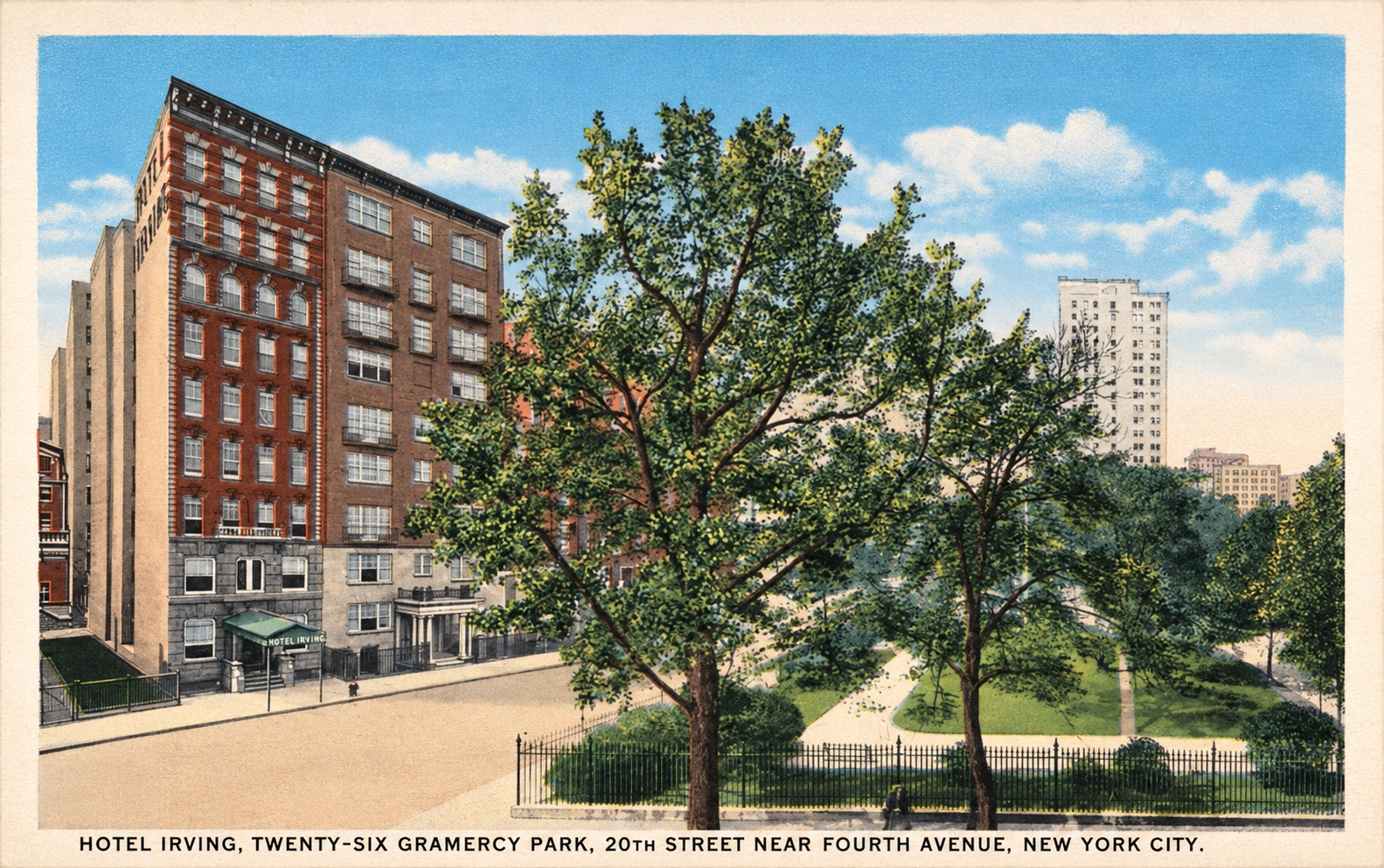
The building at a glance
- Address
- 26 Gramercy Park South · 133 East 19th Street
- Historic name
- Hotel Irving / Irving Hotel
- Construction
- Generally dated to 1903
- Height
- Ten stories
- Original use
- Residential family hotel
- Cooperative conversion
- 1986
Sources & further reading
- The Story of Gramercy Park, 1831–1921, John B. Pine, 1921, pp. 6–7 and 17–18. The deed’s restrictions, enforcement rights and the hotel challenge. Pine identifies the plaintiff and the lot owners’ meetings; he does not describe a collective purchase proposal.
- Reformed Protestant Dutch Church v. Madison Avenue Building Co., New York Court of Appeals, February 25, 1915. This later Murray Hill decision cites the Gramercy Gallatin case; it is not the original judgment against the Irving proposal.
- Hotel Irving advertisement, New-York Tribune, August 29, 1915. Library of Congress.
- “Backward Boy”, Andy Logan and Russell Maloney, The New Yorker, January 15, 1944 issue. Young’s last years and final evening. Subscription may be required.
- Bob Wood, David Saunders, Pulp Artists, 2019. Includes contemporary newspaper clippings. Sidney Kline’s Daily News report of August 28, 1958 identifies Violette Phillips and the Hotel Irving. Some later retellings give a different victim’s name; this account follows the contemporary report.
- Carmen Herrera chronology, Mónica Espinel, in Carmen Herrera: Lines of Sight, 2016, p. 204. Her temporary hotel stay in December 1963 and subsequent East 19th Street address.
- “Comic”, James Stevenson, The New Yorker, April 17, 1965 issue. A visit to Steve Mills’s apartment at the Irving. Subscription may be required.
- Single Room Occupancy: A Need for National Concern, Senate Special Committee on Aging, 1978, appendix 4, p. 45. Reprints Joseph Berger’s July 11, 1977 New York Post article. The Irving is among the properties expressly distinguished from the deteriorated hotels discussed afterward.
- The Irving building record, CityRealty. Height, through-block addresses and the commonly reported 1903 construction date. Property listing for the 1986 cooperative-conversion date. Listings disagree on some building details; no architect or apartment count is asserted here.