
Brotherhood Synagogue
A meeting house, a refuge and a very close call
28 Gramercy Park South · 144 East 20th Street
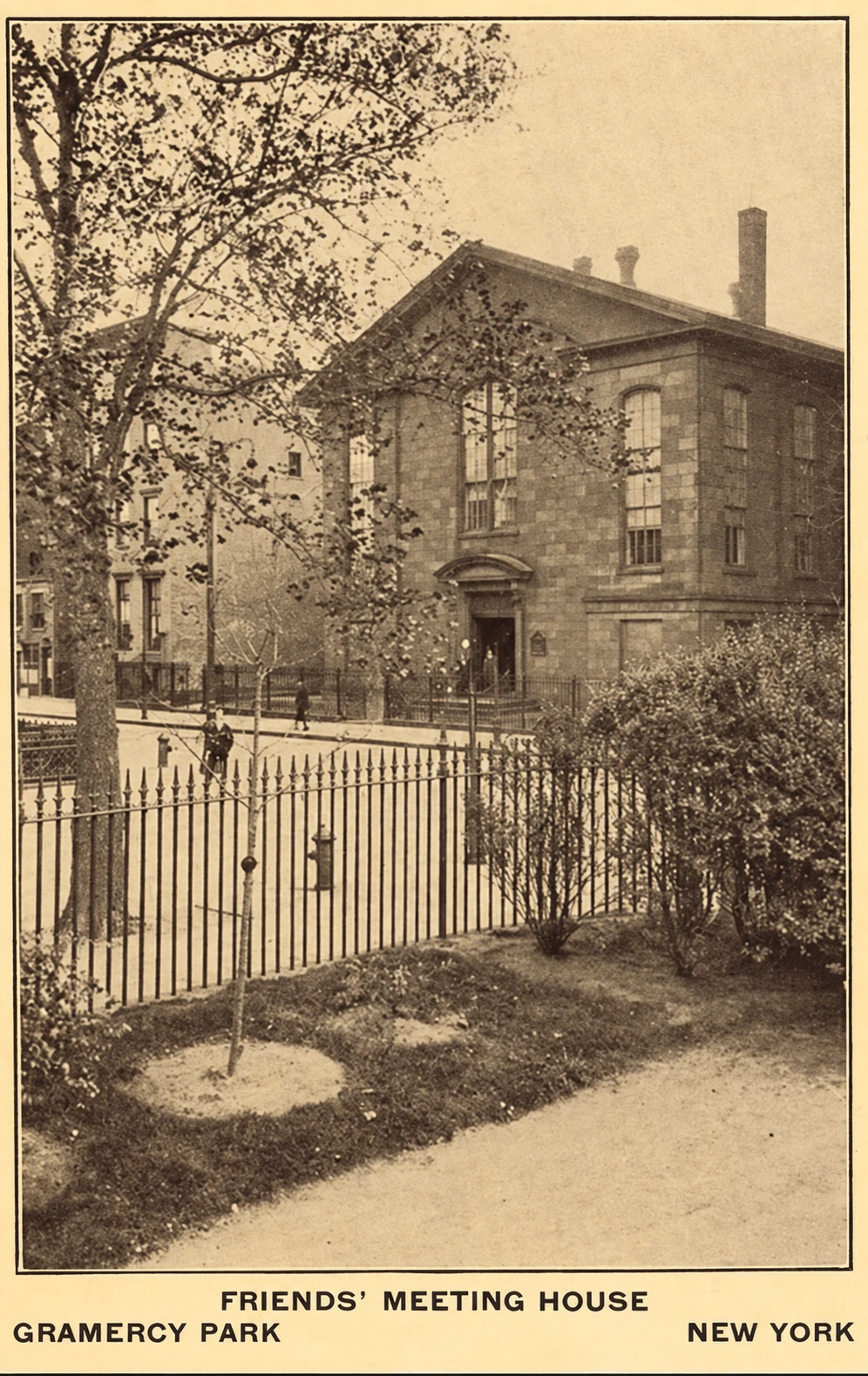
In 1965, a developer proposed replacing the Friends Meeting House at 28 Gramercy Park South with a thirty-story apartment building. The low stone meetinghouse had been there for more than a hundred years. Gramercy was not prepared to let it go.
Winning landmark protection did not settle the building’s future. A performing-arts proposal fell through; another owner came and went. By 1975, leaks had brought down plaster inside, and the room needed extensive repairs.
Meanwhile, a Jewish congregation that had spent almost twenty years sharing a Presbyterian church was looking for a home. Brotherhood needed a building. The old meetinghouse needed a congregation willing to take it on.
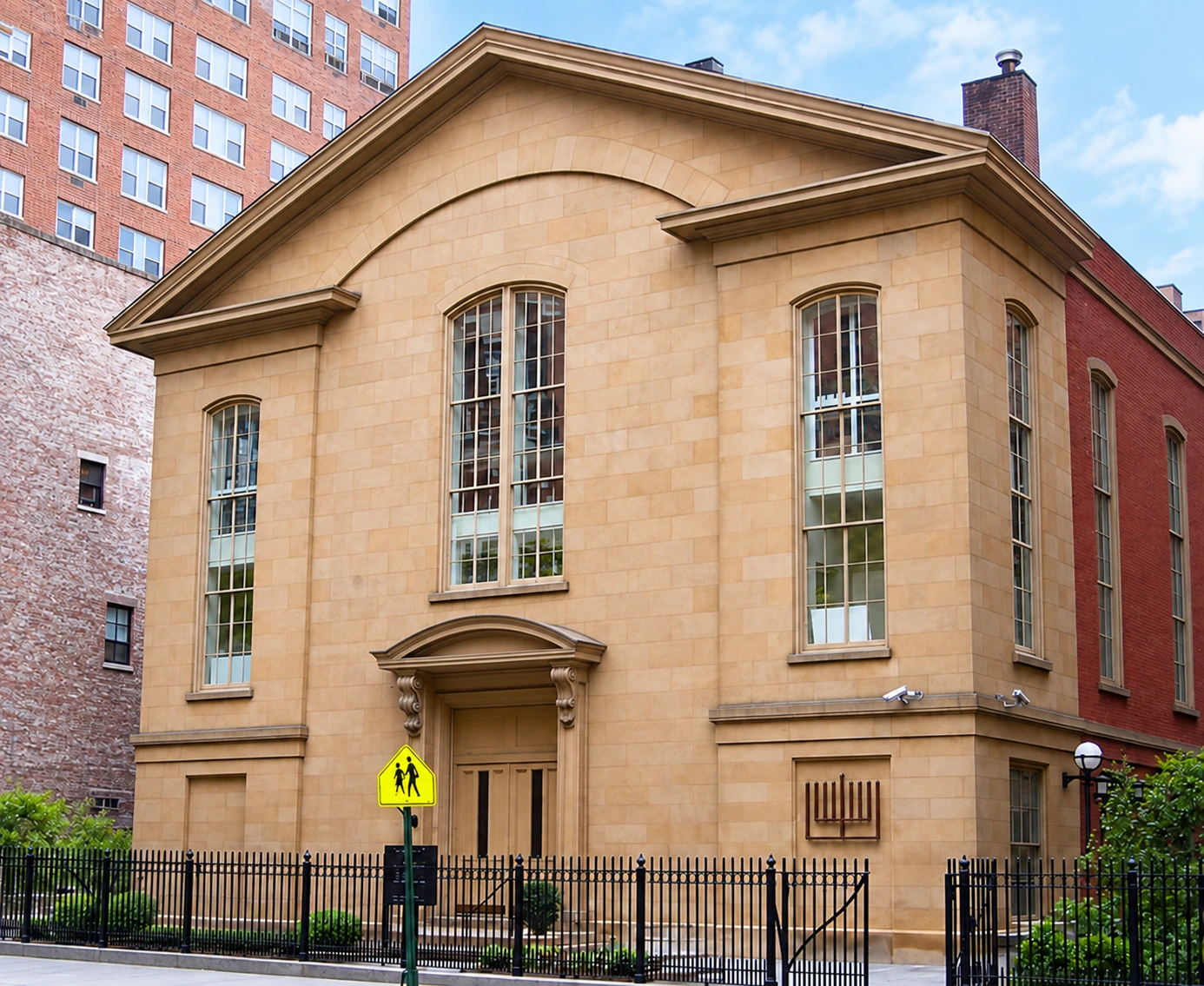
Good proportions. No useless ornament.
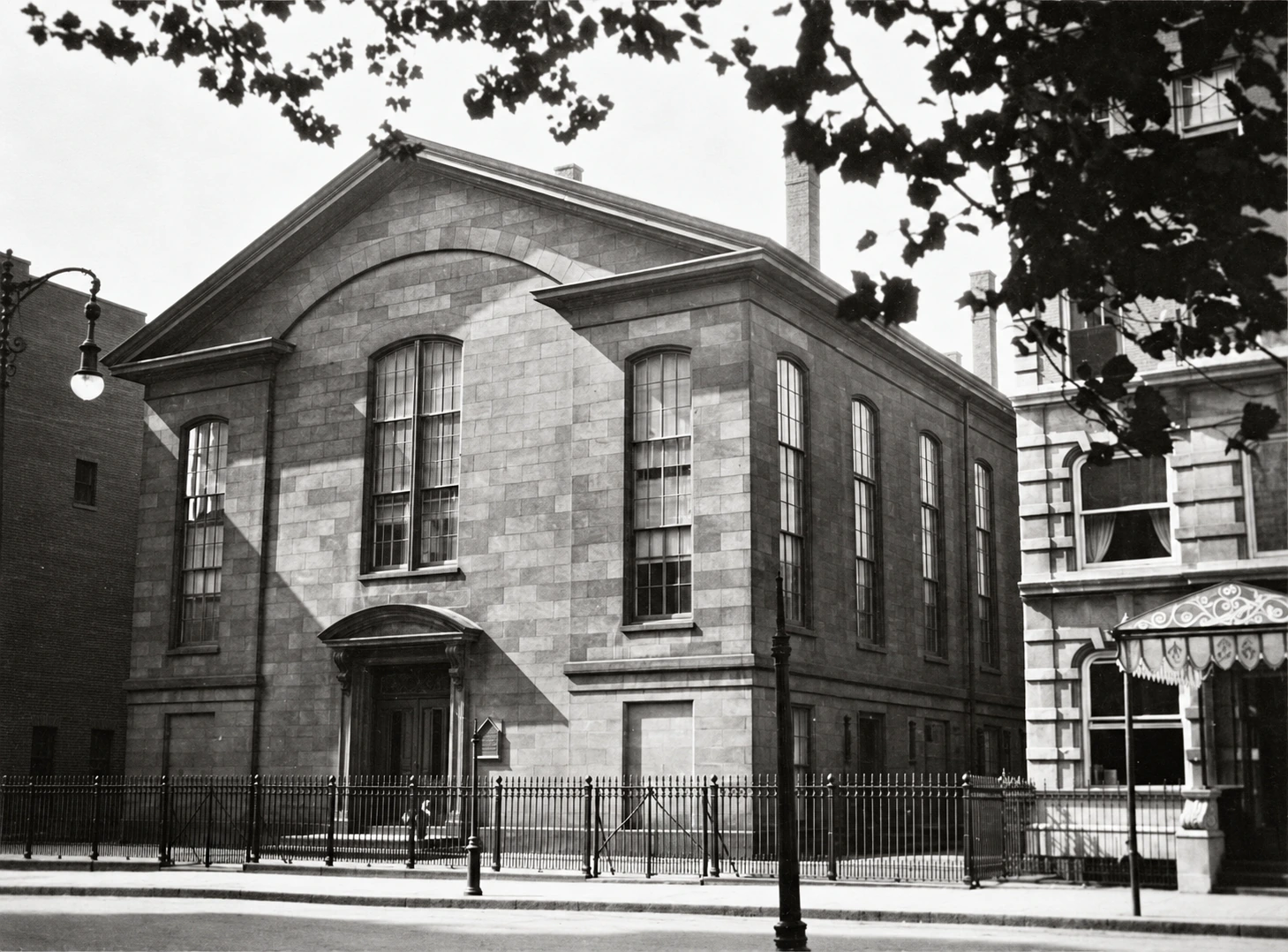
The Society of Friends, generally known as the Quakers, commissioned Gamaliel King and John Kellum to design the meetinghouse completed in 1859. The architects gave them an Anglo-Italianate building: a broad classical pediment, tall windows and a carefully measured facade. The Landmarks Commission’s designation report would later praise the discipline of its design. There is very little here that is simply showing off.
The Friends had been clear about that. Their building committee wanted good proportions while “avoiding all useless ornament.” A pediment was evidently useful. So were the generous windows. The building manages to be solemn without looking forbidding, an achievement easier to admire than to reproduce.
The synagogue’s architectural history describes a structure combining heavy timber with iron posts and beams, light brick behind a facade of Dorchester Olive stone. Its large wooden entrance is sheltered by a curved pediment. The broad triangle above finishes the composition; the smaller curve below brings it down to the scale of a person arriving at the door.
The Friends needed special permission to put a nonresidential building on the Park. Behind the gate, a small forecourt separates the house from the sidewalk. That pause before the entrance still distinguishes it from its neighbors.
The Friends had moved north through several Manhattan addresses. Their Henry Street meetinghouse was sold to Anshe Chesed in 1840; from there they went to Orchard Street, then briefly to a chapel on Fifth Avenue before reaching Gramercy. The Landmarks Commission’s account records the earlier sale. This would not be the first Quaker building to become a synagogue.
Inside, two curving staircases with mahogany handrails rise to the main room. The Sacred Space International guide describes twelve tall, clear windows and a gallery carried on twelve iron columns.
The wooden pews came from the Friends’ earlier meetinghouse on Orchard Street. They were already used furniture when they arrived at this brand-new address.
A quiet room with a complicated history
The Gramercy meeting belonged to the Orthodox branch of the Friends. The name describes a division within Quakerism; it has nothing to do with the Jewish congregation that would arrive much later. New York Friends had separated into Orthodox and Hicksite groups in 1828. For generations they maintained different meetings and properties.
Nancy Hadley-Jaffe’s history for New York Quarterly Meeting, drawn from its records, follows their gradual reunion in the 1950s. The two branches reunited at the yearly-meeting level in 1955; local arrangements took more work. By 1958, worship at the Gramercy meetinghouse had been discontinued as the Friends came together at Fifteenth Street and Stuyvesant Square. A religious reconciliation created a real-estate problem.
The room had seen smaller reconciliations long before that. Historian Tom Miller recounts an 1897 newspaper report about a letter from Philadelphia Friends, arriving after roughly fifty years of estrangement. New York’s meeting debated whether a general letter required a reply. Eventually it recorded its pleasure in the minutes and sent a copy to Philadelphia. Even making up could require careful paperwork.
Miller also found a less formal resident in Meyer Berger’s 1956 newspaper column: a tortoise that apparently wintered somewhere at the meetinghouse. Neighbors fed it. Its reappearance from the shrubbery was the sexton’s sign that spring had arrived. No committee seems to have been required.
The Underground Railroad connection
Brotherhood’s own history identifies the building as a stop on the Underground Railroad. Its account of the meetinghouse says Friends sheltered people escaping slavery on the second floor and describes a surviving passage beneath the building as an escape route. It also records members’ work establishing trade schools for formerly enslaved people in the South.
The National Park Service’s history places Black communities and vigilance committees at the center of this wider network. Quaker assistance belonged within a much larger effort, sustained above all by people seeking their own freedom.
Brotherhood preserves the upstairs refuge and passage as part of its building’s history. Its published account does not identify the people sheltered here or document particular journeys through the passage.
The apartment tower that never arrived
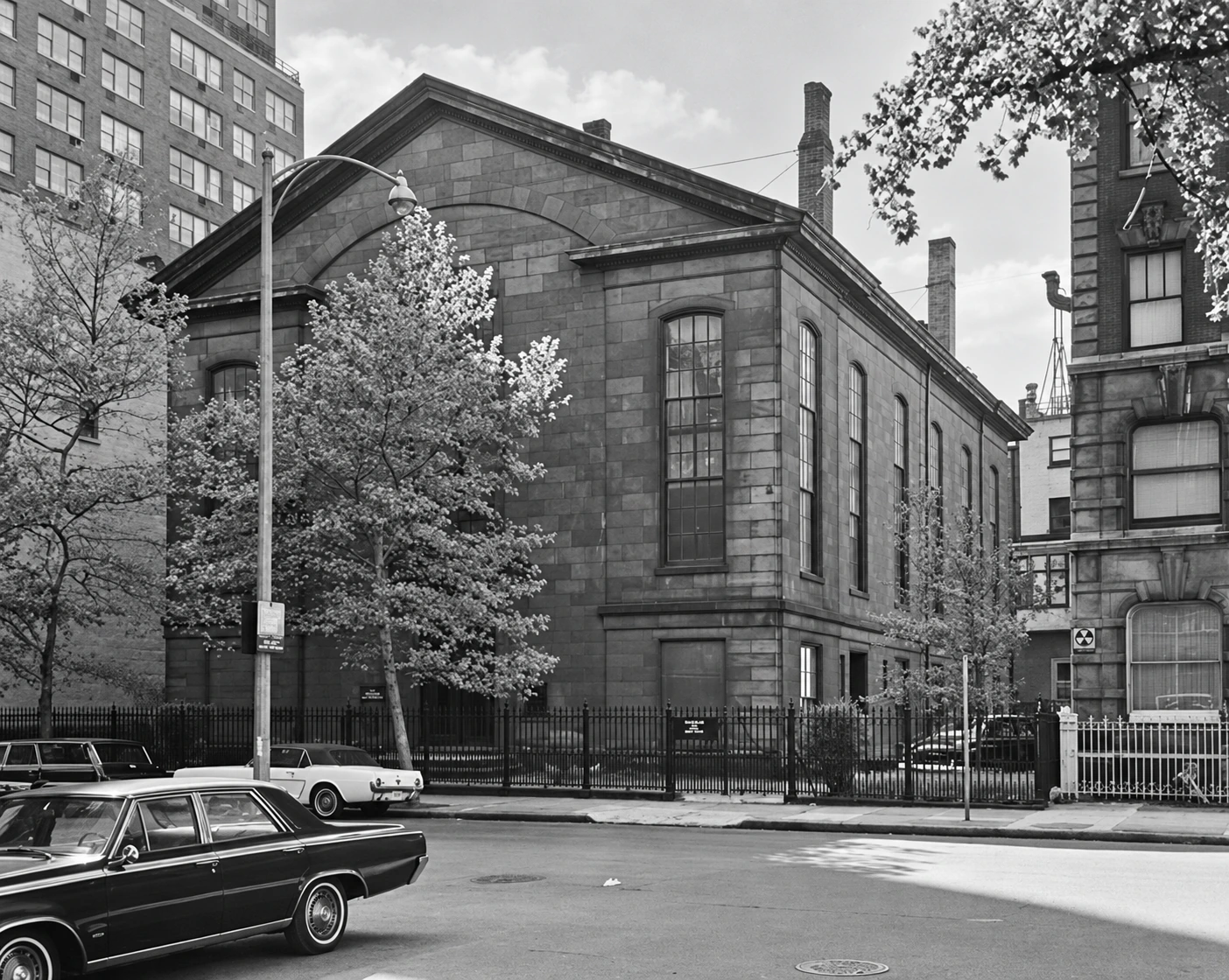
A large site on Gramercy Park did not have to advertise its possibilities. Ada Louise Huxtable later reported that a developer received an option in 1965 to replace the meetinghouse with a thirty-story apartment building.
The original landmark report makes unusually vivid reading. At the September 21 hearing, fifteen witnesses supported protection. Representatives of the owner and the contract purchaser opposed it. More than seventy-five letters and telegrams arrived in support, along with numerous telephone messages. The building was designated on October 26, 1965, in the opening months of the city’s new landmarks law.
Frank Gilbert, the commission’s first secretary and later executive director, remembered the hearing in his 2011 oral history. A commissioner beside him marveled at the apparently spontaneous public support. Gilbert pointed out the lawyer at the back of the room who had worked hard to organize it. The enthusiasm was real; so was the preparation.
Gilbert credited Benjamin Sonnenberg, who lived nearby at No. 19, with leading the neighbors’ effort. He also remembered the difficulty of obtaining a necessary signature from someone who was away. Even a landmark campaign could be held up by one missing signature.
Protection did not immediately produce a permanent use. A proposed performing-arts center fell through. The United Federation of Teachers acquired the property for meetings and offices, then decided to sell. The building remained standing, and continued to deteriorate.
A rabbi and a minister share an address
Brotherhood began on May 12, 1954, when Rabbi Irving J. Block and twenty-five men and women founded Congregation Beit Achim. The congregation’s seventieth-anniversary account sets out five founding principles: freedom of the pulpit, freedom of the pews, social service, community service and practical cooperation across religious lines.
The first two were quite precise. The rabbi could speak according to conscience rather than present an official congregational opinion. A person’s place at worship, particularly on the High Holy Days, should not depend on buying a ticket. Block summarized the pulpit’s independence as speaking to, and not for, the congregation.
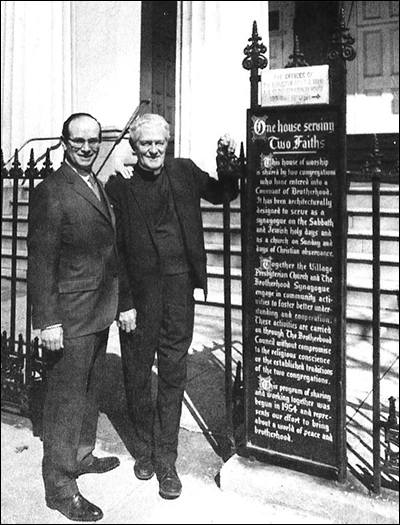
For its first two decades, Brotherhood shared the Village Presbyterian Church on West 13th Street. Block’s friendship with its minister, the Rev. Dr. Jesse W. Stitt, made the arrangement much more than a rental. The congregations kept their own religious identities while working together in the arts and social action. The sign outside made the arrangement wonderfully plain: One house serving two faiths.
The congregation’s history treats this partnership as central to its founding purpose. Jewish worship and learning belonged alongside an active concern for people beyond the membership. The name Brotherhood described work the congregation intended to do.
The partnership did not survive indefinitely. After Stitt’s death, relations with his successor deteriorated. A March 1974 report by the Jewish Telegraphic Agency traced the final break to a public disagreement during the 1973 Yom Kippur War: Block posted a message supporting Israel, and the minister answered with a critical notice in the church bulletin. The formal sharing arrangement ended that November.
Brotherhood planned to leave with a Torah procession on March 19, 1974. Two Village congregations, Derech Amuna and Emunath Israel, offered temporary space without charge. Block said Brotherhood would contribute toward upkeep. There would be Friday-night worship in one location and Sabbath-morning services in the other, while classrooms and offices occupied rented quarters nearby.
Brotherhood needed space for worship, school and the ordinary business of a congregation. The old meetinghouse on Gramercy Park could accommodate all three.
A landmark needs plumbing, too
Brotherhood found its new home in 1974–75. In her June 15, 1975 account, Huxtable put the purchase price at $420,000. Architect James Stewart Polshek and contractor Lawrence Held and Son worked without fees.
The structure was sound, but leaks had brought plaster down inside. New plumbing, wiring and lighting were needed; windows required repair. Polshek chose pale blue walls with creamy-white trim, letting the room’s proportions carry the result.
Money remained tight. Air conditioning could wait. Huxtable reported that construction workers were coming to Friday-night services.
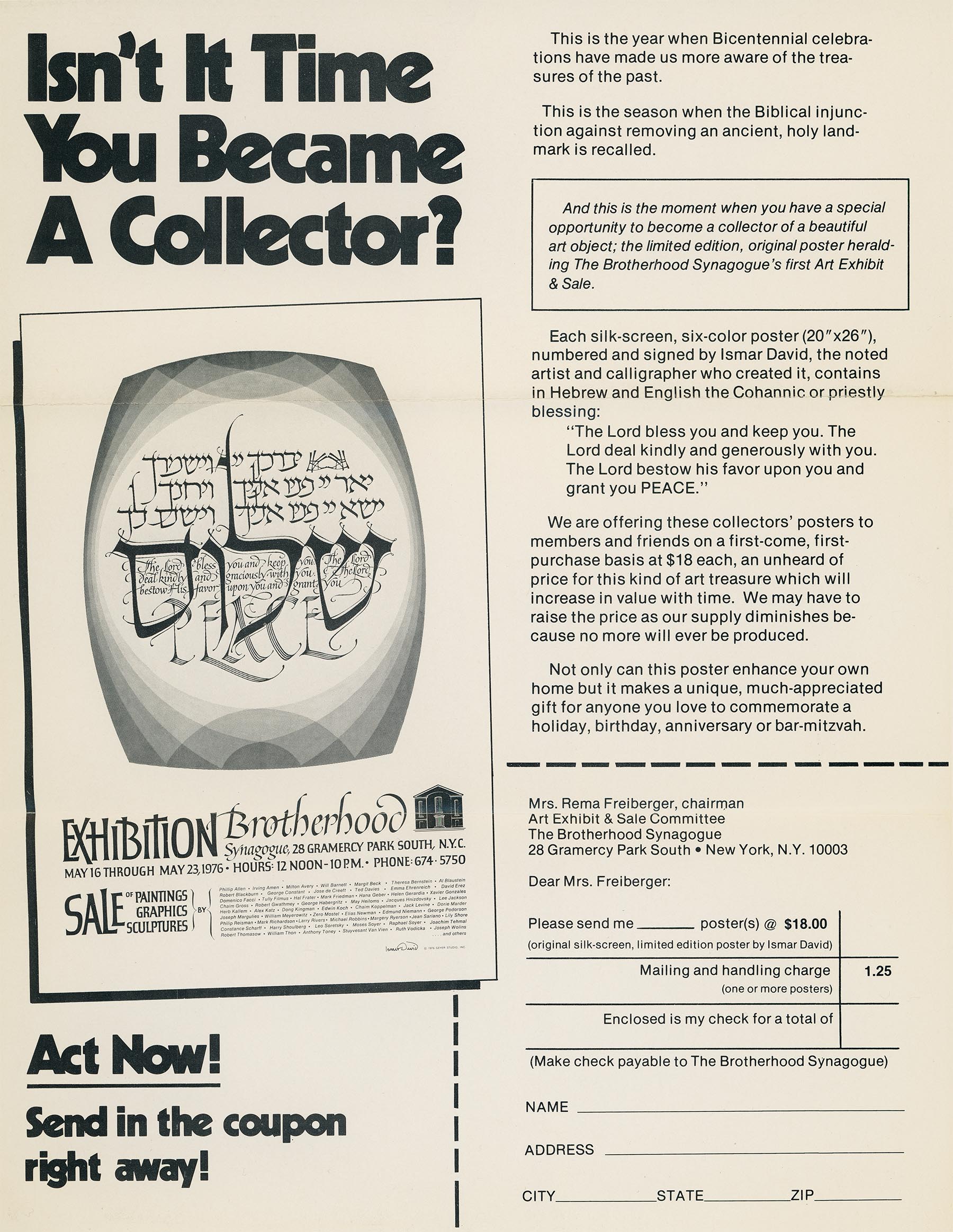
Fundraising continued. In 1976, artist and designer Ismar David created a silk-screen poster for an exhibition and sale benefiting the synagogue. The surviving flyer asks its reader to become a collector, then supplies a coupon. A handsome building still needed its bills paid.
This was the less photogenic part of preservation: a budget, donated professional time, repairs and repeated appeals. Without it, the victory of 1965 would have left Gramercy with an increasingly fragile building and no settled future.
A Jewish sanctuary within the Quaker room
The work continued after the initial restoration. The Sacred Space International guide records a 1987 renovation by M. Milton Glass, adding an elevator and educational facilities.
In 1994, Brotherhood turned again to Ismar David, this time for the sanctuary. His archive chronology dates the inauguration of the design to June 10. David’s career had long moved between lettering, books and architectural work; decades earlier he had developed the Hebrew type family that bears his name.
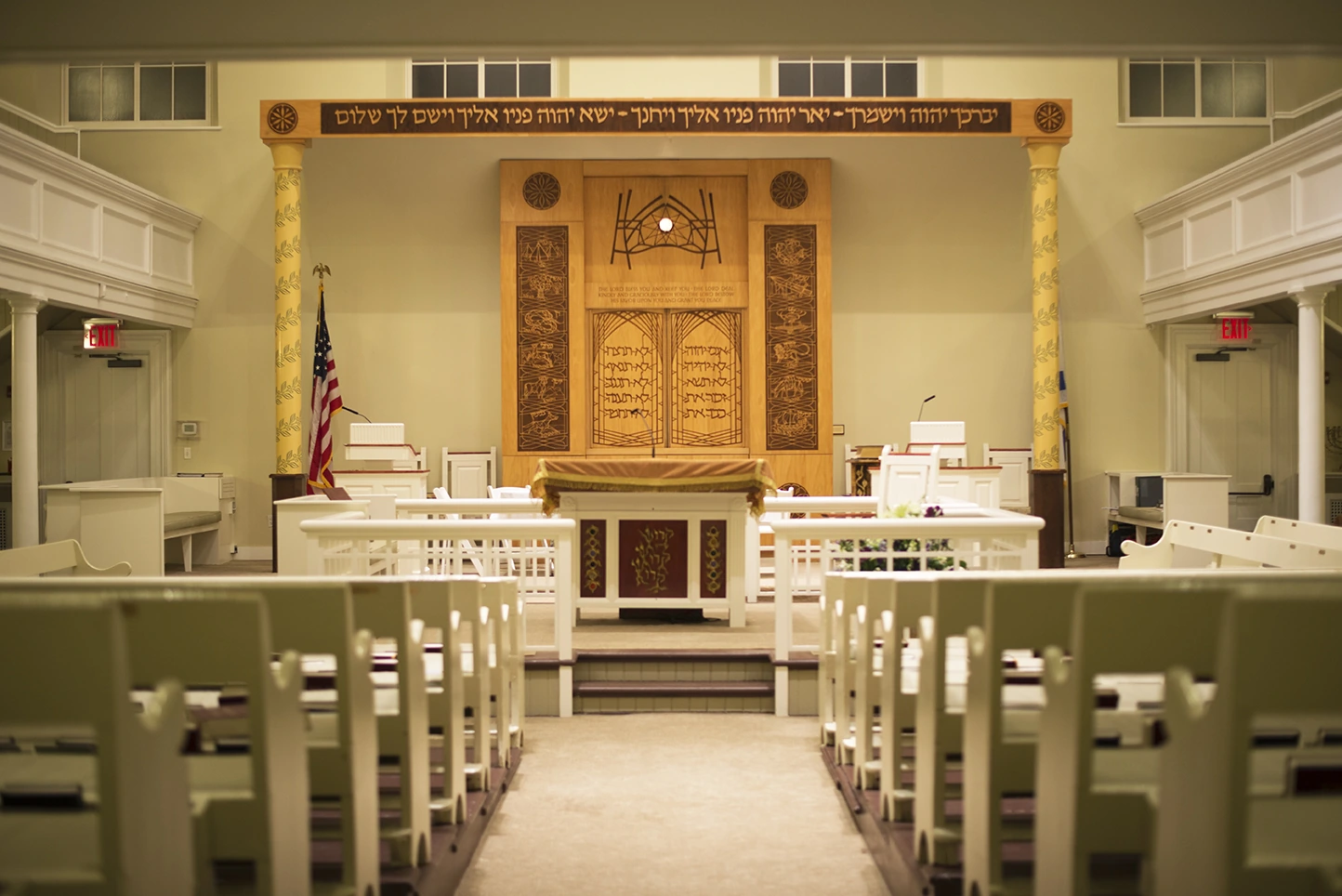
The archive’s description of his scheme explains how it incorporated the old Quaker sounding board, the curved canopy intended to help carry a speaker’s voice. The ark’s wood marquetry introduced the Ten Commandments, the twelve tribes of Israel and a blessing in Hebrew and English. Laser-cut veneers helped translate intricate drawings into wood.
The design gave the room a clear Jewish focus while working with its spare architecture. The archive also records a loss: during a later renovation, parts of David’s work were removed for safekeeping and inadvertently destroyed. The sanctuary has its own history of alterations; the photograph here records it in 2014.
The gallery, its columns and the high windows still give the room its shape.
A building full of life
Brotherhood gives the old meetinghouse a busy week. Its egalitarian congregation follows the Conservative Jewish tradition, gathering for Shabbat and holidays, study and celebration. Children come to school, adults come to classes, and volunteers prepare meals for people who need them. The building earns its keep.
Prayer, music and learning
Friday-night and Saturday-morning services give the week its rhythm. Families with young children gather for Tot Shabbat, with stories and song. The community choir welcomes people with or without musical or Hebrew experience; its members sit among the worshippers, helping other worshippers learn the tunes. Concerts bring music into the sanctuary and courtyard, and children have a choir of their own.
Learning starts early. The Nursery School welcomes families from varied backgrounds into a program rooted in play, curiosity and Jewish life. The Hebrew School carries that education forward through study, worship and service. For children with different learning needs, the Tikvah program offers adapted teaching in Hebrew, prayer, Jewish history and holidays. It charges no tuition.
Adults have Hebrew classes, lectures, film discussions and a weekly Lunch & Learn centered on the Torah reading. The program welcomes beginners as well as experienced students. Conversion classes make room for people beginning another kind of Jewish journey. The calendar also makes room for knitting, walks, mahjongg and canasta.
A warm room and a shared meal
The Brotherhood Homeless Shelter has been part of that life since the early 1980s. During the winter season, volunteers prepare and serve dinner, sit and talk with guests, and pack breakfast and lunch for the following day. A warm place to sleep comes with company and a meal at a table. The synagogue’s volunteer page explains how to take part.
Its Social Action Committee also organizes food, clothing, book and blood drives. The annual Chuck Ginsburg Memorial Blood Drive gives neighbors another practical way to help. Brotherhood’s refugee and immigration committee arranges monthly dinners for asylum-seeker families with children in New York City public schools, along with packages of seasonal clothing, toys and games.
Other efforts extend beyond the building. Partnerships with organizations including City Harvest, New York Common Pantry, DOROT and Reading Partners connect members with food assistance, visits and tutoring. Interfaith programs and service projects carry forward the cooperation Block and Stitt began on West 13th Street.
For visitors, Brotherhood publishes information about services, group visits and accessibility. Groups should arrange visits in advance; the upstairs sanctuary has elevator access. Its current calendar is the best place to find the next class, concert or community gathering.
Brotherhood is one of the Park’s cherished, defining institutions. Generations of neighbors have known it through a child’s first school, a holiday service, a friendship, or a shift at the shelter. The building that Gramercy fought to save has given the neighborhood a great deal in return.
The building at a glance
- Address
- 28 Gramercy Park South · 144 East 20th Street
- Original use
- Orthodox Friends Meeting House
- Architects and completion
- King & Kellum · 1859
- New York City landmark
- October 26, 1965 · LP-0018
- Brotherhood founded
- May 12, 1954 · Rabbi Irving J. Block
- Conversion to a synagogue
- 1974–75 · James Stewart Polshek
- Later sanctuary design
- Ismar David · inaugurated June 10, 1994
- Today
- An active synagogue, school and community gathering place
Sources & further reading
- Friends Meeting House designation report. New York City Landmarks Preservation Commission, October 26, 1965. Architecture, hearing testimony and landmark designation.
- Our Building. Brotherhood Synagogue. Architectural details and the congregation’s account of the Underground Railroad connection.
- History. Brotherhood Synagogue. Founding, shared church, social service and interfaith work.
- Our 70th Anniversary. Brotherhood Synagogue. Founding date, original membership and excerpts from Rabbi Block’s 1999 memoir, A Rabbi and His Dream.
- The Formation of Today’s New York Quarterly Meeting. Nancy Hadley-Jaffe, 2024. The Quaker divisions and reunion, drawing on Quarterly Meeting records.
- Friends Meeting House and Seminary, Rutherford Place. Landmarks Preservation Commission, December 9, 1969. The earlier meetinghouses and the 1958 consolidation.
- The 1859 Friends Meeting House—28 Gramercy Park. Tom Miller, Daytonian in Manhattan, May 2013. Historic newspaper accounts, including the 1897 letter and the 1956 tortoise.
- The Reminiscences of Frank Gilbert. New York Preservation Archive Project, 2011, transcript pp. 35–36. The designation hearing and Benjamin Sonnenberg’s role.
- Brotherhood Synagogue Finds New Temporary Facilities. Jewish Telegraphic Agency, March 14, 1974. The departure from the shared church and temporary arrangements.
- Recycling a Landmark for Today. Ada Louise Huxtable, The New York Times, June 15, 1975; scan hosted by Brotherhood Synagogue. Purchase, repairs and the Polshek restoration.
- City Guide to Sacred Spaces: New York. Sacred Space International, 2010, pp. 21–24. The room’s architecture and the 1987 alterations.
- About the synagogue and sanctuary. Ismar David Archive, 2021. The 1976 poster, 1994 design and subsequent loss of portions of that work.
- Ismar David: Chronology. Ismar David Archive. The designer’s career and the June 10, 1994 inauguration.
- Volunteering Here. Brotherhood Synagogue. Current shelter and service programs.
- Tikvah Special Education Hebrew School. Brotherhood Synagogue. Teaching approach and enrollment policy.
- Visiting Brotherhood. Brotherhood Synagogue. Group visits and accessibility information.
- Underground Railroad: Frequently Asked Questions. National Park Service. Freedom seekers, Black vigilance committees and historical evidence.
- Beyond the Village and Back. Joey Rodriguez, Village Preservation, November 6, 2020.
- Friends Meeting House. Dante Mazza, American Landmarks, May 23, 2024.
A note on dates: the congregation’s history uses 1974 for its acquisition and move; Huxtable’s June 1975 account describes the purchase as occurring that year. This profile uses 1974–75 for the transition. Brotherhood’s pages also give both 1982 and 1983 for the shelter’s beginning; the text uses “the early 1980s.”
Gramercy Stories explores the buildings, addresses and places that give the neighborhood its character.