
James Harper
The Mayor’s Lamps on Gramercy Park
1795–1869 · 4 Gramercy Park West · 1847–1869
A life in Gramercy
Two lamps outside a publisher’s door
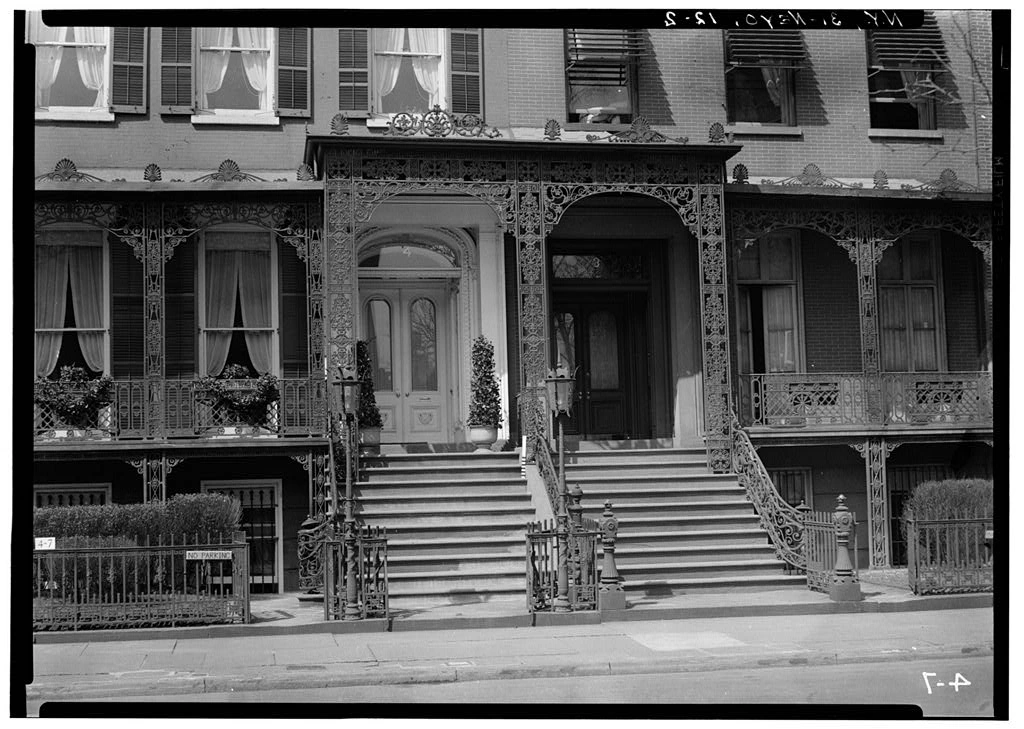
The two lamps at 4 Gramercy Park West announce a distinction the house’s quiet façade might otherwise keep to itself. James Harper had been mayor of New York. Beside them, an elaborate cast-iron veranda joins his entrance to that of No. 3, its palmettes and rosettes making an almost weightless pattern across two substantial houses. Harper moved here in 1847, bringing the public title with him to a private square.
He had earned his living by quite different kinds of repeated impressions. Before the mayoral lamps, before the tall windows and carved staircase, there had been ink, loose type, damp paper, and the pull of a hand press. With three younger brothers, he built a publishing business whose name appeared on novels, schoolbooks, family libraries, and, eventually, magazines read across the country. Their fortunes depended on knowing what people wanted to read—and getting it into their hands.
At Gramercy Park, that enormous enterprise acquired a domestic address. Harper was a neighbor, husband, father, churchman, and Park Trustee, as well as the senior partner of Harper & Brothers. His genial manner and dry jokes survived in family recollections alongside stories of punishing work and sudden disaster. The house offers a useful way into his life: the lamps recall an ambitious and divisive year at City Hall; the rooms behind them belonged to a man who spent most of his years making books.
A printer crosses the river
Franklin points the way
James Harper was born on April 13, 1795, in Newtown, Long Island, in what is now Queens. His father, Joseph, farmed, worked as a carpenter, and kept a small neighborhood store; his mother, Elizabeth Kolyer, came from a local Dutch family. The four boys grew up in a Methodist household where work and religious observance were closely joined. Their schooling occupied only part of the year. The rest brought the ordinary demands of a farm and the practical education of helping to keep a household going.
For James, a book opened a route beyond that life. Reading Benjamin Franklin’s autobiography suggested that printing might offer both a trade and a future. In December 1810, his father took the fifteen-year-old to Manhattan to enter the shop of Paul & Thomas. The family’s later account follows them in a sleigh to Brooklyn, then across the East River on a scow propelled by long sweeps. The boy who arrived with a shilling in his pocket would spend the next half-century turning other people’s words into his business.
His father chose Abraham Paul with care: apprentices lived with their employers, and Paul’s Methodism mattered alongside his standing as a printer. The work itself allowed little room for romantic notions. One pressman inked the type with hand-held balls while another laid the paper and pulled the press; then they changed places. Strength, rhythm, and attention mattered as much as literacy. James developed all three, and a reputation for staying at the press after others had finished.
Two brothers, two presses
His brother John followed him into the trade, apprenticing at another New York shop. In 1817 they established J. & J. Harper with two presses, their savings, and help from their father—an enterprise begun on roughly five hundred dollars rather than an inherited publishing fortune. Their first substantial commission was an edition of two thousand copies of Seneca’s Morals for the bookseller Evert Duyckinck. At this stage they supplied skilled labor and finished books to someone else’s order; choosing books and risking their own money came next.
When orders ran thin in 1818, they printed Locke’s Essay Concerning Human Understanding on their own account. James canvassed booksellers for advance commitments, offering each a place on the title page if the order was large enough. It was a cautious way to become a publisher: secure enough customers before setting the whole investment in motion. Their early catalogue was respectable, but the method already contained the mixture of nerve and calculation that would carry them into popular fiction.
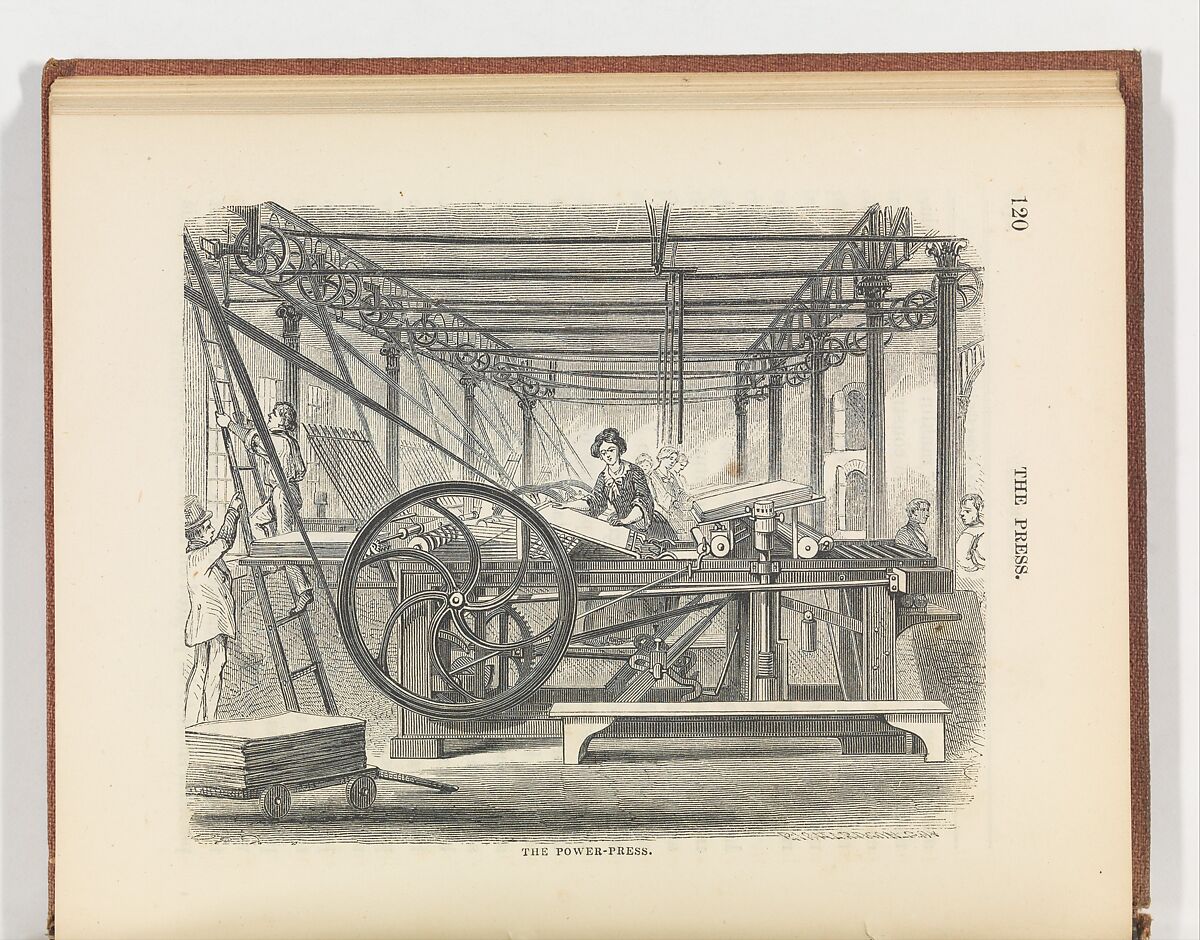
The family’s favorite story about their expanding machinery concerns a white horse installed in a cellar. Harnessed to a beam, he walked in circles to turn the shaft that powered the presses above, pausing for meals and returning to his rounds. When he grew old, the brothers sent him to their father’s farm. There, the story goes, he resumed his circuit around a solitary tree when the work whistle sounded. It was an affectionate legend about a faithful worker—and a wonderfully literal picture of the business before steam.
The race to the reader
Four names behind the imprint
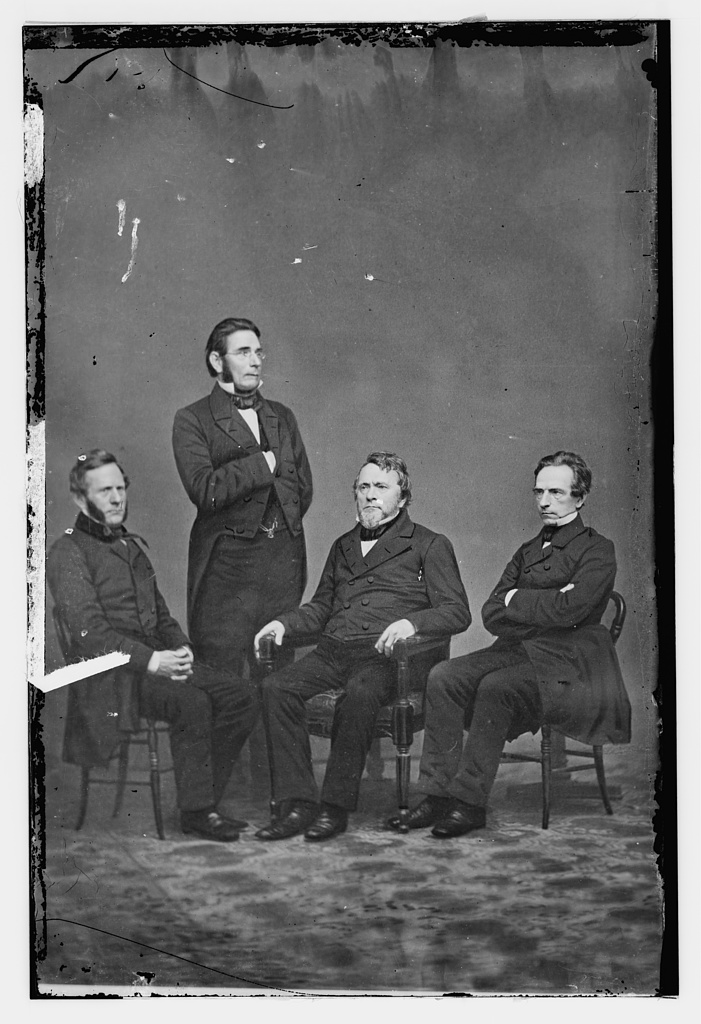
Joseph Wesley bought into the firm in 1823, and Fletcher joined in 1825. In 1833 the sign finally caught up with the partnership: J. & J. Harper became Harper & Brothers. The brothers had different strengths. James knew the mechanical side of bookmaking; John watched the money and purchases; Wesley handled correspondence and proofs; Fletcher increasingly directed the literary business. Asked which one was Harper and which were the brothers, James replied that any one could be Harper and the others the brothers. The joke suited a firm that resisted making one sibling its sole hero.
Their compact was unusually intimate. Each could object to a proposed undertaking, and for years they drew household money from a common fund rather than keep sharply separated personal accounts. This did not make the business leisurely. New British fiction set American publishers racing toward the same customers. A messenger could meet an incoming packet before it had finished docking, collect advance sheets, and hurry them to compositors waiting to begin. When a desirable novel arrived, the presses and the entire shop’s attention could be turned toward it.
Sir Walter Scott’s Peveril of the Peak supplied the family’s great example: their edition was ready in twenty-one hours. Such feats depended on workers as well as owners, with type set through the night and printing pushed forward as rapidly as sheets became available. American copyright law did not then protect British authors as it protected Americans. Reprinting an English success could therefore be cheap, profitable, and fiercely contested. The Harpers’ reach grew within that unequal transatlantic system, even as they developed arrangements to pay authors for advance material.
A library within reach
The Family Library made a different promise: useful reading in manageable, affordable volumes. History, travel, biography, and science could arrive one book at a time, making a shelf of general knowledge possible without an expensive set purchased all at once. The same concern for price and circulation helped shape their fiction lists. A publisher who understood a hand press also understood what paper, type, labor, and an unsold edition could cost. James’s early habit of securing buyers before committing to a book never became irrelevant.
The brothers also helped establish the professional reader as a regular part of publishing. In the early 1830s they employed John Inman to assess manuscripts, separating some of the work of literary judgment from the daily demands of running the firm. Authors did not always appreciate the intermediary: a manuscript might now be judged by someone whose name was absent from the imprint. But the arrangement recognized that choosing books had become a specialized occupation, requiring more time than four busy partners could always give it.
American writers increasingly shared the list with imported successes. William Cullen Bryant’s poems, Edgar Allan Poe’s The Narrative of Arthur Gordon Pym, and Richard Henry Dana Jr.’s Two Years Before the Mast carried very different voices into the catalogue. Herman Melville would follow in the next decade. They were not yet a tidy row of national classics; they were new books competing for attention and sales. Harper & Brothers helped make the physical and commercial machinery through which such writers could find a much larger public.
A year at City Hall
Out on a branch
On April 9, 1844, New York elected James Harper mayor. That night, facing a crowd from the balcony of his Rose Street home, he compared himself to a boy who had climbed a tree to retrieve a kite. The boy edged farther along a branch until going forward was dangerous and going back impossible. He was stuck. Harper said he felt much the same. It was a disarming response from a successful businessman newly entrusted with a city, and the family preserved the less dignified detail of candle grease dripping onto his coat.
His victory belonged to the American Republican Party, whose reform language came entangled with nativism and hostility to Irish Catholics. Its supporters wanted to curb the established political organizations, but they also wanted native-born Protestants to retain power in a changing city. Disputes over religion in public schools had made the Protestant Bible a political emblem. The Harpers’ illustrated Bible therefore carried an electoral significance beyond the book trade. His mayoralty cannot be separated from that exclusionary movement, even when its practical achievements are considered.
Harper brought the habits of a shop manager to problems New Yorkers could see underfoot. Pigs wandered the streets; refuse accumulated; cattle were driven through crowded districts. His administration excluded swine from public thoroughfares, restricted daytime cattle drives below Fourteenth Street, and sent some 350 sweepers to work. Contracts organized the removal of rubbish on a scale the neglected streets badly needed. These changes were immediate and physical, affecting the journey to work, a shop’s doorstep, and the movement of people through the city.
Order, and its arguments
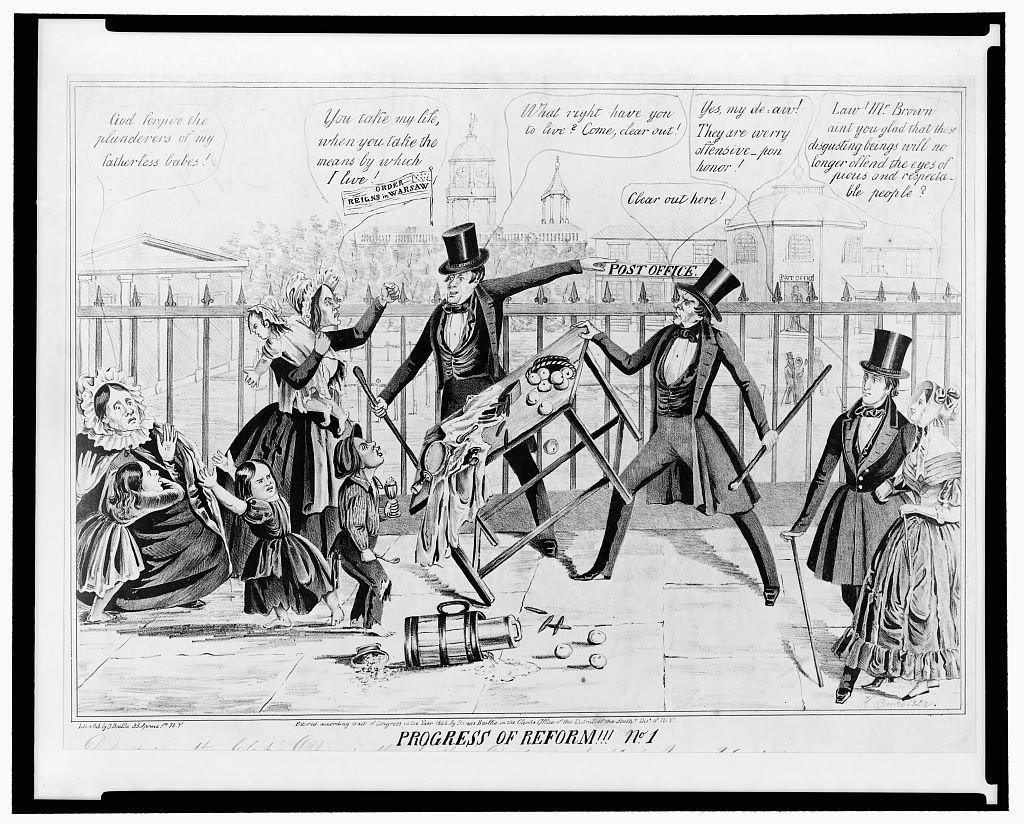
His Methodist upbringing also appeared in restrictions on drinking and Sunday activity. Bars were closed on Sundays and on the Fourth of July; disorderly grogshops and obstructions on sidewalks drew official attention. Reform could mean a cleaner street, but it could also mean a poorer New Yorker losing a place to trade or a familiar recreation. An 1844 political print, Progress of Reform!!!, made that argument through apple sellers driven from their tables near City Hall. It captures the contested meaning of the word during Harper’s year in office.
The police question brought another argument over the reach of municipal authority. Harper pressed for an organized, uniformed force in place of the older, inadequate arrangements. Opponents worried about expense and about a body of drilled men resembling a standing army. His municipal police wore blue coats with “M.P.” on their collars, while critics turned the initials into the mocking phrase “Mayor’s Pups.” The reorganization was a significant step in the development of the city’s police, though the system continued to change under his successors.
He served a single term, leaving office in 1845 when the Democrats recovered City Hall. The result returned him to a business that had never stopped demanding attention. He retained the title of mayor in conversation, in newspaper references, and eventually in the lamps outside his Gramercy house. Yet public office occupied only one year of a career otherwise measured in decades of printing. The election had brought him power and prominence; it had also placed him at the center of arguments that an affable manner could not resolve.
The house beside the Park
White’s pair of houses
Harper acquired his Gramercy property in 1846 from Norman White, the paper merchant and Park Trustee who was building the paired houses at Nos. 3 and 4. He took up residence in 1847. The connection was appropriate: paper had made both men prosperous, and both now occupied houses facing the garden created by Samuel Ruggles. White remained next door. Their shared veranda, attributed to Alexander Jackson Davis, gave the two entrances an ornamental unity while allowing each household its own door.
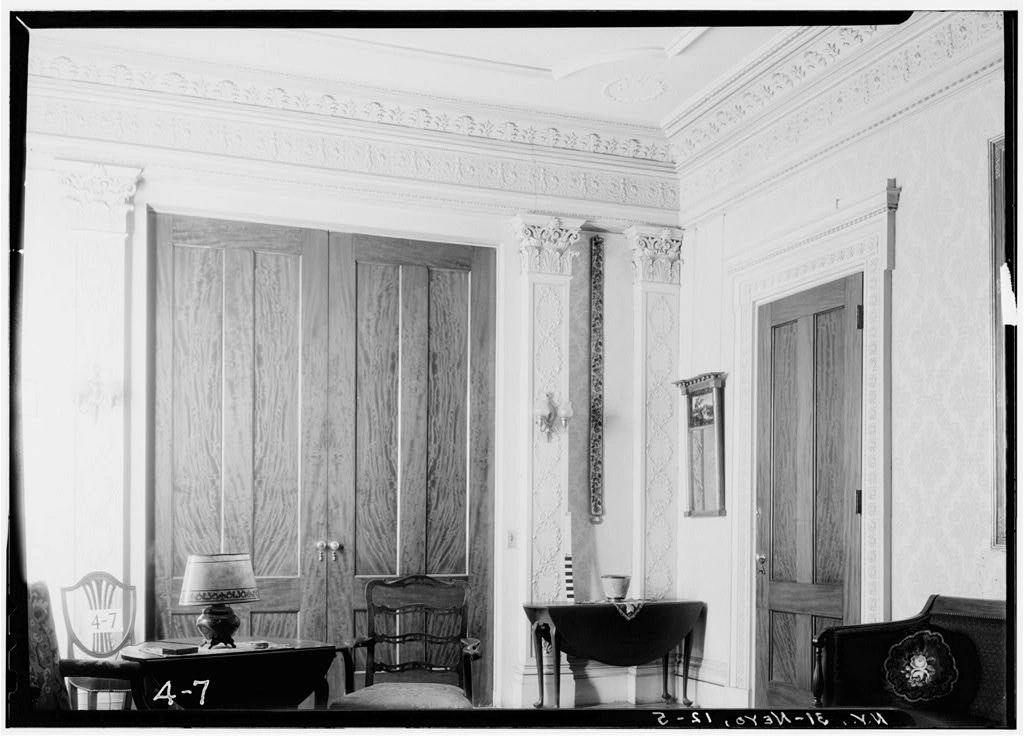
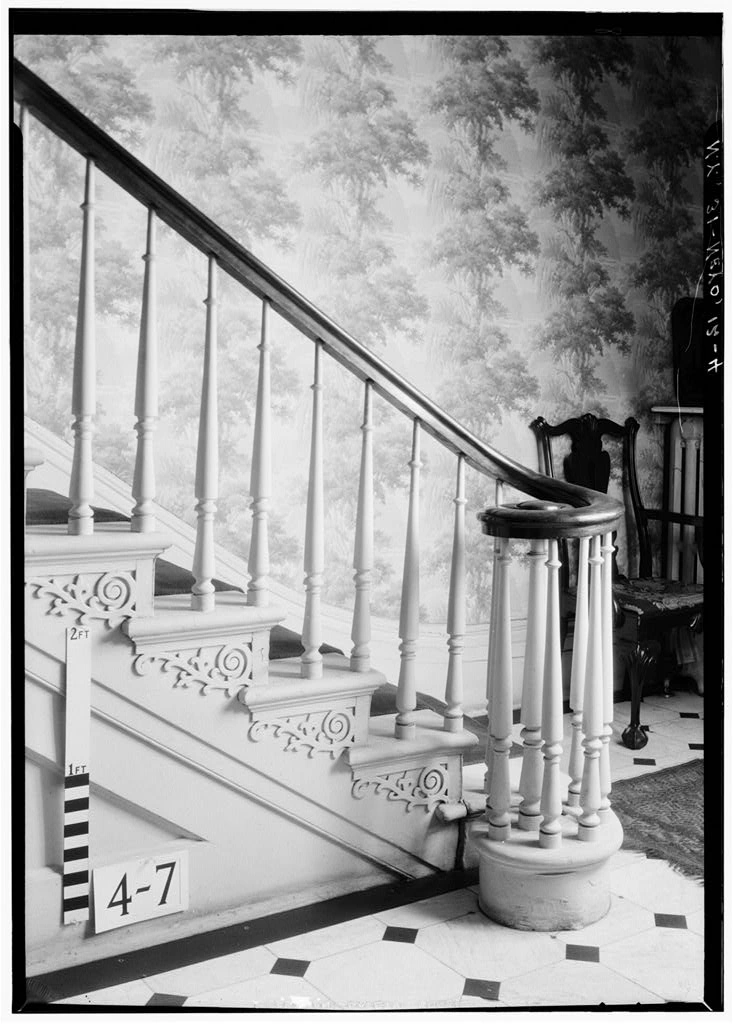
The ironwork rewards close looking. Palmettes rise between slender supports; rosettes punctuate the pattern; openwork rails frame the steps without concealing them. The walls behind are broad and restrained, so the veranda supplies much of the animation. Inside No. 4, the original staircase and Greek Revival woodwork carried that balance of solidity and ornament into the rooms. The famous Stanford White dining-room transformation came later, after James’s death. Harper’s own domestic setting belonged to the earlier house.
It was a household shaped by loss and renewal as well as success. His first wife, Maria Arcularius, died in 1847; his second wife was Julia Thorne. The family’s years at Gramercy would far outlast his own, with Julia and then their daughter Elizabeth keeping the house into the twentieth century. During James’s lifetime, however, its twenty-two years were also the years in which the firm’s name became familiar beyond the covers of individual books. A monthly magazine brought the imprint back into readers’ homes on a schedule.
Books enter the drawing room
Harper’s New Monthly Magazine began in June 1850. Fletcher supplied much of the driving editorial energy, staying with compositors as the early numbers took shape. Its mixture of stories, travel, history, pictures, and selected British writing offered readers a varied evening’s entertainment within a single cover. Illustrations became increasingly central to its appeal. The enterprise drew upon the plant’s ability to turn words and images into thousands of repeatable impressions, linking the intimate experience of reading to a remarkably elaborate factory.
William Makepeace Thackeray’s American visit in 1852 brought the international book trade into personal focus. The Harpers issued Henry Esmond that year, and the celebrated visitor met James at the publishing office. When Harper introduced his daughter, Thackeray teasingly called her a pirate’s daughter—a pointed joke about American reprinting that the publisher took in good part. Behind the exchange lay the complicated relationship between authors who wanted payment and publishers who could put them before an enormous public. Literary friendship and commercial disagreement could comfortably occupy the same room.
James’s humor was less elaborate when a persistent caller asked how the brothers divided their work. John kept the accounts, Wesley handled correspondence, Fletcher kept the business moving: what, then, did James do? He assured the visitor that his own burden exceeded all the others’. Pressed for the explanation, he said they left him to entertain the bores. The family history places the exchange at the office. It is easy to see why the story followed him home: the man behind the dignified lamps had a well-developed sense of when a conversation had gone on too long.
The afternoon the books burned
December 10, 1853
By December 1853, Harper & Brothers occupied a crowded complex on Pearl and Cliff Streets, where the successive operations of bookmaking stood close together. Paper, type, presses, finished stock, and cleaning fluids filled a plant built up through years of expansion. On Saturday, December 10, fire broke out in a room where flammable camphene was used to clean printing rollers. It spread with terrible speed. People escaped by stairways and firemen’s ladders while the brothers gathered account books and papers into a safe that could be dragged outside.
George Templeton Strong, another Gramercy neighbor, saw the smoke and went downtown. Tens of thousands of spectators crowded the approaches to Franklin Square. His diary set crashing walls and flying mortar beside the extraordinary appearance of a rainbow in the spray from the engines. The juxtaposition survives more vividly than any balance sheet: an industrial catastrophe observed through one shifting patch of color. The Harpers’ losses were reckoned at more than a million dollars; insurance covered only a fraction.
The decision to go on was made that evening at John Harper’s house. All four brothers met there with Henry J. Raymond, the magazine’s editor. They could meet their obligations and retire, but instead ordered new presses and set the work of reconstruction moving. Raymond remembered a gathering remarkably free of despair. James was nearing sixty, and the business represented most of his adult life. Starting again meant rebuilding a working institution, with employees, authors, subscribers, and sons whose futures were already tied to it.
The neighbors answer
Offers of help arrived before the ruins were cold. Cyrus W. Field & Company offered a loan of ten thousand dollars; other firms offered type, presses, and working space. Employees proposed deferring or reducing their wages. The Harpers did not need to accept all this generosity, but the offers showed how widely their credit extended beyond a bank account. Surviving stereotype plates were recovered from the vaults and distributed to printers elsewhere, allowing books to be produced while the home plant was being replaced.
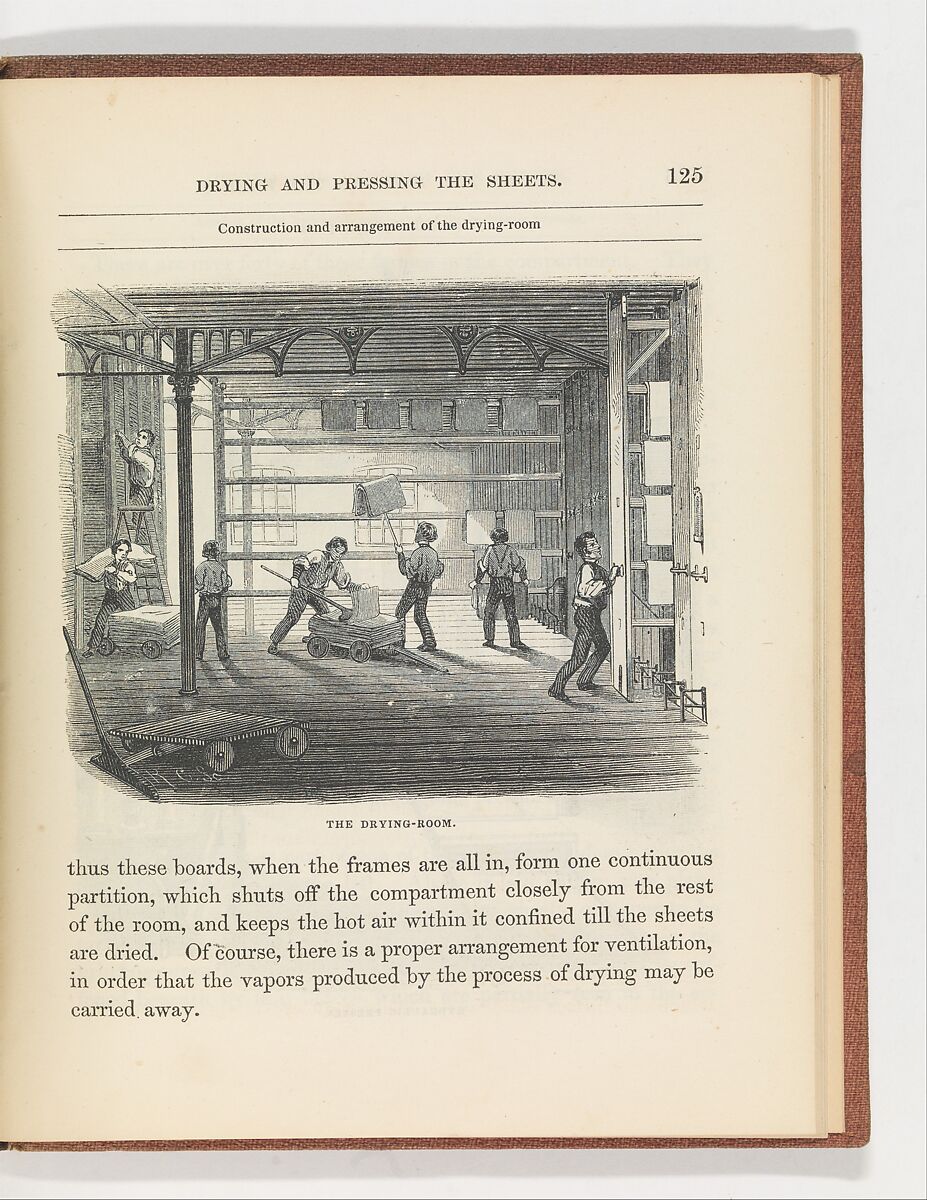
Peter Cooper helped with the new building itself. The brothers chose iron beams and a construction intended to keep another fire from sweeping through their premises. Cooper allowed their requirements to take precedence over those of his own educational building, Cooper Union. The new works separated important functions, placed boilers in the courtyard, and used a stair tower to reduce the passage of fire between floors. By 1855, the rebuilt establishment could be toured in print in Jacob Abbott’s illustrated account of how the storybooks were made.
The magazine returned in January 1854 with an explanation for its delay and, temporarily, without illustrations: its original copy, cuts, and sheets had been lost. Three years later the firm launched Harper’s Weekly, dated January 3, 1857, adding an illustrated newspaper to its books and monthly. The sequence was extraordinary without needing to be turned into a fable. A single afternoon had exposed how much could burn. Recovery depended on reserves, surviving printing plates, other people’s presses, experienced workers, and decisions made quickly by four brothers who knew their trade.
Home by the garden
Institutions close to home
Harper’s later life remained anchored in the neighborhood. As a Gramercy Park Trustee, he shared responsibility for the private garden outside his windows. Ruggles’s square had become a place where people engaged in very different kinds of institution-building could live within a few minutes of one another. Cyrus Field at One Lexington Avenue, Peter Cooper at the corner now numbered 7 Lexington Avenue, and Harper on the western side brought educational, commercial, and publishing ambitions into unusually close proximity.
He was also a charter Trustee of Vassar College, serving until his death. The new college for women extended the educational interests of a man whose own formal schooling had been brief. His business had supplied readers with portable libraries; here his responsibility concerned a place in which students would live and study. The work belonged to a broader period of private institution-building, when gifts, trusteeships, and personal commitments could establish organizations intended to last beyond their founders.
Within the publishing house, James remained a familiar presence. George William Curtis’s account after his death emphasized his knowledge of the people who worked there and his interest in their families. Long-serving employees had seen the same man through ordinary days, commercial growth, and the fire. The affectionate picture they left is best read beside the harder public history of his mayoralty. One does not erase the other. His life contained the employer remembered for kindness and the politician elected by a movement that drew narrow boundaries around belonging.
One last drive
On March 25, 1869, Harper went driving with a daughter near Central Park. A part of the carriage gear broke, the horses bolted, and both were thrown. She escaped serious injury; he did not. Taken to St. Luke’s Hospital, he remained unconscious and died on March 27, aged seventy-three. The abruptness struck those who had seen him still active at the office. Only that January, all four brothers had signed an old copy of the Seneca volume they had printed in 1817—a small reunion with the book that had begun their working lives together.
His funeral was held at St. Paul’s Methodist Episcopal Church at Fourth Avenue and East 22nd Street, close to Gramercy Park. The employees met separately to record their loss, with Henry Marsh, who had worked with the business for forty-seven years, presiding. John, Wesley, and Fletcher continued the firm. Julia remained at No. 4 until her death in 1902, and Elizabeth kept the family home until 1923. The house thus carried the Harper name well beyond the period when its original owner walked between the Park and his downtown office.
Later occupants changed the rooms, and later New York changed almost everything around them. Yet the paired veranda still makes its delicate pattern against the façade, and the lamps still identify a former mayor’s door. Look closely at the ironwork and the building becomes less remote: a paper merchant next door, a printer in this house, and two entrances made as a pair. For James Harper, the city’s public life and the practical business of making books finally met at this address, a few steps from the garden.
Places, people & connections
Around the Park
4 Gramercy Park West
Harper’s home from 1847 to 1869, with its mayoral lamps and shared cast-iron veranda.
3 Gramercy Park West
Norman White’s adjoining house completes the pair he built before selling No. 4 to Harper.
1 Gramercy Park West
Norman White, who built Harper’s house, later occupied this corner mansion before the surgeon Valentine Mott.
One Lexington Avenue
Cyrus Field’s Gramercy home connects the publisher’s circle to the paper trade and the Atlantic cable.
7 Lexington Avenue
The site of Peter Cooper’s former house, numbered 9 Lexington in his lifetime, links Harper’s rebuilding to his inventive neighbor.
50 Gramercy Park North
The earlier house on this site belonged to diarist George Templeton Strong, whose account records the 1853 Harper fire.
Life at a glance
The biographical record
| Born | April 13, 1795 · Newtown, Long Island (now Queens) |
|---|---|
| Died | March 27, 1869 · New York City, aged 73 |
| Gramercy Park address | 4 Gramercy Park West |
| Years on the Park | 1847–1869; property acquired in 1846 |
| Vocation | Printer, publisher, and mayor of New York (1844–1845) |
| Spouse & family | Married Maria Arcularius in 1823; after her death, Julia Thorne. Publishing partners: brothers John, Joseph Wesley, and Fletcher. |
| Key institutions & works | J. & J. Harper / Harper & Brothers; Harper’s New Monthly Magazine; Harper’s Weekly; Gramercy Park Trustees; Vassar College charter Trustee. |
Over time
Across the river to the press
At fifteen, James enters Paul & Thomas’s printing shop.
J. & J. Harper
James and John establish their business and print Seneca’s Morals.
Four brothers on the sign
The firm adopts the name Harper & Brothers.
A year as mayor
Street cleaning and police changes accompany a divisive nativist victory.
A home on Gramercy Park
Harper moves into No. 4 beside Norman White.
The Monthly begins
A new magazine brings the Harper imprint into homes every month.
Fire, rebuilding, and the Weekly
The brothers rebuild their plant and expand into illustrated news.
The final drive
Harper dies after a carriage accident; his family remains at No. 4.
Sources cited
- J. Henry Harper, The House of Harper: A Century of Publishing in Franklin Square (New York: Harper & Brothers, 1912), pp. 1–26, 38–43, 49–51, 85–107, 122–125, 310–312. Family history, early printing methods, partnership, mayoralty, fire and rebuilding, Thackeray, and Harper’s death. Read the digitized book.
- Carole Klein, Gramercy Park: An American Bloomsbury (Boston: Houghton Mifflin, 1987), pp. 61–69, “Purveyors of Culture.” Harper’s printing career, mayoralty, Gramercy household, and the 1853 fire.
- Thomas W. Hotchkiss, The James Harper Residence, Historic American Buildings Survey, March 29, 1934, HABS NY,31-NEYO,12. Acquisition, construction, interiors, and the paired houses. Historical data sheets.
- Stephen Garmey, Gramercy Park (New York: Balsam Press, 1984), pp. 54–60, 116–117. West-side houses, the Harper family, and the later Stanford White dining room.
- Eugene Exman, The House of Harper: One Hundred and Fifty Years of Publishing (New York: Harper & Row, 1967); reissued as The House of Harper: The Making of a Modern Publisher. Early book production and John Inman’s employment as a reader. Publisher-history text.
- New-York Historical Society, James Harper Papers, 1844–1845, MS 284, collection guide, biographical note. Political affiliation and municipal reforms. Collection guide.
- New York City Department of Records and Information Services, Guide to the Records of the Early Mayors, 1826–1897, Series VII: James Harper, 1844–1845. Municipal Archives guide.
- Jacob Abbott, The Harper Establishment; or, How the Story Books Are Made (New York: Harper & Brothers, 1855). Illustrated description of the rebuilt printing works. Metropolitan Museum of Art collection record.
- John B. Pine, The Story of Gramercy Park, 1831–1921 (New York: Gramercy Park Association, 1921), pp. 12, 29–30, 39. Park Trustees, Harper, and St. Paul’s Church. Read the book.
- Vassar College Encyclopedia, “A Brief Guide to Vassar’s Charter Trustees,” James Harper entry. Charter Trustees.
- George William Curtis, memorial to James Harper, Harper’s Weekly, April 10, 1869, p. 226; funeral coverage, April 17, 1869, p. 242. April 10 issue; April 17 issue.
Photo credits for this page
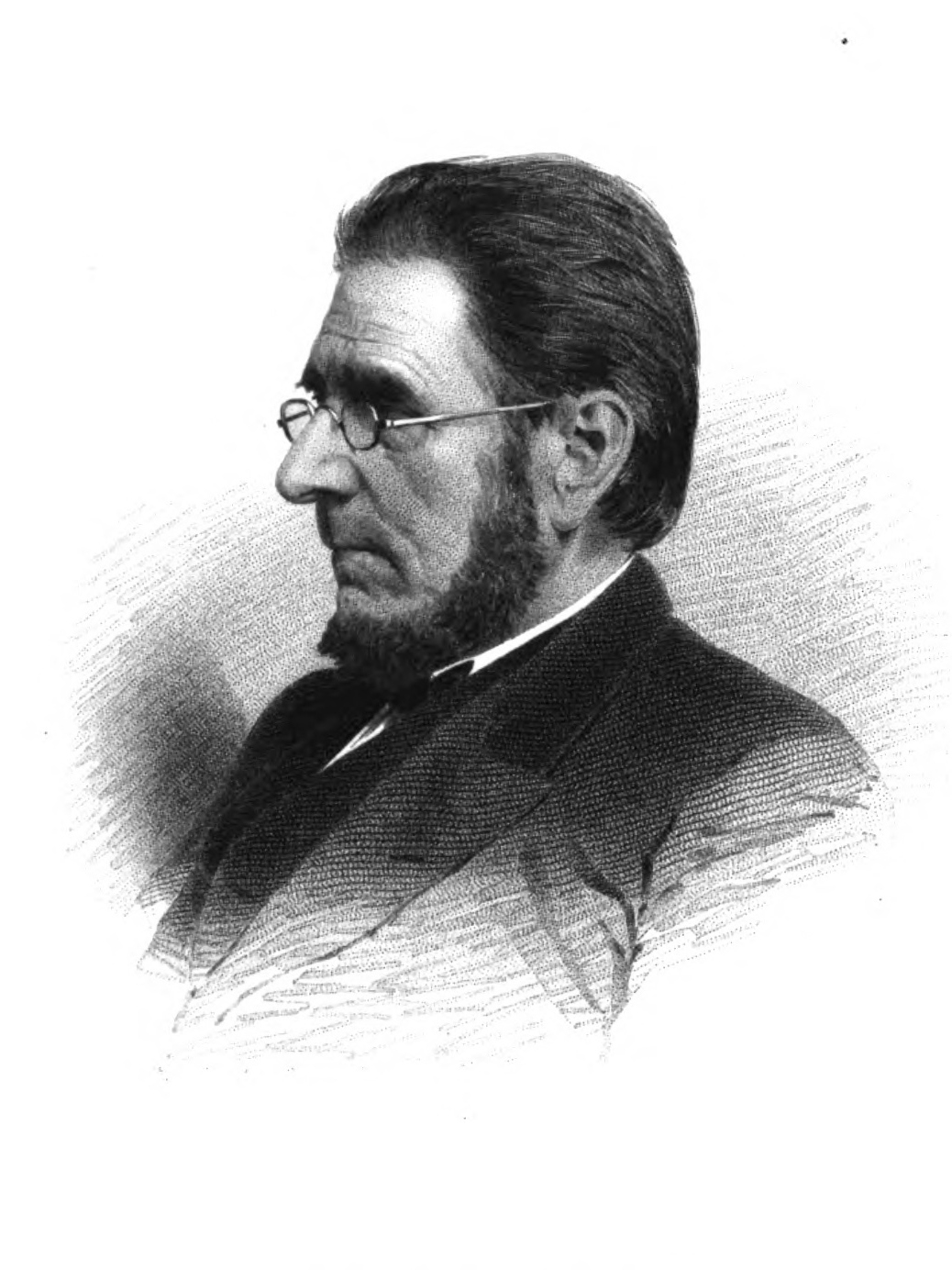
- James Harper, engraving reproduced in J. Henry Harper, The House of Harper (1912). Public domain. Source.
- E. P. MacFarland, paired entrances, March 27, 1934. Historic American Buildings Survey, Library of Congress, Prints and Photographs Division, HABS NY,31-NEYO,12. Public domain. Source.
- “The Drying-Room,” in Jacob Abbott, The Harper Establishment (1855), p. 125. The Metropolitan Museum of Art. Public domain. Source.
- Harper brothers, photograph, circa 1855–1865. Brady-Handy Photograph Collection, Library of Congress. Public domain. Source.
- Progress of Reform!!! No. 1, 1844. Library of Congress, Prints and Photographs Division. Public domain. Source.
- C. E. Knell, first-floor living room, March 22, 1934. Historic American Buildings Survey, Library of Congress, Prints and Photographs Division, HABS NY,31-NEYO,12. Public domain. Source.
- E. Doppler, “The Power-Press,” in Jacob Abbott, The Harper Establishment (1855), p. 120. The Metropolitan Museum of Art, accession 42.105.22. Public domain. Source.
- C. E. Knell, main-hall staircase, March 22, 1934. Historic American Buildings Survey, Library of Congress, Prints and Photographs Division, HABS NY,31-NEYO,12. Public domain. Source.