
Henry Whitney Bellows
The Minister at the Nation’s Bedside
1814–1882 · All Souls Church & Rectory, 104 East 20th Street (now 8 Gramercy Park South) · 1855–1882
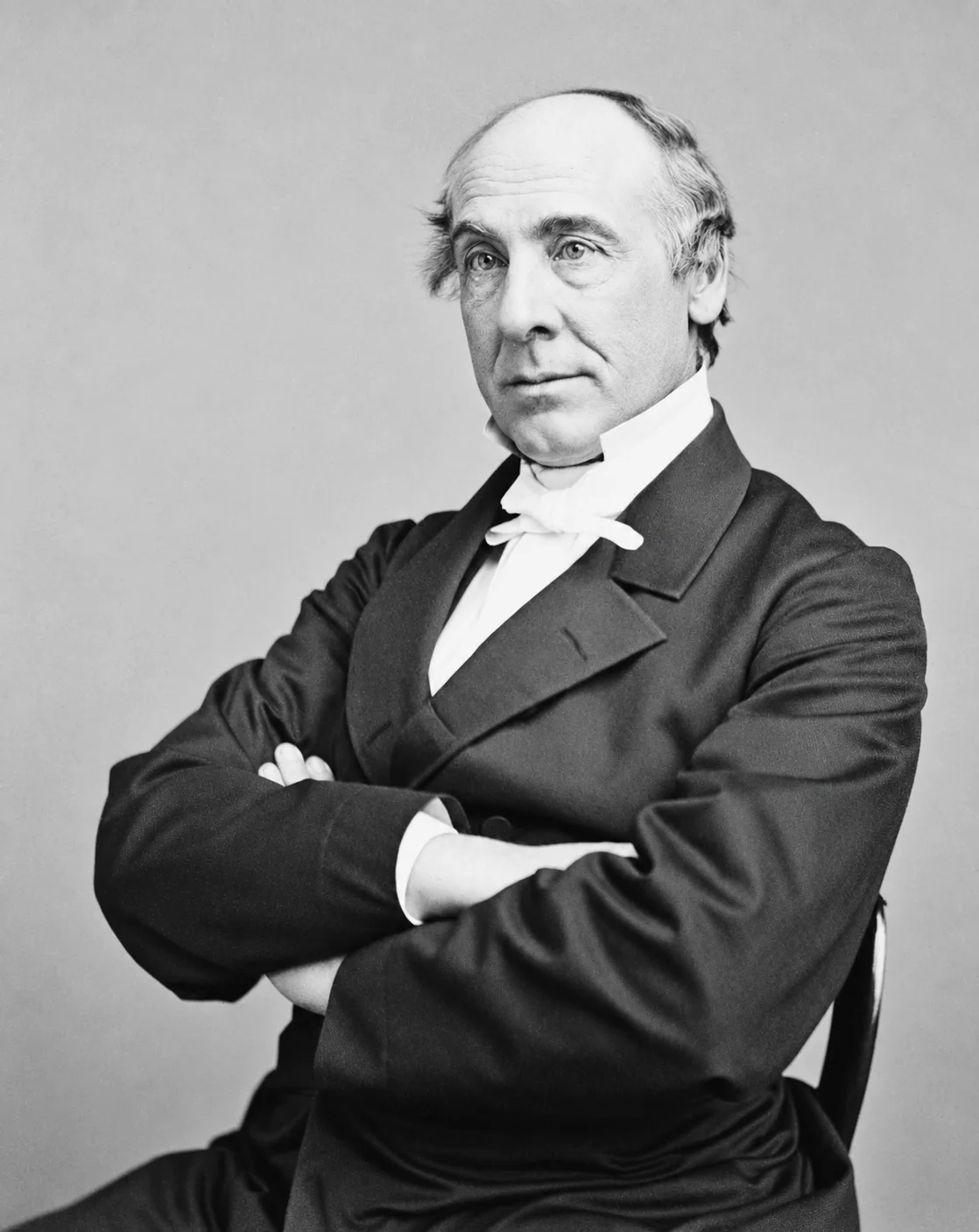
A life in Gramercy
The house beside the striped church
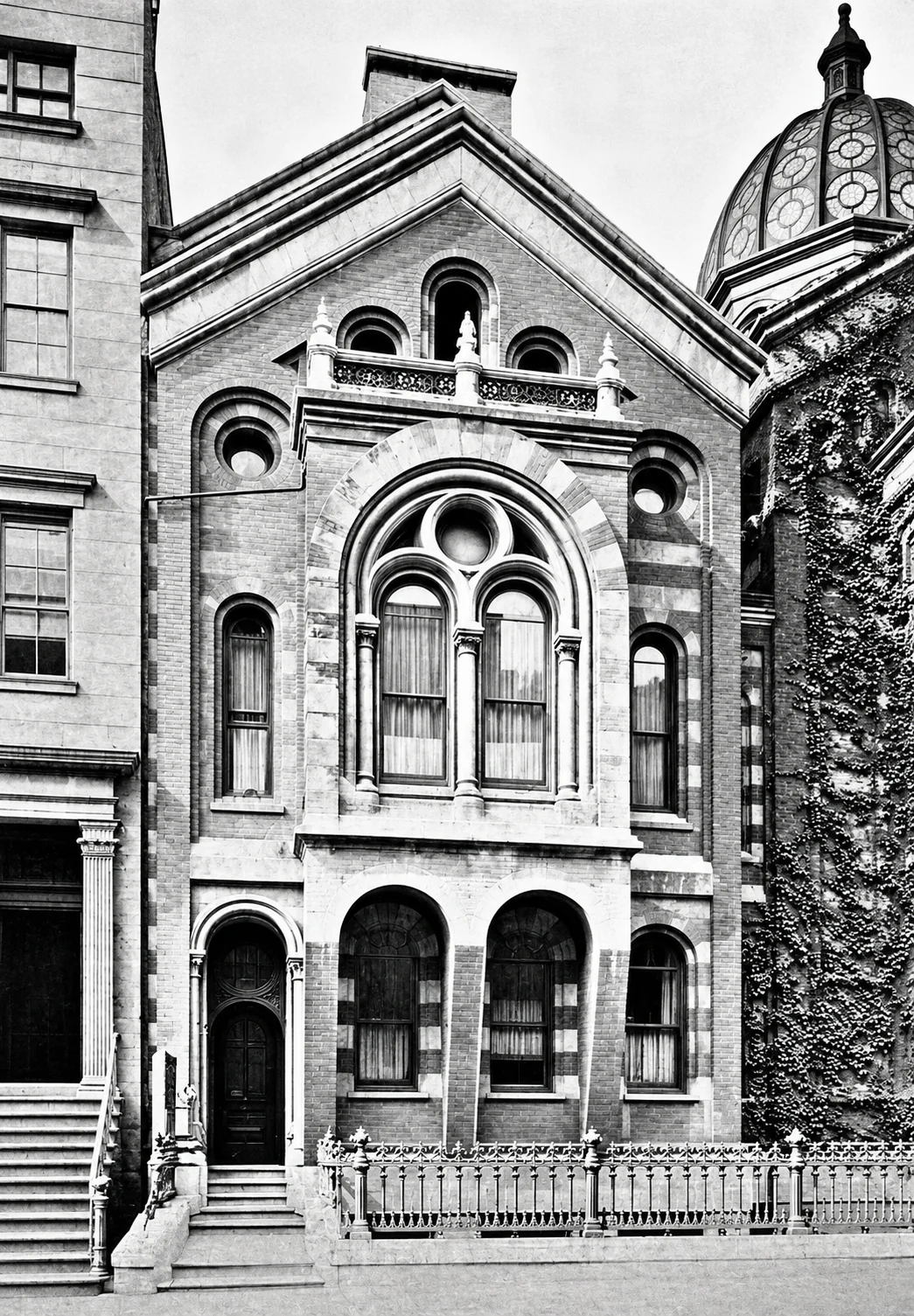
At 104 East 20th Street, immediately beside the striped walls of All Souls Church, Henry Whitney Bellows lived in a house that scarcely resembled a conventional New York parsonage. Its projecting bay window, round arches, and steep gable belonged to the same architectural experiment as the sanctuary next door. Inside, a family negotiated an inconvenient arrangement of rooms and staircases. Outside, a neighborhood of publishers, inventors, lawyers, and merchants supplied the minister with friends who could help him get things done.
The rectory stood on the site now occupied by 8 Gramercy Park South. During the Civil War, this corner became one of the places where civilian concern for soldiers was turned into organized work. Bellows was president of the United States Sanitary Commission; across the Park lived its treasurer, George Templeton Strong. Their partnership joined the minister’s persuasive voice to the lawyer’s demanding attention to money and administration. Frederick Law Olmsted brought another essential gift: the ability to organize an enterprise whose work could not wait for a convenient moment.
Bellows’s interests were wider than the church and wider than the war. He defended the theater when respectable opinion distrusted it, encouraged Peter Cooper’s educational ambitions, helped build the Century Association and the Union League Club, and took an interest in making art available to a public larger than the owners of private collections. His Christianity required institutions as well as convictions. A sermon could set work in motion; committees, subscriptions, correspondence, and paid staff had to carry it forward.
The scale of that work ranged from national relief to a bunch of flowers brought to a hospital patient. The contrast suits him. Bellows could argue with officials in Washington and then return to a neighborhood where charitable projects found room in the rectory basement. His story begins with that busy house, its difficult stairs, and the extraordinary number of lives that came within reach of its front door.
A Pulpit Comes to Gramercy
A vocation beyond Boston
Henry Whitney Bellows was born in Boston on June 11, 1814, into a mercantile family with deep New England connections. His mother died when he was a small child. Schooling at Round Hill in Northampton introduced him to the historian George Bancroft, and Harvard followed in 1828. He graduated in 1832, still only eighteen. The familiar route from a prosperous family to a learned profession was interrupted by changes in his father’s finances: before entering divinity school, Bellows supported himself by teaching.
Those teaching years took him beyond the institutions that had educated him. He worked in Cooperstown and in Louisiana, then returned to Massachusetts and graduated from Harvard Divinity School in 1837. A possible ministry in Mobile confronted him with slavery and with the danger that personal kindness from slaveholders could soften his opposition to their system. He chose a northern congregation. By 1839, the young minister had taken charge of New York’s First Congregational Church, a Unitarian society then worshipping on Chambers Street.
New York supplied a congregation but also an audience. Bellows became known as a forceful preacher who spoke to questions beyond denominational theology. He helped establish the weekly Christian Inquirer in 1846 and used religious journalism to address the city around him. He could be conservative in his understanding of Christian belief while expansive in his understanding of what a minister should do. The two impulses remained together throughout his career.
Red brick, pale stone, and an unruly parsonage
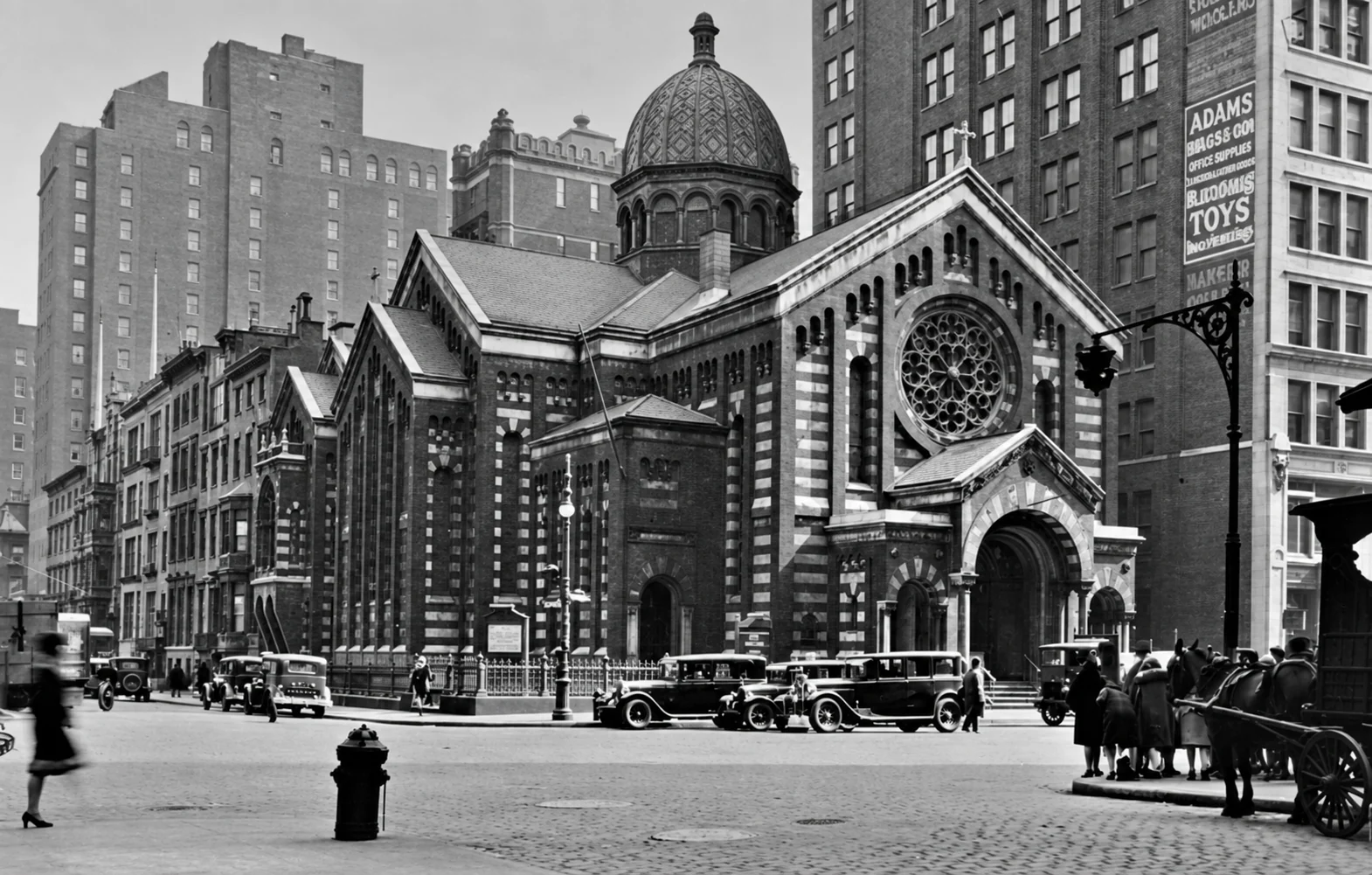
The congregation moved first to Broadway and then farther uptown, reaching Fourth Avenue and East 20th Street in the 1850s. Merchant Moses H. Grinnell supported the ambitious building designed by the young English architect Jacob Wrey Mould. Alternating bands of red brick and pale Caen stone, a great circular window, and a dome made the new church impossible to mistake for its neighbors. Dedicated on Christmas Day 1855, it soon acquired the irreverent nickname “the Church of the Holy Zebra.”
Bellows did not share every architectural enthusiasm of his patron. Costs and practical difficulties mattered to a minister trying to house a congregation. Mould’s adjoining rectory was elaborate too: the projecting bay, ornamented arches, and irregular interior made a memorable family home. Bellows lived there with his wife, Eliza Townsend, and their children. Their daughter Anna remembered the house’s complicated rooms with pleasure; her mother, responsible for making them work, was less enchanted.
The move placed Bellows close to people whose religious, business, and civic interests repeatedly overlapped. Peter Cooper was both parishioner and neighbor. William Cullen Bryant belonged to the congregation, while the Strongs lived along the Park’s northern side. The church drew its strength from this network, but its doors also opened onto the larger city. Its conspicuous architecture gave physical form to a congregation increasingly involved in public affairs.
The City Beyond the Sermon
A novelist in a church
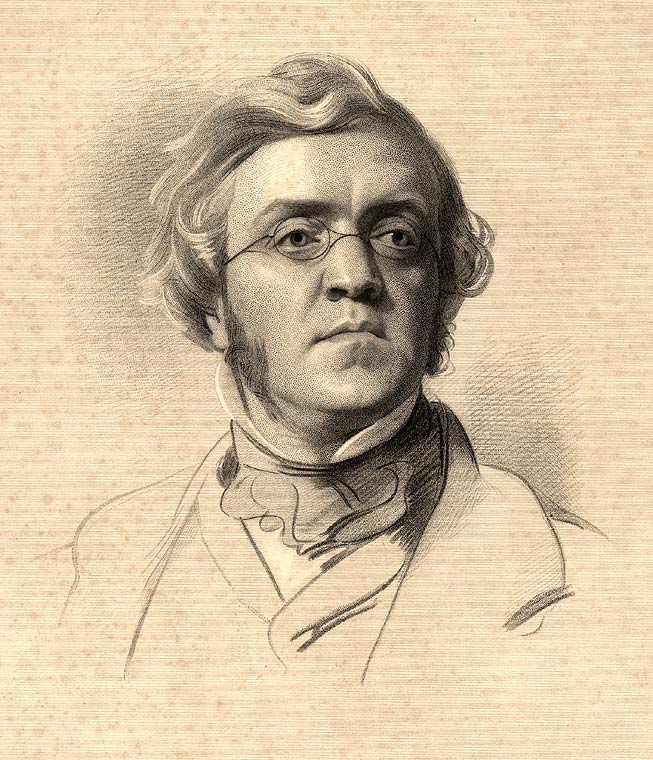
When William Makepeace Thackeray brought his lectures on the English humorists to New York in 1852, Bellows made his congregation’s church available. The lecture audiences included the sort of readers who also filled publishers’ offices and literary drawing rooms. Strong listened with the alert, sometimes merciless attention he brought to music and public speaking. Bryant belonged to the same intellectual circle. A religious building could become a meeting place for people drawn together by literature rather than by a common creed.
The audiences gathered at the Broadway church; the striped sanctuary on East 20th Street was still three years away. Thackeray’s relationship with James Harper and his brothers brought another part of that circle into view. The publishers supplied books, the minister a platform, and the city an audience eager to encounter a celebrated author in person.
Bellows was also a founder of the Century Association, organized in 1847 to bring together men interested in letters and the arts. Such memberships were not incidental ornaments to his ministry. They gave him a place to meet writers, artists, and professional men as colleagues, and helped make him a person who could draw cooperation from people who did not all worship in his pews.
Education, public pleasure, and the right to a larger life
Peter Cooper’s plans for an institution open to working people found an ally in Bellows. Cooper Union, opened in 1859, joined technical instruction, art education, reading, and public discussion. Bellows’s encouragement belonged to the long preparation of that project. The industrialist supplied the fortune and the relentless attention; the minister helped sustain the conviction that access to knowledge should reach far beyond those able to pay for a conventional education.
The same widening of public life lay behind Bellows’s interest in parks and the arts. Bryant argued for a great public park; Calvert Vaux, another member of the congregation, would help design Central Park with Olmsted. These projects did not arise from a single parish plan, but All Souls brought some of their advocates into regular contact. The congregation stood within a much larger conversation about what an increasingly crowded city owed its inhabitants.
Bellows’s defense of the theater was more controversial. In an 1857 address to the Dramatic Fund Society, he argued for the moral possibilities of public amusement rather than treating the stage as inherently corrupt. The resulting dispute showed how far that position departed from clerical convention. He was not endorsing every play or performance. He was insisting that a powerful art deserved cultivation, and that a minister could enter its world without surrendering his own responsibilities.
From the Parish to the Army
The women who made relief possible
The firing on Fort Sumter in April 1861 transformed ordinary civic energies into an urgent question: how could civilians help the men going to war? Volunteers rushed into military service faster than the government could provide for them. Good intentions produced clothing, supplies, and offers of nursing, but usefulness depended on getting the right things to the right place. The work required organization before it required another stirring speech.
At Cooper Union, a great women’s meeting helped establish the Woman’s Central Association of Relief. Bellows worked with physicians and parishioners, including Dr. Elisha Harris, Sarah Bedell Cooper, Eliza Bellows, and the young Louisa Lee Schuyler. Elizabeth Blackwell brought medical authority to the undertaking. Ellen Ruggles Strong joined the wartime relief work that would eventually take her aboard a hospital transport. Women supplied managerial skill and sustained labor as well as donations.
Bellows went to Washington in May with a proposal for a civilian commission concerned with the sanitary condition of the volunteer army. Its ambitions included inspecting camps, collecting information, advising officials, and coordinating support. Disease could disable an army before a battle began. Food, clothing, drainage, shelter, and cleanliness were matters of military capacity, not merely personal comfort.
Permission, then the work itself
The proposal met resistance. An outside organization could look to government officials like an intrusion into their responsibilities, and Bellows had to argue for cooperation rather than a competing command. The War Department authorized the commission in June; Lincoln approved the order on June 13. On June 21, its early organizing work brought members to Bellows’s Gramercy rectory. The machinery of a national undertaking was being assembled in rooms designed for a minister’s household.
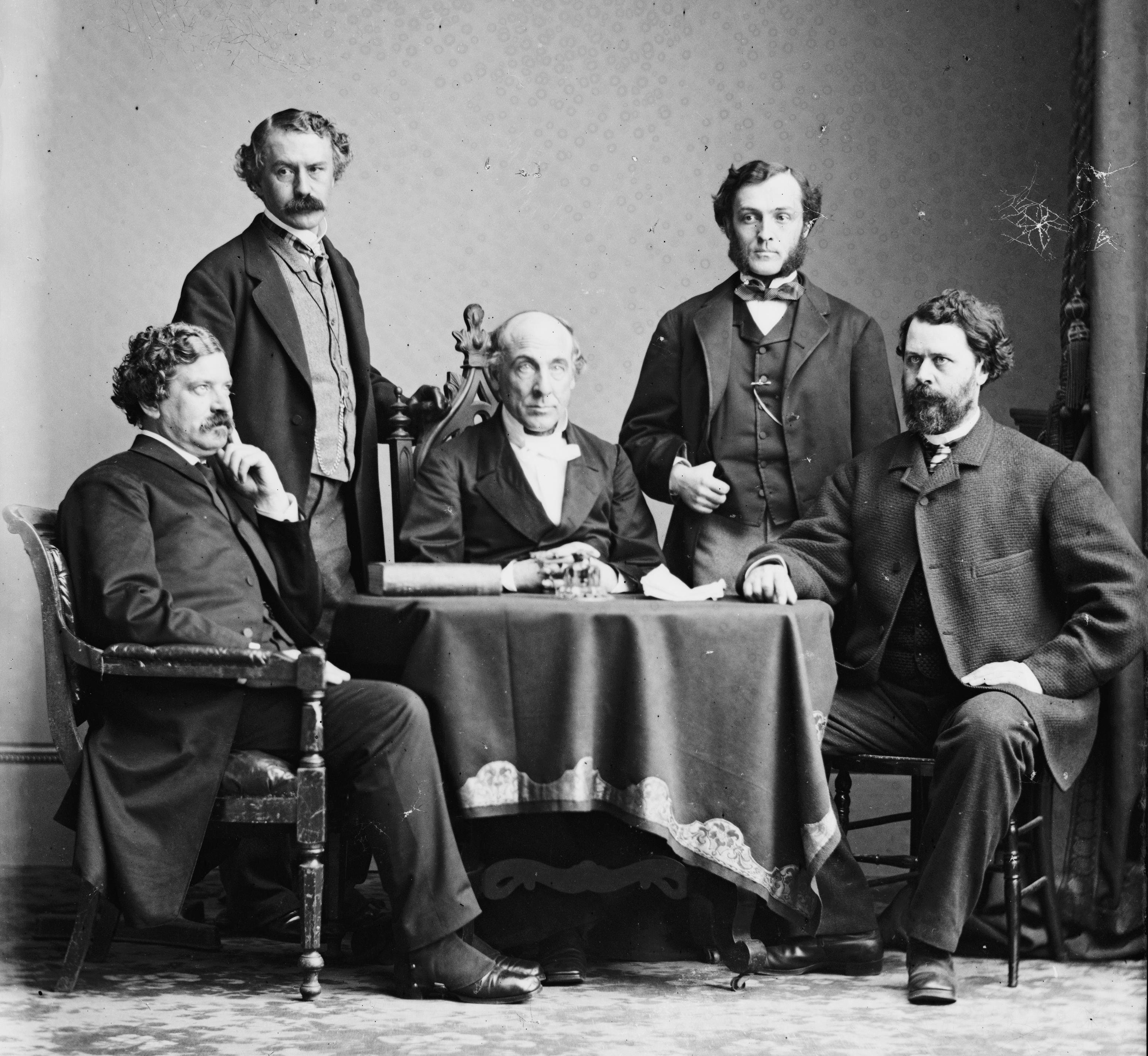
Bellows became president, Strong treasurer, and Olmsted general secretary. Their tasks were distinct but inseparable. Bellows represented the commission, recruited support, and negotiated with powerful officials. Strong insisted on accountable finances. Olmsted translated broad purposes into instructions, offices, transport arrangements, and reports. None of those abilities could make up for the absence of the others. Nor could a small group in New York succeed without the local associations that collected supplies and raised money across the country.
Bellows’s letters to Samuel B. Ruggles in July 1861 reveal the practical concerns beneath the organization’s public purpose: its standing in Washington, relations with the Army Medical Bureau, and the value of Strong’s service. The surviving correspondence makes the neighborhood connection unusually tangible. The men knew one another through Gramercy, but the work now passing among them concerned soldiers hundreds of miles away.
The Long Journey to a Sickbed
Persuasion at the White House
Authorization did not settle the commission’s difficulties. Bellows and Strong pressed for changes in the Army Medical Department, whose existing arrangements were inadequate to a rapidly expanding war. Their visits to Lincoln belonged to a sustained effort to turn civilian observation into administrative reform. Legislation in April 1862 reorganized the department, and William A. Hammond became surgeon general. The commission had helped make the case for change, though the new system brought arguments of its own.
The work repeatedly forced Bellows to move between unlike worlds. He could appeal to patriotic feeling before a large audience, then argue over jurisdiction or the appointment of an officer. To the commission’s supporters, a needed reform might look obvious; to an official responsible for an established department, the same proposal could look like a challenge to authority. Bellows’s usefulness lay partly in continuing those conversations after enthusiasm had given way to friction.
Hospital transport during the Peninsula Campaign exposed the stakes. Sick and wounded men had to be collected, sheltered, fed, and carried from the front to hospitals farther north. Olmsted’s letters to Bellows in May and June 1862 describe crowded facilities, contradictory orders, shortages, and the extraordinary work of the women aboard the transports. Ships such as the Knickerbocker became part of a moving system of care. Ellen Strong served among its volunteers, bringing the war into the life of another Gramercy household.
A national subscription
Bellows’s presidency demanded money as well as influence. Contributions from California and the Pacific region became crucial to the commission’s finances. Thomas Starr King and other western organizers turned distance from the battlefields into a reason to give. Gold sent east could buy food, medicine, transport, and the services of people who worked near the armies. Bellows traveled west in 1864, encouraging the network that had already made such consequential gifts.
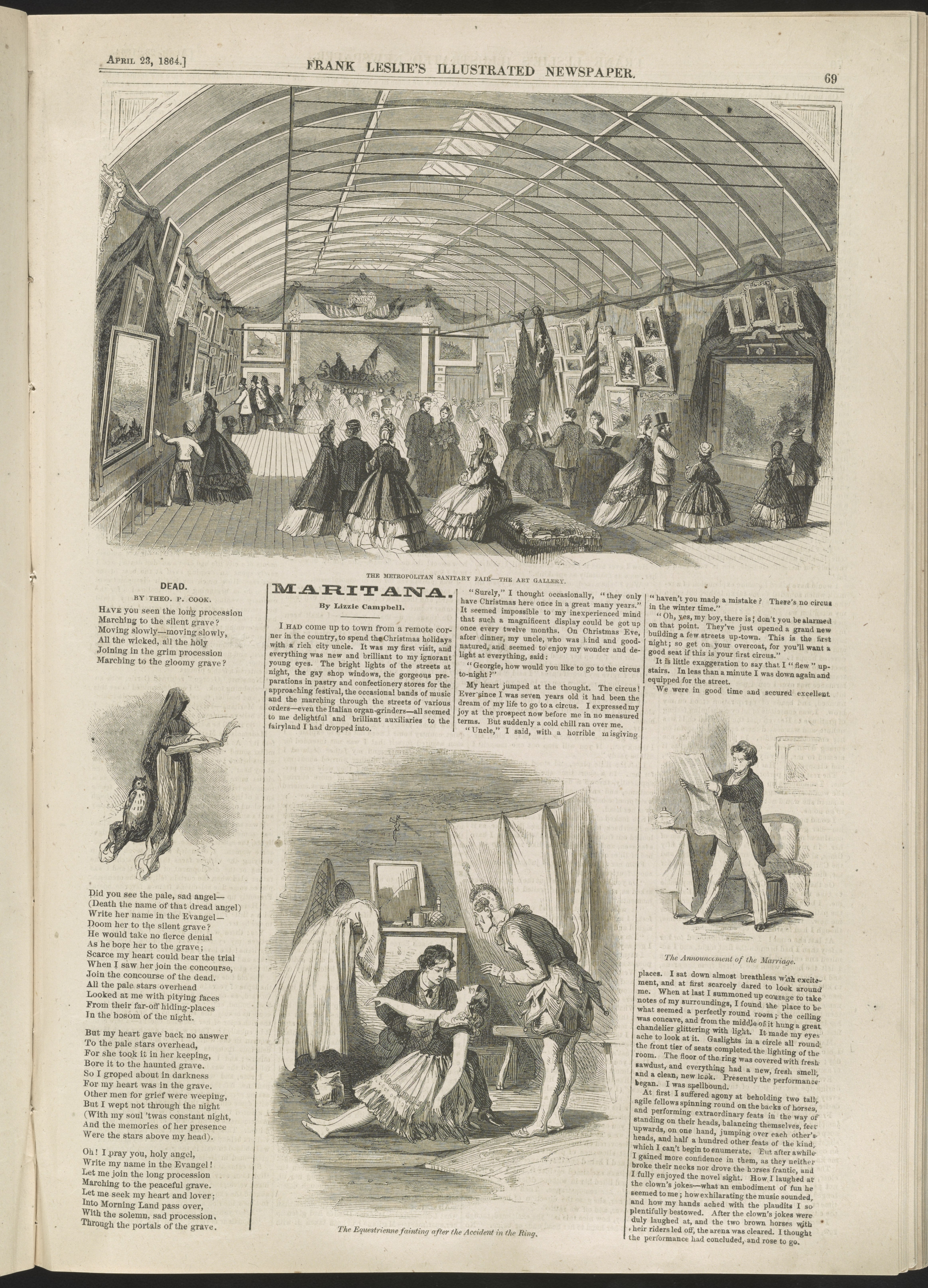
The great sanitary fairs translated the same impulse into public spectacle. New York’s Metropolitan Fair in 1864 combined objects for sale, displays, entertainments, and works of art in a large fundraising enterprise near Union Square. Women organized much of its work. Ellen Strong served as a treasurer. It raised more than a million dollars, a sum made from thousands of separate decisions to contribute and from months of preparation that the visitors did not see.
The commission’s achievement was therefore larger than the reputation of any one organizer. Its offices and agents linked sewing circles, merchants, physicians, nurses, donors, and military officials. Bellows supplied an unusually effective public voice, but the organization’s purpose was fulfilled in an unglamorous final transaction: a sick man receiving something he needed. After the war, Bellows contributed the account of Pacific Coast fundraising to Charles J. Stillé’s official history, preserving the part played by communities far from the fighting.
A Neighbor’s Grief, a Patient’s Flowers
An actor after the assassination
Lincoln’s assassination brought Bellows a different kind of duty. Edwin Booth, whose brother John Wilkes had murdered the President, was living near Gramercy Park on East 19th Street. The actor faced grief, public suspicion, and the crushing knowledge that his family name had become inseparable from the crime. Bellows was called to comfort him. A minister who had worked for the Union could also distinguish a bereaved brother from an assassin.
His sympathy belonged to the same view of the theater he had defended before the war. Actors were people with claims on pastoral care, not a profession to be approached only in denunciation. When Edwin returned to the New York stage as Hamlet in January 1866, he did so amid an outpouring of support. Bellows’s friendship was part of the personal world that made a return to work possible, even though it could not remove the burden of the family catastrophe.
Public projects continued alongside such private obligations. Bellows had helped organize the Union League Club in 1863 to support the Union cause. After the war, the experience of exhibitions and fundraising helped encourage discussion of a permanent public art museum. The Metropolitan Museum of Art emerged from a broad coalition, not from one minister’s plan. Bellows belonged among the civic advocates who saw that pictures gathered temporarily for a fair could suggest a more lasting public institution.
The basement on East 20th Street
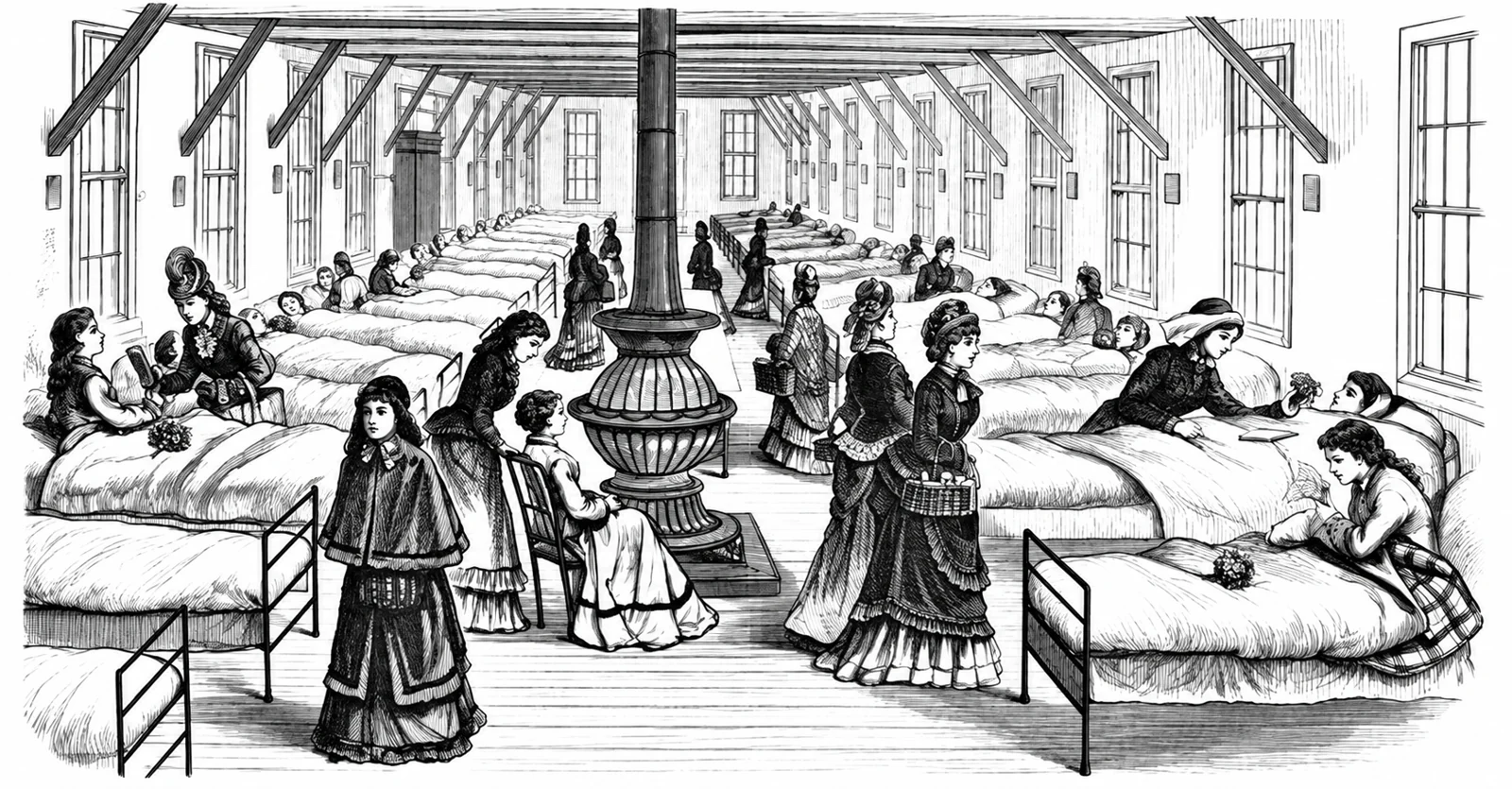
By the 1870s, the New York Flower Mission was using space at the All Souls rectory. Flowers sent from the country were sorted and taken to hospitals and other institutions. The work offered no cure in the medical sense. It brought something living and beautiful into rooms where illness, confinement, and poverty could make every day look much like the last. The modest nature of the gift was part of its meaning: a patient had been remembered.
The rectory was well suited to such cooperation in purpose, if not always in floor plan. The same building associated with wartime committees now supplied a base for a different charitable undertaking. Young volunteers handled the flowers and carried them into the city. An illustration published in 1877 shows women distributing them in a hospital ward, giving visible form to an enterprise that depended on many repetitive, easily overlooked acts.
Bellows was still building organizations. In 1865 he helped establish the National Conference of Unitarian Churches, seeking a stronger relationship among congregations accustomed to considerable independence. He also became involved in civil service reform. The range can make his later career seem scattered, but it followed a recognizable habit: identify work that ought to be done, bring people together, and give their cooperation a form that might outlast the meeting.
The Voice and the Bronze
A congregation remembers
Bellows died in New York on January 30, 1882, at sixty-seven. His ministry had lasted more than four decades, carrying the congregation from downtown quarters to its unmistakable Gramercy church. Eliza had died in 1869; in 1874 he married Anna Peabody, daughter of his friend the Rev. Ephraim Peabody. His family and parish had lived with the demands of a man whose attention was constantly being sought by a cause, a correspondent, or someone at the door.
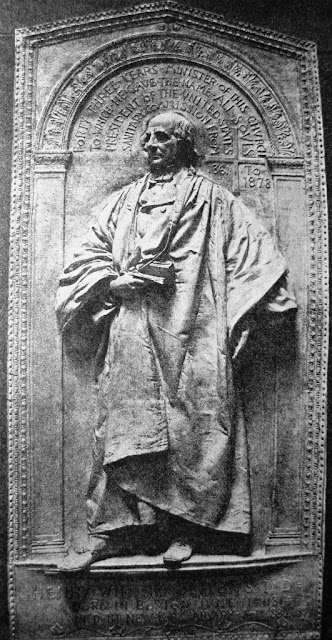
The congregation commissioned a memorial from Augustus Saint-Gaudens, with an architectural setting associated with Stanford White. Saint-Gaudens knew the neighborhood from his own youth; his early education at Cooper Union belonged to another part of the circle Bellows had encouraged. The bronze relief presents the minister standing in clerical dress. Its presence is bodily and individual, a person occupying space rather than a catalogue of offices represented by an inscription.
Installed in All Souls in June 1886, the memorial gave later visitors a way to encounter Bellows after his voice was gone. Helen W. Henderson described it in A Loiterer in New York in 1917, when the old church and rectory were still standing. Her account also preserves the family’s memories of Mould’s troublesome house. Public commemoration and domestic recollection sit close together: the energetic civic figure in bronze, and the father whose children explored an awkward parsonage.
What remained when the church moved
The buildings did not vanish at the moment of Bellows’s death. They continued to serve worship and neighborhood activity for decades. All Souls eventually planned a new home at Lexington Avenue and East 80th Street. The vacated Gramercy church burned in August 1931, and the six-story apartment building now known as 8 Gramercy Park South was completed in 1938. Its restrained brickwork belongs to a different architectural world from Mould’s bands of pale stone and red brick.
Bellows’s memorial survived the departure from Gramercy and remains part of the congregation’s history. The institutions with which he worked have had differing afterlives: the Sanitary Commission completed its wartime task, Cooper Union continued to educate, the Century and Union League remained meeting places, and the museum grew far beyond the scale imagined by its early advocates. Their histories do not reduce to his biography, but each helps explain the kind of public life he inhabited.
At the old rectory site, a visitor now sees an apartment entrance. To picture Bellows there is to restore a particular arrangement of people and work: Strong a short walk away, Cooper nearby on Lexington Avenue, letters going to Washington, and volunteers finding space for useful projects. The most revealing memorial may be that geography. For twenty-seven years, one busy household at the corner helped connect the Park to needs that could not be contained within it.
Places, people & connections
Around the Park
8 Gramercy Park South
The apartment building occupies the former church and rectory site. Its history reconstructs Mould’s unusual buildings and their later uses.
50 Gramercy Park North
George Templeton Strong’s earlier north-side home places the Sanitary Commission’s treasurer within a short walk of its president.
7 Lexington Avenue
Peter Cooper’s former house stood here. His support for education and wartime relief repeatedly intersected with Bellows’s ministry.
One Lexington Avenue
Cyrus and David Dudley Field’s adjoining houses belonged to the network of neighbors Bellows knew through civic work and wartime organization.
16 Gramercy Park South
Edwin Booth established The Players here years after the assassination crisis in which Bellows offered him comfort.
Edwin Booth
The actor’s life places Bellows’s pastoral friendship within the larger story of the Booth family and the American stage.
George Templeton Strong
Bellows’s neighbor and fellow commission officer recorded the pressures of wartime work in his diary.
Peter Cooper
The industrialist and All Souls parishioner helped make the education and relief projects of this circle possible.
Life at a glance
The biographical record
| Born | June 11, 1814 · Boston, Massachusetts |
|---|---|
| Died | January 30, 1882 · New York City |
| Gramercy Park address | All Souls Unitarian Church and adjoining rectory, 104 East 20th Street, at Fourth Avenue; now the site of 8 Gramercy Park South |
| Years on the Park | 1855–1882 |
| Vocation | Unitarian minister, writer, civic organizer; president of the United States Sanitary Commission |
| Spouse & family | Eliza Townsend (married 1839; died 1869); Anna Peabody (married 1874). Children of the first marriage included Russell and Anna Langdon Bellows. |
| Key institutions & works | All Souls; the U.S. Sanitary Commission; the Century Association; the Union League Club; the National Conference of Unitarian Churches; The Christian Inquirer; The Old World in Its New Face (1868–1869) |
Over time
A Boston childhood
Born June 11; studies at Harvard and prepares for the Unitarian ministry.
A New York congregation
Begins the long ministry that will lead All Souls to Gramercy Park.
The striped church opens
The congregation dedicates Jacob Wrey Mould’s church on Christmas Day.
The Sanitary Commission
Bellows becomes president of a national civilian relief organization.
Care across a continent
Medical reform, hospital transports, western gifts, and sanitary fairs sustain the work.
Sympathy after the war
Bellows comforts Edwin Booth and helps organize the National Conference of Unitarian Churches.
Flowers from the rectory
The Flower Mission distributes country flowers to hospital patients.
A ministry remembered
Bellows dies in 1882; Saint-Gaudens’s bronze memorial is installed in June 1886.
Sources cited
- Carole Klein, Gramercy Park: An American Bloomsbury (Boston: Houghton Mifflin, 1987), accounts of Bellows, the Strong household, Cooper, and Gramercy’s wartime civic circle.
- Helen W. Henderson, A Loiterer in New York (New York: George H. Doran, 1917), pp. 230–236: All Souls, Mould, Grinnell, Anna Bellows’s recollections, and the Saint-Gaudens memorial.
- Charles J. Stillé, History of the United States Sanitary Commission (Philadelphia: J. B. Lippincott, 1866). Official report; the chapter on California and the Pacific Coast was contributed by Bellows and the financial history by Strong.
- Frederick Law Olmsted, letters to Henry Whitney Bellows, May 7, 1862 and June 3, 1862, The Papers of Frederick Law Olmsted, vol. 4, digital edition, University of Virginia Press. Hospital transports, nursing, orders, and the Peninsula Campaign.
- Columbia University, Archives & Special Collections, Henry W. Bellows letters, 1861–1863. Letters to Samuel B. Ruggles on the commission, Strong’s work, and later civic projects.
- The New York Public Library, Manuscripts and Archives Division, United States Sanitary Commission records: New York, N.Y. archives, 1861–1878, MssCol 22263. Standing Committee papers, Bellows correspondence, hospital transport records, and the Historical Bureau.
- All Souls Historical Society, “1838–1860: The Bellows Era, Part 1” and “1861–1882: The Bellows Era, Part 2”. Congregational chronology, Cooper, the women’s relief organization, the Metropolitan Fair, and civic associations.
- John White Chadwick, biographical remembrance of Bellows, reproduced by Harvard Square Library. Education, ministry, public amusements, and personal recollections.
- Alan Seaburg, “Henry Whitney Bellows”, Dictionary of Unitarian & Universalist Biography. Theology, the National Conference, family, and bibliography.
- John B. Pine, The Story of Gramercy Park, 1831–1921 (New York: Gramercy Park Association, 1921), the Park’s households and civic institutions.
- Tom Miller, “The Lost All Souls’ Church Rectory—104 East 20th Street” (May 2020), archival illustrations, the Flower Mission, and the rectory’s later history.
- New York Sun, October 14, 1938, “In the Gramercy Park Section.” Completion notice for the apartment house at No. 8; New York Public Library, image 5146196.
Photo credits for this page
- Henry Whitney Bellows, Brady-Handy Photograph Collection, Library of Congress, Prints and Photographs Division. Public domain. Source.
- All Souls Rectory, Old Buildings of New York City (New York: Brentano’s, 1907). Public domain. Source.
- All Souls Church, photograph taken before 1931. Irma and Paul Milstein Division, The New York Public Library. Public domain. Source.
- Francis Holl, after Samuel Lawrence, William Makepeace Thackeray, steel engraving published by Smith, Elder & Co., 1853. Public domain. Source.
- Mathew Brady studio, United States Sanitary Commission officers, 1861–1865. Brady-Handy Photograph Collection, Library of Congress, LC-BH82-5308 A. Public domain. Source.
- The Metropolitan Sanitary Fair—The Art Gallery, 1864. Library of Congress, Prints and Photographs Division. Public domain. Source.
- Frank Leslie’s Illustrated Newspaper, May 5, 1877. Public domain. Source.
- Augustus Saint-Gaudens, Henry Whitney Bellows memorial, installed 1886. Photograph in Helen W. Henderson, A Loiterer in New York (1917). Public domain. Source.