
Cyrus W. Field
An Ocean Beyond the Library Window
1819–1892 · 123 East 21st Street (now One Lexington Avenue) · 1852–1892
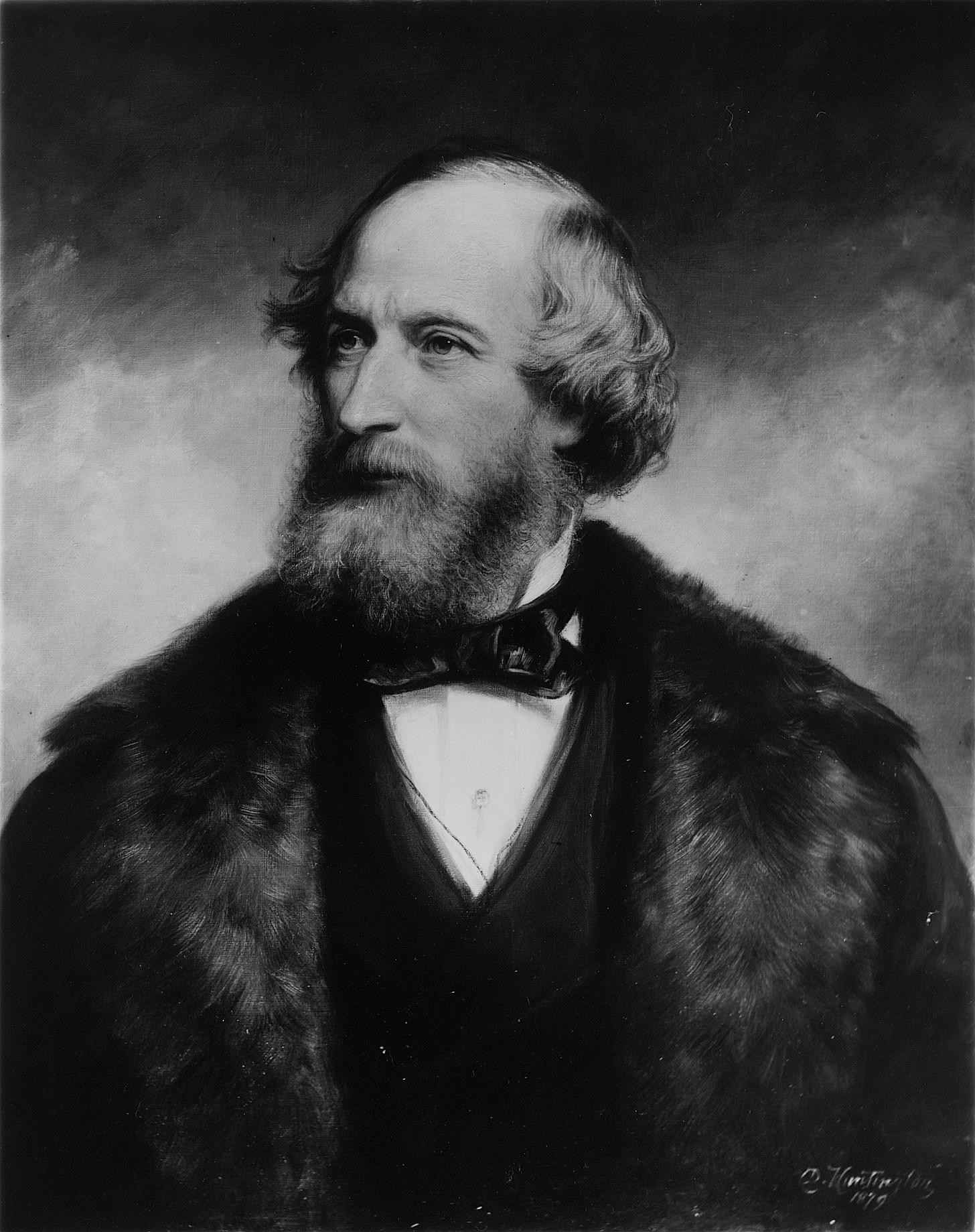
A life in Gramercy
Four evenings around a dining table
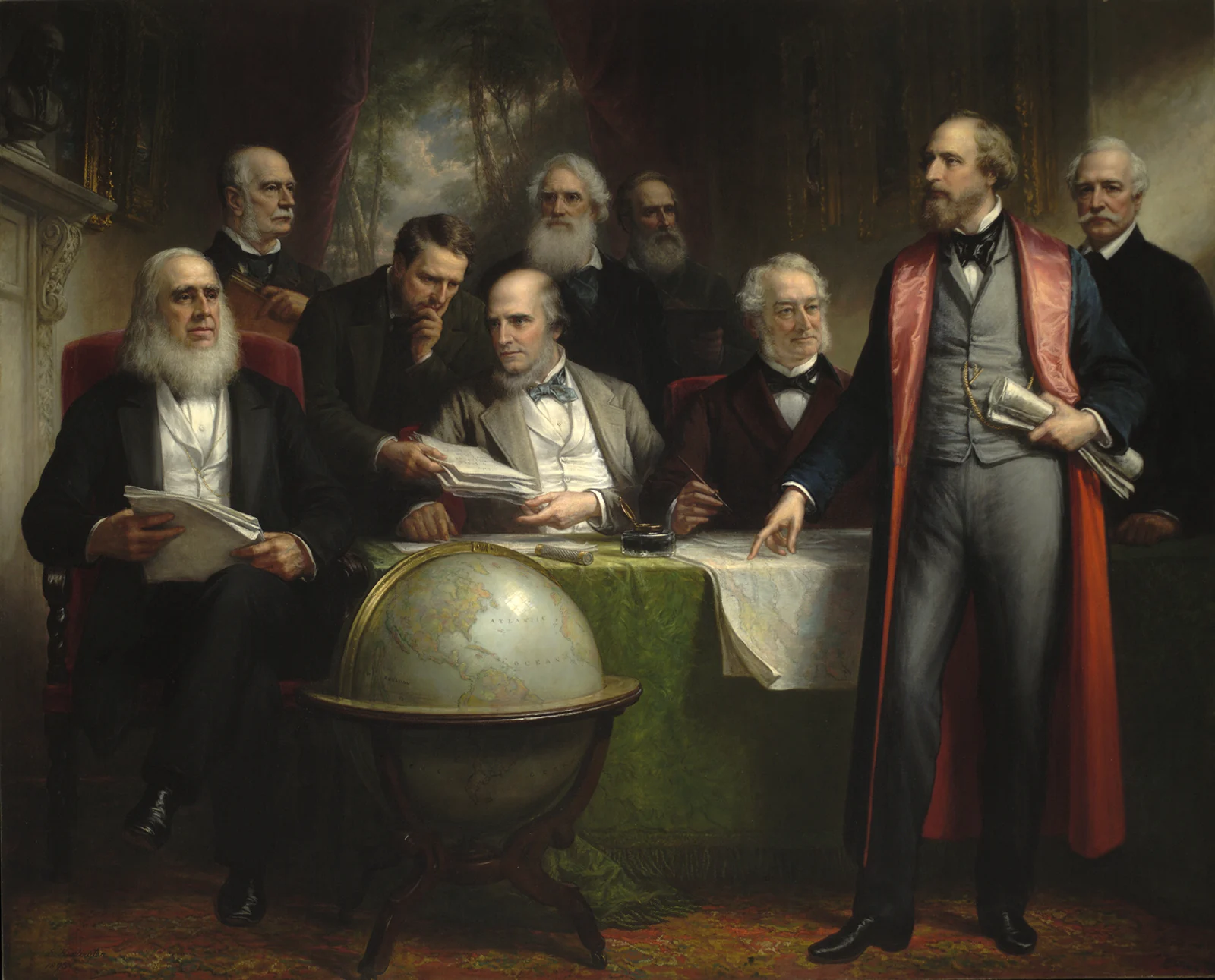
For four evenings in 1854, Cyrus Field’s dining table on Gramercy Park disappeared beneath the business of crossing an ocean. Maps, estimates, and the records of a struggling telegraph company gave five New York businessmen plenty to consider. The host had made his money selling paper. His neighbor Peter Cooper made iron, machinery, and a habit of backing useful inventions. The enterprise before them would ask for more patience, more money, and more faith in one another than any of them yet understood.
Outside stood the young square’s houses and trees. Inside, the scale had changed. A line that began as a scheme to bring news through Newfoundland was becoming a cable beneath the Atlantic, carrying a message from Europe to America without waiting for a ship. Field had arrived at that larger possibility while studying the globe in his upstairs library. Once the thought took hold, the retired merchant’s comfortable life was over.
His house occupied the corner now known as One Lexington Avenue. Next door lived his older brother David Dudley Field, whose legal work would help give the project a corporate existence. Cooper was only a few doors away. Around Gramercy Park, business introductions and family visits could turn into working meetings with consequences far beyond the neighborhood.
The cable’s story would include broken machinery, lost fortunes, cheering crowds, and a public triumph that went silent almost as soon as New York had finished celebrating. Field returned to the problem each time. For forty years, through celebrity and disappointment, this corner of Gramercy remained the place he came home to.
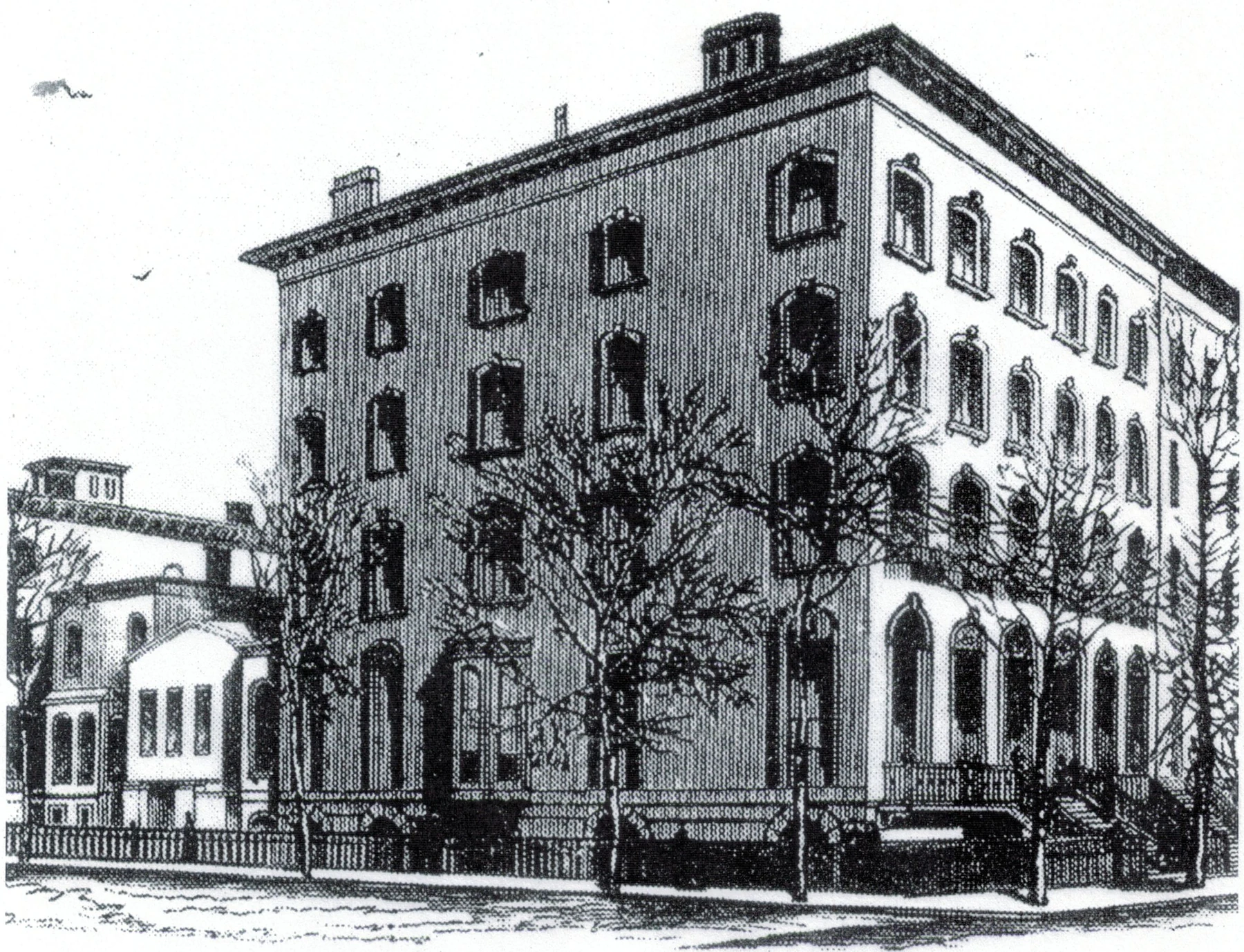
A merchant makes his way
A boy with an expense book
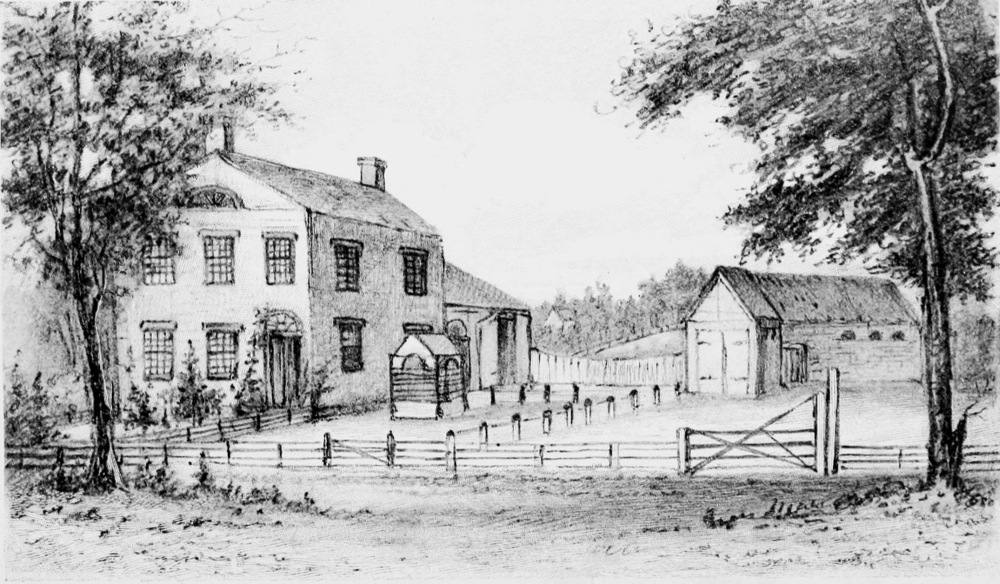
Cyrus West Field was born in Stockbridge, Massachusetts, on November 30, 1819, into the large family of the Reverend David Dudley Field and Submit Dickinson Field. His father’s Congregational ministry supplied a demanding example of work and duty. The children found very different occupations: David Dudley became a law reformer, Stephen a justice of the United States Supreme Court, and Henry Martyn a minister and author. Cyrus’s education took a more commercial direction, though the brothers would remain closely involved in one another’s lives.
In the spring of 1835, at fifteen, he went to New York to become an errand boy at A. T. Stewart’s dry-goods store on Broadway. His first year’s salary was fifty dollars. Board and lodging cost two dollars a week, so David had to lend him money to make the arrangement possible. Cyrus carefully recorded the small expenses of independence: shoe repairs, a haircut, turpentine to remove spots from his coat, and a replacement straw hat. Even his economy required help.
The boy who would cross the Atlantic repeatedly was desperately homesick on that first journey away. His daughter later described him watching northbound boats from the Hudson shore and imagining the welcome waiting in Stockbridge. Work gradually gave him a place in the city. Stewart’s store taught him attention to customers, stock, hours, and money; subsequent employment took him into the paper business, where the expanding newspaper and publishing trades offered opportunities to a young man willing to work very long days.
Paper, credit, and a place on the square
He became a junior partner in a paper concern in 1840, only to see it fail the next year. The settlement released him from liabilities that he nevertheless continued to regard as his own. Starting again as Cyrus W. Field & Co., he built a successful wholesale paper business. On December 2, 1840, he married Mary Bryan Stone of Guilford, Connecticut. As the company grew, so did the family: they would have seven children. Success meant security for a household, as well as a balance in a ledger.
The pace eventually caught up with him. In 1849, on medical advice, Cyrus and Mary left for Europe, entrusting their four young daughters to relatives. The passage to England took eighteen days. Letters and a box of toys carried affection back across the water; Mary asked that the little girls kiss one another for her. Once ashore, the couple traveled rapidly through Britain and the Continent. Field later amused friends by saying that the first word he learned in each new language was “faster.” Even a journey prescribed as rest acquired something of a business schedule.
By his early thirties, Field could retire from daily business. In 1851–1852, he and David acquired adjoining sites on the north side of Gramercy Park and established the paired houses first numbered 84 and 86 East 21st Street, later 123 and 125. A shared stoop and communicating rooms kept the brothers within easy reach. Cyrus had traveled a considerable distance from his Murray Street boardinghouse. He now had a home large enough for a growing family, pictures, visitors, and the business gatherings that would soon fill his supposed retirement.
The house behind the public man
Rooms for a prosperous retirement
Field’s house made no secret of his prosperity. He engaged professional help for its decoration; accounts of the rooms describe French taste, Italian curtains, sculpture, marble, and painted ceilings. In the dining room, 262 pieces of blue-and-white Minton china formed an extravagant display. An English butler presided over meals. Across the square, George Templeton Strong found material for private amusement in his neighbor’s elaborate domestic ambitions. Field was furnishing a family home, but he was also giving Gramercy something to talk about.
Mary’s greenhouse brought another kind of abundance indoors. She knew trees and flowers well, and plants remained a pleasure through years crowded with travel and hospitality. The house also held paintings by Frederic Edwin Church, a friend with whom Field traveled in South America in 1853. The man who measured his mornings in minutes could still make room for landscapes and long journeys.
There was a less imposing side to this establishment. The family kept a cow, and the children remembered a New York in which it could be driven to pasture near Madison Square. Field’s own habits were exact. He rose early, made a list of the people he needed to see, and put it in his hat before breakfast. He disliked losing even ten minutes at the start of a day. Yet unopened evening letters could wait: bad news might cost him sleep, while good news would still be good in the morning.
A family door closes
Connected houses did not guarantee a united family. In 1851, Henry Martyn Field married Henrietta Desportes, a French teacher who had been the governess in the household of the Duc de Choiseul-Praslin. The duchess’s murder in 1847 had engulfed that household in scandal. Henrietta was not the murderer, but the notoriety followed her to New York, where she taught at Miss Haines’s school at 10 Gramercy Park South. Mary Field refused to receive her. The rejection made a painful boundary inside a family whose homes and daily routes otherwise lay so close together.
Henry and Henrietta’s later life at 22 Gramercy Park South would give them their own place in the neighborhood. Cyrus, meanwhile, could be notably generous beyond his front door. In 1853, with his fortune exceeding $250,000, he paid the balances his former creditors had forgiven, adding interest. After the December fire that destroyed Harper & Brothers, he offered James Harper a $10,000 loan. The same square that held family friction also furnished a remarkably practical circle of assistance.
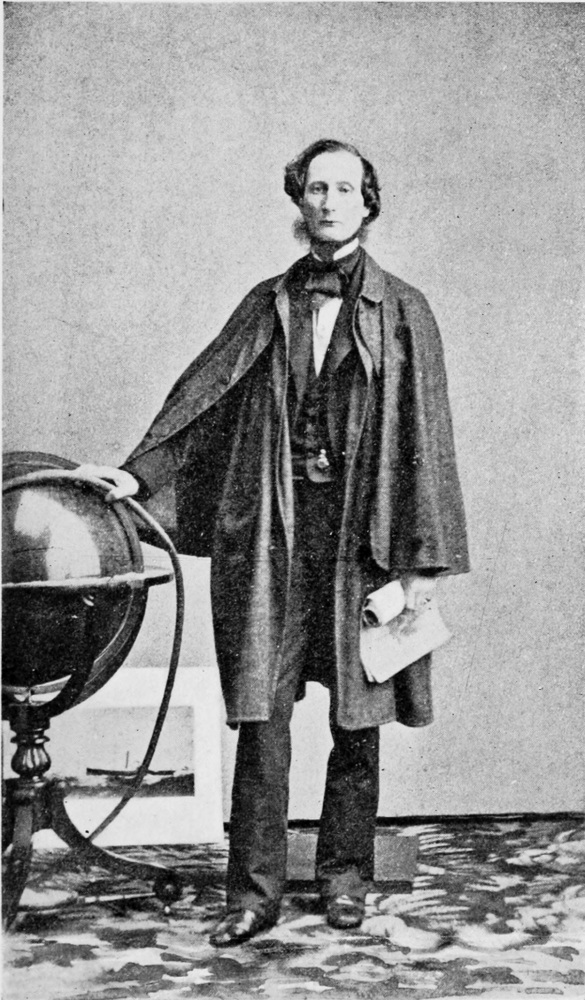
The globe and the dawn meeting
A larger question
Late in January 1854, another brother, Matthew, asked Cyrus to meet Frederick Newton Gisborne. The engineer had begun a telegraph route across Newfoundland, then run out of money. His proposal had an intelligible commercial purpose: news arriving by steamship could be landed on the island and sent onward electrically, reaching American cities sooner. Gisborne needed someone to rescue unfinished work and unsettled debts. Field listened, met him again, and began thinking beyond the limits of the original scheme.
After one of their evening conversations, Field turned to the large globe in his library. If a wire could connect Newfoundland with the American mainland, why should it stop there? Ireland lay on the other side of the Atlantic. A cable between those coasts would remove the steamship from that part of the news journey altogether. His daughter’s account gives this domestic object a decisive role: the globe allowed a merchant to see two faraway shores as the ends of one undertaking.
Field immediately sought knowledge he did not possess. He wrote to Samuel F. B. Morse about sending electrical signals over such a distance and to naval oceanographer Matthew Fontaine Maury about the sea floor. Morse had already considered an Atlantic telegraph; Field’s contribution was to gather the people and money needed to attempt it. He consulted David on law and Cooper on the enterprise itself. The ambition was personal, but the work from its first days depended on other men’s expertise.
From the table to the charter
Cooper, Moses Taylor, Marshall O. Roberts, and Chandler White joined the meetings at Cyrus’s dining table. Four evenings went into examining records, maps, and costs. On March 10, they committed themselves to taking over Gisborne’s undertaking, subject to a satisfactory new charter. Cyrus, David, and White then traveled to Newfoundland. There, negotiation mattered as much as engineering: they needed rights of way, governmental cooperation, and terms under which investors could reasonably risk their money.
The resulting New York, Newfoundland, and London Telegraph Company had an authorized capital of $1.5 million. At six in the morning on May 8, 1854, the organizers met next door at David’s house to complete their arrangements before one of the party left town. Cooper became president. For the moment, the immediate task remained the Newfoundland route. An Atlantic cable was the greater prospect beyond it—a prospect now supported by a charter, subscriptions, and a group of neighbors who had put their names to the same difficult promise.
A city celebrates, then listens
Before the ocean
The first obstacle was land. A telegraph line across Newfoundland meant cutting and building through a sparsely settled island whose interior was far less convenient than its outline on a globe. Supplies, labor, weather, and transport all drove up the difficulty. At the western end, a submarine cable still had to cross the Gulf of St. Lawrence. An attempt in 1855 failed; the following year brought a working connection. Even before the Atlantic was attempted, the investors had learned how quickly a straightforward line on a map could consume time and money.
Field carried the larger scheme to Britain, where capital, cable manufacture, and naval assistance were essential. The Atlantic Telegraph Company was organized in 1856. Its work brought together businessmen, electricians, engineers, shipbuilders, and governments on both shores. Cable had to conduct faint signals across an unprecedented distance and survive the strain of being lowered through deep water. No single invention would make the venture succeed. A fault in insulation or a violent movement of a ship could defeat years of preparation.
In August 1857, the American frigate Niagara and the British Agamemnon took the cable to sea. The attempt began from Ireland, but after several hundred miles had been laid the line broke and disappeared into the Atlantic. The following summer brought new attempts and further breaks. Field kept pressing to use the cable and time still available. On July 29, 1858, the two ships joined their cable in mid-ocean and sailed in opposite directions, paying it out toward Ireland and Newfoundland.
The brief summer of the cable
This time they reached shore. On August 5, the ocean connection was complete; on August 16, Queen Victoria’s message to President James Buchanan made the achievement official. Across roughly 1,950 miles of ocean, words had arrived without a ship carrying them. Transmission was laborious, and the electrical signals were weak, but those limitations hardly diminished the wonder. Newspapers, merchants, diplomats, and families could all imagine what a dependable connection might change.
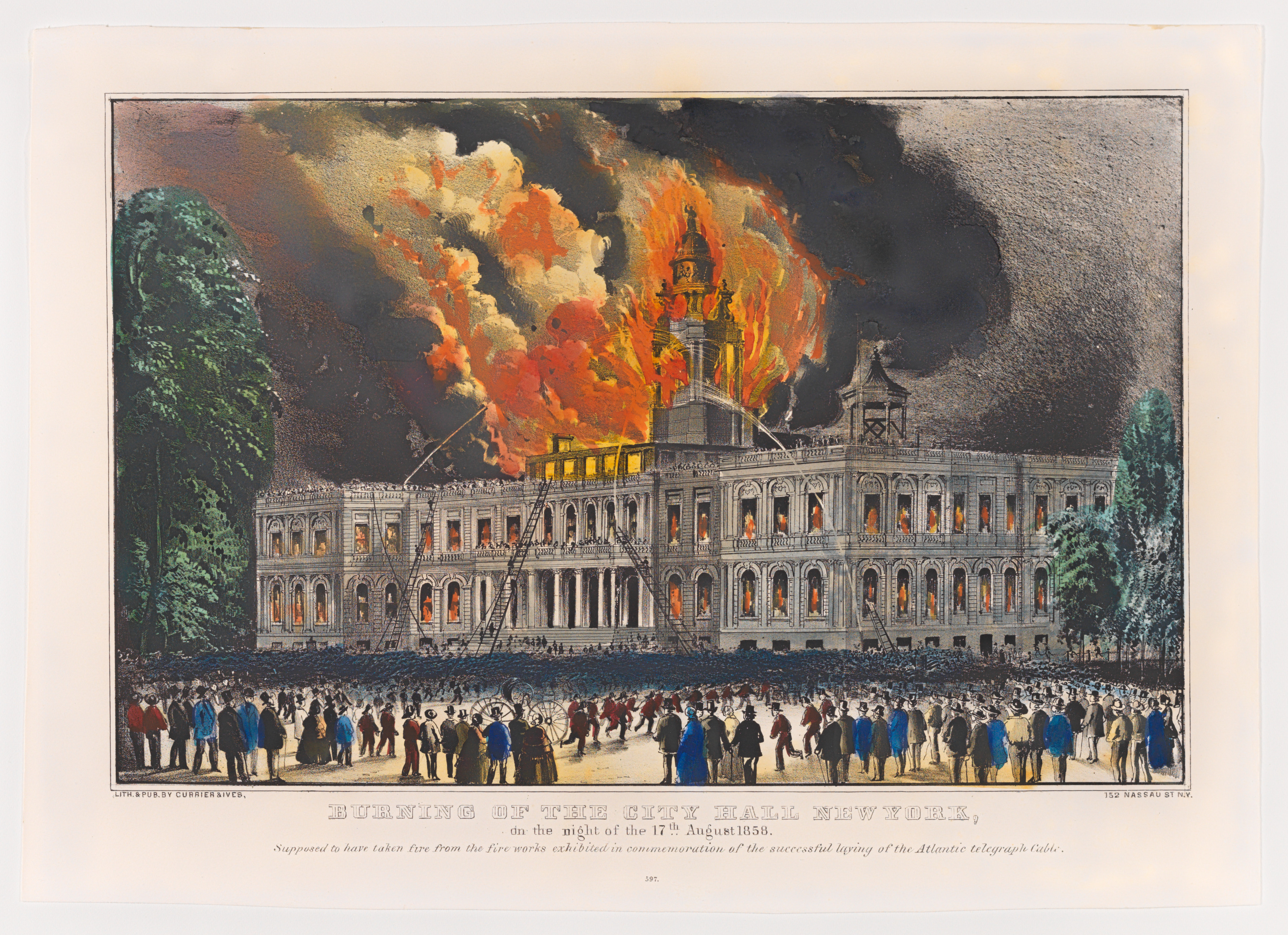
New York celebrated with bells, processions, illuminations, and crowds. Gramercy Park shared the excitement surrounding its suddenly famous resident. Fireworks during the August festivities accidentally set City Hall’s roof ablaze. On September 1, the city honored Field with another great procession and a reception at the Crystal Palace. The scale of the acclaim made the disappointment sharper: the cable’s signals deteriorated, then failed. Later that autumn, the Crystal Palace itself burned, adding another image of loss to a season that had begun in extravagant confidence.
Suspicion replaced applause. Some people doubted that the cable had ever worked; others regarded the whole venture as an expensive delusion. Field, who had been willing to stand publicly for the project, also bore its humiliation. In Cooper’s library, Field broke down; his neighbor was still ready to continue. Cooper’s answer was simple: “We will go on.” The next successful Atlantic cable lay eight years ahead. At that moment, keeping the partnership intact was an achievement in itself.
The ship large enough for the task
Other urgent work
The Civil War gave Field and his neighbors more immediate claims on their energy. In June 1861, the United States Sanitary Commission named him and Cooper among the businessmen invited to form its central financial committee. Their task was to raise money and support the organization’s relief work for Union soldiers. Henry Whitney Bellows led the commission; George Templeton Strong kept its national accounts. The familiar Gramercy network was now helping to supply hospitals, improve camp conditions, and care for men far from home.
Field’s British connections could serve that work too. In 1864, correspondence records his efforts to arrange transport for a gift of one thousand tons of coal for the Sanitary Commission. Mary participated in relief organizing and corresponded with Bellows. The cable was never quite abandoned, however. Field continued seeking money and political support on both sides of the ocean. Over the long campaign he would make more than forty Atlantic crossings, traveling repeatedly through the very delay he hoped to abolish.
A second cable within reach
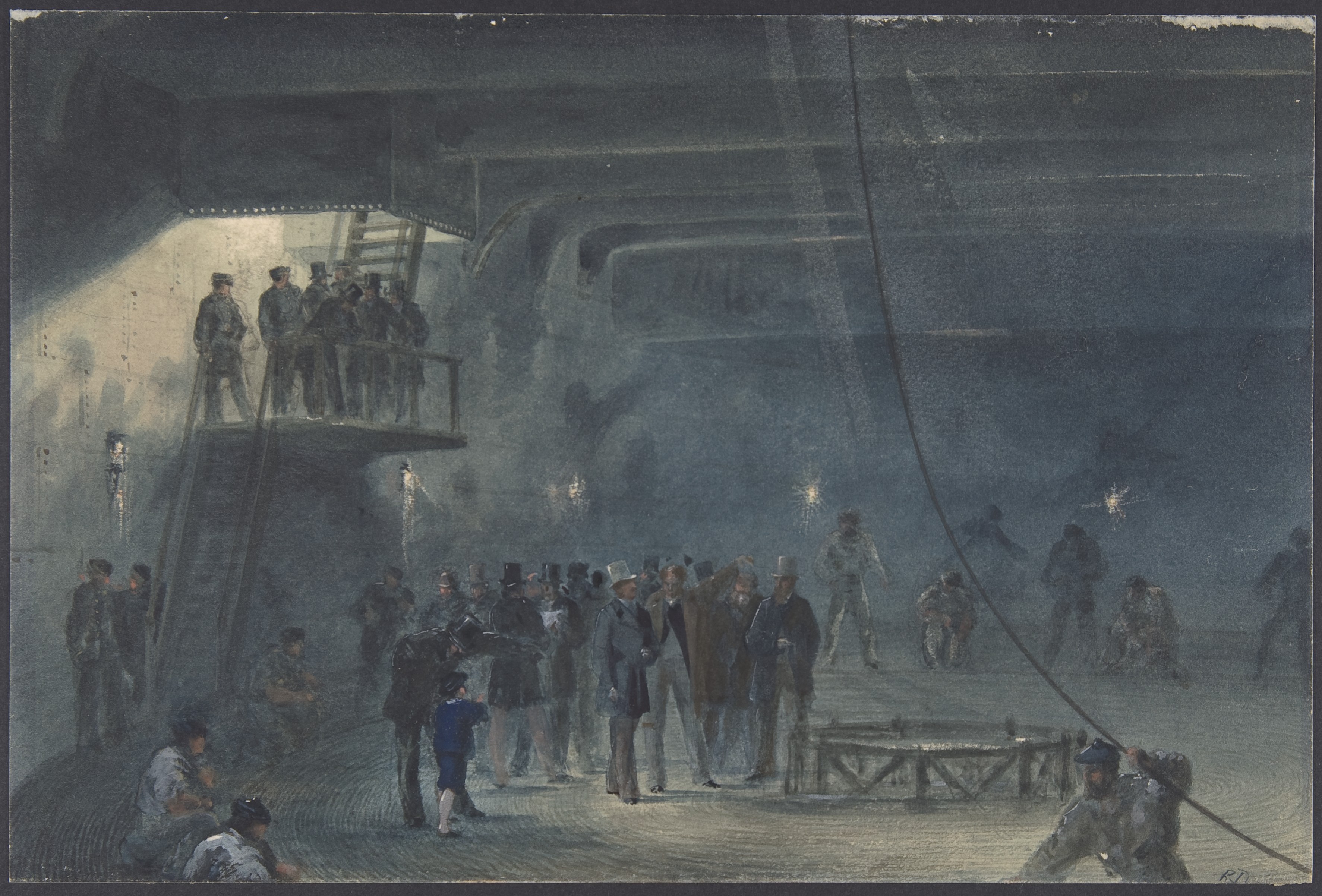
For the renewed attempt, the enormous iron steamship Great Eastern offered a practical advantage that no speech could supply: room for the whole Atlantic cable. Its vast tanks held coils that previously had to be divided between ships. Improved cable and machinery accompanied the change of vessel. In 1865, the ship laid much of the route before another break ended the attempt. Efforts to grapple the lost line failed, but the operation demonstrated that a cable on the deep Atlantic floor might be recovered.
On July 27, 1866, the Great Eastern reached Heart’s Content, Newfoundland, with a working cable from Ireland. This success endured. The ship then returned to sea for the unfinished business of 1865. In early September, the crew recovered that cable, spliced on a new section, and completed it to Newfoundland. After twelve years of effort, the enterprise possessed two functioning Atlantic connections. Field’s achievement rested at last on something stronger than a celebration: messages continued to arrive.
The neighbors celebrate again
Honors followed on both continents. New York’s Chamber of Commerce celebrated him, and Congress authorized a gold medal on March 2, 1867, recognizing his determination in establishing transatlantic communication. At a company dinner after his return in 1866, Cooper recalled how little the original investors had understood the obstacles ahead. He compared their leader to Moses, capable of pointing discouraged companions toward the promised country, and toasted the health and happiness of “our Moses, Mr. Cyrus W. Field.”
The cable did not make the world peaceful, as its most hopeful supporters imagined. It did change the speed at which the world could conduct its affairs. A financial instruction, a diplomatic message, or a report of an event no longer had to spend days aboard an Atlantic steamer. Behind that new daily fact stood the men who manufactured and laid the wire, the crews who recovered it, the investors who returned after failure—and a Gramercy resident who repeatedly persuaded them that the work was still worth doing.
The city rises; the fortune falls
Another kind of connection
Field did not settle into quiet celebrity. New York’s elevated railways drew his interest as the crowded city needed faster ways to move people along its length. He invested heavily in rapid transit and in real estate, including the Washington Building at 1 Broadway. He also became a newspaper proprietor, owning the Mail and Express during the 1880s. Communication remained a recurring attraction: a cable, a railway, and a newspaper each promised to put people or information into motion.
These ventures brought new wealth and new exposure to loss. Railway finance involved powerful competitors, large obligations, and changing alliances; property and newspaper investments also absorbed capital. The confidence that had served him so well during the cable campaign offered no protection against every market reversal. By the end of his life, financial disasters had consumed almost everything. The man whose name had become a guarantee of persistence found that persistence could not rescue all the enterprises carrying it.
What remained
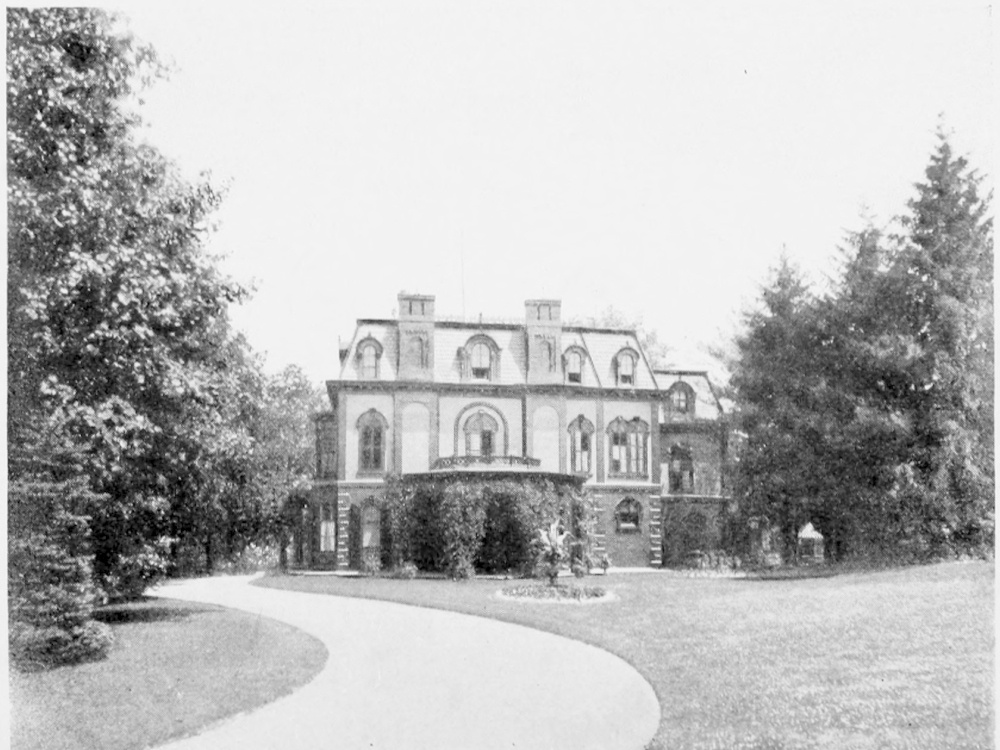
Cyrus and Mary celebrated their golden wedding in December 1890, surrounded by messages from family and old friends. The following year brought her final illness. On November 23, 1891, she died after nearly fifty-one years of marriage. Financial and family troubles deepened his distress during the same period. J. Pierpont Morgan helped him maintain his insurance and reach his country home, Ardsley, near Irvington on the Hudson. Field died there on July 12, 1892, aged seventy-two, and was buried in Stockbridge.
The Gramercy houses outlived him only briefly in their original form. Henry William Poor brought the adjoining properties together, and Stanford White transformed them into a single mansion. In 1910–1911, that mansion gave way to the cooperative apartment house now standing at One Lexington Avenue. A bronze tablet installed in 1929 recalls the forty years Field lived on the site and the cable plans made there. The corner has changed its architecture twice while keeping his name within reach of a passerby.
A quieter survivor is the 1852 terrestrial globe from his library, preserved at the Smithsonian’s National Museum of American History. Family gifts also carried his papers, cable specimens, and commemorative objects into public collections; his portrait and pictures of the cable expeditions went to the Metropolitan Museum of Art. The globe has none of the grandeur of an ocean steamer. It is still possible to follow its curved surface from Newfoundland to Ireland and see the distance that once kept Cyrus Field awake in a house on Gramercy Park.
Places, people & connections
Around the Park
One Lexington Avenue
The site of Cyrus and David Dudley Field’s connected houses, the 1854 cable meetings, and today’s memorial tablet.
7 Lexington Avenue
Peter Cooper’s former home stood here, a short walk from the dining table where he backed Field’s Atlantic plans.
22 Gramercy Park South
Henry Martyn and Henrietta Field’s later home extends the family story across the square.
10 Gramercy Park South
Henrietta Desportes taught at Miss Haines’s school before her marriage to Henry Martyn Field.
4 Gramercy Park West
James Harper’s home recalls the neighborhood assistance Field offered after the publishing firm’s devastating fire.
50 Gramercy Park North
George Templeton Strong’s house connected the neighborhood to music, private diaries, and Civil War relief work.
Life at a glance
The biographical record
| Born | November 30, 1819, Stockbridge, Massachusetts |
|---|---|
| Died | July 12, 1892, at Ardsley, his country home near Irvington, New York; buried in Stockbridge |
| Gramercy Park address | 84, later 123, East 21st Street; the site is now One Lexington Avenue |
| Years on the Park | 1852–1892 |
| Vocation | Paper merchant, Atlantic cable organizer, railway and real-estate investor, newspaper proprietor |
| Spouse & family | Mary Bryan Stone, married December 2, 1840; seven children. Brother of David Dudley, Stephen J., and Henry Martyn Field. |
| Key institutions & works | Cyrus W. Field & Co.; New York, Newfoundland, and London Telegraph Company; Atlantic Telegraph Company; New York elevated railways; the Mail and Express |
| Principal honor | Congressional Gold Medal authorized March 2, 1867 |
| Surviving objects | His library globe and cable memorabilia at the Smithsonian; portrait and cable-expedition art at the Metropolitan Museum of Art; commemorative tablet at One Lexington Avenue |
Over time
A Stockbridge childhood
Born into a minister’s large family in western Massachusetts.
Fifty dollars a year
Begins as an errand boy at A. T. Stewart’s New York store.
A home beside his brother
Settles on Gramercy Park’s north side in one of two connected Field houses.
The Atlantic on a globe
Organizes the investors and charter behind the Newfoundland and Atlantic venture.
Triumph and silence
The first Atlantic cable carries official messages, then fails within weeks.
Two working cables
The Great Eastern lays a new cable and recovers the line lost in 1865.
A nation’s thanks
Congress authorizes a gold medal honoring the Atlantic cable achievement.
The final summer
Dies at his Hudson River country home; his collections preserve the cable story.
Sources cited
- Isabella Field Judson, Cyrus W. Field: His Life and Work, 1819–1892 (New York: Harper & Brothers, 1896), chapters I–V, VII–XII, XIV–XVI. Family biography incorporating Field’s letters, financial records, speeches, travel accounts, and recollections; especially useful for childhood, the 1854 meetings, the cable expeditions, and the final years.
- Henry M. Field, The Story of the Atlantic Telegraph (New York: Charles Scribner’s Sons, 1898), especially pp. 23–36 and the accounts of the 1857–1858 and 1865–1866 expeditions.
- Carole Klein, Gramercy Park: An American Bloomsbury (Boston: Houghton Mifflin, 1987), pp. 49–58, 69, 71–72: the Field household, family relationships, Gramercy neighbors, and the Atlantic cable enterprise.
- Stephen Garmey, Gramercy Park (New York: Balsam Press, 1984), pp. 80–85, 127–131, 164, 172, 174–175: the Field properties, decoration and collections, Poor’s remodeling, and the later cooperative. Samuel Carter III, Cyrus Field: Man of Two Worlds (1968), p. 68, cited by Garmey for household furnishings.
- National Museum of American History, Archives Center, Cyrus W. Field Papers, 1835–1897, collection NMAH.AC.1386. Biographical history, correspondence, expedition records, photographs, and commemorative material.
- New York Public Library, Manuscripts and Archives Division, Cyrus W. Field papers, 1831–1905, MssCol 993. Business and family chronology; railway, newspaper, and property investments; estate papers.
- Library of Congress, “First Transatlantic Telegraph Cable”, This Month in Business History. Technical and corporate background to the 1858 and 1866 cables.
- United States Sanitary Commission, Documents of the U.S. Sanitary Commission, no. 6, resolution of June 22, 1861: proposed central financial committee, including Cyrus W. Field and Peter Cooper.
- New York Public Library, Surveys of Materials by and Relating to Prominent Individuals, D–F, pp. 116–117, Cyrus West Field: correspondence with Henry W. Bellows concerning the 1864 gift and transport of coal for the Sanitary Commission.
- United States Congress, joint resolution of March 2, 1867, 14 Stat. 574, thanking Cyrus W. Field and authorizing a gold medal.
- Smithsonian American Art Museum, Newton & Son, Newton’s New and Improved Terrestrial Globe, 1852, exhibition record for Alexander von Humboldt and the United States: Art, Nature, and Culture. Identifies Field’s globe and its preservation at the National Museum of American History.
- The Metropolitan Museum of Art, Daniel Huntington, Cyrus W. Field, 1879, accession 92.10.41, and Robert Charles Dudley’s 1865–1866 cable-expedition watercolor, accession 92.10.56; gifts of Cyrus W. Field, 1892.
- Museum of the City of New York, Wurts Bros., Cyrus W. Field tablet at One Lexington Avenue, 1929, X2010.7.1.3669 (MNY237228).
Photo credits for this page
- Daniel Huntington, Cyrus W. Field, 1879. The Metropolitan Museum of Art, Gift of Cyrus W. Field, 1892, accession 92.10.41. Public domain. Museum record.
- Unidentified engraver, Field residence, undated nineteenth-century view. Reproduced in Eugene E. Weise, M.D., A Tour of Historic Gramercy Park, Gramercy Park Block Association, May 7, 2006, PDF p. 27. Original engraving public domain. GPBA architectural history and illustration.
- Unidentified artist, The Parsonage, Stockbridge, Mass., plate facing p. 10 in Isabella Field Judson, Cyrus W. Field: His Life and Work, 1819–1892 (New York: Harper & Brothers, 1896). Project Gutenberg digitization. Public domain. Illustrated volume.
- Unidentified photographer, Cyrus W. Field, 1860, plate facing p. 124 in Isabella Field Judson, Cyrus W. Field: His Life and Work, 1819–1892 (New York: Harper & Brothers, 1896). Project Gutenberg digitization. Public domain. Illustrated volume.
- Daniel Huntington, The Atlantic Cable Projectors, 1895, oil on canvas. New York State Museum, Albany. Public domain. Smithsonian exhibition record.
- Currier & Ives, Burning of the City Hall New York, on the Night of the 17th August 1858, 1858, lithograph. The Metropolitan Museum of Art, Bequest of Adele S. Colgate, 1962, accession 63.550.369. Public domain. Museum record.
- Robert Charles Dudley, Coiling the Cable in the After-tank on Board the Great Eastern at Sheerness: Visit of H.R.H. the Prince of Wales on May 23rd, 1865, 1865–1866. The Metropolitan Museum of Art, Gift of Cyrus W. Field, 1892, accession 92.10.56. Public domain. Museum record.
- Unidentified photographer, Ardsley, Irvington-on-Hudson, plate facing p. 264 in Isabella Field Judson, Cyrus W. Field: His Life and Work, 1819–1892 (New York: Harper & Brothers, 1896). Project Gutenberg digitization. Public domain. Illustrated volume.