
Augustus Saint-Gaudens
The Shoemaker’s Son Who Shaped America
1848–1907 · His father’s shop · East 21st Street near Fourth Avenue · Boyhood in the 1860s
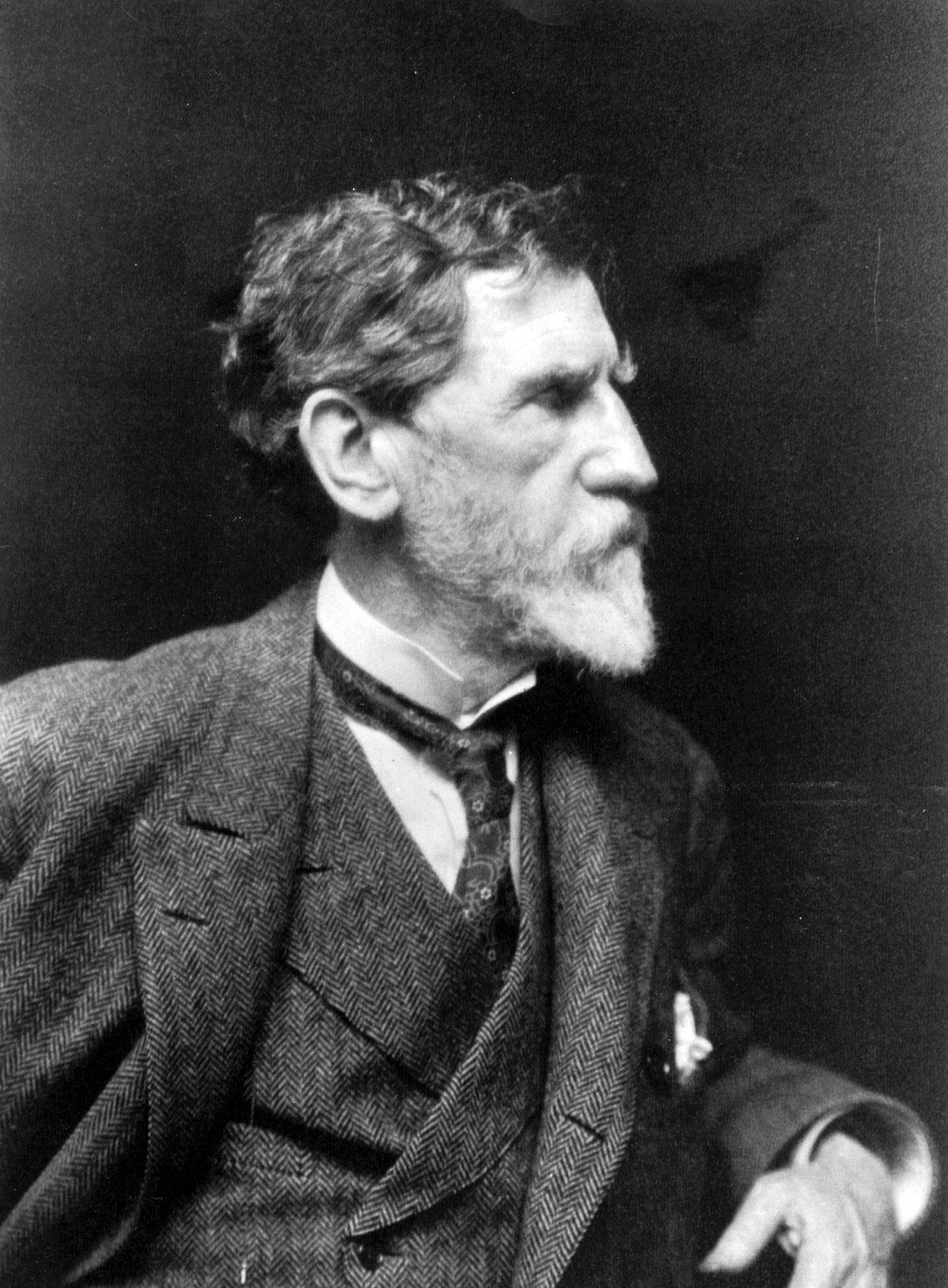
A life in Gramercy
A Delivery at the Park Gate
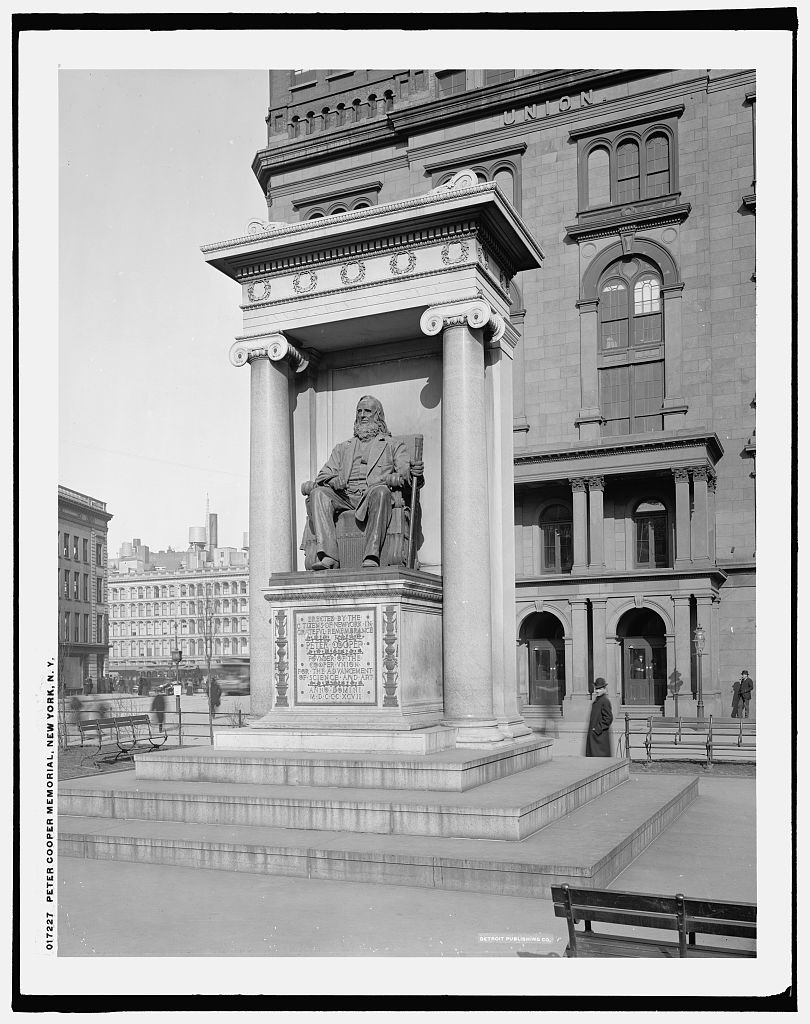
When Augustus Saint-Gaudens carried shoes from his father’s shop to the houses around Gramercy Park, he could enter his customers’ homes more readily than their garden. The children who came to the shop knew him; some were friendly. But the locked gates marked a distinction that the shoemaker’s son understood. Years later, when he wrote about the neighborhood, he remembered both the companionship and the exclusion. The Park belonged to the world his father served, close enough to look into and beyond the boy’s ordinary reach.
Bernard Saint-Gaudens’s customers included Peter Cooper, whose school would help his son become an artist. The connection eventually ran in both directions. The boy who delivered the family’s footwear grew up to model Cooper’s monument, studying the familiar old man until bronze could convey something of his patient, unceremonious presence. The statue still sits beneath a canopy designed by Stanford White, Saint-Gaudens’s friend and collaborator, outside Cooper Union.
Gramercy was never simply an address in Saint-Gaudens’s story. It was a network of shops, classrooms, patrons, churches, studios, and clubs through which a working boy found his way into American art. His father’s East 21st Street business put him in contact with neighbors who would help him; his later membership in The Players and the National Arts Club extended those associations. Between came years in Paris and Rome, an exacting apprenticeship in sculpture, and public monuments that asked how a person might be remembered without becoming merely a pedestal and a name.
The Boy Outside the Gates
Dublin to New York
Augustus was born in Dublin on March 1, 1848, to Bernard Paul Ernest Saint-Gaudens, a French shoemaker, and Mary McGuinness, who was Irish. His parents brought him to America while he was an infant. He grew up in New York rather than remembering an Irish childhood, absorbing the streets, trades, and unequal circumstances of a city expanding around him. His father’s skilled work supported the household. Making footwear to order required attention to individual bodies, good materials, and customers who expected a careful fit.
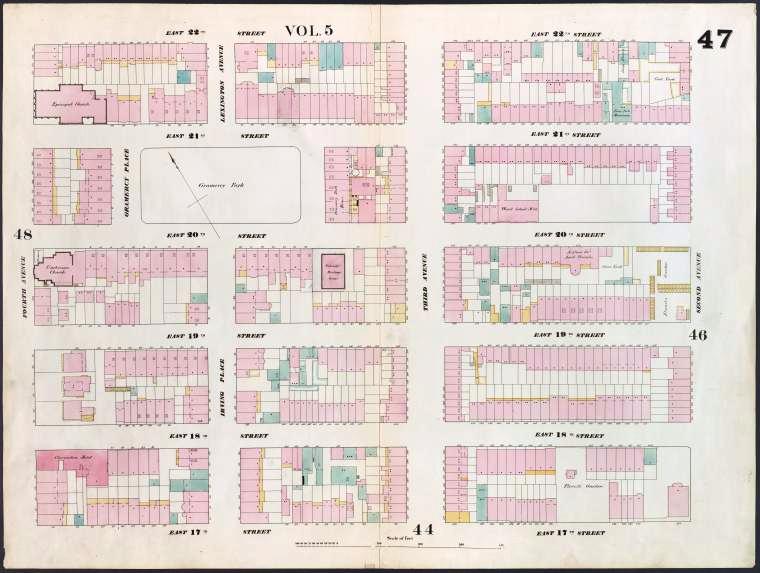
By 1860, when Augustus was twelve, the family’s life had become closely connected with Gramercy. Bernard’s boot-and-shoe business on East 21st Street, near Fourth Avenue, served households around the Park. Peter Cooper, members of the Cooper–Hewitt family, and Horace Greeley were among his customers. Their names would later belong to the sculptor’s public world; initially they belonged to his father’s order book. This was an introduction to influential New Yorkers through useful work, with the expectations and social distances that such work involved.
Customers and companions
The shop also drew the neighborhood’s children. Nursemaids brought them to Mrs. Saint-Gaudens, who sewed winter leggings to match their coats. Children waiting over fittings and clothing could become familiar to the shoemaker’s son in a way their parents’ position did not suggest. His recollections preserve these small domestic transactions alongside the famous names. The family did not encounter Gramercy society only through formal patronage. They saw its everyday needs, its children growing, and its dependence on the labor of people outside the Park’s gates.
Delivering finished footwear carried Augustus farther into that world without making him part of it. His memory of the private garden gives the neighborhood connection its particular edge: he knew children who could play there, but he lacked their access. His father’s customers had money, property, and opportunities unavailable in the shoemaker’s household. Yet the encounters also brought possibilities that could not have been predicted from an order for a pair of boots. Peter Cooper would help him enter a classroom, and his family would remember the customers long after the deliveries ended.
A habit of drawing
Drawing began before he could describe it as a vocation. Slates and whitewashed fences supplied surfaces; figures supplied problems worth solving. Looking back, Saint-Gaudens remembered the pleasure of discovering how to draw a bent knee. The detail is modest, but it catches the absorption that would govern his mature work: a bodily form becoming intelligible beneath his hand. No monument stood at the end of that early experiment. There was simply the satisfaction of seeing something clearly enough to make another person see it.
His father recognized that the habit might lead to a trade. For a household living by skilled craft, artistic ambition did not immediately mean years of independent study or an expensive studio. It meant finding work in which the boy could draw, carve, and earn. At thirteen Augustus entered the workshop of a cameo cutter. The little carved portraits offered a practical answer to a family question, although the apprenticeship would also show how narrow the distance could be between learning a craft and enduring an employer.
An Artist After Working Hours
The discipline of a small surface
Louis Avet, the cameo cutter to whom Augustus was apprenticed in 1861, taught a demanding miniature art. A cameo might be held in the hand, yet a recognizable profile, hair, clothing, and the turn of a neck had to emerge from its shallow material. Such work trained the eye to discriminate between tiny changes in contour. It also required long, repetitive labor. Avet’s temper made the workshop oppressive, and Saint-Gaudens remembered the apprenticeship with a bitterness quite different from his affectionate descriptions of drawing as a child.
The experience nevertheless left him with a durable command of relief. Throughout his career he could make a face seem present with remarkably little projection from a flat ground. Cameo cutting helped pay his way before sculpture could support him, including during his early European years. His later bronzes would be vastly larger and more ambitious, but their sensitivity to a profile or a hand belonged to an education begun at a bench. The craft was valuable; the conditions under which he learned it were another matter.
A roll of brown paper
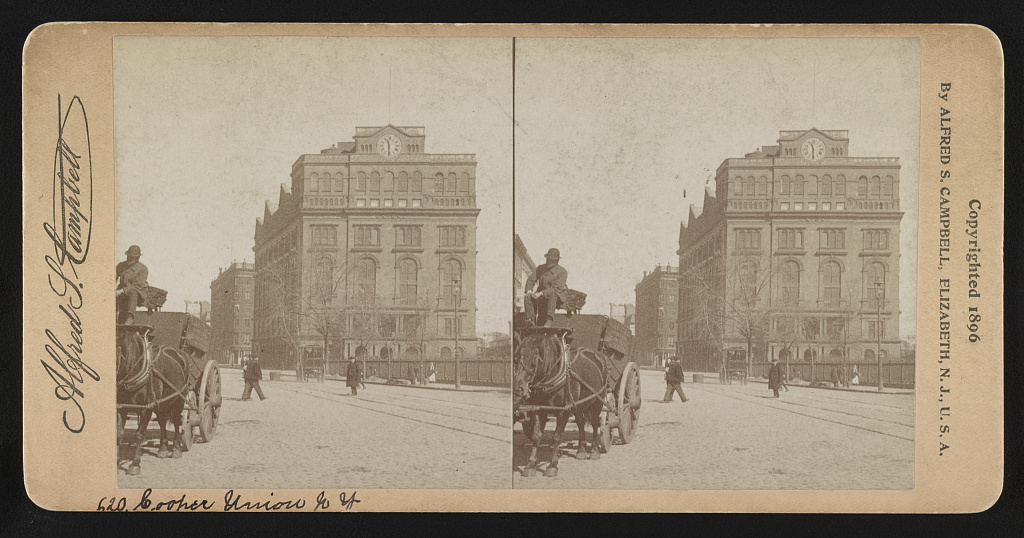
Bernard took his fourteen-year-old son to Cooper Union to seek admission to its evening classes. While his father spoke with Abram S. Hewitt, Cooper’s son-in-law, Augustus drew on the roll of brown paper they had brought. The school ordinarily admitted students at sixteen. The younger boy’s drawings helped win an exception. Hewitt belonged to the family associated with the Cooper and Hewitt houses on Lexington Avenue; through school and neighborhood, people who had known the shoemaker now had an opportunity to recognize his son.
Cooper Union’s provision for working students mattered as much as the exception. Augustus could continue earning during the day and attend classes at night, studying casts and the human figure. Six evenings a week, the discipline of employment was followed by the discipline of learning to see. The school supplied instruction that his family could not otherwise readily purchase. Peter Cooper’s idea of useful, accessible education became tangible in this arrangement: a young artisan did not have to choose absolutely between supporting himself and developing abilities beyond his existing job.
Learning to look beyond the shop
The National Academy of Design added another part of his education. Its Venetian Gothic building at Fourth Avenue and East 23rd Street stood a short walk north of his father’s business, placing a conspicuous institution of art within the landscape of his working life. The Academy and Cooper Union offered different settings, but both enlarged the world available to him. Casts, models, other students, and teachers introduced standards beyond the immediate demands of a paying cameo customer. Drawing became preparation for work he had not yet learned to make.
By the later 1860s, New York had given him technical habits and a direction. It had not exhausted his ambition. Paris offered the prestige of formal sculptural training; Rome offered ancient and Renaissance works available to sustained inspection. Going abroad would be expensive and uncertain for a young man with no independent fortune. But he possessed a portable skill that could help meet the cost. With his father’s assistance, he sailed for Europe in 1867, traveling in steerage and carrying a craftsman’s means of supporting an artist’s education.
Finding a Language in Rome
Making a living while learning
In Paris, Saint-Gaudens studied with François Jouffroy at the École des Beaux-Arts. The city offered a formal training in the figure and a dense field of sculpture to examine, but tuition and ambition did not remove the need to earn. He continued cutting cameos. The alternation between paid miniature work and larger artistic experiments followed the pattern established in New York: his education developed alongside employment. It gave him access to European art without the freedom from practical worries enjoyed by students supported more comfortably from home.
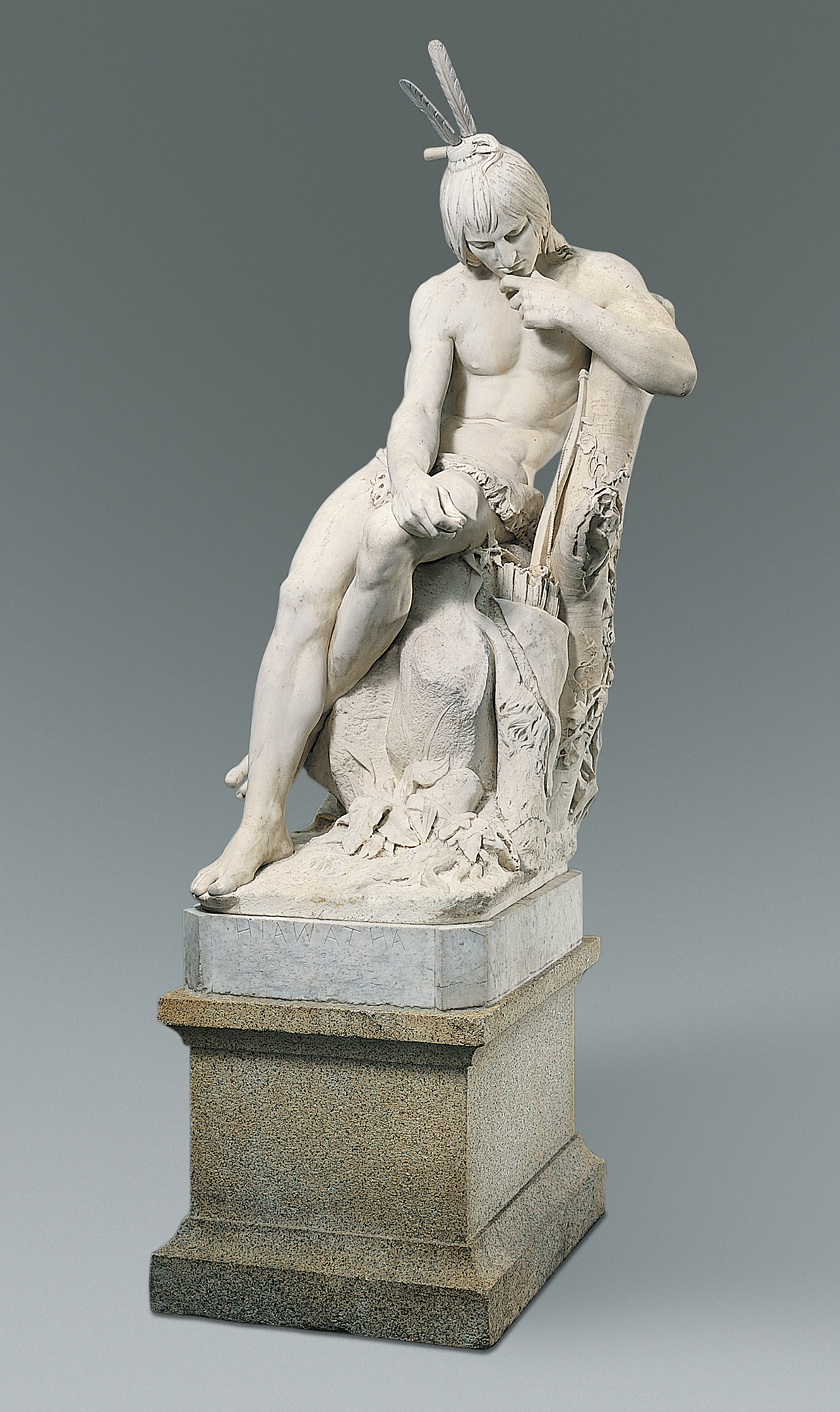
He went to Rome in 1870. There, his early full-length figure of Hiawatha, made for former New York governor Edwin D. Morgan, represented an important step beyond the cameo bench. The subject came from Longfellow’s poem, while the treatment drew on the classical sculpture surrounding him. The seated young figure, absorbed in thought, allowed Saint-Gaudens to work at a scale and degree of finish that a major patron could recognize. The marble belongs to the beginnings of his career, when literary subject, European training, and American patronage were still being brought together.
Augusta Homer
Rome also brought him into the company of Augusta Fisher Homer, an American art student. Known as Gussie, she was deaf, and their courtship developed within the expatriate artistic world in which both were working. They married in June 1877. Augusta would share the movements, uncertainties, and demands of a sculptor’s household, while their son Homer later became an editor and interpreter of his father’s recollections. The surviving family history therefore comes partly through the people who lived beside the making of the monuments, rather than only through public ceremonies.
Saint-Gaudens carried Rome back to New York in an unexpectedly domestic form. Missing the fountains of the Barberini Gardens, he let water run from a studio faucet to suggest their sound. The gesture has the intimacy of a working artist arranging his surroundings rather than a traveler displaying souvenirs. Italy remained a store of remembered places and artistic experience. Yet his career would be made largely through American faces, streets, committees, and commissions. The task was to bring what he had learned abroad into the circumstances waiting for him at home.
A friendship heard before it was seen
His friendship with Stanford White began in 1875, with music. White heard him singing passages associated with Beethoven’s Fifth Symphony and Mozart’s Don Giovanni. The architect and sculptor discovered shared enthusiasms that extended far beyond their professions. Their later collaboration depended on this ease as well as on complementary skills. Saint-Gaudens could give a figure life and character; White could place it within an architectural setting that guided the approach, the eye, and the experience of standing before it. Together they made the surroundings part of a monument’s meaning.
Their circle was taking institutional form as well. In 1877 the Society of American Artists emerged from meetings at the East 15th Street studio of Helena and Richard Watson Gilder, creating an alternative exhibition setting for artists dissatisfied with established arrangements. Saint-Gaudens belonged to this younger, outward-looking company. The gatherings joined writers, painters, sculptors, and architects whose work did not fall neatly into separate professional boxes. Gramercy and the streets nearby supplied a social geography for these exchanges, close to the classrooms and customers of his boyhood.
A City Learns His Name
Farragut in Madison Square
The Farragut Monument in Madison Square made Saint-Gaudens’s reputation public in 1881. Admiral David Glasgow Farragut stands with a firmness that belongs to a living body rather than a conventional emblem of command. White’s setting gives the figure a place within the square, including the curved stonework and decorative treatment that make approaching it part of the composition. The collaboration showed how sculpture and architecture could work together without either becoming an afterthought. A visitor encountered a person, a setting, and a national memory in one deliberate arrangement.
Bernard Saint-Gaudens lived to witness the success. The father who had found an apprenticeship and argued for a place in night school could now see his son’s work installed in a major New York square. The site lay within easy reach of the neighborhood where he had made shoes. The change in Augustus’s circumstances was considerable, but the routes connecting the stages of his life remained surprisingly short: shop, Academy, school, patrons’ houses, and a public monument were all points in the same familiar city.
A neighbor remembered in bronze
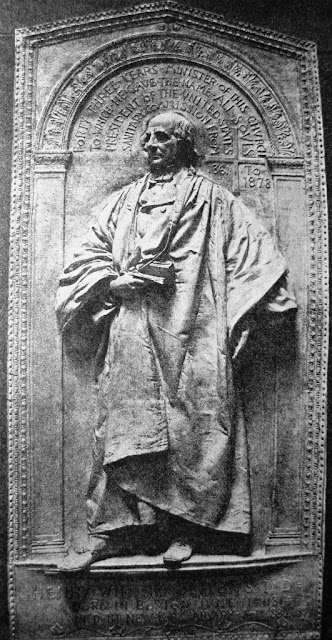
A more intimate memorial returned Saint-Gaudens to the religious and civic life of Gramercy. Henry Whitney Bellows, minister of All Souls and a leader of the United States Sanitary Commission during the Civil War, had lived at 8 Gramercy Park South. Saint-Gaudens’s bronze relief memorial was installed in June 1886 in the All Souls church then standing at Fourth Avenue and East 20th Street. It joined the sculptor’s feeling for portraiture to the remembrance of a man whose public work had grown from a neighborhood ministry.
Relief sculpture offered a register different from the commanding figure in a square. A face could retain its particularity while an inscription and a restrained setting established the act of remembrance. Saint-Gaudens used that range in his portrait of Robert Louis Stevenson, begun after sittings in 1887. The writer appears at ease with the materials of his work, allowing physical frailty and intellectual animation to coexist. These portraits asked viewers to attend closely. Their effect depended on the observed person and the spaces around a gesture, rather than on size alone.
Diana above the rooftops
At the other extreme stood Diana, the gilded figure made for the tower of White’s Madison Square Garden. Installed in 1891 and replaced by a smaller version in 1893, she transformed a sporting and entertainment building into a landmark visible across the city. The archer’s poised body and lifted bow had to read against sky, weather, and distance. Work developed through studio modeling became part of New York’s skyline. Saint-Gaudens and White were again solving a shared problem: how a figure should belong to the architecture that carried it.
The figure also grew from the daily work of the studio and its models, including Davida Clark. The problem of a body poised high above a roof began with a person posing within reach of the sculptor’s eye and hand. For neighbors near Gramercy, Diana became part of the changing city a few blocks away. For Saint-Gaudens, she extended his work beyond a monument’s fixed audience to the passing glance of people who might never enter a gallery.
The Man Beneath the Canopy
The demands of remembrance
By the late 1880s, Saint-Gaudens was receiving commissions that carried large expectations about national memory. His standing Lincoln in Chicago, unveiled in 1887, makes the president’s gravity visible in posture and bowed head. The Adams Memorial in Washington’s Rock Creek Cemetery, completed in 1891, takes another course: a seated, draped figure gives the bereaved room for contemplation without prescribing a simple expression of grief. These works differed in subject and setting, yet each required him to decide how much a body could convey before gesture hardened into theatrical display.
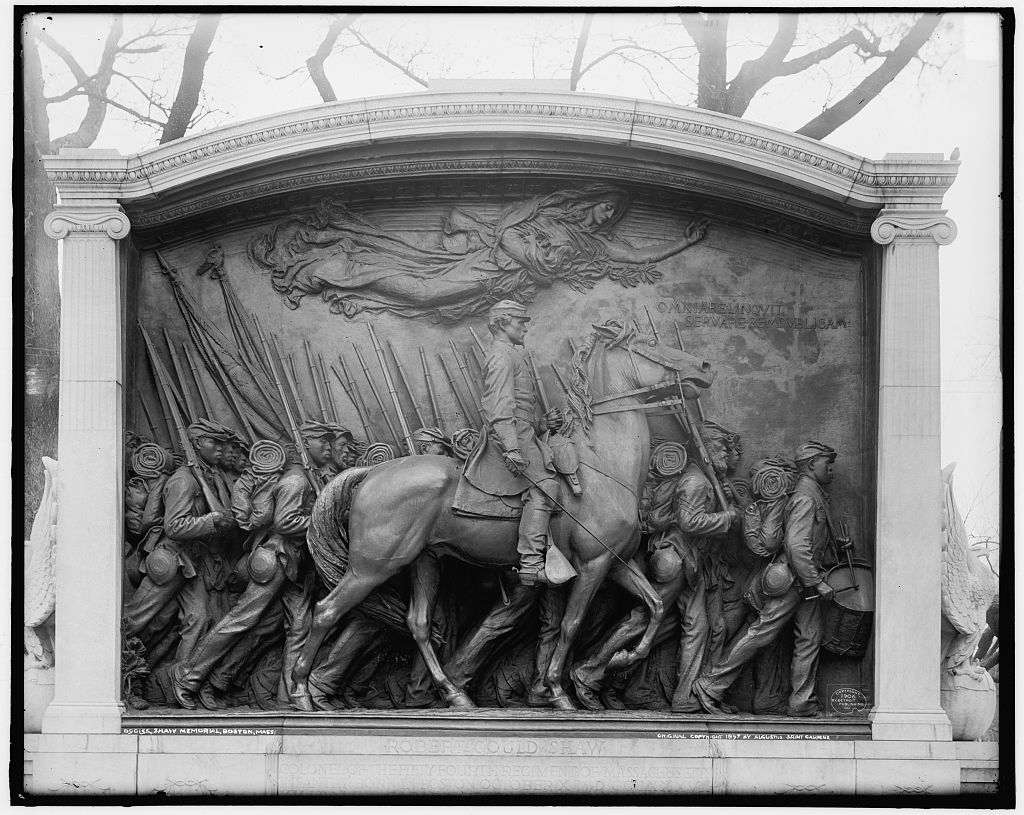
The Robert Gould Shaw and Massachusetts 54th Regiment Memorial, unveiled in Boston in 1897, took years to resolve. Shaw rides while the Black soldiers advance on foot in ranks whose individual faces prevent the formation from becoming anonymous decoration. The relationship between commander and regiment remains central to reading the monument. Its dense relief uses the craft Saint-Gaudens had learned on a small scale to organize a public account of war, service, and sacrifice. The work makes the march collective while insisting that the men within it can be seen.
Friends around the Park
Professional recognition did not dissolve his attachment to the neighborhood’s social life. He became a charter member of The Players in 1888, joining actors, writers, artists, and their friends at Edwin Booth’s house on Gramercy Park South. The club provided another setting in which conversation crossed the boundaries between arts. Saint-Gaudens’s ear for music and affection for performers belonged easily in that company. The Park he had once approached on deliveries now lay outside an institution in which he participated as a recognized artist.
He was also a charter member of the National Arts Club when it was founded in 1898. The organization moved in 1906 to the Tilden mansion at 14–15 Gramercy Park South, the home familiar to neighbors today. Saint-Gaudens belonged first to the club and its artistic ambitions, before they acquired that particular address. The Players and the National Arts Club put the work of artists into conversation with the interests of a broader membership, in houses facing the garden he remembered from boyhood.
Returning to Peter Cooper
The Cooper monument brought a particularly personal obligation. Commissioned in 1887 and unveiled in 1897, it occupied Saint-Gaudens for a decade and involved twenty-seven preliminary studies. The subject was a benefactor he remembered, not a remote historical figure known only through portraits. Cooper’s bearing had to suggest the man who had made room for working students, including a shoemaker’s son below the usual admission age. Seated rather than elevated in a martial pose, he could meet the city with something of the accessibility for which people had valued him.
White designed the canopy and setting at Cooper Square. Their collaboration gave Cooper a sheltered place beside the institution that expressed his purpose most clearly. The monument’s long preparation stands beside another demanding undertaking, the Sherman Monument at Grand Army Plaza, unveiled in 1903, with its moving horse and winged Victory. Saint-Gaudens could work at that heroic register, but the seated Cooper has a different claim on a Gramercy reader. It closes a circuit between the boy’s evening education and the mature artist’s painstaking effort to remember the person who had enabled it.
The Last Summer at Aspet
A household in Cornish
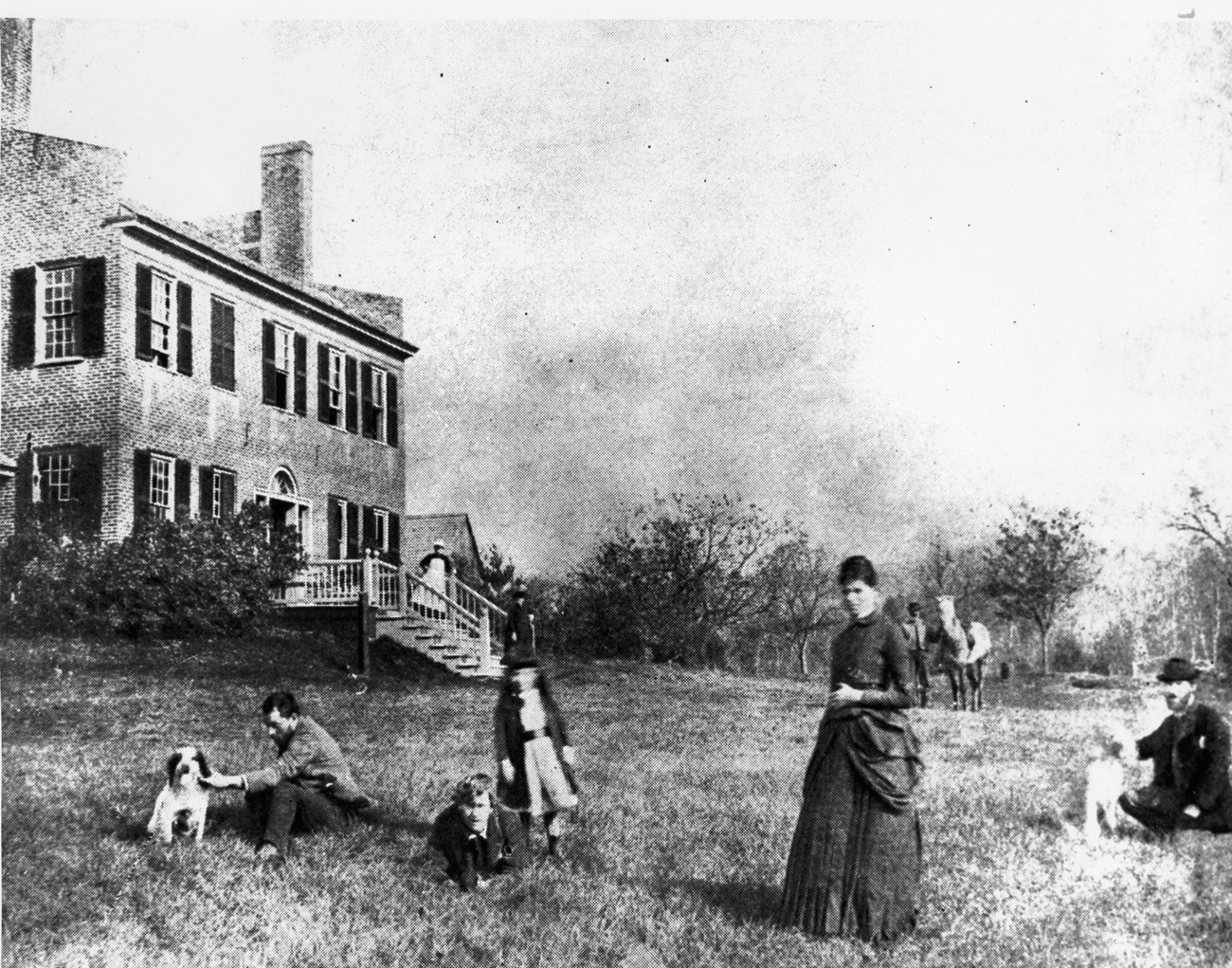
Saint-Gaudens first summered in Cornish, New Hampshire, in 1885, well before he made it his permanent home in 1900. The house he called Aspet took its name from his father’s birthplace in France. Family life, assistants, visiting friends, and studio work gathered around the property, while other artists and writers settled nearby. The Cornish colony developed through these overlapping relationships rather than appearing all at once. Distance from New York changed the setting of his work, but commissions and correspondence kept the sculptor engaged with the public demands that had filled his city years.
By the time the household settled there permanently, cancer had made those demands harder to meet. Saint-Gaudens continued working with assistants, refining models and directing projects as his health allowed. Sculpture at his level had long involved a workshop: enlarging a model, preparing a cast, and realizing a large public bronze required many hands. Illness made this collaboration still more consequential. Aspet was both a home and a workplace where objects passed through successive stages of making, with the sculptor’s attention often directed toward changes too small to register from a distance.
A public art that fit in a hand
President Theodore Roosevelt drew him into a final kind of commission: redesigning American gold coinage. Roosevelt, born nearby on East 20th Street, wanted coins with greater artistic ambition, and Saint-Gaudens accepted the challenge of putting sculptural form into ordinary circulation. The 1907 twenty-dollar gold piece, the double eagle, carries a striding Liberty and an eagle in flight. Its small diameter called for a composition that could be understood quickly and still reward looking. The cameo cutter’s early sensitivity to a shallow surface had found another public use.
The work also exposed the distance between an artist’s preferred relief and the requirements of repeated minting. A coin had to be produced efficiently, stacked, handled, and accepted in commerce. Designs moved through revisions as the ideal met manufacturing limits. The commission belongs with his monuments because it required him to imagine an object’s life beyond the studio. Yet its audience was different: a person need not visit a square, cemetery, or museum to encounter a sculpture carried in a pocket or exchanged across a counter.
The absence of an old friend
White’s murder in June 1906 broke one of the longest collaborations of Saint-Gaudens’s life. In a public letter to Collier’s, the sculptor recalled the tenderness and generosity he had known over more than thirty years. His tribute concentrated on the friend who had shared his enthusiasms and helped give his figures their architectural settings. By then Saint-Gaudens’s own health was failing. Farragut, Cooper, and Diana remained in New York, while the conversations and arguments that had brought them into being could no longer be resumed.
He died at Cornish on August 3, 1907. His friend Charles McKim subsequently sought out the Stevenson memorial in St. Giles’ Cathedral in Edinburgh, another encounter with a familiar hand through a remembered face. Nearer Gramercy, the route back to Saint-Gaudens remains shorter. Farragut stands in Madison Square; Bellows survives in bronze; Cooper sits beneath White’s canopy. Of these, Cooper offers the most direct return to the boy with his drawings: a man who opened a classroom door, remembered by a student who spent years deciding how he should sit.
Places, people & connections
Around the Park
The Cooper–Hewitt House
His father’s customers included the family whose educational work helped Augustus begin his artistic training.
Peter Cooper
The founder of Cooper Union became the subject of a monument that occupied his former student for a decade.
Stanford White
The architect supplied settings for major sculptures and remained a close friend for more than thirty years.
8 Gramercy Park South
Henry Whitney Bellows’s home connects the neighborhood with Saint-Gaudens’s bronze memorial for All Souls.
Henry Whitney Bellows
The minister and Civil War organizer was commemorated in a relief installed in June 1886.
The Players
Saint-Gaudens joined Edwin Booth’s club as a charter member in 1888.
The National Arts Club
A charter member from 1898, he knew the organization before it moved to its present Gramercy home in 1906.
24 Gramercy Park South
The later home of Richard Watson and Helena Gilder continues the story of the artistic circle that helped form the Society of American Artists.
Life at a glance
The biographical record
| Born | March 1, 1848, Dublin, Ireland |
|---|---|
| Died | August 3, 1907, Cornish, New Hampshire |
| Gramercy Park connection | His father Bernard’s shoe shop on East 21st Street, near Fourth Avenue; neighborhood customers, art education, and later club memberships |
| Years in the neighborhood | Boyhood in the 1860s; continuing artistic and institutional connections through his career |
| Vocation | Sculptor and medallist |
| Spouse & family | Augusta Fisher Homer, married June 1877; their son Homer Saint-Gaudens edited his father’s reminiscences |
| Key institutions & works | Cooper Union; National Academy of Design; The Players; National Arts Club; Farragut, Lincoln, Adams, Shaw, Cooper, and Sherman memorials; Diana; 1907 gold coinage |
Over time
Dublin to New York
Born in Dublin, Augustus comes to New York with his parents while still an infant.
The Gramercy shop
His father’s East 21st Street shoe business connects the family with households around the Park.
Cooper Union at night
Admitted below the usual age, he begins the evening study that enlarges his working education.
Europe and a marriage
Paris and Rome provide training, an early major sculpture, and his introduction to Augusta Homer.
Farragut unveiled
The Madison Square monument establishes his reputation and his partnership with Stanford White.
Relief and skyline
The Bellows memorial, Stevenson portrait, and Diana show the range of his work.
Cooper and the 54th
The Cooper and Shaw memorials bring long projects to public completion.
The final Cornish years
At Aspet, illness accompanies continued monument work and Roosevelt’s gold-coin commission.
Sources cited
- Augustus Saint-Gaudens, The Reminiscences of Augustus Saint-Gaudens, edited by Homer Saint-Gaudens, 2 vols. (New York: The Century Co., 1913): childhood, apprenticeship, Cooper Union, European study, family, friendships, and commissions.
- John H. Dryfhout, The Work of Augustus Saint-Gaudens (Hanover, New Hampshire: University Press of New England, 1982): catalogue and chronology of the sculptor’s work.
- Charles H. Caffin, American Masters of Sculpture (New York: Doubleday, Page & Company, 1903), discussion of Saint-Gaudens and his monuments.
- Carole Klein, Gramercy Park: An American Bloomsbury (Boston: Houghton Mifflin, 1987): Saint-Gaudens’s neighborhood childhood and Gramercy’s artistic circle.
- Helen W. Henderson, A Loiterer in New York (New York: George H. Doran, 1917), pp. 234–236: the Bellows memorial and its installation in June 1886.
- John B. Pine, The Story of Gramercy Park, 1831–1921 (New York: Gramercy Park Association, 1921): neighborhood residents and institutions.
- Rossiter W. Raymond, Peter Cooper (Boston and New York: Houghton, Mifflin and Company, 1901): Cooper’s educational work and public life.
- The Cooper Union, institutional history and Foundation Building history: the school and its provisions for education.
- Smithsonian American Art Museum, Inventories of American Painting and Sculpture, “Peter Cooper Monument”: Saint-Gaudens, Stanford White, and the dedication on May 29, 1897.
- National Park Service, “Aspet’s Apple Trees”: the family’s Cornish property, its landscape, and an 1885 photograph of the Saint-Gaudens household.
- The Metropolitan Museum of Art, Hiawatha, accession 2001.641: modeled in 1871–72, carved in 1874; object record and Open Access image.
Photo credits for this page
- Unidentified photographer, Profile of Saint-Gaudens, 1905. National Park Service, Saint-Gaudens National Historical Park, asset fa5f4579-155d-451f-677b-21e1fe17e8b2. Public domain. Source.
- Detroit Publishing Co., Peter Cooper Memorial, New York, N.Y., c. 1900–1906. Library of Congress, Prints and Photographs Division, Detroit Publishing Company Collection, LC-DIG-det-4a11532. Public domain; no known restrictions on publication. Source.
- William Perris, cartographer; Perris & Browne, publisher, Plate 47: Map bounded by East Twenty-second Street, Second Avenue, East Seventeenth Street and Fourth Avenue. The New York Public Library, Lionel Pincus and Princess Firyal Map Division, digital ID 1268337; via Wikimedia Commons. Public domain. Source.
- Alfred S. Campbell, Cooper Union, N.Y., 1896, stereograph. Library of Congress, Prints and Photographs Division, LC-DIG-stereo-1s07232. Public domain; no known restrictions on publication. Source.
- Augustus Saint-Gaudens, Hiawatha, 1871–72, carved 1874, marble. The Metropolitan Museum of Art, Gift of Diane, Daniel, and Mathew Wolf, in memory of Catherine Hoover Voorsanger, 2001; accession 2001.641. Public domain; The Met Open Access. Source.
- Augustus Saint-Gaudens, Henry Whitney Bellows memorial, installed 1886. Photograph in Helen W. Henderson, A Loiterer in New York (1917). Public domain. Source.
- Augustus Saint-Gaudens, sculptor; Detroit Publishing Co., Shaw Memorial, Boston, Mass., c. 1906. Library of Congress, Prints and Photographs Division, Detroit Publishing Company Collection, LC-DIG-det-4a25020. Public domain; no known restrictions on publication. Source.
- Unidentified photographer, Saint-Gaudens family and companions at “Huggins’ Folly,” 1885. National Park Service, Saint-Gaudens National Historical Park, SAGA 859. Public domain. Source.