
Monuments of Gramercy Park
The Edwin Booth Statue
Twenty-Four Minutes Before the Matinee
By Timothy Cohen
For Founder’s Day on November 13: Three sculptors, a fierce debate at the National Arts Club, an Armistice unveiling at noon, and E. B. White’s midnight poem.
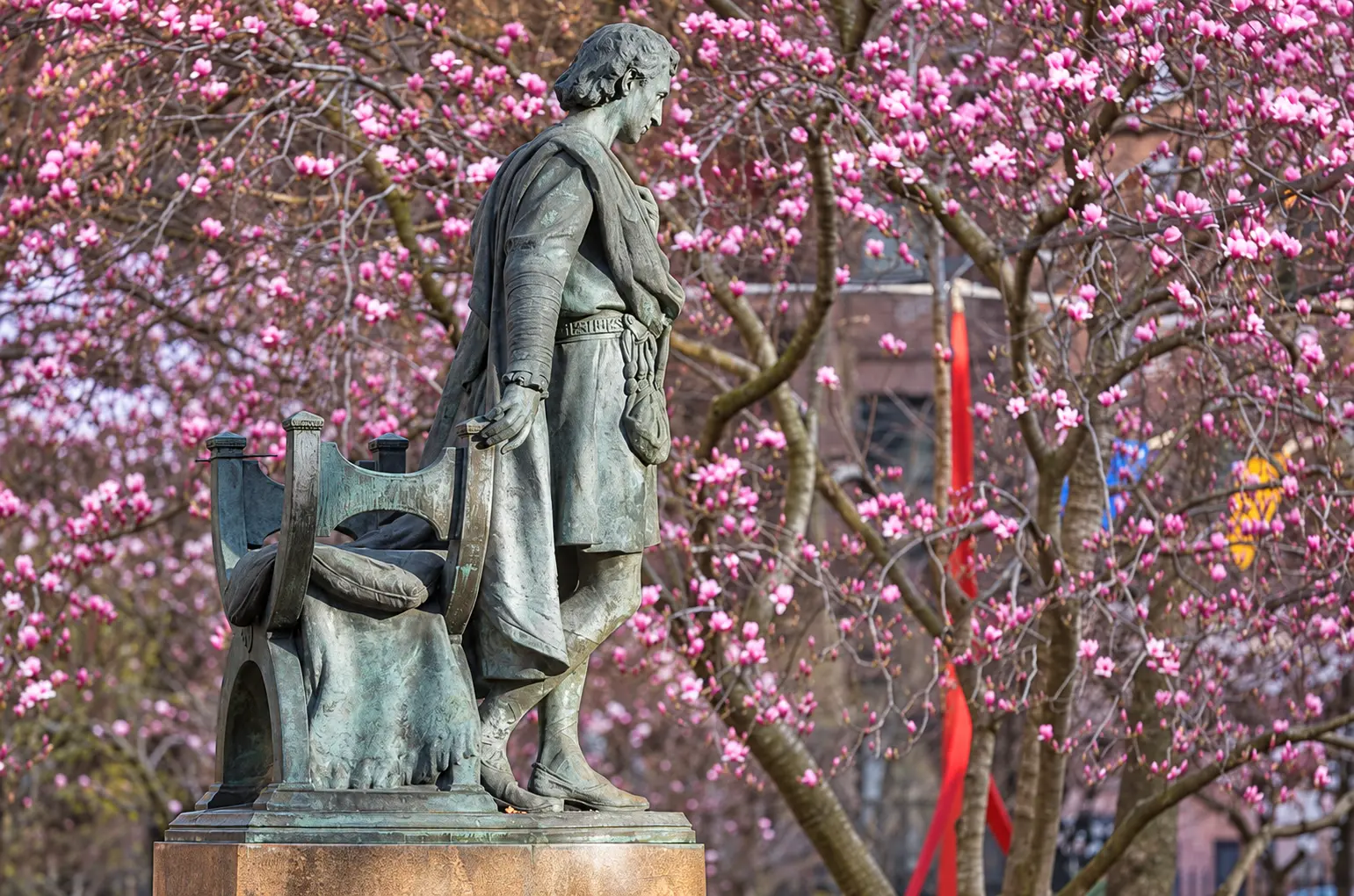
Today, November 13, marks a double anniversary at the physical heart of Gramercy Park.
It is the birthday of Edwin Booth (born November 13, 1833), celebrated each autumn as Founder’s Day at The Players—and the anniversary of the exact hour in 1918, two days after the World War I Armistice, when more than two hundred actors and neighbors gathered where the gravel paths cross at the center of Gramercy Park to unveil Edmond T. Quinn’s bronze statue of Booth as Hamlet.
Rising from a carved medieval chair with his right hand resting lightly on its arm and his head bowed in the quiet instant before “To be, or not to be,” the silent prince looks south across the iron pickets toward his old third-floor bedroom windows at No. 16. Getting him to the center of the square took twelve years, three sculptors, a fierce artistic revolt, a cracked block of New Hampshire granite, and the end of a world war.
Three sculptors and an “admiral in a Morris chair”
When The Players first wrote to the Trustees of Gramercy Park in March 1906, the club asked only to tuck a small bronze bust of its founder just inside the southern iron fence opposite No. 16. Within weeks, a committee of Players—advised by Stanford White in the final weeks of his life and Impressionist painter Childe Hassam—decided America’s greatest tragedian belonged in full length.
Master sculptor Augustus Saint-Gaudens eagerly agreed to model the statue in July 1906, only to die at his New Hampshire home a year later before signing a contract. His successor, Paris-based sculptor Frederick MacMonnies, made the visionary suggestion that reshaped the square: rather than placing Booth by the southern railings, he urged setting the monument at the exact center of Gramercy Park, where the Park’s original 1848 fountain then stood. Yet MacMonnies’s 1910 plaster model framed the seated actor beneath a towering Baroque stone proscenium arch. When the committee asked him to drop the arch, MacMonnies fumed that Hamlet on a bare park pedestal would look as ridiculous as “a statue of an admiral seated in a Morris chair,” and resigned in 1913.
To break the deadlock, eight sculptor-members of The Players entered an anonymous competition judged on October 2, 1914, next door in the gallery of the National Arts Club at 15 Gramercy Park South. With the artists’ names sealed in envelopes, twenty-one jurors chose the plaster model marked with Hamlet’s tribute to his father: “HE WAS A MAN.” Inside the envelope was the name of sculptor Edmond T. Quinn—who also created the bronze medallion of Samuel B. Ruggles at the Park’s western gate. To guide Quinn’s work in his Brooklyn studio, a veteran Player put on a full replica of Booth’s wool tunic, cloak, and miniature medallion of his father so one generation of actors could pass Booth’s living posture into bronze.
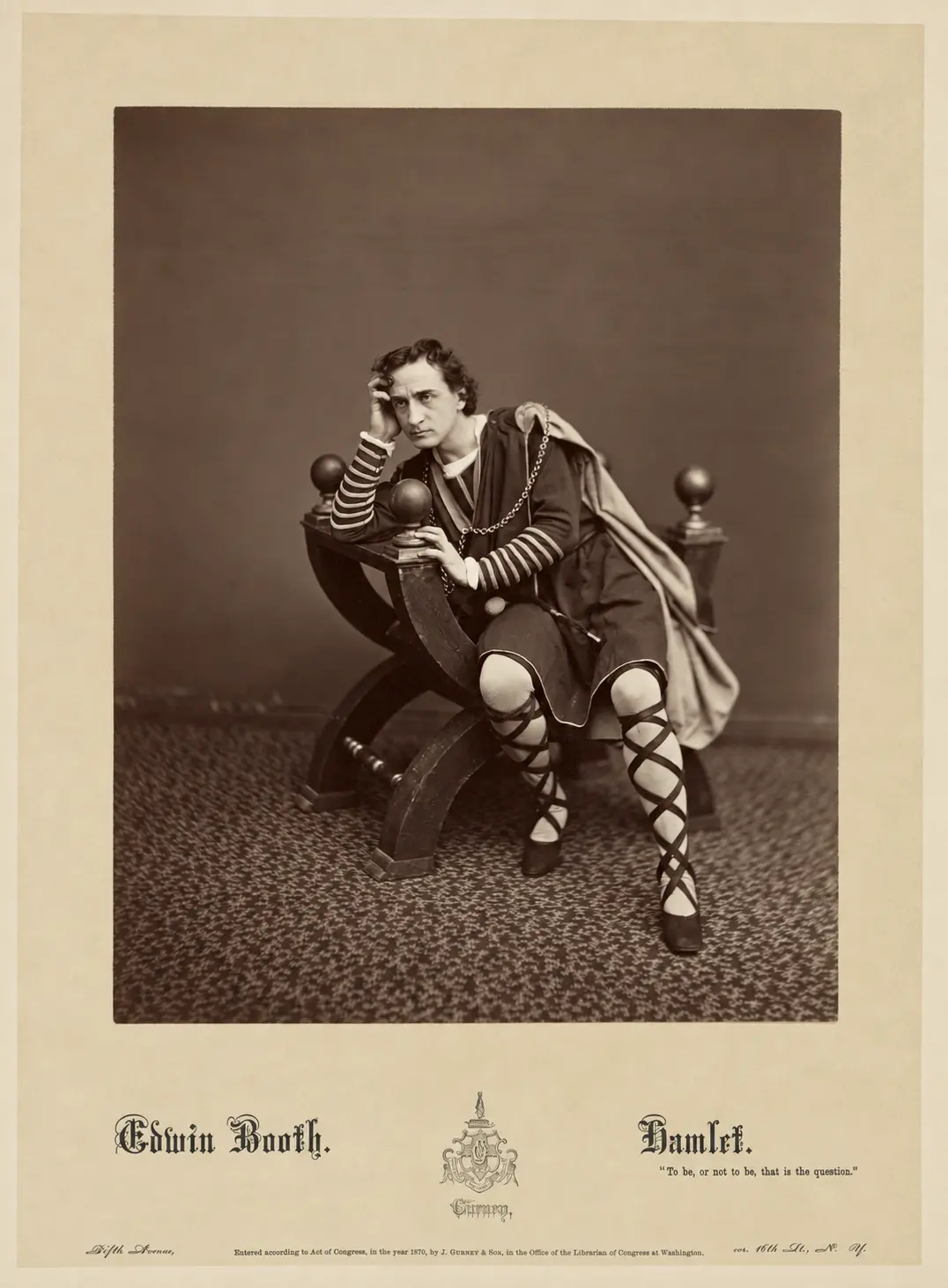
Twenty-four minutes at noon on November 13, 1918
Cast in bronze in 1917, the statue was delayed another eighteen months when the first block of Conway pink granite arrived from New Hampshire with a hairline fissure, and wartime federal rail embargoes stranded the replacement stone in New England until late May 1918.
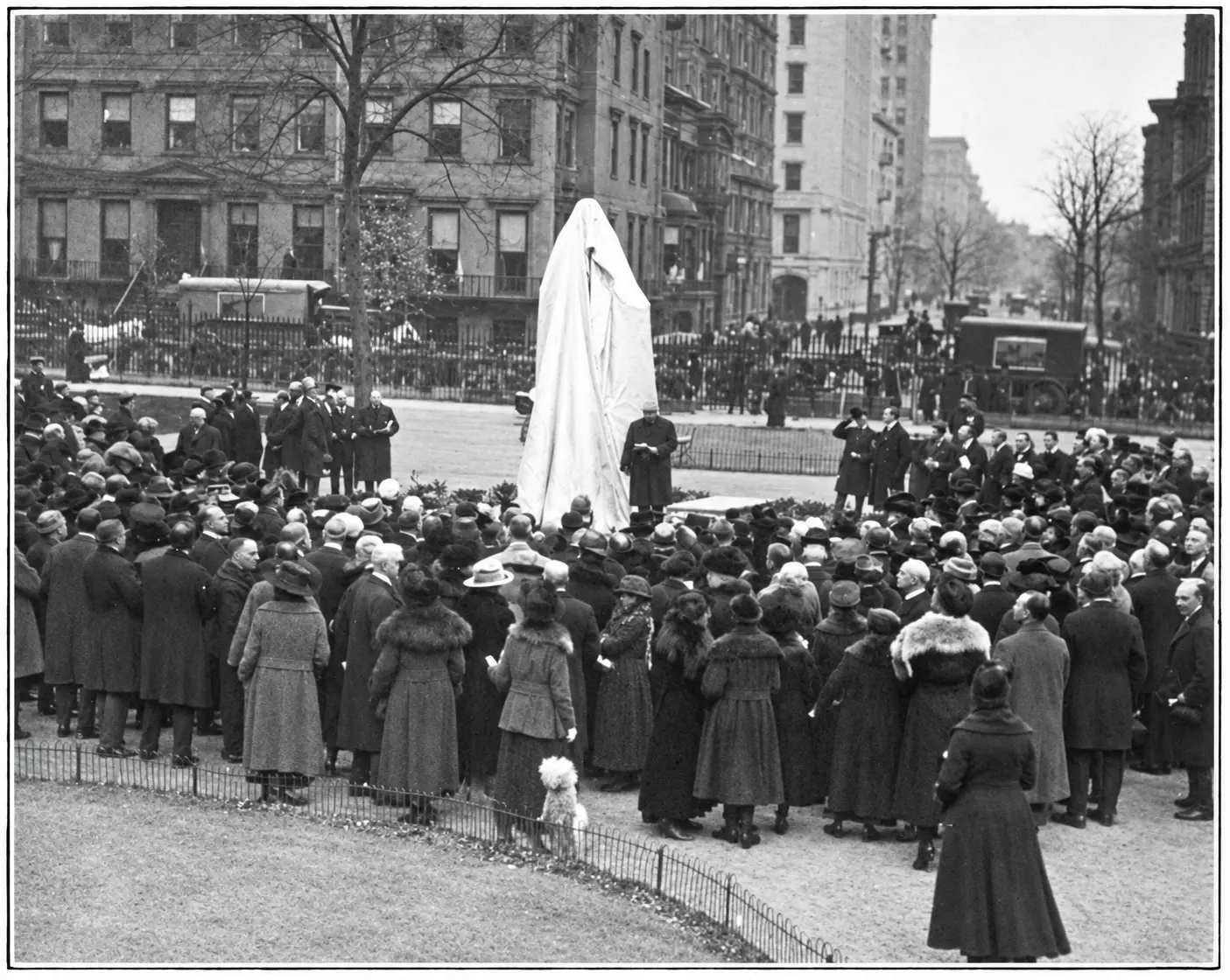
Finally, at noon on Wednesday, November 13, 1918—Booth’s eighty-fifth birthday and two days after the Armistice ending the First World War—the gates of Gramercy Park swung open. Because Wednesday was Broadway matinee day, the entire dedication was timed to finish in exactly twenty-four minutes so working actors could make their afternoon curtains, while neighborhood nursemaids and toddlers in prams stayed along the sunny gravel paths as part of the audience.
Three people bound to Booth by blood, friendship, and daily life at No. 16 unveiled the statue together: his grandson loosened the cord, an old actor friend drew away the canvas shroud, and the retired clubhouse steward who had waited on Booth in his third-floor rooms folded the cloth from the lawn. After tributes on behalf of The Players and the Park Trustees, Booth’s daughter, Edwina, looked up at Quinn’s bronze and said quietly: “Everything has been just right. The statue is wonderful. It is my father as I knew him. He seems to live again and the more I look at the figure the more deeply I am moved.”
As the crowd walked back toward the south gate on East 20th Street, a playwright in the gathering glanced back through the iron pickets and spoke the line that has belonged to the monument ever since: “There he is, Edwin Booth taking his eternal curtain call!”
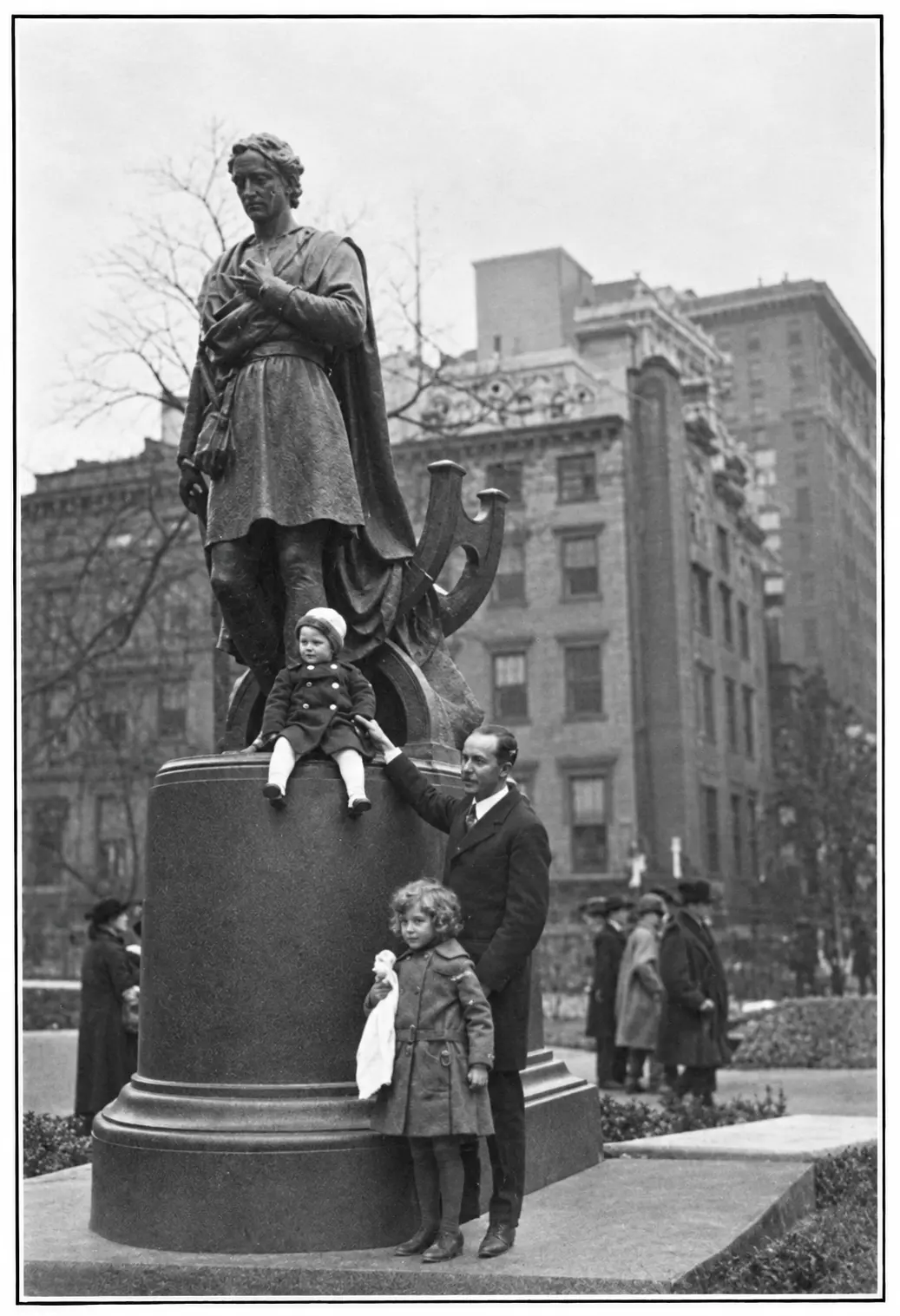
E. B. White’s midnight climb & the Founder’s Day wreath
In the century since, the lonely prince at the center of the lawn has become an emblem of the neighborhood in art and verse—from a snowy February 1950 Saturday Evening Post cover ↗ to Ludwig Bemelmans’s 1959 oil painting framing the statue behind a pot of white lilies on his windowsill.
In the March 3, 1928 issue of The New Yorker, E. B. White even gave the bronze guardian a speaking part in his poem “Gramercy Park”—imagining climbing over the iron pickets on a dark night without a key, being scolded by Booth’s statue (“This park is administered privately...”), and then winning the lonely actor’s blessing when Booth spots the girl standing beside him:
“You haven’t a pass and you haven’t a key,
But give her the tiniest kiss for me!”
Restored for its 2018 centenary by the Trustees of Gramercy Park with support from The Players, Quinn’s bronze Hamlet still looks south toward the conserved third-floor bedroom windows of No. 16—where members of the club emerge by candlelight each Founder’s Day to cross the street and lay a laurel wreath at his feet.
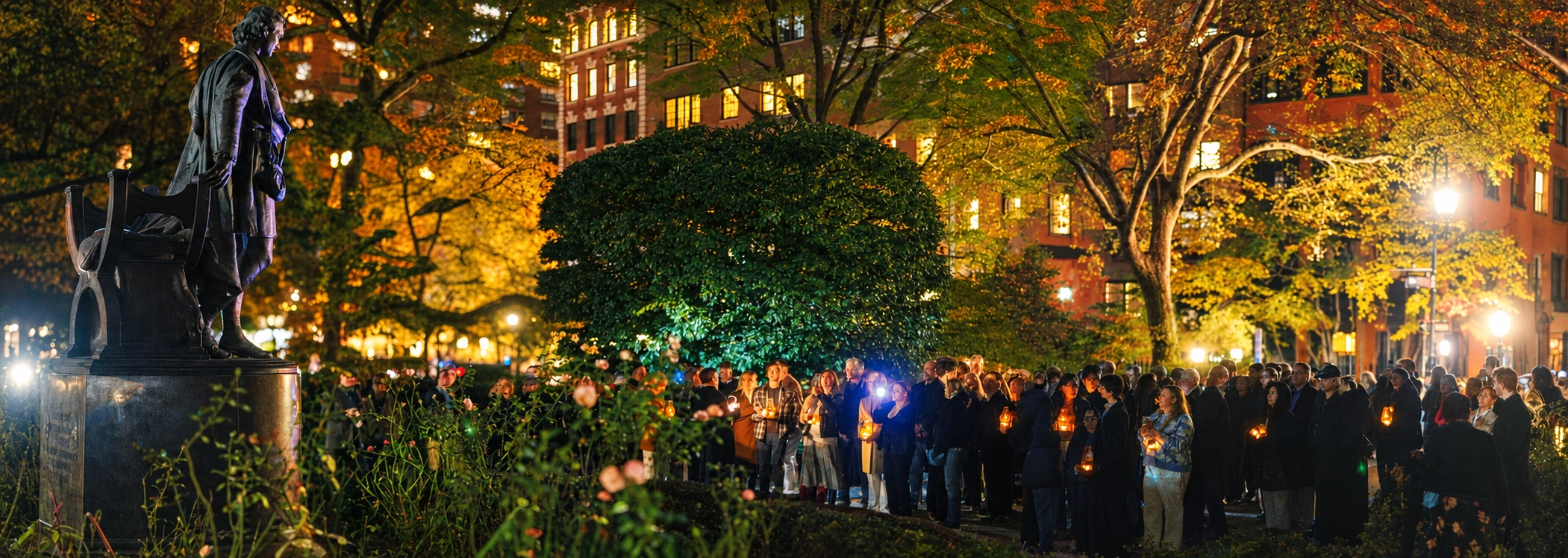
Next time you pass the center of Gramercy Park or peer through the southern gate opposite No. 16, pause for a moment with the neighbor who has been taking his curtain call under the Park’s trees since noon on November 13, 1918.
Explore the story of The Edwin Booth Statue →
Read E. B. White’s complete 1928 New Yorker poem and see the full 1918 unveiling gallery on the monument page. Missed Tuesday’s story? Explore Edwin Booth and 16 Gramercy Park South (The Players).
Images: Contemporary photographs of the Edwin Booth Memorial in Gramercy Park by Sean Brady / Gramercy Park Block Association. Edwin Booth as Hamlet, c. 1870, J. Gurney & Son, Library of Congress Prints and Photographs Division. November 13, 1918 unveiling photographs from Howard Kyle, The History of the Edwin Booth Memorial (The Players, 1918), Harvard College Library. Photo credits → · Historical sources →