
The history reading room
Sources & original documents
The documents, books, maps and reporting behind the history—with notes on what each source can establish.
Founding document
The Gramercy Park indenture
The four-page reproduction records the conveyance by Samuel B. and Mary R. Ruggles to five trustees. It describes the intended garden, surrounding properties and provisions for continuing care.
The signature and acknowledgment text is dated December 17, 1831. The accompanying Edwin Smith map is not included in this copy.
Read the complete indenture · PDF, 142 KBHistorical context: The garden held in trust.
John B. Pine
The Story of Gramercy Park, 1831–1921
Published by the Gramercy Park Association for the ninetieth anniversary of the Park’s founding. This 63-page scan includes the text, illustrations and historical list of Trustees.
Read the complete original book · PDF, 14.8 MB& 1988
Landmarks Preservation Commission
Historic district reports
The original designation report and the later extension report record the City’s recognition of the district and of 36 Gramercy Park East.
- September 20, 1966 · Original district report · PDF Official LPC report, hosted by the Trust for Architectural Easements.
- July 12, 1988 · District extension report · PDF Official LPC report, hosted by the City of New York.
- January 23, 1980 · National Register record National Park Service, NRIS 80002691. Federal recognition is separate from City designation. The NPS online record currently provides a notice that the nomination file has not yet been digitized.
Plans, boundaries and photographs
Read the landscape
- Explore four historical map sheets Edwin Smith’s 1831 Ruggles plan, a Perris atlas sheet from the 1857–1862 edition, and two Sanborn insurance maps from 1903, with source records.
- Detroit Publishing Co. · Gramercy Park, 1909–1915 Library of Congress, LC-DIG-det-4a20041. Elevated view across the garden; no known restrictions on publication.
- E. P. MacFarland · James Harper House, March 27, 1934 Historic American Buildings Survey; Library of Congress.
- Edwin Smith · Map of the Park and surrounding lots, December 1, 1831 PR 370, Series VI, Oversize 2. Catalogue; consultation required.
- LPC · Gramercy Park Historic District map Official boundary map for LP-0251; map prepared in 2019, designation dated 1966.
- LPC · Historic District Extension map Official map of the 1988 extension, LP-1559.
- New York Historical · Photographs, stereoviews and postcards PR 370, Series IV; catalogue only.
- Ruggles’s plan for the neighborhood, December 31, 1831. Edwin Smith; engraving by D. R. Harrison. Samuel B. Ruggles papers, NYPL. Image via the National Park Service.
- Gramercy Park, Nos. 3–5, November 27, 1935. Berenice Abbott · The New York Public Library.
- Paths and benches in the garden, about 1922. Possibly Charles I. Berg · Frances Benjamin Johnston Collection, Library of Congress, LC-DIG-ppmsca-16151.
- A fountain in Gramercy Park, about 1922. Possibly Charles I. Berg · Frances Benjamin Johnston Collection, Library of Congress, LC-DIG-ppmsca-16153.
- The growing neighborhood in the Perris atlas, 1857–1862 edition. William Perris · The New York Public Library, image 1268337.
- Edwin Booth as Hamlet, 1870. J. Gurney & Son · Library of Congress, LC-DIG-ds-04503.
- James Duane, painted in 1805. John Trumbull, after Robert Edge Pine · New York City Hall portrait collection. Public domain.
- The former Friends Meeting House: historic and later exterior views. Brotherhood Synagogue · Building history.
- Troops and rioters on First Avenue during the Draft Riots, 1863. Illustrated London News, August 15, 1863, p. 168 · NYPL Picture Collection.
- 34 and 36 Gramercy Park East, photographed in 1988. Forster · NYC Landmarks Preservation Commission, 1988 designation report, p. 16.
- The Players, 16 Gramercy Park South, drawn in 1947. Josephine Barry, 75.43.85. Museum of the City of New York.
- The Park and the adjoining western blocks, mapped in 1903. Sanborn Map Company, vol. 2, plate 45 · The New York Public Library, image 1996145.
- National Arts Club and Gramercy Park South, about 1977. Edmund Vincent Gillon, 2013.3.2.266. Museum of the City of New York.
- The entrance to 36 Gramercy Park East, photographed in 1988. Forster · NYC Landmarks Preservation Commission, 1988 designation report, p. 18.
- Looking west along Gramercy Park South, about 1916. George F. Arata, X2010.11.2075. Museum of the City of New York.
- From 60 Gramercy Park North, about 1939. Wurts Bros. (New York, N.Y.), X2010.7.1.17157. Museum of the City of New York.
- The original Gramercy Park Historic District boundary, 1966. NYC Landmarks Preservation Commission · Original designation map.
- The sanctuary after its adaptation as Brotherhood Synagogue. Brotherhood Synagogue · A later view from its building history.
- Looking toward 18 Gramercy Park South, May 5, 1929. Samuel H. (Samuel Herman) Gottscho (1875-1971), 88.1.1.669. Museum of the City of New York.
- The Fantasy Fountain’s unveiling in Gramercy Park. Photograph from the Fantasy Fountain Fund’s history.
- The historic district and its extension to 36 Gramercy Park East. NYC Landmarks Preservation Commission · Map in the July 1988 designation report.
- Arlene Harrison speaking at City Hall during the 1994 neighborhood campaign. the Gramercy Park Block Association archive.
- Volunteers prepare meals in the neighborhood relief effort, 2001. Photograph by Linn Sage and Lyndee Yamshon · GPBA archive.
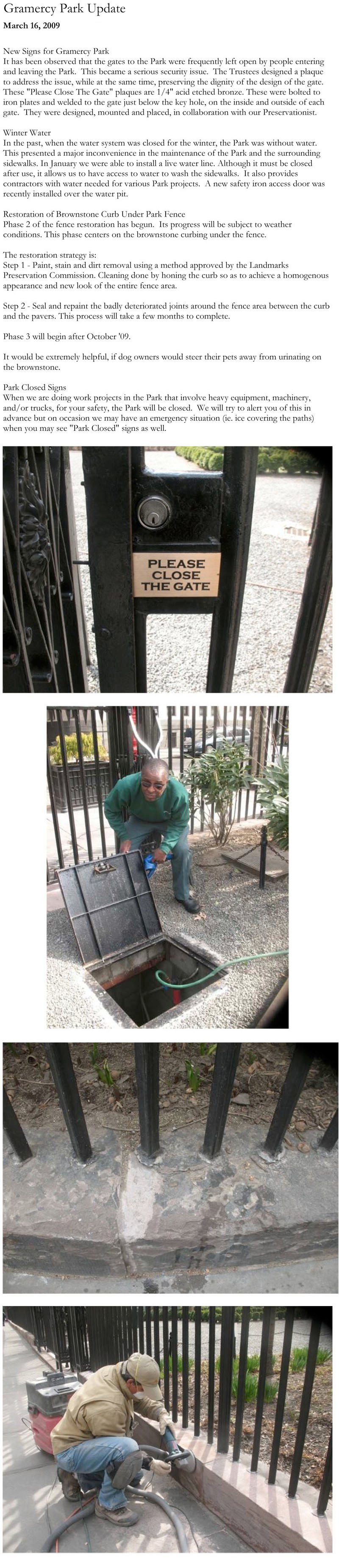
- Work on the Park’s brownstone curb, March 2009. Trustees of Gramercy Park · Restoration update.
- The Christmas Grove behind the Ruggles Fountain, December 2011. Trustees of Gramercy Park · December 2011 update.
- The central flower beds in summer 2013, before that autumn’s perimeter project. Photograph by Sean Brady · GPBA archive.
- Historic-district street signs introduced around the Park in April 2014. the Block Association archive.
- Street-tree planting on the Park’s perimeter, 2022. A later chapter in the care of the sidewalk canopy · GPBA archive.



The Museum of the City of New York’s Gramercy Park collection offers further drawings, photographs and postcards. The museum’s drawing of The Players appears in the neighborhood chapter, with a link to its individual catalogue record.
New York Historical
The neighborhood’s surviving records
PR 370: Gramercy Neighborhood Associates records, 1828–2009. Finding aid reviewed; archival items require consultation.
- Organization, flower shows and local periodicals Series I, III and V.
- Trustees’ documents Series VII, Box 11.
The 1912 Gramercy Park Association became Gramercy Neighborhood Associates in 1966. It is distinct from the Trustees and from the Block Association, founded in 1994.
Institutional histories
The people and places around the square
- National Arts Club · Mission and history First-party account of the 1898 founding, 1906 move, membership and Tilden mansion.
- The Players at 16 Gramercy Park South The house, Edwin Booth’s founding gift, the club’s collections and the Booth memorial, with source links.
- Brotherhood Synagogue · Our building The 1859 Friends Meeting House, Quaker history and the 1974 adaptation by James Stewart Polshek.
- Brotherhood Synagogue · Congregational history A first-party account of its founding, move and community service.
- Fantasy Fountain Fund · History The artist’s foundation describes the sculpture’s early history. See the dating note below.
- MCR · Gramercy Park Hotel The current owner’s account includes the 1925 opening.
- Smithsonian · Native perspectives on Manhattan National Museum of the American Indian, Native Knowledge 360°. Context for land, exchange and colonial history before the Park’s founding.
Contemporary reports and local testimony
The modern Park, documented
These records connect the chronology with dated notices, photographs and reporting. The Block Association pages below collect their original source links; accounts by participants are identified as such.
- 1989 steam explosion · GPBA retrospective, July 23, 2018 Local testimony with links to contemporary New York Times reporting and New York magazine’s October 30, 1989 account.
- The founding of the Block Association · 1994Arlene Harrison’s account of the founding in March 1994.
- The Block Association’s first year · 1994–1995 Early priorities and neighborhood reporting.
- September 11 · Relief records, 2001–2002 Contemporary accounts, later recollections and documentary links.
- 175th-anniversary events · 2006 Town & Village reports on the neighborhood walk and gathering at The Players.
- The enclosure · Restoration and repair reports Fence, curb and gate projects from 2006 through 2026, with dated photographs.
- The water nymph · Town & Village, April 21, 2011 A report on efforts to locate the earlier sculpture.
- Christmas Grove · Trustees’ report, December 2011 A photograph and account of the memorial.
- Calder’s Janey Waney · 2011–2021 Installation, travel, return photographs and removal records for the loan.
- Street trees after Sandy · October 28, 2013 Dated report on replacement trees outside the fence.
- Perimeter planting · October 25, 2013 The Trustees’ landscape project inside the fence.
- Ruggles Fountain · October 2025 and June 2026 Announcement and completion reporting for the Trustees’ restoration.
- Arthur Lewin · Black history in Gramercy, February 21, 2022 A GPBA-commissioned essay by the Baruch professor, with its illustrated original.
- Women in Gramercy’s history Biographical research and associated sources across the neighborhood.
Books, reporting and further research
A wider bibliography
- Stephen Garmey · Gramercy Park: An Illustrated History of a New York Neighborhood (1984) Balsam Press, 1984. Further reading; library catalogue reference.
- “Gramercy Park” · The New Yorker, November 20, 1926, p. 20 Contemporary criticism of redevelopment around the Park.
- “Ruggles” · The New Yorker, May 16, 1931 A centenary-era remembrance. The deed and Pine give the conveyance and lot counts more precisely.
- GPBA · Searchable newsletter archive Dated letters and original notices for following later projects and local events.
How to read this history
Evidence, dates and open questions
Founding, fencing and fountains
1831: the acknowledgment in the reproduced deed is dated December 17, 1831. The 1833 confirmation is a separate document. 1844: Pine records a fenced and graded Park by the first recorded Trustees’ meeting; that does not date each section of the fence. By 1921: Pine establishes that the eastern and western fountains existed by publication, without fixing their installation dates.
Fantasy Fountain: loan and installation dates
The Fantasy Fountain Fund dates a loan to the Park to 1981. Later reporting associates the sculpture’s dedication with 1983, including the April 2011 account linked in the fountain history. The timeline uses “Early 1980s” while preserving the difference between those accounts.
What has been reviewed, and what remains archival
The timeline draws on the reproduced founding deed, Pine’s complete 1921 book, official designation reports, institutions’ own histories and the dated records linked with each entry. Archive catalogues describe their holdings; Garmey’s book is listed for further reading.
The National Register’s online record currently provides a notice that the nomination file has not yet been digitized.
Perspective, attribution and photographs
Pine wrote a commemorative history from within the Park’s community. Institutional accounts and the Block Association’s own records also have identifiable viewpoints. They are read alongside public records and reporting.
Last updated September 22, 2026.