
The first fountain
The Park’s earliest fountain story begins with a proposal that was never built. In 1846, the lot owners tabled a costly design inspired by Rome. Two years later, a more modest fountain was erected, establishing water and sculpture as a focus of the garden.
Pine records an instruction in 1866 to replace the statue on that fountain. He connects the replacement with the water nymph familiar to later generations. His book reproduces a photograph captioned “The Old Fountain,” preserving a view of the arrangement before the Park’s center changed.
A new center for the Park
The central fountain was removed to make room for the statue of Edwin Booth as Hamlet. The Players had organized the memorial to its founder, with the cooperation of the Park’s Trustees. Pine dates the unveiling to November 13, 1918.
Sculptor Edmond T. Quinn modeled the bronze, and architect Edwin S. Dodge designed the pedestal. Pine reproduces the dedication address by John Drew, president of The Players, which describes a collaborative tribute to Booth and the artistic community he had brought together.
The nymph moves east
Rather than disappear from the garden, the water nymph became the centerpiece of a smaller fountain facing the eastern entrance. Pine describes the removal of layers of white and gold paint, revealing the statue’s pewter-colored surface.
Architect Charles I. Berg designed the two end fountains, each with a semicircular basin and pedestal. The eastern fountain gave the older sculpture a new setting among trees and shrubs. Pine’s description shows that continuity in the Park sometimes meant moving and reusing an existing feature.
Ruggles remembered at the west
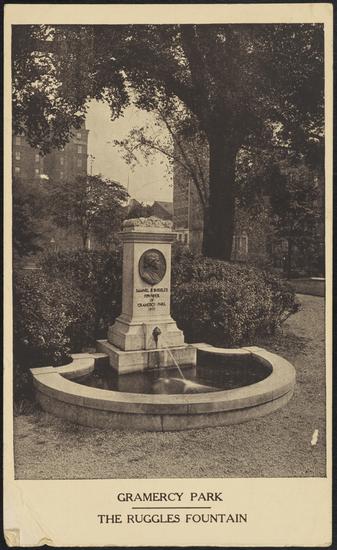
At the western fountain, a marble shaft and bronze portrait medallion honored Samuel B. Ruggles. Quinn, who had also created the Booth statue, made the portrait. John R. Strong, Ruggles’s grandson, gave the memorial.
Pine connects this monument with an earlier commemorative stone at the western gate, placed in 1875. Together they brought the founder’s name and likeness into the landscape he had established. The book’s west-fountain plate records the memorial as it appeared by the time of publication.
A history that continues through care
Water returned to the Ruggles Fountain in 2026 after work on its basin, stonework and water system. The restoration story carries this history forward: the memorial we inherit still needs people with the skill and resources to care for it.
2011
Looking for the earlier nymph
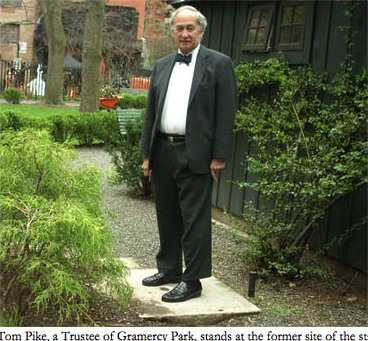
The story of the older fountain continued well beyond Pine’s book. In April 2011, Town & Village reported Trustee Tom Pike’s effort to recover the nymph sculpture, which had been removed from the Park in 1983 and placed in the National Arts Club’s care for restoration.
At the time of that article, the sculpture’s whereabouts and condition were unresolved.
Sources
John B. Pine, The Story of Gramercy Park, 1831–1921 (1921), printed pages 12–16 and 46–48; Town & Village, April 21, 2011.