
Elsie de Wolfe
Light and Company on Irving Place
1865–1950 · The Washington Irving House, 122 East 17th Street · Corner of Irving Place · 1892–1911
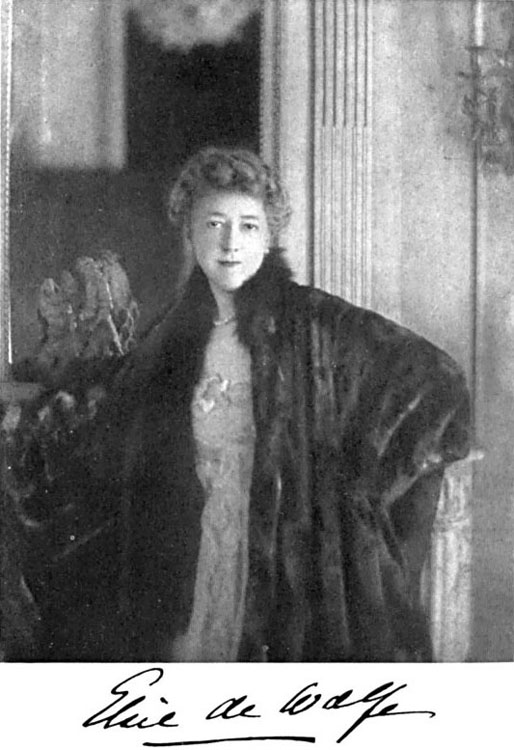
A life in Gramercy
The house with the open doors
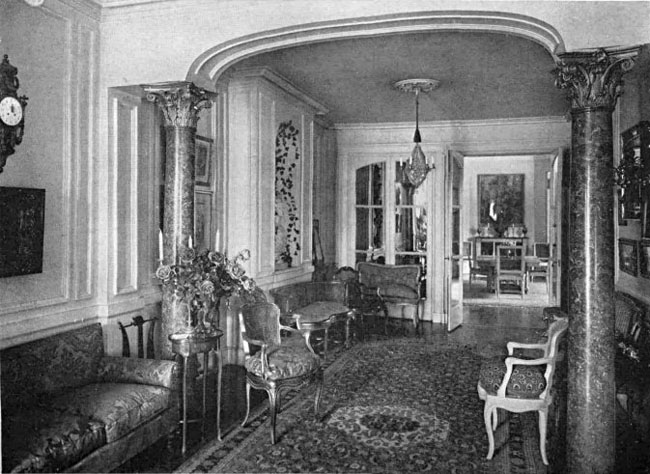
At 122 East 17th Street, on the corner of Irving Place, the heavy curtains came down. Elsie de Wolfe replaced the dark, crowded effect of a Victorian interior with pale woodwork, chintz, mirrors, and eighteenth-century French furniture. The house she shared with theatrical agent Bessie Marbury became a place where rooms opened invitingly into one another—and where, on Sunday afternoons, much of literary, theatrical, and fashionable New York came through the door.
The two women set up their household in 1892 in the building popularly known as the Washington Irving House. Society called them “the Bachelors.” Marbury brought formidable professional connections; de Wolfe brought an eye that critics had already noticed on the stage, where her clothes sometimes received warmer reviews than her performances. Together they made a home whose appearance and company offered something different from the more solemn conventions of New York entertaining.
Before de Wolfe had a major decorating commission, visitors could see what she had done at Irving Place. Stanford White recognized the talent and helped her secure the Colony Club, the project that carried her into a new profession. The career that followed would take her into millionaires’ houses, French wartime hospitals, and international society as Lady Mendl. Its beginnings remained visible in this shared home: a room made lighter, a chair chosen carefully, and a gathering made comfortable.
An eye before a profession
The trouble with the parlor
Born Ella Anderson de Wolfe in New York in 1865, Elsie grew up with the kind of domestic decoration she would spend much of her career undoing. Victorian brownstones could be impressive places: dark woodwork, heavy upholstered furniture, deep draperies, and a great accumulation of objects. She remembered their gloom with particular dislike. The objections that later became professional advice began with an unusually strong response to the rooms around her. Their expense did not persuade her that they were pleasant places to live.
A presentation at Queen Victoria’s court brought her into a very different setting, though hardly a modest one. De Wolfe’s subsequent taste was never a campaign against elegance, fine clothes, or expensive things. She delighted in all three. What she disliked was an oppressive effect, the sense that furnishings had taken possession of a room at the expense of its occupants. Her preference for light and graceful arrangements would eventually make French antiques seem unexpectedly fresh to an American clientele accustomed to more ponderous displays.
The gowns received the notices
Before decoration offered her a livelihood, she became an actress. Her theatrical career included work with Charles Frohman’s Empire Theatre company, placing her in the professional world that supplied so many of Gramercy’s friendships and dinner-table acquaintances. The stage required an attention to appearance that suited her. Critics admired her couture gowns, sometimes more enthusiastically than her acting. It was an awkward distinction for a performer, but it established a reputation for taste that could exist independently of the quality of a particular role.
The theater also offered connections between people who made things and people who could pay for them. Actors, managers, writers, and fashionable patrons passed through overlapping circles. De Wolfe’s later career would draw on that world, but the transition was gradual. She did not leave the stage with an established decorating practice waiting for her. First came a household on Irving Place, where she could work out her ideas in rooms used every day—and where visitors would encounter the results at close range.
The Bachelors of Irving Place
A formidable theatrical agent
De Wolfe met Elisabeth Marbury in 1887. Known as Bessie, Marbury had been born in 1856 and grown up in the Gramercy Park neighborhood. She was building an exceptional career as a literary and theatrical agent, representing such writers as Oscar Wilde, George Bernard Shaw, Victorien Sardou, and James M. Barrie in America. Her work was a business of negotiations, rights, productions, and personalities. She occupied a position of authority in a profession where women were more commonly visible onstage than across the bargaining table.
Marbury’s importance to de Wolfe’s story extends well beyond introducing her to useful people. The two women made a lasting household together, combining professional lives that brought a wide range of visitors into their home. Marbury understood theatrical talent and the practical arrangements needed to make it successful. De Wolfe’s eye for clothes and rooms complemented that experience. Their partnership placed an actress with ambitions beyond performance beside a woman already accustomed to turning creative work into a durable business.
A household with its own rules
In 1892 they moved into 122 East 17th Street, at the southwest corner of Irving Place. The old building was known as the Washington Irving House, a name that became part of the household’s public identity. They would remain until 1911. Its nineteenth-century rooms provided de Wolfe with a substantial, lived-in subject for her experiments. Changes could be judged by the women who occupied the house and by the guests who returned to it, rather than only by the impression of an opening night.
New York society called the pair “the Bachelors,” acknowledging a household that did not follow the usual married arrangement. De Wolfe embroidered silk pillows with “Never Complain, Never Explain,” a motto well suited to someone determined to decide for herself how a room—and a life—should look. The phrase would become inseparable from her public personality. On Irving Place it belonged among the furnishings of a home shared by two women with their own incomes, work, friends, and considerable powers of persuasion.
Sunlight and Sunday company
A lighter way to live
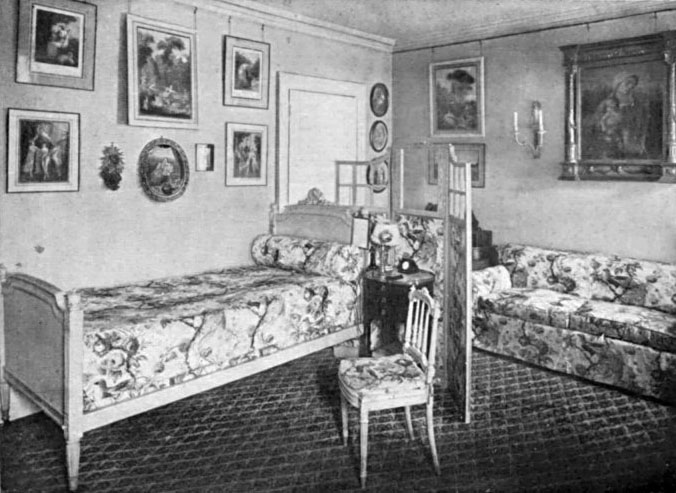
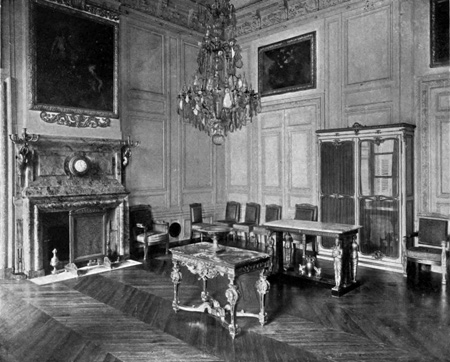
De Wolfe stripped away the effect of the heavy Victorian portières and dark woodwork, introducing pale painted paneling, mirrors, chintz, and eighteenth-century French furniture. These were not empty rooms. They contained possessions chosen with care, and offered places for people to sit and talk. The difference lay in their scale, arrangement, and lightness of effect. A visitor could see antiques used to make a home inviting, rather than assembled into a forbidding demonstration of how much the owners could afford.
Her tastes belonged to a broader reconsideration of domestic interiors. Edith Wharton and Ogden Codman Jr. published The Decoration of Houses in 1897, arguing for proportion and architectural order. De Wolfe’s approach was distinct, with its particular affection for chintz, mirrors, and comfortable furnishings, but the rejection of indiscriminate clutter connected these efforts. Irving Place offered a persuasive, practical demonstration. The rooms were being used, and their success could be measured in the ease with which a varied company inhabited them.
Who came through the door
The Sunday gatherings became famous, especially during the years from 1897 to 1907. Among the household’s visitors were Sarah Bernhardt, Nellie Melba, Henry Adams, Charles A. Dana, Stanford White, and Mrs. William Astor, as well as people from Oscar Wilde’s circle. The guest list joined the theater’s international reach to literary life and established New York society. Marbury’s professional relationships helped make the mixture possible; de Wolfe’s rooms gave it a setting that guests remembered and discussed elsewhere.
Mrs. Astor’s response supplies a particularly good measure of the salon’s influence. She told de Wolfe that she, too, was giving a “Bohemian party,” with J. P. Morgan and Edith Wharton among the company. The label could stretch a surprising distance in New York. For the women on Irving Place, the useful achievement was less a name for their circle than the range of people willing to join it. The house was gaining a reputation at the same time that its decorator was beginning to acquire a clientele.
“Give it to Elsie”
White puts his confidence behind her
By 1905 de Wolfe was ready to leave acting for decoration. Marbury encouraged the move, and so did Stanford White, the architect whose own Gramercy house displayed an appetite for beautiful objects rather different from de Wolfe’s lighter interiors. He could recognize an ability without requiring it to duplicate his own taste. At about forty, she had business cards printed and began presenting decoration as a professional service. The household experiment had become work for which clients could engage her.
The decisive opportunity was the new Colony Club, a women’s club in a building designed by White. Its governors hesitated to entrust the interiors to an inexperienced woman. White’s answer, as it came down in the account of the commission, was emphatic: “Give it to Elsie, and let the girl alone! She knows more than any of us.” His support carried practical weight. It gave her access to a prominent project whose members were also well placed to commission work in their own houses.
The garden comes indoors
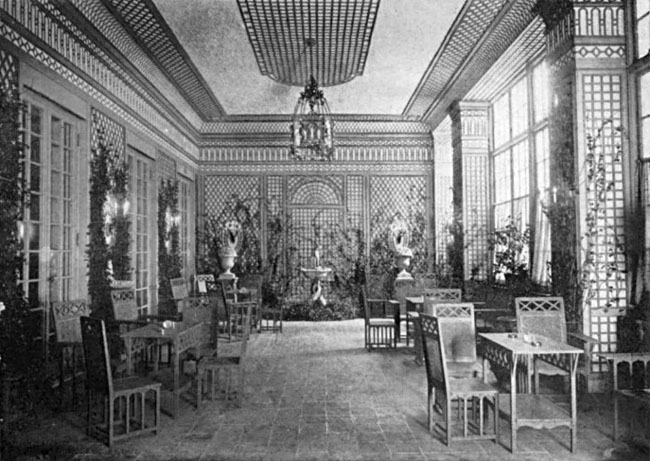
At the club’s 1907 opening, the bright interiors and trellised garden room made a sensation. Chintz and an airy treatment of the rooms offered an alternative to the heavier furnishings associated with many established clubs. In the trellis room, garden forms became part of an indoor social space. The photograph de Wolfe later included in The House in Good Taste shows the result: a room with an unmistakable decorative identity, arranged for people to use comfortably.
The commission helped establish interior decoration as a profession distinct from acting, architecture, or simply having a reputation as a stylish hostess. De Wolfe is often described as America’s first professional female decorator; her more readily visible achievement was to make the occupation prominent, desirable, and commercially successful. The route from Irving Place to the Colony Club also explains the value of the earlier Sundays. People who had admired her own rooms could now see the same judgment applied to a larger, public undertaking.
Beyond the drawing room
Clients, a book, and the Castle Walk
The Colony Club opened the way to an extraordinary clientele. De Wolfe worked for Henry Clay Frick and members of the Vanderbilt and Morgan families, including Anne Morgan. With Marbury and Morgan, she also helped restore the Villa Trianon at Versailles, extending the shared household’s attachment to France. The commissions required her to work with people who could buy almost anything. Selection mattered all the more in such circumstances: her usefulness depended on knowing what belonged together and what a room could do without.
In 1913 she published The House in Good Taste, bringing her advice to readers who would never employ her. Other ventures carried the Irving Place circle into a new social fashion. De Wolfe and Marbury joined Mamie Fish and fellow patrons in supporting Irene and Vernon Castle’s dance academy, Castle House. The Castle Walk and other dances offered fashionable New Yorkers a lively departure from more formal entertaining. Once again, Marbury’s theatrical world and the drawing rooms of society proved close neighbors.
Work in the French hospitals
The First World War gave de Wolfe’s attachment to France a different purpose. She volunteered for Red Cross nursing work and cared for wounded men, including burn victims, in hospitals near the front. This was demanding service, far removed from choosing furnishings or receiving guests. Her work brought French recognition, including the Croix de Guerre and the Legion of Honour. The same biography that contains extraordinary clothes and ingenious rooms also contains sustained practical help for people caught in the war.
Several figures in the wider Gramercy literary world directed their efforts toward relief in France, among them Edith Wharton. Their activities took different forms, from fundraising and publications to work with refugees and hospital patients. De Wolfe’s nursing belongs in that history on its own terms. She was known for elaborate comfort and for making life agreeable; during the war, she put time and energy into circumstances where suffering could not be wished or decorated away. It was a substantial part of her life abroad.

A name, a style, a home
Lady Mendl in society
In 1926, at sixty, de Wolfe married the British diplomat Sir Charles Mendl and became Lady Mendl. The name added another identity to a woman already known as actress, decorator, author, and hostess. Her later life moved among Paris, Beverly Hills, and New York. The Irving Place household had ended years earlier, but the experience of making a home into a gathering place remained central to the way she appeared in society. Her surroundings and her company continued to attract attention.
She could also be wonderfully conspicuous on her own account. Stories of cartwheels and blue-tinted hair became part of the public image of a woman who did not intend to withdraw quietly as she grew older. These details have often outlasted discussion of particular decorating commissions, partly because they are so easy to picture. Yet the personality and the profession were closely associated. Clients had engaged someone with a recognizable eye and confidence in her choices; society continued to enjoy the same capacity for surprise.
What began at the corner house
De Wolfe died at Versailles in July 1950. By then, interior decoration had become a recognized occupation, and her own name was attached to its emergence in the United States. The career is easy to tell through famous clients and the Colony Club, but Irving Place supplies a more intimate beginning. There she and Marbury had made their own rooms, entertained their own friends, and shown what de Wolfe could accomplish before the profession had given her a settled place within it.
Her account of the old house survives in The House in Good Taste, along with photographs of the interiors. They preserve the arrangement of spaces that visitors once walked through and the furniture around which they gathered. The lasting pleasure of the story is its domestic scale. Before the great commissions, the titles, and the international parties, two women established a household at East 17th Street and Irving Place. De Wolfe changed the rooms, Marbury helped fill them with company, and New York took notice.
Places, people & connections
Around the Park
Stanford White
The Gramercy architect whose support helped de Wolfe secure the Colony Club commission.
19 Gramercy Park South
Mamie Fish’s former home, linked to the society patronage behind the Castles’ dance academy.
Edith Wharton
Another Gramercy writer and observer of society who argued for a thoughtful approach to domestic interiors.
21 Gramercy Park South
John Bigelow’s home offers another view of the neighborhood’s literary and international connections.
O. Henry
The short-story writer’s Irving Place years overlapped with the later life of de Wolfe and Marbury’s salon.
Ludwig Bemelmans
A later Gramercy artist and writer with his own eye for rooms, restaurants, and memorable company.
Life at a glance
The biographical record
| Born | 1865 · New York City · Ella Anderson de Wolfe |
|---|---|
| Died | July 1950 · Versailles, France |
| Irving Place home | The Washington Irving House, 122 East 17th Street · southwest corner of Irving Place · 1892–1911 |
| Household companion | Elisabeth “Bessie” Marbury (1856–1933), literary and theatrical agent |
| Early career | Actress; associated with Charles Frohman’s Empire Theatre company |
| Major breakthrough | Colony Club interiors · opened 1907 · supported by Stanford White |
| Book | The House in Good Taste (The Century Co., 1913) |
| French home | Villa Trianon, Versailles |
| Wartime service | Volunteer Red Cross nursing in France; Croix de Guerre and Legion of Honour |
| Later name | Lady Mendl, following her 1926 marriage to Sir Charles Mendl |
Over time
A New York beginning
Ella Anderson de Wolfe is born in New York City.
Meeting Bessie Marbury
De Wolfe meets the literary and theatrical agent who becomes her longtime companion.
A shared household
The women establish their home at 122 East 17th Street on Irving Place.
The Sunday salon
Their gatherings bring theatrical, literary, and fashionable New York into the same rooms.
Decoration becomes a business
With encouragement from Marbury and White, de Wolfe leaves acting for a professional decorating career.
The Colony Club opens
The interiors, including the trellis room, bring de Wolfe wide attention.
Leaving Irving Place
The household moves on from the old corner house to East 55th Street.
Advice in print
The House in Good Taste presents de Wolfe’s rooms and decorating ideas to a broad readership.
Patronage and wartime service
Support for the Castles’ dance academy is followed by Red Cross nursing work in France during the First World War.
Lady Mendl
De Wolfe marries British diplomat Sir Charles Mendl.
Marbury’s death
Bessie Marbury dies after a distinguished career in theater and public life.
Death at Versailles
De Wolfe dies in July, leaving a career that helped make interior decoration an established profession.
Sources cited
- Carole Klein, Gramercy Park: An American Bloomsbury (Boston: Houghton Mifflin, 1987), for de Wolfe, Marbury, and the Irving Place circle.
- Elsie de Wolfe, The House in Good Taste (New York: The Century Co., 1913), particularly the chapters on the old Washington Irving House, trellises, and Villa Trianon; period photographs reproduced on this page.
- Elisabeth Marbury, My Crystal Ball: Reminiscences (New York: Boni and Liveright, 1923), for the theatrical and social world of the shared household.
- Edith Wharton and Ogden Codman Jr., The Decoration of Houses (first published 1897; illustrated 1914 edition), for a contemporary, distinct approach to domestic decoration.
- Amber Paranick, “Elsie de Wolfe: America’s First Interior Designer”, Library of Congress, Headlines & Heroes, July 11, 2018, with links to contemporary newspaper coverage.
- Library of Congress, “Miss Elsie de Wolfe”, photograph by Zaida Ben-Yusuf reproduced in Metropolitan Magazine, May 1901, p. 590.
- Gramercy Park Block Association, Stanford White, Edith Wharton, and 19 Gramercy Park South, for connected architectural, literary, and social histories.
Photo credits for this page
- Elsie de Wolfe, portrait published in 1913. Photographer unidentified. Frontispiece, with facsimile signature, in The House in Good Taste (New York: The Century Co., 1913). Project Gutenberg edition. Public domain.
- Interior of the Washington Irving House. Photographer unidentified. Plate captioned “The Washington Irving house was delightfully rambling,” in Elsie de Wolfe, The House in Good Taste (New York: The Century Co., 1913). Project Gutenberg edition. Public domain.
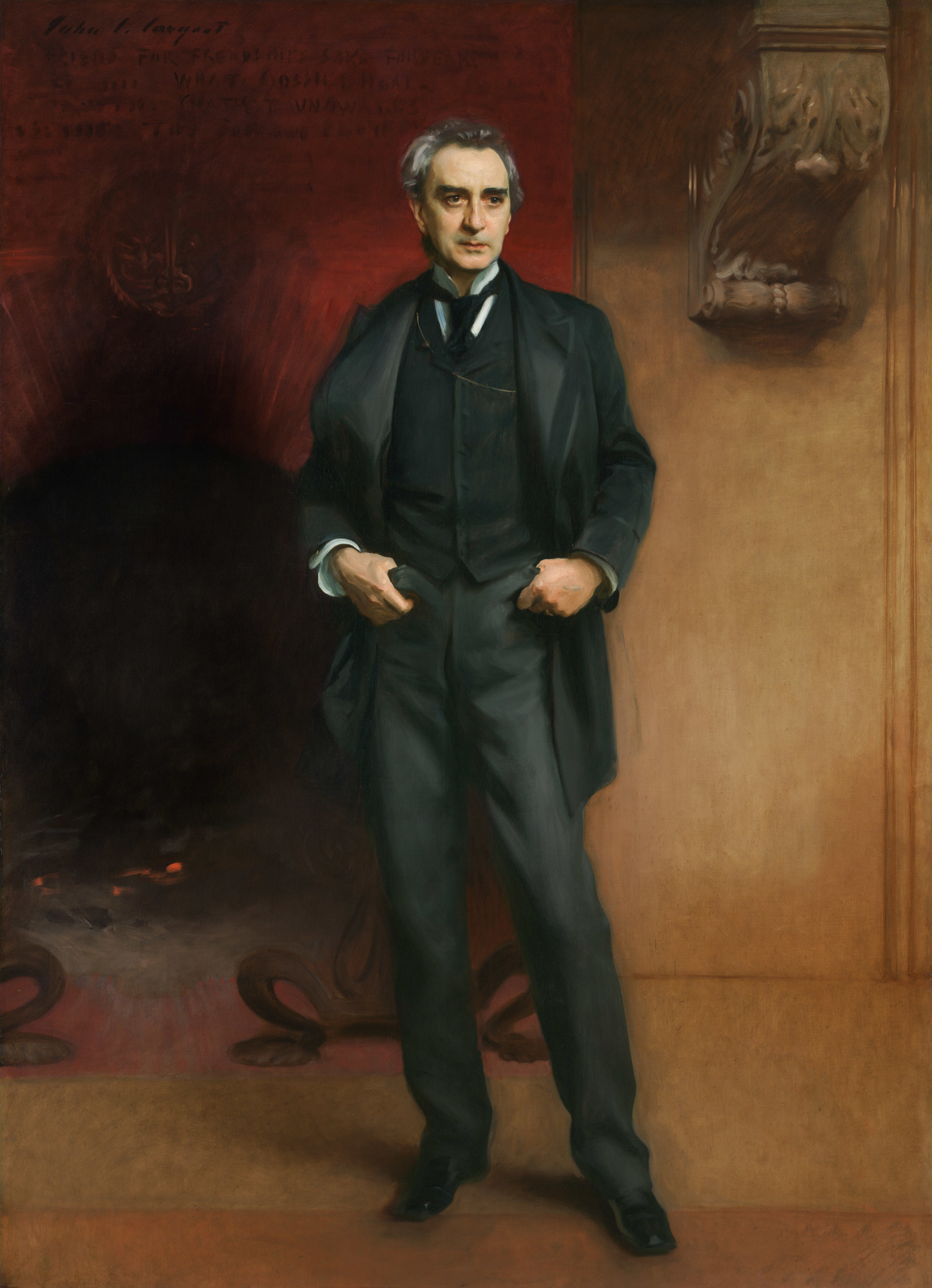
- Edwin Booth, 1890. John Singer Sargent, oil on canvas. Amon Carter Museum of American Art, Fort Worth, Texas, 2013.7. Collection record. Public domain.
- Miss Marbury’s bedroom, Washington Irving House. Photographer unidentified. Illustration in chapter III of Elsie de Wolfe, The House in Good Taste (New York: The Century Co., 1913). Project Gutenberg edition. Public domain.
- Room in the Grand Trianon, Versailles. Plate V in Edith Wharton and Ogden Codman Jr., The Decoration of Houses (Charles Scribner’s Sons, 1914 edition; first published 1897). Photographer unidentified. Project Gutenberg, from Internet Archive scans. Public domain.
- The trellis room in the Colony Club. Interior by Elsie de Wolfe; photographer unidentified. Illustration in The House in Good Taste (New York: The Century Co., 1913). Project Gutenberg edition. Public domain.
- The Book of the Homeless, 1916. Illustrated title page; Edith Wharton, editor (Charles Scribner’s Sons, New York). Project Gutenberg edition. Public domain.
- Spring, Gramercy Park, 1912. John Sloan, oil on canvas. Delaware Art Museum / John Sloan Memorial Foundation; image preserved in the GPBA historical collection. Related building profile. Public-domain artwork.