
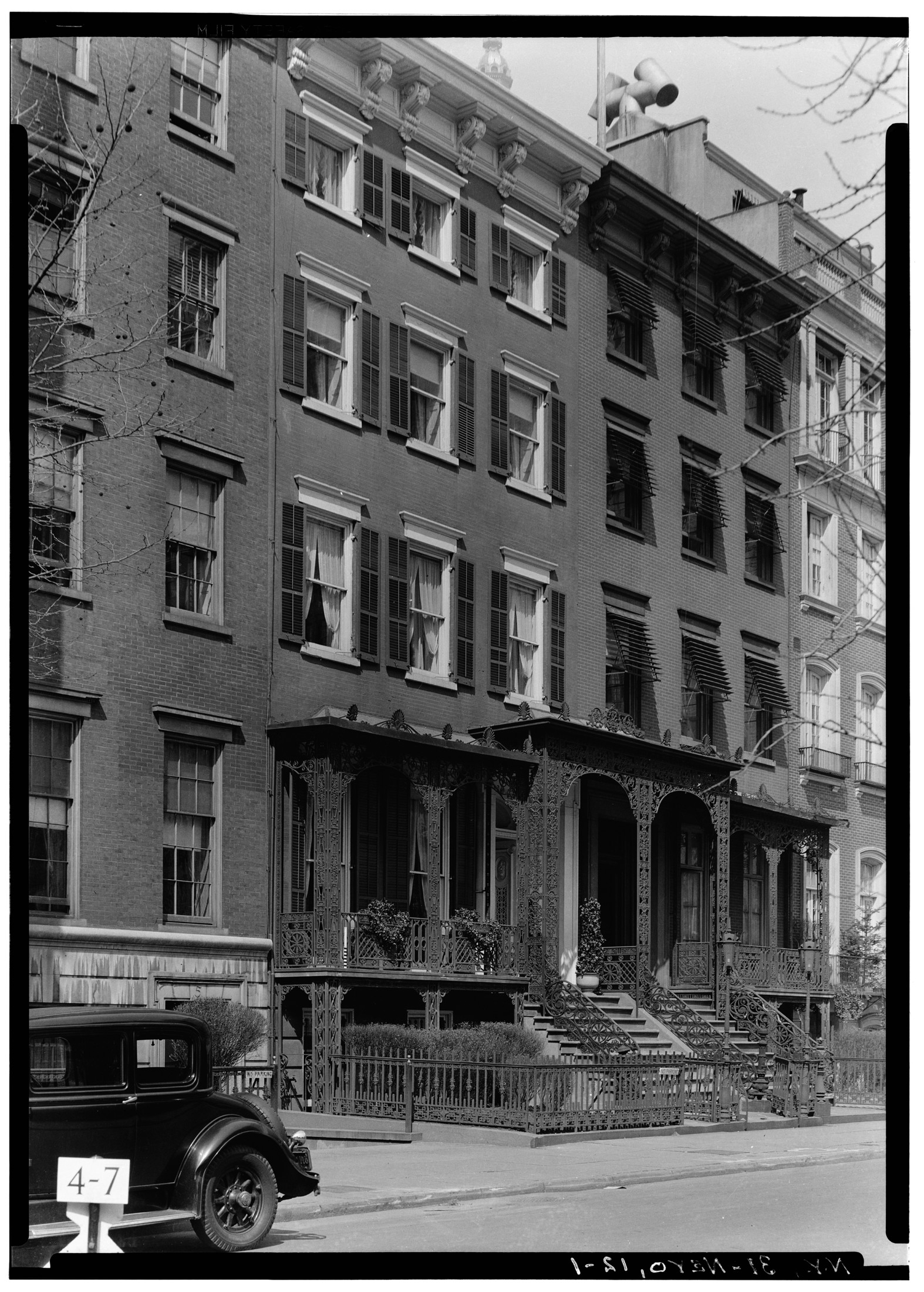
Peter Cooper at No. 9 Lexington Avenue
Pine records that Peter Cooper completed his house at the corner of Lexington Avenue and Twenty-second Street in 1848 and lived there until his death in 1883. The book describes details that linked his domestic life to his work: cast-iron lintels from his foundry, a stable entrance on Twenty-second Street and his familiar one-horse carriage.
Cooper’s inventions and manufacturing interests occupied a large part of his life, but Pine gives particular weight to his educational work. Cooper Institute offered technical learning to people who otherwise might have lacked access to it. The institution was a central expression of his belief in practical education.
Abram S. Hewitt and practical education
Abram S. Hewitt joined the Cooper household after marrying Cooper’s daughter in 1855. His career brought together iron and steel manufacturing, national politics, municipal government and education. Pine describes his continuing involvement in Cooper Institute as one of the central commitments of his life.
Hewitt’s public service extended to New York’s rapid-transit planning and a range of educational and cultural institutions. Pine writes admiringly about him; the enduring connection for this neighborhood is the relationship between a private home at the Park’s edge and work intended to benefit the wider city.
Tilden’s bequest and Bigelow’s work
Samuel J. Tilden’s house on the south side of the Park was the center of a very different public story during the disputed presidential election of 1876. Pine describes the political attention focused on the neighborhood, then follows Tilden’s legacy into his provision for a public library.
John Bigelow, a neighbor, friend and biographer of Tilden, served as an executor of his estate and became a leader of the New York Public Library. Pine connects the Tilden bequest with the consolidation of the Astor and Lenox libraries and the library proposed by Tilden. The account brings the Park into the history of an institution used by generations of New Yorkers.
Publishing and classrooms
James Harper, of Harper Brothers, lived at No. 4 from 1847 to 1869, according to Pine. A former mayor as well as a publisher, he represents another connection between the square and the circulation of books and ideas.
The book also records Henrietta B. Haines’s school for girls at No. 10 as early as 1851. Pine’s brief, socially framed description leaves much of the school’s daily work unexplored, but it establishes education as part of the neighborhood’s own life as well as a cause supported by its residents.
Read across the neighborhood
Explore more writers, educators and reformers in Women who shaped Gramercy.
An opportunity handed on
Today’s neighborhood educational support works at a more personal scale. Scholarships and mentoring and books for classrooms show how a neighbor’s contribution can help someone else begin.
Sources
Adapted from John B. Pine, The Story of Gramercy Park, 1831–1921 (1921), printed pages 24–25, 27–40, 50.