
A neighborhood organized around open space
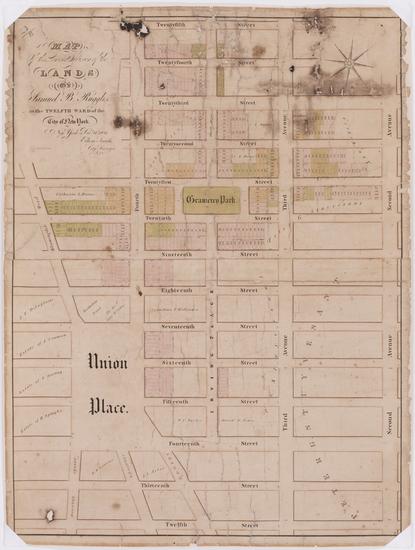
When Samuel B. Ruggles acquired land from the Duane estate in 1831, he set about reshaping more than a single building lot. His plan placed an ornamental garden at the center of a residential neighborhood. Houses and open space would give value and character to one another.
On December 17, Samuel and Mary Ruggles conveyed the Park parcel to trustees. The founding indenture joined the creation of the landscape to provisions for its continuing care. The document’s attention to fences, planting, paths and maintenance made the garden a lasting part of the plan.
Irving Place and Lexington Avenue
Ruggles also laid out the streets that meet the Park from the south and north. Pine’s history records Irving Place as a tribute to Washington Irving and Lexington Avenue as a reference to the Revolutionary battlefield. Ruggles chose those names rather than his own.
The streets and square established a recognizable relationship between movement and open space. The later proposals to continue a route through the Park would challenge that arrangement and bring neighbors together in its defense.
1831 · Ruggles’s plan for the neighborhood
Union Square and the wider city
Pine reproduces an 1851 account by Charles King describing Ruggles’s work on the land and his involvement in the creation of Union Square. The account emphasizes the effort, negotiation and investment required to turn irregular parcels into a substantial open space.
Pine praised Gramercy as an example of city planning and wondered whether London’s garden squares had influenced Ruggles. He offered no documentary evidence for that possible connection.
Public works and education
Ruggles’s interests extended to the Erie Canal, the Croton Aqueduct and public education. Pine describes his work advising John Jacob Astor on the Astor Library, purchasing books abroad and serving as a trustee. He also served as a trustee of Columbia College.
Those connections give the Park’s founder a place in the wider story of New York’s infrastructure and institutions. The garden was one expression of a broader interest in how a growing city could be organized and improved.
A founder remembered in the landscape
A commemorative stone at the western gate, placed by John Ruggles Strong in 1875, recorded Ruggles’s role in founding the Park. By the time Pine wrote, a marble memorial with a bronze portrait medallion had also been installed at the western fountain.
Explore the history of the fountains and memorials, or follow the practical work that began turning the plan into a garden in How the garden took root.
A neighborhood still being made
The story did not end with the founding deed. Follow the history of Gramercy Park through the people who protected it, the buildings that changed around it and the care that continues today.
Sources
Based on the 1921 edition of John B. Pine’s The Story of Gramercy Park, printed pages 3–15, and the founding indenture.