
A vision still taking shape
The deed established the idea of an ornamental garden in 1831, but John B. Pine’s 1921 history describes slow progress during its first thirteen years. By the first recorded meeting of the Trustees, on November 15, 1844, the grounds appear to have been fenced and graded. Much of the planting that would give the Park its character still lay ahead.
That meeting took place at the home of James W. Gerard. Changes among the original trustees had brought Gerard, Norman White and William Samuel Johnson into the group. Under Charles Augustus Davis’s presidency, the Trustees began placing specific orders for the garden’s development.
A thousand hedge plants
The Trustees contracted with James Virtue to supply one thousand healthy privet plants, enough to surround the Park inside its fence. That detail reveals the relationship between the iron boundary and the living landscape: the enclosure would be softened by a planted edge.
They also ordered one hundred trees. Pine’s list includes horse chestnuts, willows, lindens, maples, catalpas, elms, beech, ash, poplars, sycamores, walnuts and mulberries. The variety points to a garden intended to offer changing forms, foliage and shade, rather than a single repeated planting.
Trees become part of neighborhood memory
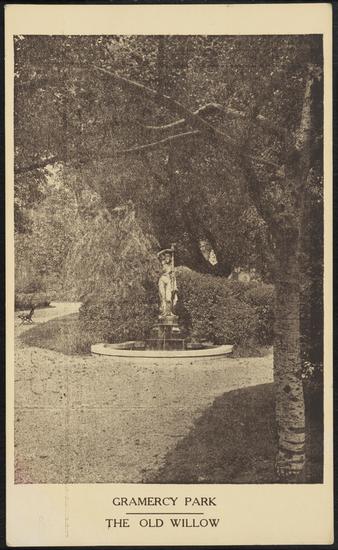
Writing in 1921, Pine identified an elm and a willow as survivors of those early plantings. His account includes Seabury Lawrence’s poem imagining what an old willow might remember of children, neighbors and the city beyond the gate. Those observations belong to Pine’s time; they are not identifications of trees living in the Park today.
Pine also notes that the early order for a hedge had been repeated by later trustees. Even within his ninety-year history, renewal was already part of the story. A living garden could preserve its purpose while individual plants aged, disappeared and were replaced.
Ambition meets a budget
The planting program was accompanied by plans for a fountain. A proposal inspired by the fountains before St. Peter’s in Rome carried an estimated cost of $5,300, to be raised through voluntary contributions. The lot owners did not fund it, and the proposal was tabled in April 1846.
A smaller fountain was built in 1848.
Continue through the landscape
The choices have changed, but the need for attention has not. The Trustees continue caring for the garden within the fence. Outside it, the Gramercy Park Block Association tends the 41 street trees that frame our walks. Each new planting asks the same patient question: what will this place become as it grows?
Sources
Adapted from John B. Pine, The Story of Gramercy Park, 1831–1921 (1921), printed pages 12–16.