
Edwin Booth’s gift
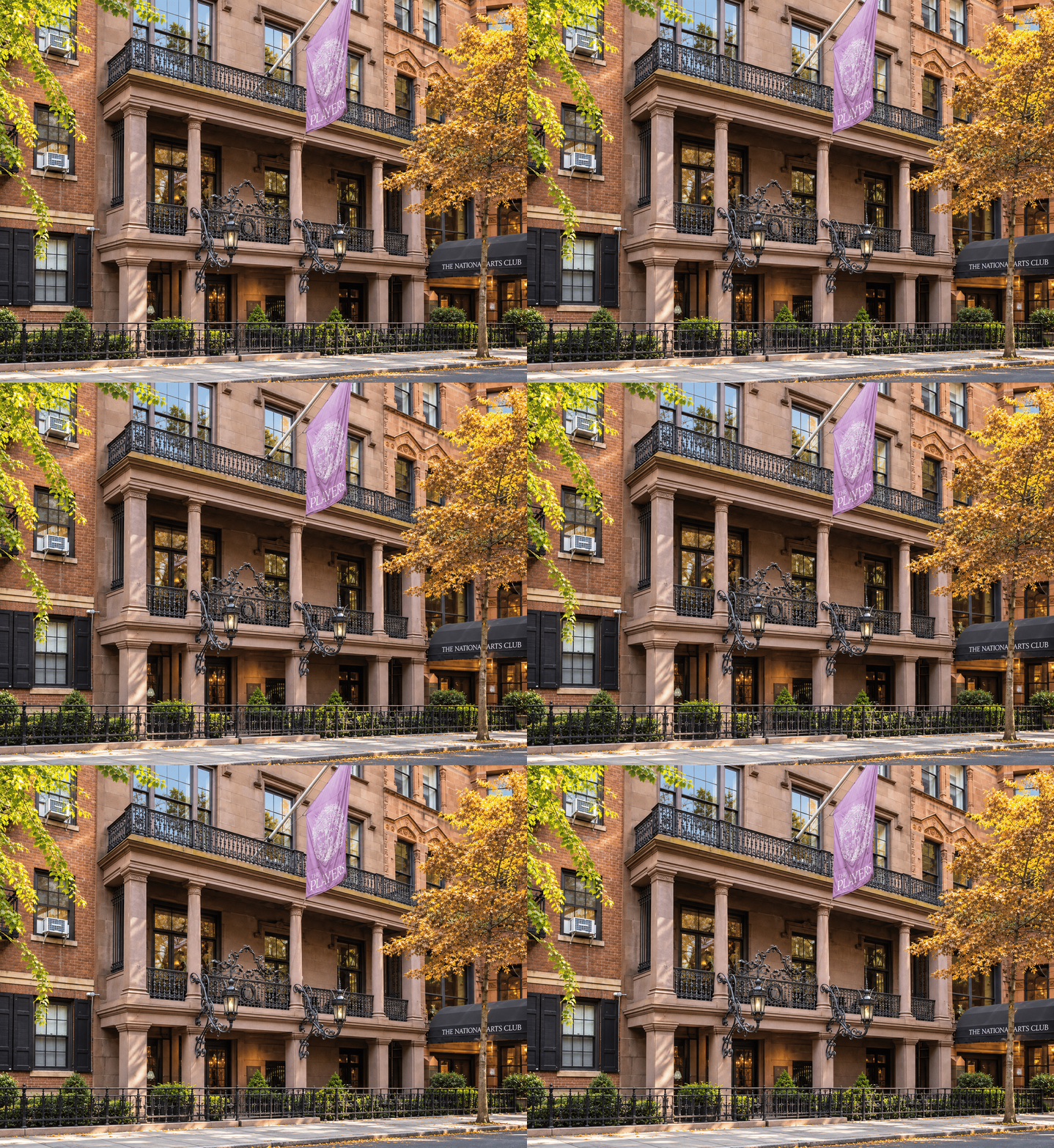
The Players was founded in 1888 by Edwin Booth to bring members of the theater into conversation with people working in literature, painting, sculpture and music, and with patrons of the arts. Booth gave No. 16 to the club after Stanford White had remodeled and decorated the house for its new purpose.
Booth was giving away more than a handsome address. His home became a place where people from different arts could meet, exchange ideas and enjoy one another’s company. A private drawing room had acquired a wider purpose.
A tribute in the garden
The Players later organized the statue of Booth as Hamlet, unveiled in the Park on November 13, 1918. The bronze was modeled by Edmond T. Quinn, with a pedestal designed by Edwin S. Dodge. The Trustees cooperated in placing the memorial among the trees Booth had seen from his home.
From the house to the garden, Booth’s presence crossed the street. The memorial took the place of the old central fountain, changing the composition of the landscape as well as commemorating the actor. The fountains’ story follows what happened next.
The Tilden house becomes the National Arts Club
The National Arts Club acquired Samuel J. Tilden’s former home at Nos. 14 and 15, including its garden extending toward Nineteenth Street. Pine describes the club’s aim of bringing art lovers and art workers together and credits it with helping create a community of artists around the Park.
By the time of his account, an apartment building for members had been erected on the rear part of the property. This was another way a former private house adapted to collective use. The later preservation work at the National Arts Club is documented elsewhere on this site.
A changing group of clubs
Pine’s 1921 survey also names university, service and national clubs occupying houses around the square. The Columbia University Club purchased No. 18 in 1905 and moved to larger quarters in 1917; the Army and Navy Club followed it there. A house once occupied by Stanford White was used successively by the Princeton Club and, during the First World War, the United Service Club.
He records the Tech Club in the old Gerard house and the Netherlands Club’s purchase of No. 4 in 1913. These are historical occupancies, not a directory of current tenants. They reveal how the social uses of Gramercy’s houses continued to change even when the buildings remained familiar.
Culture as neighborhood life
For later accounts, explore Gramercy’s cultural institutions, The Players and National Arts Club Community Day.
A house can have more than one life
These changing uses are part of what makes Gramercy worth exploring. Across the south side, No. 19 moved from family home to apartments to a mansion known for art and entertaining. The architectural setting holds many different stories.
Sources
Adapted from John B. Pine, The Story of Gramercy Park, 1831–1921 (1921), printed pages 45–50.