Paragraph breaks and line-end hyphenation have been adjusted for reading. Original wording and period language are retained; editorial additions appear in square brackets.
Manhattan’s Quiet Eddy in Gramercy Park
Sole Surviving Private Park in New York—Its Atmosphere Unique—How It Got Its Name.
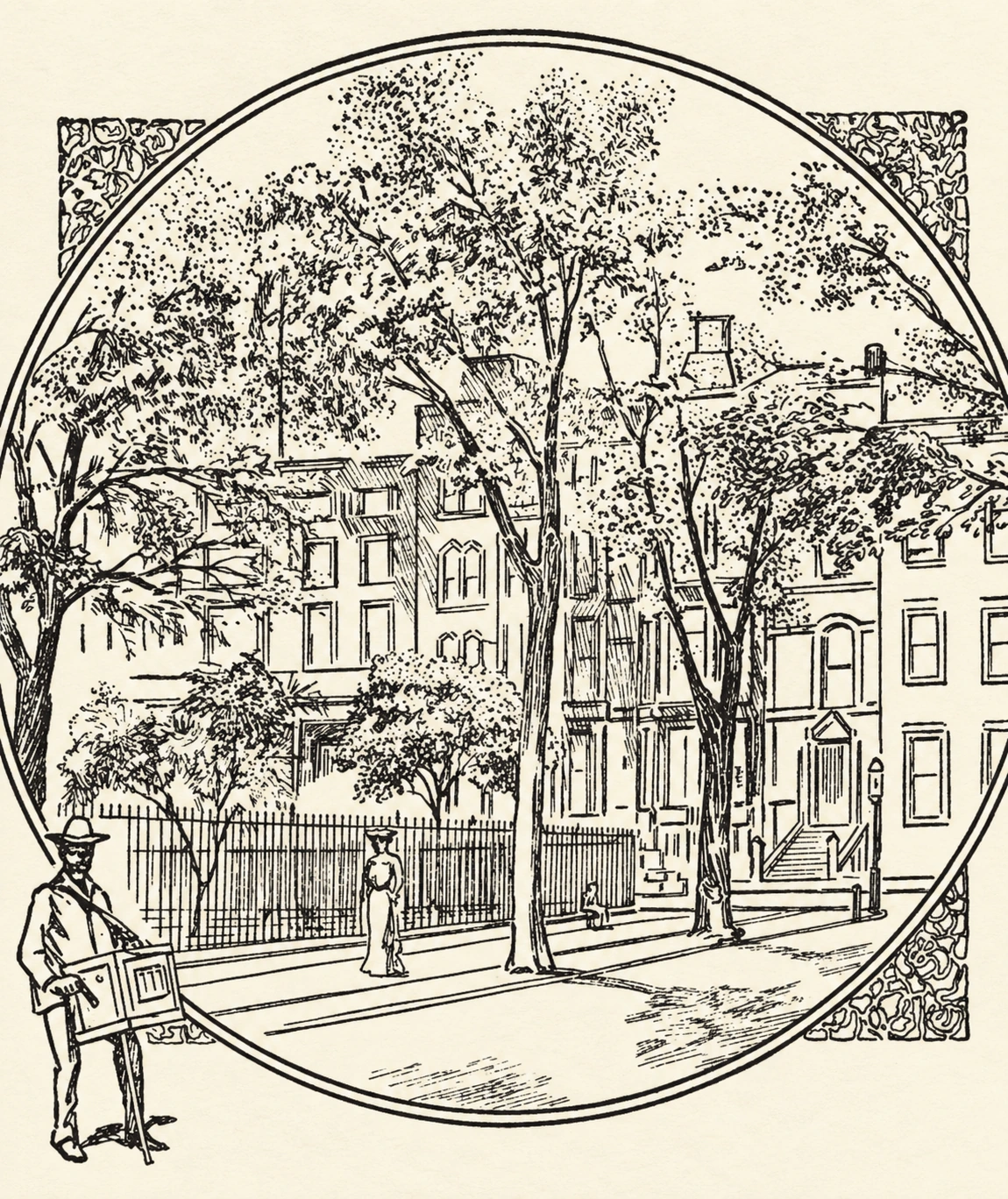
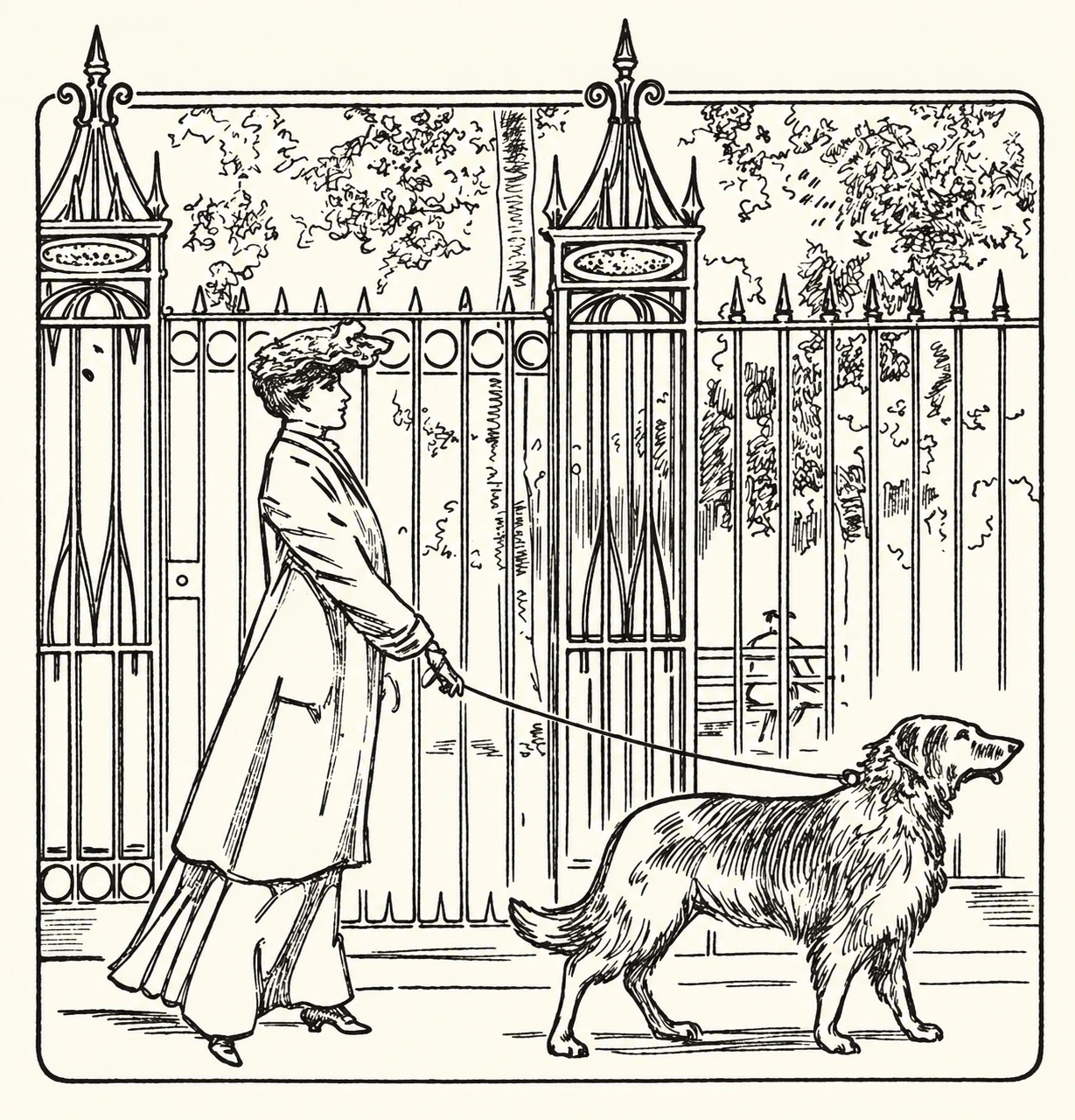
As the shops and hotels, the apartment houses and skyscrapers push their way northward along the avenues of Manhattan they have left to one side in a quiet eddy the last remaining private park of the city. Gramercy is the sole survivor of the type. Passing through its hushed precincts one often sees children gathered in front of the tall iron gates, rigorously closed against them. They gaze wistfully through the bars at other children who have the privilege of entrance that is denied them. Outsiders are they, rank outsiders, and one can see on their faces a trace of indignation that they, too, cannot play about that plashing fountain, which seems so thin to us of to-day, and disport themselves under the shade of the trees. For this private recreation ground is open only to the owners or occupiers of the houses round about who are compelled by the terms of their purchase or lease to contribute annually to a fund for the maintenance of the park.
Each householder is furnished with a key to the gates, and to guard against abuse of the privilege the key is changed from time to time. It is fair to say that the householders have never been rigidly exclusive in their views, and often the children of those whose houses do not front the park have been allowed the run of it. But generally speaking the exclusiveness that began fourscore years ago has been maintained, and Gramercy Park to-day is still a little haven of quiet, where the governess can read her book while her youthful charges gambol unmolested by the little Mohawks of the street.
Of late years the clubs, driven to desperation by the tumult of the city which has steadily invaded Fifth Avenue and the broader cross streets, have been discovering Gramercy Park. Edwin Booth lived there, and his home became that of the Players Club, an organization of actors and lovers of the drama. It lies between the house of the late Samuel J. Tilden, who arranged a single mansion out of two dwellings, with the intention of making room for his library, now, however, part of the New York Public Library, and the home of the late James W. Gerard. The house on the corner of Irving Place, next to the Gerard’s, was then bought for the Alumni of Columbia University.
A club of graduates from a woman’s college settled in the same block near Fourth Avenue, and now the National Arts Club, driven from West Thirty-fourth Street by lack of room and by the noise and bustle of that thoroughfare, has purchased the Tilden mansion, so that the block on the southerly side of the park between Fourth Avenue and Irving Place will soon have four clubs in line. As all of these organizations seek quiet, their gradual encroachment on private dwellings will scarcely change anything in the atmosphere of Gramercy Park. Their fronts are as impassive as those of the old mansions, and probably the only difference will be an increase of pedestrians and cabs about the dinner hour, when the echoes will be oftener raised than at other times of the day. Though central and accessible, owing to its nearness to the Fourth and Third Avenue surface lines, the Subway station at Eighteenth Street, the Third Avenue elevated, the crosstown lines of Fourteenth, Seventeenth, and Twenty-third Streets, this little park is no thoroughfare. If the incessant Protean changes of New York are not sparing even Gramercy, it must be confessed that they are very gentle alterations so far, which the householders thereabouts can afford to regard with equanimity.
The Tilden mansion will be altered somewhat to fit the requirements of the Arts Club. The main entrance will be into the basement, like that of the adjoining Players Club; but the smaller entrance, with its outer stair leading to the first floor, will remain. This is to be a special entrance for the ladies of the club, taking them directly by a second flight to their own little suite of apartments on the second floor. The dining room in the rear will have a skylight over it, and form part of the picture galleries, which will extend quite through to Nineteenth Street when the large studio-apartment annex is built. This addition will occupy the bulk of the Tilden garden, and rise twelve stories, the upper stories obtaining thereby a good north light over the Tilden mansion and the park. It is designed by Mr. George B. Post, the first President of the club, and still one of its Governors, and although the foundations are not yet laid, a large proportion of the studios have already been engaged.
It need hardly be mentioned that only members of the club can lease apartments and studios in the annex. This club is composed of men and women in the proportion of three to one, having very successfully solved the problem of a club for both sexes.
The Players, exclusively a man’s club, having for its new President since the death of Joseph Jefferson the popular actor Mr. John Drew, pays particular attention to the literature of the stage, and includes in its membership a good many writers and artists. The Columbia Alumni Club is organized on the lines of the Yale, Harvard, and Princeton Clubs, for the purpose of having a meeting place for young graduates of the university. While a club district has been formed west of Fifth Avenue in the side streets north of Forty-second, apparently another club centre is crystallizing on Gramercy Park. The Lotos Club has had many tempting offers for its rather overcrowded quarters on Fifth Avenue, and should it decide to move it is not impossible that Gramercy Park will have a fifth club added to its householders.
Hudson Park, where the freight station of the New York Central stands, below Canal Street, was such a private concern as Gramercy, and was supported by the contributions of the owners of houses overlooking it, many of whom were parishioners of St. John’s Church. The movement of residences northward destroyed the social standing of Hudson Park and it disappeared. Is it to be supposed that Gramercy will in the course of time follow suit? Hardly. With the North and East Rivers tunneled, with bridges across the East River, and with quicker communications in every direction, there is likely to be a slackening of the steady pushing of business into all the residential quarters. Stuyvesant Place and Gramercy Park on the east and Chelsea on the west bid fair to escape the fate that has befallen so many other quiet spots on Manhattan.
Who has not wondered how this park obtained its name of Gramercy? As a matter of record it is a corruption of the name given by the Dutch to a stream which started in rills west of Broadway from Twenty-first to Twenty-seventh Street and formed a pond covering part of what is now Madison Square. Issuing thence it slanted southeast across Fourth Avenue, and skirting the present park emptied into a bay about the foot of Sixteenth Street, which in time became known as Kip’s Bay because Jacobus Kip built there a substantial house of bricks imported from Holland. Occupying the site of the park was a hill. Stream and hill were called Crummashie Vly and Crummashie Kop—and that is why we say Gramercy to-day. Now, whether the “crum” in Crummashie means crooked and “Crummashie” itself signifies the “winding” stream may be left to the patient delvers into place-names. We have the root “crum” in English in such words as crumpet and crumple—things like the fried cakes and cow’s horns which are twisted and curved. But there is also in English the old word “cramesy” for red or crimson, a word that is known in French and Dutch; so that if the hill where the park now is was of red clay and in the Fall covered with crimson foliage it might have been called by the first settlers Cramesy Kop. By the seventeenth century, in English at least, the French spelling “cramoisy” had driven out the older spellings, crymsy and cramosy. Cramoisy at any rate comes nearer the sound of the name Crummashie, and would have been understood to mean crimson or bright red equally well by the Dutch traders, the English immigrants, and the colony of Walloons, who spoke a dialect of French.
Gramercy Hill was the scene of a skirmish on the landing of the British and Hessians at Kip’s Bay, when Col. Samuel Selden was mortally wounded and was taken prisoner, the raw levies from New England having bolted, to the despair of Gen. Washington. It is said that he tore his hair and threw his sword on the ground when he failed to rally them, and came indeed within an ace of capture.
Gramercy Seat is the name that James Duane gave his twenty-acre farm in 1780, which farm included what is now Gramercy Park. Fifty years later it belonged to Samuel B. Ruggles, one of the founders of the Bank of Commerce, whose residence on the east side of Union Square can still be remembered by many citizens. The young wags forty years ago thought it a good joke to chop about the name of his son James, or “Jimmy” Ruggles, into “Rummy Jiggles,” though guiltless of too much conviviality.
Mr. Ruggles sold the lots about the present park and gave the space, about 404 feet east and west, 184 north and south, to the buyers of the sixty or more parcels of land. But it was with that proviso that each piece of land should be assessed annually a small sum for maintaining the park. Whence the exclusive feature of this recreation ground and, indeed, its continuance with little change for three-quarters of a century in a city which ought to have for patron the Slavonic St. Vitus, inheritor of the rites of the pagan god Viddo in Dalmatia, whose votaries danced themselves into convulsions to appease his wrath.
Gramercy Park has the honor of being the spot where Cyrus Field hatched the idea of the Atlantic cable and valiantly supported the rebuffs that Fate had in store for him as one disaster after another smote the submerged line. Here also lived Peter Cooper, whose memory flourishes in the Cooper Union, and near by Abram S. Hewitt, his son-in-law. One of the most famous girls’ schools was here, that of Mademoiselle de Janon. In 1839 Charles Augustus Davis, author of “Jack Downing Letters,” directed the planting of Gramercy Park with trees and shrubs. In later years he was identified as a householder with Washington Square, his residence being at 1 University Place. In 1851 the fountain was placed, and the careful statistician of the day has given its cost as $3,000.
On Belden’s famous model of New York, accurately carved of wood, and painted as nearly like nature as that dame would permit, Gramercy Park was not forgot, neither its trees nor its palings nor fountain. It was E. Porter Belden who, on the completion of this model of the city, with the aid of 159 men laboring for twelve months, (July, 1845, to July, 1846,) was complimented by admirers for “the taste of an artist, the skill of a mathematician, the energy, the patience, and the perseverance of a man of genius.” Where is that marvelous model of New York now? What became of it in the hurly-burly? Does any one know? It had a canopy of carved wood over it, and in the rooms where it was shown to breathless throngs hung one hundred real oil paintings done by hand, representing as many notable scenes in the metropolis.
Gramercy Park has its church also, but one might easily overlook the plain brownstone Meeting House of the Quakers in the southeast corner. The large churches in the neighborhood face Fourth Avenue and help to fence the park from the inroads of business. Here is an eddy in the rush of New York. May it long remain the same quiet spot it has been for more than half a century.
CHARLES DE KAY.