
80 Irving Place
An Italianate corner, a surgeon’s home and a familiar face on film
THE HOUSE BEHIND THE MOVIE ADDRESS
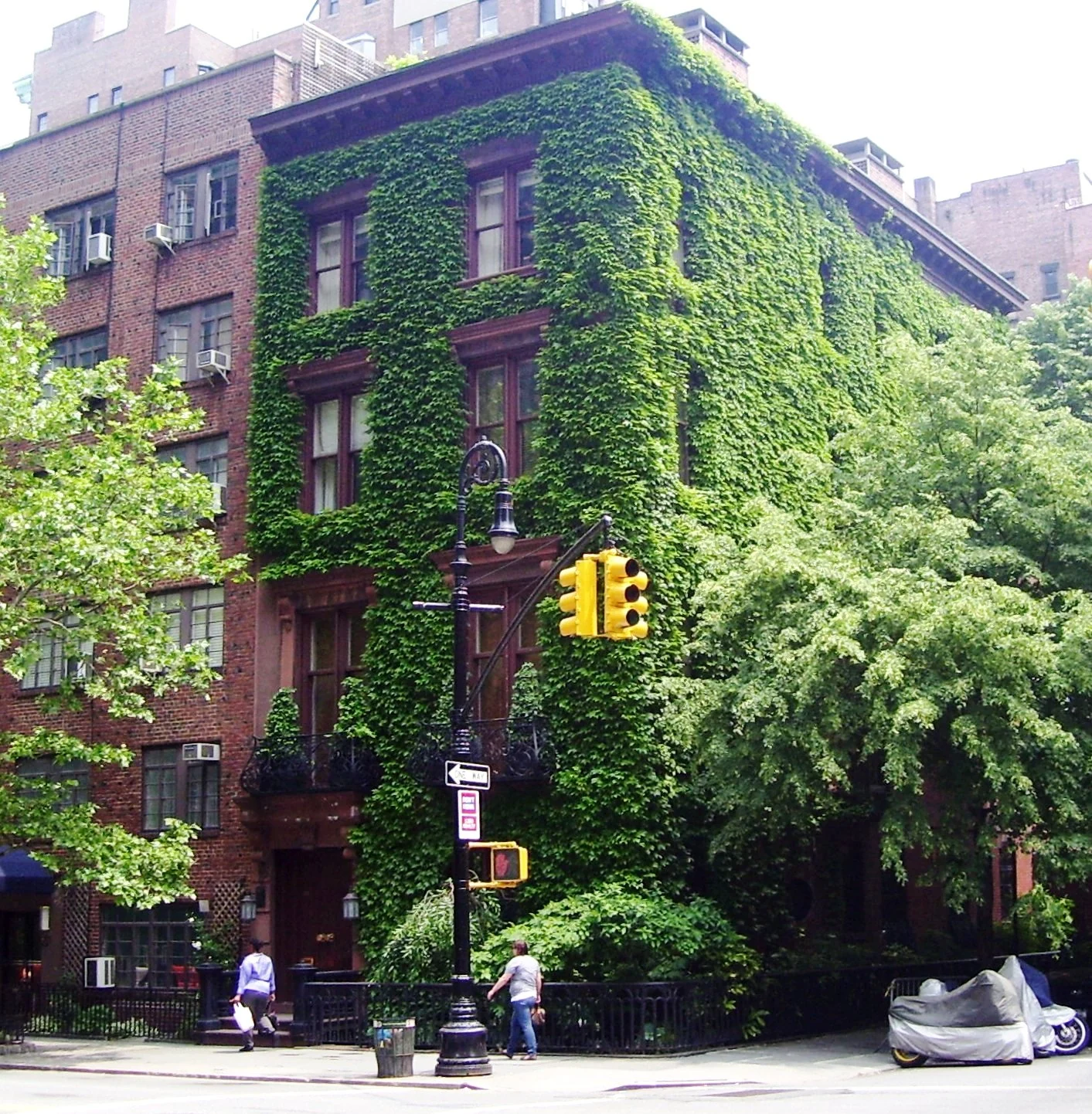
Moviegoers often recognize the ivy-draped townhouse at the northeast corner of Irving Place and East 19th Street as the Manhattan home of Katharine Parker, Sigourney Weaver’s formidable executive in the 1988 comedy Working Girl. While the interior scenes for Katharine’s home were filmed across town at 66 Morton Street in the West Village, 80 Irving Place supplied the unmistakable Gramercy arrival at the front door. Long before the cameras rolled, however, the house’s own residents had given this corner a rich history spanning nineteenth-century surgery, the Gilded Age stage, and the New York bench.
Built in 1853–1854 for lawyer and Gramercy Park Trustee William Samuel Johnson, the four-story Italianate residence turns a finely detailed entrance toward Irving Place and a long brick elevation down East 19th Street. Even when summer ivy nearly conceals its masonry, the house’s scrolled iron balconies, arched forecourt railings, and carved brownstone doorway stand as enduring hallmarks of early Gramercy domestic architecture.
Explore the history
The house behind the movie address
An Italianate corner
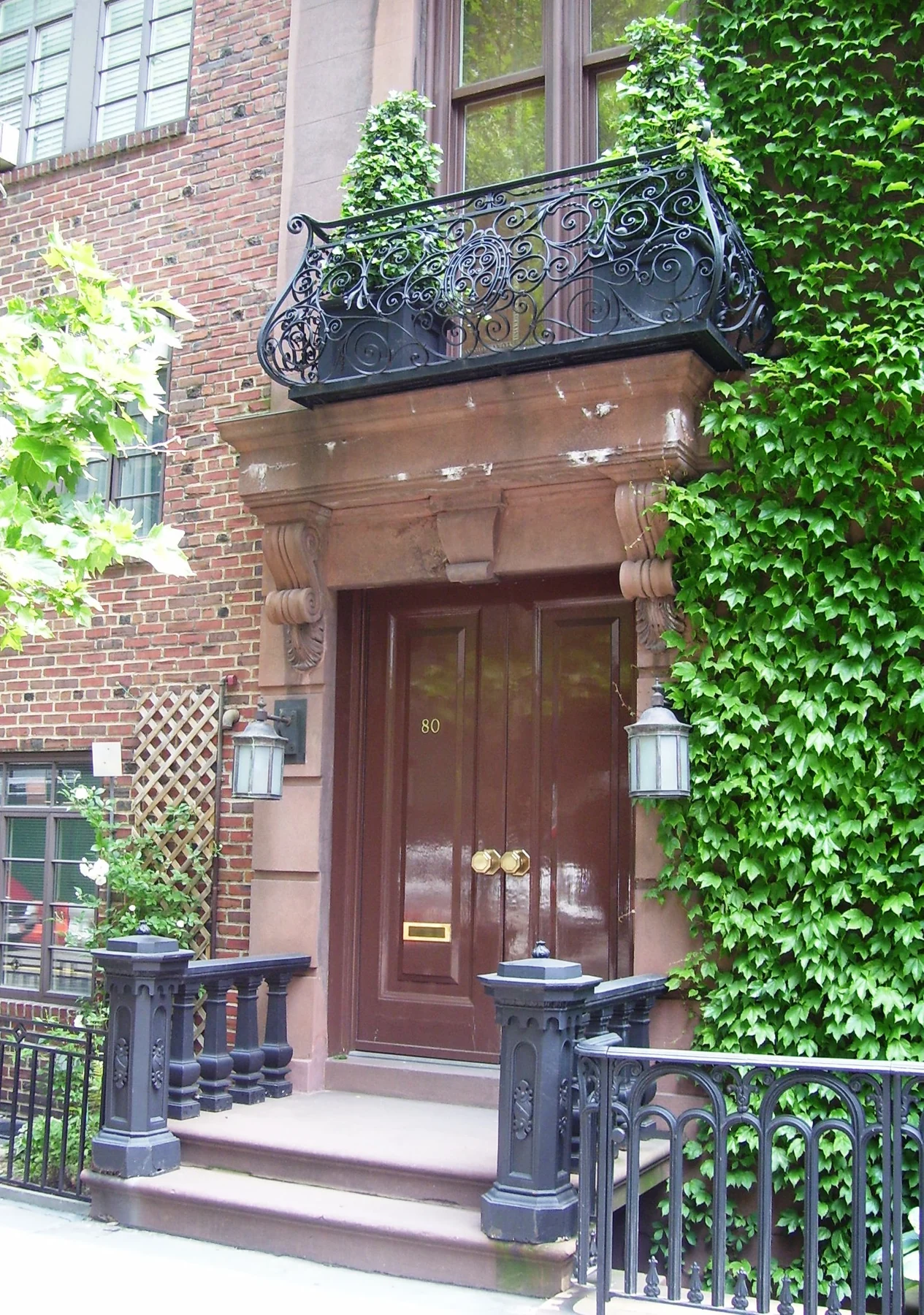
Rather than mounting a high ceremonial stoop, the entrance to 80 Irving Place makes an unusually intimate transition from the sidewalk. Three low brownstone steps flanked by paneled cast-iron newel posts and turned balusters lead to recessed double mahogany doors beneath a heavy, scroll-bracketed brownstone lintel. Immediately overhead, a bowed wrought-and-cast-iron balcony basket projects in front of the parlor casements. Around the corner on East 19th Street, a tall projecting oriel window breaks the long side elevation, allowing the house to engage both streets without repeating the same composition.
When the Landmarks Preservation Commission designated the Gramercy Park Historic District in 1966, it singled out No. 80—built in 1853–1854—for its round-arched windows and exceptional mid-nineteenth-century ironwork, including the interlaced arched railings enclosing the front yard and the foliate balconies at the parlor floor. The house was erected for William Samuel Johnson, the prominent attorney and Gramercy Park Trustee who had earlier built the corner mansion at 86 Irving Place (now 19 Gramercy Park South) at the northern end of the same blockfront. Johnson’s 1853–1854 commission also included an associated carriage house down the side street at 127 East 19th Street.
Looking east from the corner of Irving Place, Johnson’s house serves as the western gateway to the stretch of East 19th Street toward Third Avenue that became celebrated in the early twentieth century as the "Block Beautiful"—where nineteenth-century rowhouses and former stables were remade into artist studios and stuccoed townhomes just south of the Park.
The surgeon’s house
In 1865, as the Civil War came to an end, Dr. James Rushmore Wood (1813–1882) moved into 80 Irving Place with his family, establishing both his residence and his consultation rooms behind its brownstone doorway. Over the next seventeen years, the corner house was home to an influential operative surgeon and medical educator.
At Bellevue Hospital, Wood worked to improve American medical training. He championed bedside clinical lectures, fought to reform hospital sanitation, and played a leading role in founding Bellevue Hospital Medical College in 1861, serving as its professor of operative surgery and surgical pathology until 1868 and thereafter as professor emeritus.
Convinced that surgical instruction required direct study of anatomical pathology, Wood donated his private collection of surgical and anatomical specimens to Bellevue in 1857 to establish the Wood Museum, housed in the hospital’s pathology building for generations of medical students. Wood remained at 80 Irving Place until his death at the house in 1882.
An actress and a collector-judge
By the 1890s, 80 Irving Place had become the home of retired stage star Agnes Ethel Tracy, who lived here with her niece. Born Agnes Ethel, she had risen to fame in the early 1870s as a leading actress of Augustin Daly’s company and starred in the title role of Victorien Sardou’s drama Agnes at the Union Square Theatre, a few blocks south of her future home, in 1872. In retirement, she turned 80 Irving Place into a gathering place for history and theatrical philanthropy, opening her drawing rooms in 1895 for a series of six lectures on colonial history by scholar Jane Meade Welch while actively supporting younger performers and the Actors’ Fund.
Following Agnes Ethel Tracy’s death in 1903, the corner townhouse became the residence of the prominent Ingraham judicial family. Here in 1915, lawyer and later New York Supreme Court Justice Phoenix Ingraham entertained the Hobby Club, filling the rooms of 80 Irving Place with a private exhibition of his collection of William Makepeace Thackeray letters, original drawings, and first editions. As the Great Depression reshaped residential patterns along Irving Place in the 1930s, the private mansion was subdivided into a rooming house and later partitioned into apartments and professional offices.
Medicine and the movies
More than a century after Dr. James Rushmore Wood practiced here, medicine returned to 80 Irving Place in a different form during the early 1970s, when the building housed the Women’s Medical Center. Recorded at the address in August 1972—shortly after New York State’s landmark 1970 reform of reproductive healthcare laws—the clinic placed the building squarely within the history of the modern women’s health movement in New York City.
In 1987, after decades of multi-unit and institutional occupancy, 80 Irving Place was reconverted into a single-family private residence. In Mike Nichols’s 1988 film Working Girl, its ivy-clad corner façade and low brownstone stoop appear as the exterior of Katharine Parker’s townhouse, paired with interior rooms filmed at 66 Morton Street in Greenwich Village.
Today, the most public part of this private townhouse remains the intricate threshold between building and sidewalk: arched cast-iron railings, carved brownstone brackets, and scrolled iron balconies peeking through a curtain of green ivy at the corner of Irving Place and East 19th Street.
Residents of Note
The People of Gramercy- James Rushmore WoodBellevue Hospital surgeon, medical educator, and co-founder of Bellevue Hospital Medical College; lived at 80 Irving Place from 1865 until his death in 1882.
- Agnes Ethel Tracy1870s stage actress in Augustin Daly’s company and theatrical philanthropist; lived at No. 80 in retirement until her death in 1903.
- Phoenix IngrahamManhattan attorney, bibliophile, and New York Supreme Court Justice; hosted the Hobby Club at 80 Irving Place in 1915 to exhibit his William Makepeace Thackeray collection.
Building at a glance
The building record
- Address
- 80 Irving Place · northeast corner of East 19th Street
- Built
- 1853–1854
- Original owner
- William Samuel Johnson (lawyer and Gramercy Park Trustee)
- Associated carriage house
- 127 East 19th Street
- Style
- Italianate
- Form
- Four-story brick and brownstone corner townhouse (restored to single-family residence in 1987)
- Architect
- Not established in the sources cited
- Historic district
- Gramercy Park Historic District, designated September 20, 1966
Over time
Built as a four-story Italianate corner townhouse for William Samuel Johnson, together with a carriage house at 127 East 19th Street.
Bellevue surgeon and medical educator Dr. James Rushmore Wood resides here until his death in 1882.
Retired stage star Agnes Ethel Tracy opens the house for historian Jane Meade Welch’s six lectures on colonial history.
Following Agnes Ethel Tracy’s death in 1903, the Ingraham family acquires the house; Phoenix Ingraham exhibits his Thackeray collection to the Hobby Club here in 1915.
Subdivided into a rooming house during the Great Depression, followed by apartments and professional offices.
Included within the Gramercy Park Historic District upon its designation on September 20, 1966.
Houses the Women’s Medical Center, documented at 80 Irving Place in August 1972.
Reconverted into a private single-family residence (1987) and featured as the exterior of Katharine Parker’s townhouse in Working Girl (1988).
Sources cited
NYC Landmarks Preservation Commission, Gramercy Park Historic District Designation Report (September 20, 1966)
Construction dates (1853–1854), Italianate architectural analysis, round-arched openings, and surviving iron railings and balconies.Stephen Garmey, Gramercy Park: An Illustrated History of a New York Neighborhood (1984), pp. 112–113, 140–146, 151, 157–161, 172–174
Identifies William Samuel Johnson as original owner, the associated carriage house at 127 East 19th Street, and the development of Irving Place and East 19th Street’s “Block Beautiful.”Tom Miller, Daytonian in Manhattan, “The 1854 House at No. 80 Irving Place” (2014)
Detailed chronicle of the Wood, Tracy, and Ingraham households, the 1915 Hobby Club exhibition, and twentieth-century occupancy changes.NYU Medical Archives, James Rushmore Wood; Bellevue Hospital, institutional history
Document Dr. James Rushmore Wood’s role in founding Bellevue Hospital Medical College (1861), his surgical professorship (1861–1868), and the Wood Museum of anatomical specimens (1857). His address is corroborated by the May 24, 1866 clinical testimonial in A. A. Marks, catalogue of artificial limbs · National Library of Medicine scan.The Hotel Guests’ Guide to the City of New York (1872–1873)
Contemporary theatrical record of Agnes Ethel’s starring performance in Victorien Sardou’s Agnes at the Union Square Theatre.Contemporary feminist newspaper, August 1972; Virginia K. Smith, Brick Underground (2015)
Document the Women’s Medical Center at 80 Irving Place in 1972, the 1987 single-family reconversion, and the locations used in the 1988 film Working Girl: 80 Irving Place for the exterior and 66 Morton Street for Katharine Parker’s interiors.
Photo credits for this page
- Exterior photograph: Beyond My Ken, May 26, 2011. CC BY-SA 4.0.
- Entrance photograph: Beyond My Ken, May 26, 2011. CC BY-SA 4.0.
Web copies are resized and converted to WebP; the linked sources retain the original photographs.