
Building around the garden
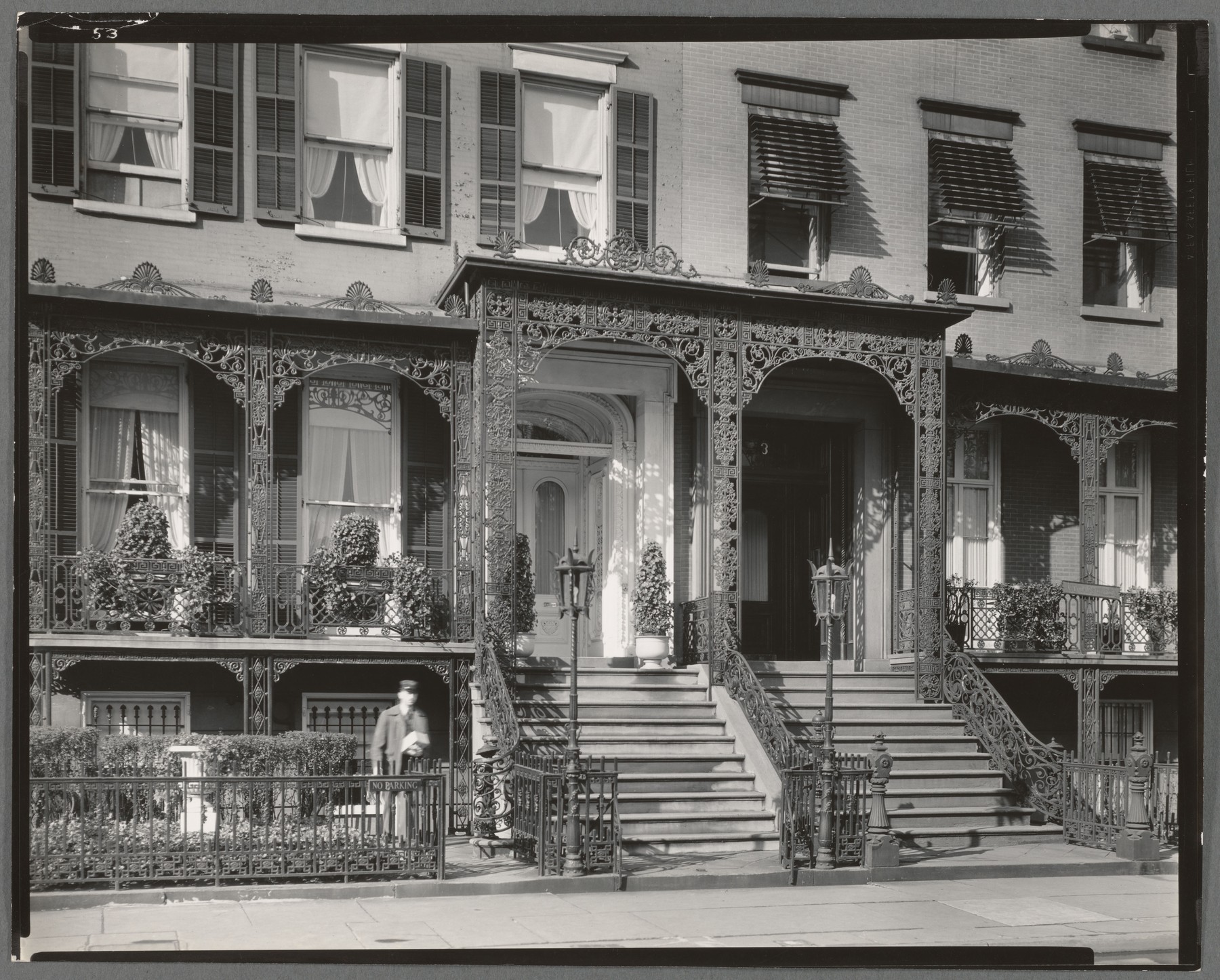
Pine reports that the surrounding lots were largely built upon and occupied by about 1851. The founding deed had specified brick or stone dwellings at least three stories high near the fronts of the lots. That combination of an open center and a substantial residential edge helped establish the neighborhood’s character.
The buildings did not all arrive at once, and their uses did not remain fixed. A history of Gramercy’s appearance is also a history of changes within houses, combinations of properties and new forms of residence.
A house altered for another generation
Peter Cooper’s home at No. 9 Lexington Avenue offers one example. Pine describes its original high stoop and records that Mrs. Abram S. Hewitt removed it in 1884, working with Stanford White to create a basement entrance. The address remained connected with the family while the building adapted to new preferences.
Elsewhere, White transformed the interior of the former Field house for Henry W. Poor. Pine evokes its elaborate rooms through an earlier description of the house. The account reminds us that a familiar exterior could contain substantial architectural change.
Hotels and apartment living
The Gramercy Park House occupied the eastern frontage from 1860 until about 1880, according to Pine. Under proprietor Curtis Judson, it also served as a meeting place for lot owners. The neighborhood’s residential history therefore included a hotel as well as individual houses.
Pine dates an early cooperative apartment building on the east side to 1883 and notes that several more apartment houses followed. He also recounts a dispute beginning in 1902 over the proposed Irving Hotel. The controversy concerned whether a residential apartment hotel satisfied the dwelling-house language of the older covenant; his account reports that the courts permitted that form of building.
From houses to institutions
The Players and the National Arts Club adapted former homes for shared cultural life. University and service clubs also occupied Park houses at different times. Pine treats these institutions as part of the neighborhood’s identity, even while celebrating the continuity of its residential setting.
The result was a neighborhood people could recognize even as the lives inside its buildings changed. A garden, a row of stoops and a familiar roofline could hold together several generations of very different uses.
Reading the streets today
That is a useful way to look at the streets today: notice what has endured, then ask what has changed behind it. Later stories at 18 Gramercy Park South and 5 Gramercy Park West return to the same questions of use, detail and care.
Sources
Adapted from John B. Pine, The Story of Gramercy Park, 1831–1921 (1921), printed pages 6, 16–18, 24–25, 28–29, 39–49.