
Alfred Ringling
The showman at No. 36
1861–1919 · Showman, musician & publicist
The musician, press director, and family storyteller who helped build the Ringling circus made his New York home behind the armored knights at 36 Gramercy Park East.
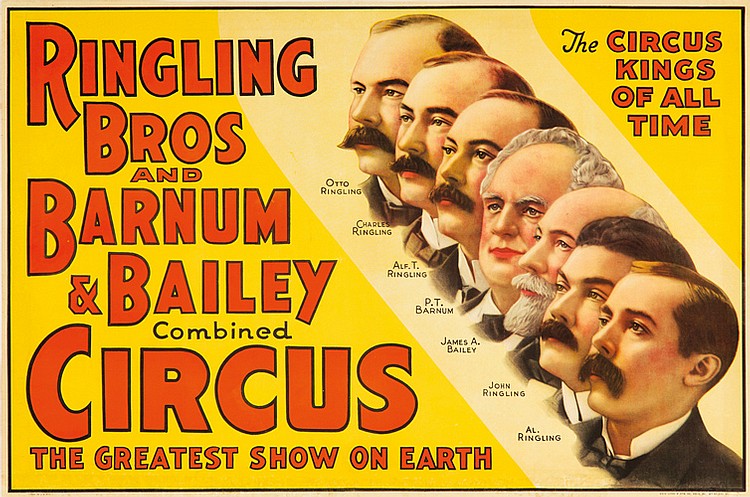
CIRCUS WAGONS AT THE DOOR
In October 1918, The Billboard reported an unusual sight on Gramercy Park: several circus wagons standing outside Alfred Ringling’s home. The columnist added a detail too good to leave out: “they did not bear the Ringling name either!”
The notice occupied a single sentence. It is enough to put a little of the circus back on our sidewalk. It also carried a quiet neighborhood irony. When Samuel B. Ruggles drafted the founding trust deed for Gramercy Park on December 17, 1831, he had expressly forbidden any “circus” from ever being erected on the lots surrounding his private garden—eighty-seven years before one of America’s circus kings would live on the east side of the square with circus wagons waiting at his curb.
Alfred Theodore Ringling maintained his New York home at 36 Gramercy Park East, architect James Riely Gordon’s pale terra-cotta Gothic apartment house completed in 1910 with two armored knights guarding its entrance court. Its bronze plaque remembers him alongside sculptor Daniel Chester French and actor John Barrymore. To circus audiences across America, he was Alf. T. Ringling, one of the five brothers whose surname became a promise of an extraordinary afternoon.
For a Ringling executive in New York, Gramercy Park was as practical as it was quiet. Six blocks northwest stood Stanford White’s Madison Square Garden, where the circus opened every spring season; two blocks away on East 22nd Street stood the Bailey Building, where Alfred worked with his advance press staff. His particular contribution was helping people imagine the show before they saw it. He began as a bandleader, cornetist, and juggler, became the circus’s director of press, and wrote the family’s story with much of the exuberance that filled its posters.
Music before the menagerie
A riverboat on the Mississippi and a frog from “Timbuctoo”
Alfred Theodore Ringling was born on December 13, 1861, in the Mississippi River port of McGregor, Iowa, the fourth of seven sons of August Rüngeling—a harness-maker from Hanover, Germany, who anglicized the family name to Ringling—and Marie Salome Juliar, a native of Alsace. His 1900 family history opens on the riverfront at daybreak in 1870, when the boys watched a side-wheel steamboat carrying Dan Rice’s circus tie up at the McGregor levee. The sight of the gilded cages and canvas, Alfred wrote, so affected the brothers “that they stood riveted to the spot, clasping each other’s hands in speechless ecstasy.”
Soon the boys were staging backyard circuses of their own—charging ten straight pins for admission before raising the tariff to a penny—and practicing the showman’s language on whatever creatures were at hand. One early menagerie attraction was a local bullfrog displayed in a wooden box beneath a sign announcing: “From Timbuctoo. Captured at great risk from the depths of a far-away swamp from which no other frog collector ever emerged alive.”
The “Carnival of Fun” and stage fright at Mazomanie (1882–1884)
Long before the Ringlings commanded railway trains and enormous tents, they had to persuade rural Wisconsin and Iowa townspeople to come indoors and hear them. After the family returned to Wisconsin and settled in Baraboo, the brothers took to the road in the autumn of 1882 as a winter hall troupe, the Ringling Bros. Classic and Comic Concert Co.
In his 1900 Life Story of the Ringling Brothers, Alfred preserved an early concert program that gives a wonderfully practical picture of the family at work. Charles played the violin, Alfred the organ. A little later on the bill, Alfred returned as “America’s Cornet Virtuoso.” Later still, the two brothers offered a musical act on twelve instruments. Between the music came comic characters, plate-spinning, juggling, and sketches, with Albert, Otto, Alfred, Charles, and sixteen-year-old John appearing repeatedly in different roles.
The grand announcement at the top promised a “Carnival of Fun.” The performers underneath were making that promise one act at a time.
Alfred also included Charles’s recollection of their nervous first touring performance at Mazomanie, Wisconsin, on November 27, 1882. Rehearsal had gone well. Once the paying audience arrived, the opening overture fell apart: instruments squeaked and shrieked, and the young players struggled to stay together. Charles remembered fifty-nine people looking more intimidating than the enormous audiences the circus later drew.
It is an appealing admission in a book otherwise full of triumph. The Ringlings had learned in front of paying customers, and their family history still made room for the embarrassment.
On May 19, 1884, partnered with the veteran showman Fayette Lodawick “Yankee” Robinson, the five founding brothers—Albert, Otto, Alfred, Charles, and John—opened their first tented circus in Baraboo, Wisconsin, under a 45-by-90-foot canvas. There was not yet a menagerie or a carved bandwagon, and Alfred led the band himself. Over the next six seasons of overland wagon travel—before the show moved onto railway cars in 1890—the little traveling enterprise grew into a business large enough to divide among brothers with distinct responsibilities.
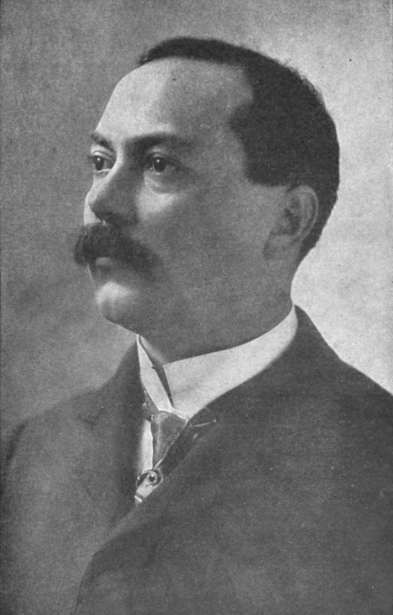
The man ahead of the show
Five brothers, five departments
The circus’s 1900 route book makes Alfred’s executive role unusually clear. While the five brothers owned the enterprise in equal shares, its managerial list assigns each brother his own territory: Alfred is named Director of Press. Charles directed advertising, John the advance operation and routing, Otto finances, and Albert—usually billed simply as “Al.”—the ring exhibitions.
The distinction matters. While Charles oversaw the billposters who covered walls and barns with lithographs, Alfred’s work included the newspaper stories and editorial attention that made the coming circus an event.
A partitioned corner near Gramercy Park (March 1909)
A March 1909 report in Variety catches him doing precisely that in New York. Preparations for the Ringling spring opening at Madison Square Garden had begun, and Alfred was working with press agents in a partitioned corner of theatrical agent Joe Mayer’s offices in the Bailey Building at 27 East 22nd Street, just two blocks northwest of Gramercy Park. For all the grandeur advertised on the posters, this glimpse of the work is agreeably ordinary: a few men in a corner of somebody else’s offices getting the publicity moving.
The same report describes a relay system for the touring press staff. An agent would go three weeks ahead, work a group of towns, and remain until the circus arrived. Once the show moved on, he would jump ahead again. Anticipation had its own itinerary.
By then, the brothers had acquired their greatest rival, Barnum & Bailey, which they purchased in October 1907 following the death of James A. Bailey. In the 1850s, P. T. Barnum himself had been a favorite guest on East 20th Street at the Sunday evening salons of poet sisters Alice and Phoebe Cary, regaling Gramercy visitors with his tall tales. Later, six blocks northwest at 26th Street and Madison Avenue, the 9,000-seat amphitheater of Madison Square Garden, designed in 1890 by Gramercy Park North architect Stanford White, provided a setting for elaborate circuses and animal shows. For more than a decade the Ringlings routed their two giant railroad circuses separately across North America, until their historic combination at White’s Madison Square Garden in March 1919 produced the familiar Ringling Bros. and Barnum & Bailey name.
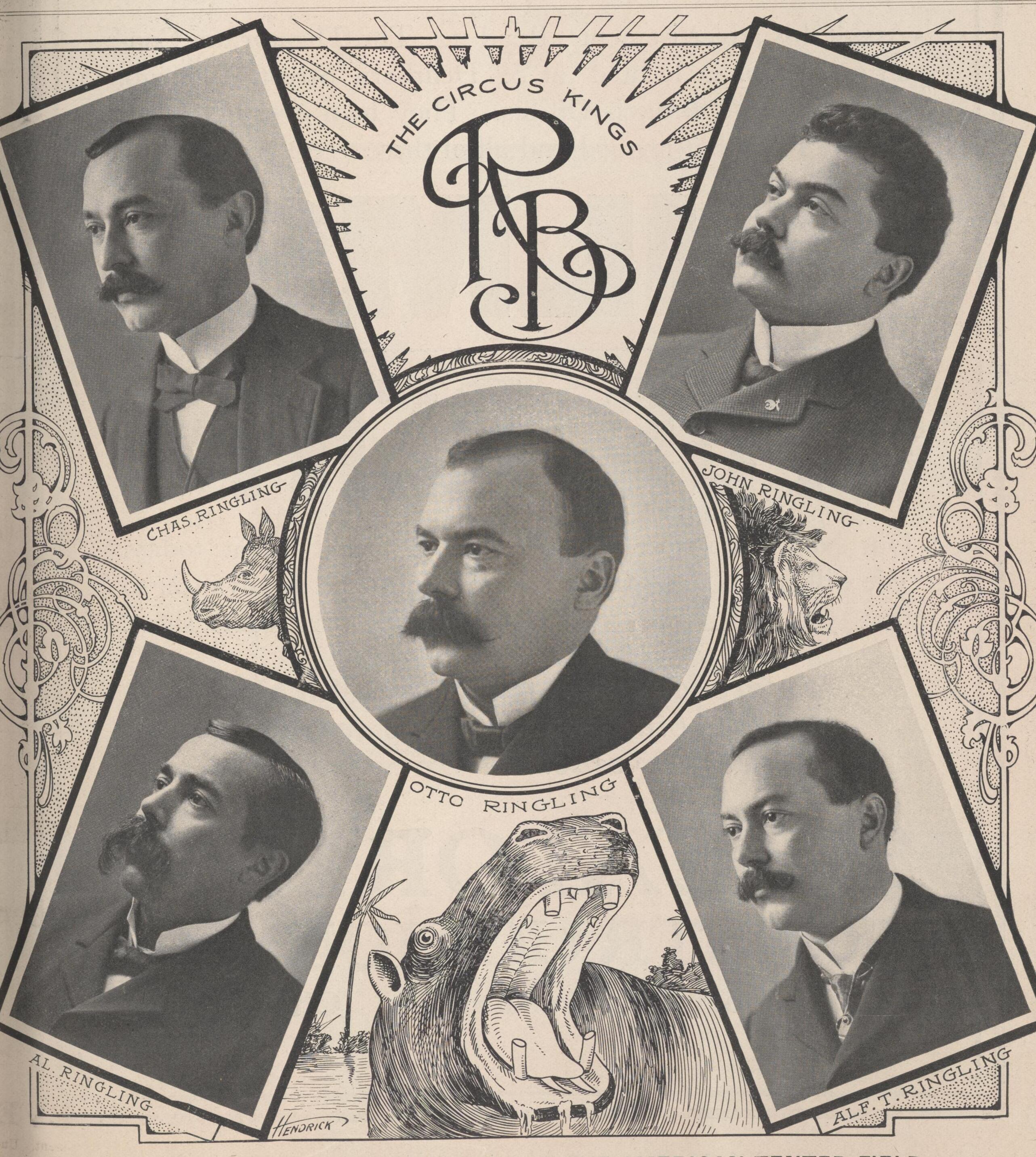
“Bill it big”
A hyena with a very large billing
Alfred’s family history—subtitled Humorous Incidents, Thrilling Trials, Many Hardships, and Ups and Downs, Telling How the Boys Built a Circus—shows how much pleasure he took in the language of the business.
In one episode from the spring of 1886, he tells how Albert and Otto bought a hyena—their very first wild animal—while Alfred, Charles, and John were away earning money on a winter concert tour. The animal was waiting in a darkened barn when the travelers returned. In the telling, Otto revealed it by torchlight; the startled brothers were introduced to what amounted to their entire menagerie.
Then came the advertising.
The creature became the “Hideous Hyena Striata Gigantium, the Mammoth Midnight Marauding Man-Eating Monstrosity,” a terrifying presence whose supposed grave-robbing activities required a remarkable number of capital letters. A single animal had acquired a whole imaginative world around it.
How the brothers wanted their beginnings remembered
Alfred presented the episode as an illustration of advice from Yankee Robinson: avoid exaggeration on small things, but when an attraction was truly great, “bill it big.” The gap between that sensible rule and the extravagant hyena advertisement is part of the pleasure of reading him.
His book is a showman’s account of the family’s rise, complete with reconstructed conversations and polished scenes. It lets us hear how the Ringlings wanted their beginnings remembered: resourceful, funny, occasionally desperate, and always moving toward the next performance.
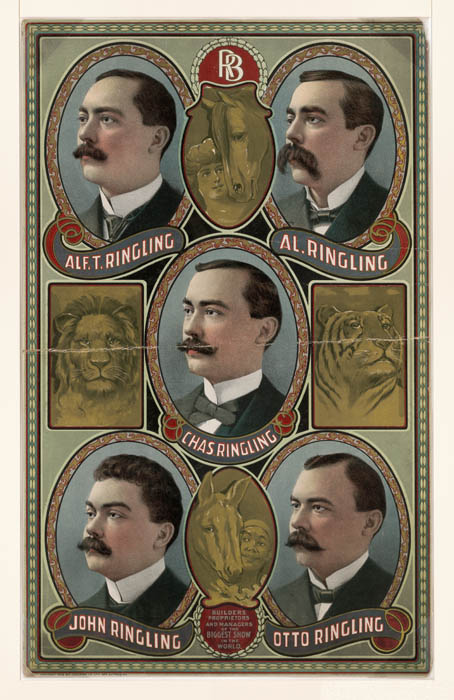
The surviving posters carry the same confidence. In the 1903 print above, the five brothers appear in formal portraits among animals and elaborate ornament. Alfred is at the upper left. Beneath them, the lettering announces their collective claim to the biggest show in the world. The family itself had become one of the attractions.
Behind the painted face
“A Word About Jules” (1910)
There is a quieter piece of Alfred’s writing that deserves a place beside all those adjectives.
In 1910, he supplied an introduction, titled “A Word About Jules,” to The Autobiography of a Clown, Jules Turnour’s story as told to Isaac F. Marcosson. Born in a circus wagon in Spain before joining the Ringling show, Turnour had been Alfred’s friend and colleague for more than twenty years. What Alfred admired was the man’s private character: behind the painted face was a book-loving performer with a “patient, serious purpose to make his life helpful.”
“We who live in this breathless era are wont to look upon the circus as a temporary amusement makeshift. It is here to-day and gone to-morrow. Yet behind its spangled, tinseled array and restless movement are real traditions. No one contributed more to its moral structure than Jules, the clown… The world has been made better by the presence and work of Jules.”
— Alfred T. Ringling, The Autobiography of a Clown (1910)
The praise is direct and affectionate. After years of selling spectacles, Alfred could still write with feeling about an individual performer and the good he had done.
Oak Ridge Manor, a Hutchings pipe organ, and a son’s circus (1916–1917)
Music remained part of his own life, too. As his health declined in the mid-1910s, Alfred divided his time between 36 Gramercy Park East and a country estate he created at Oak Ridge, in Morris County, New Jersey, where he dammed a mountain stream to form Lake Swannanoa and completed a twenty-eight-room cobblestone manor in 1916. In March 1917, The Diapason reported that the Hutchings Organ Company was completing a large residence pipe organ for his home at Oak Ridge. Alongside its traditional stops and an automatic roll player, the instrument included controls for a bass drum, snare drum, and cymbals. The former band musician had found room at home for an ambitious range of sound. Among the guests who sang in the music room at Oak Ridge was Metropolitan Opera soprano Geraldine Farrar—who had begun her own New York training right next door to Alfred’s apartment house in the drawing room of concert soprano Emma Thursby at 34 Gramercy Park East.
The New Jersey estate also served as winter quarters for a separate circus Alfred financed in 1917–1918 for his twenty-one-year-old son, Richard Theodore Ringling (1895–1931). Because Ringling partnership custom prohibited using the family surname on an outside show, father and son inverted Richard’s first and middle names and billed the venture as the R. T. Richards Supreme Show of the World—an experimental hybrid of motor trucks, wagons, and railcars that toured in 1917 and played in and around New York in 1918.
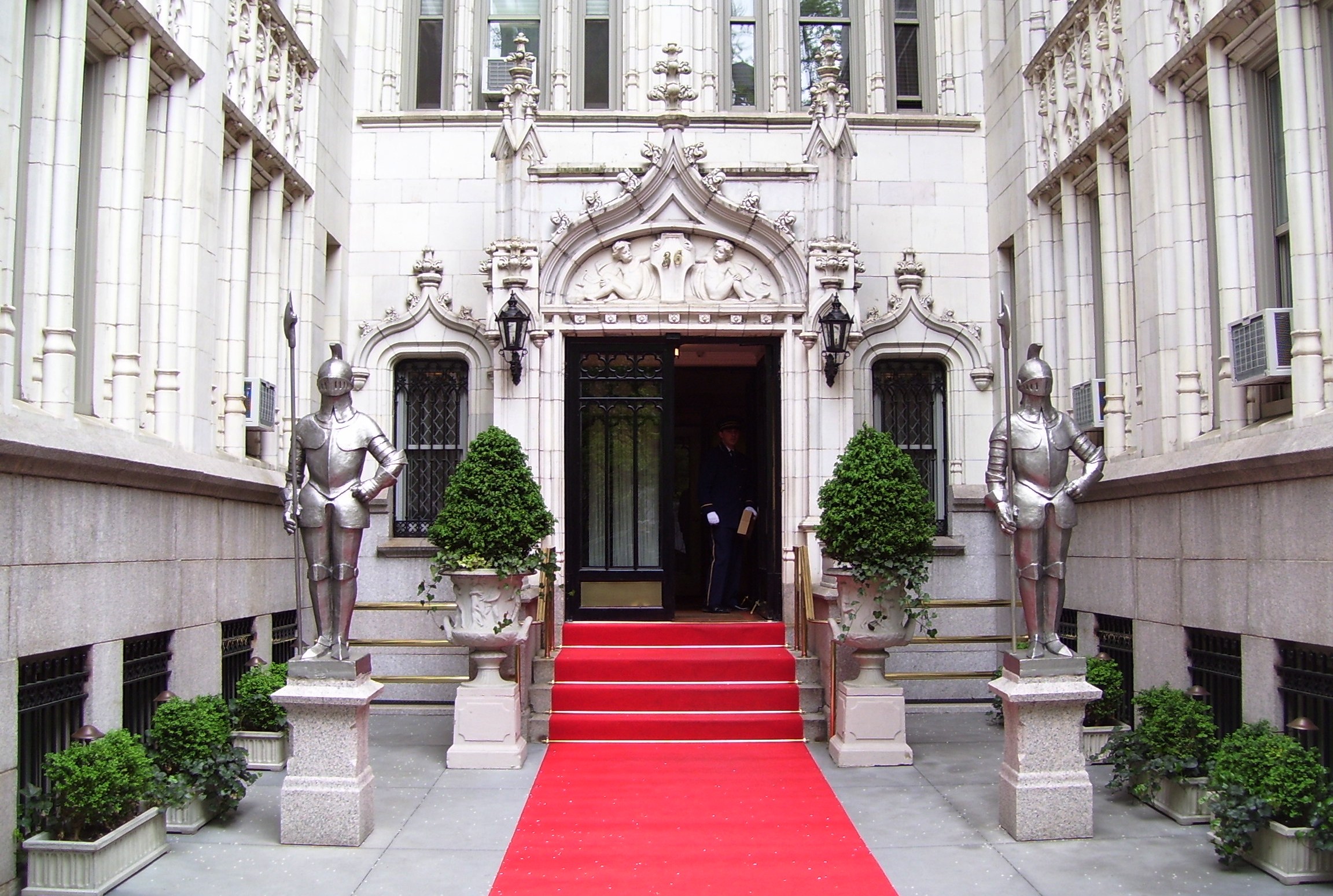
A home beside the Park
Wagons on the curb and a Gramercy bequest
The New Jersey estate did not erase Alfred’s connection to Gramercy Park. When The Billboard spotted several circus wagons standing outside his home in October 1918 and noted with amusement that “they did not bear the Ringling name either!”, the sighting came at the close of the second season of young Richard Ringling’s non-Ringling-named R. T. Richards show.
Seven months after the newly combined Ringling Bros. and Barnum & Bailey circus made its joint debut at Madison Square Garden in March 1919, Alfred died of heart disease at Oak Ridge on October 21, 1919, at the age of fifty-seven. The following month, The Billboard reported that under his will his son Richard would receive, among other property, his father’s circus partnership interest and “the furnishings of the Ringling home on Gramercy Park.”
That modest domestic detail brings him closer. Alongside the circus interests and country property were the belongings of a New York home overlooking the trees of the Park.
At No. 36 today, the two knights still stand beside the entrance. The plaque gives Alfred a few words. Behind that brief inscription are the anxious musicians in Mazomanie, the alarming hyena, the press agents traveling ahead, and the clown whose kindness he wanted readers to know.
And once, according to a columnist who noticed, there were circus wagons at the door.
Around the Park · Places in the story
- 36 Gramercy Park East. Alfred Ringling’s New York home, behind the two armored knights at architect James Riely Gordon’s 1910 Gothic Revival apartment house, where a bronze entrance plaque commemorates him alongside Daniel Chester French and John Barrymore.
- Samuel B. Ruggles. Founder of Gramercy Park whose December 17, 1831 trust deed expressly forbade any “circus” from occupying the lots around the square—eighty-seven years before circus wagons parked outside Ringling’s door at No. 36.
- The Bailey Building (27 East 22nd Street, at Broadway). Two blocks northwest of Gramercy Park, where Variety found Alfred working with his press agents in a partitioned corner of Joe Mayer’s offices in March 1909 ahead of the spring circus opening.
- Stanford White & Madison Square Garden (East 26th Street & Madison Avenue, 1890–1925). Six blocks northwest of Gramercy Park, where the 9,000-seat amphitheater designed by Gramercy Park North architect Stanford White hosted the Ringling and Barnum & Bailey spring seasons and the March 1919 debut of the Combined Shows.
- 34 Gramercy Park East & Emma Thursby. Immediately next door to No. 36, where concert soprano Emma Thursby trained young Geraldine Farrar, who later sang in Alfred Ringling’s music room at Oak Ridge Manor.
- 16 Gramercy Park South · The Players & Edwin Booth. Across the Park, the theatrical club whose members included Alfred’s fellow 36 Gramercy Park East resident John Barrymore and many of the stage and circus chroniclers of the era.
Life at a glance
- Life
- December 13, 1861 – October 21, 1919 (born in McGregor, Iowa; died at Oak Ridge, New Jersey, aged 57)
- Parents
- August Rüngeling (Ringling), German immigrant harness-maker, and Marie Salome Juliar Ringling
- Gramercy Address
- 36 Gramercy Park East (designed by James Riely Gordon, completed 1910)
- Country Estate
- Ringling Manor, Oak Ridge (Lake Swannanoa), Morris County, New Jersey (built 1915–1916)
- Children
- Richard Theodore Ringling (1895–1931; proprietor of the R. T. Richards Circus) and Marjorie Joan Ringling
- Work
- Musician, cornetist & organist, circus co-founder (1884), Director of Press, and family historian
- Founding Brothers
- Albert C. (“Al.”) Ringling (1852–1916), Otto Ringling (1858–1911), Alfred T. (“Alf. T.”) Ringling (1861–1919), Charles E. Ringling (1863–1926), and John N. Ringling (1866–1936)
- Authored Works
- Life Story of the Ringling Brothers (1900); “A Word About Jules,” introduction to Jules Turnour’s The Autobiography of a Clown (1910)
A life over time
- 1861 · Born in McGregor, Iowa
Born December 13 to German immigrant harness-maker August Rüngeling (Ringling) and Marie Salome Juliar; at daybreak in 1870, the brothers watch Dan Rice’s riverboat circus land on the Mississippi. - 1882 · The “Carnival of Fun” hits the road
Tours Wisconsin and Iowa halls with his brothers as cornetist, organist, and juggler in the Ringling Bros. Classic and Comic Concert Co., surviving stage fright at Mazomanie on November 27, 1882. - 1884 · First tented circus in Baraboo
Opens the Ringling brothers’ first tented circus with veteran showman Yankee Robinson on May 19, 1884, leading the band himself before the show moves onto railroad cars in 1890. - 1900 · Director of Press & family historian
Named Director of Press in the Ringling route book and publishes Life Story of the Ringling Brothers, immortalizing the 1886 “Mammoth Midnight Marauding Man-Eating” hyena. - 1907–1909 · Buying Barnum & Bailey and working on East 22nd Street
The Ringlings acquire Barnum & Bailey in October 1907; in March 1909, Variety finds Alfred directing advance press in the Bailey Building at 27 East 22nd Street, two blocks from Gramercy Park. - 1910 · “A Word About Jules” & 36 Gramercy Park East
Writes the affectionate preface to clown Jules Turnour’s The Autobiography of a Clown as James Riely Gordon’s terra-cotta Gothic apartment house at 36 Gramercy Park East is completed. - 1916–1918 · Oak Ridge Manor & wagons on Gramercy Park
Completes his cobblestone manor at Oak Ridge, New Jersey, with a Hutchings pipe organ and winter quarters for his son’s R. T. Richards Circus; in October 1918, The Billboard spots non-Ringling circus wagons parked outside his Gramercy Park home. - 1919 · The Combined Shows & a Gramercy bequest
Ringling Bros. and Barnum & Bailey debut together at Madison Square Garden in March 1919; Alfred dies on October 21, 1919, leaving his circus interest and the furnishings of his Gramercy Park home to his son Richard.
Sources cited
- The Billboard, October 12, 1918, p. 5, “Broadway Bits.” Contemporary report of several circus wagons—not bearing the Ringling name—standing outside Alfred’s Gramercy Park home.
- The Billboard, November 22, 1919, p. 80, “Alf T. Ringling.” Report on the probate of the will, including the bequest to his son Richard of the furnishings of the Gramercy Park home.
- The New York Times, October 22, 1919, p. 17, “Alfred T. Ringling Dies.” Obituary recording his death at his Oak Ridge, New Jersey estate on October 21, 1919, his career as one of the five founding brothers, and the use of the Oak Ridge property as winter quarters for circus animals and equipment.
- Gramercy Park Clubhouse plaque (36 Gramercy Park East). Bronze marker identifying Daniel Chester French, John Barrymore, and Alfred Ringling as former residents of 36 Gramercy Park East.
- Alfred Ringling, Life Story of the Ringling Brothers: Illustrated; Humorous Incidents, Thrilling Trials, Many Hardships, and Ups and Downs, Telling How the Boys Built a Circus, and Showing the True Road to Success, R. R. Donnelley & Sons, Chicago, 1900. The 1870 McGregor riverboat landing, early hall performances and Charles Ringling’s recollection of stage fright at Mazomanie (pp. 88–95), the concert program (pp. 150–151), and the 1886 hyena episode (pp. 206–210).
- Ringling Brothers Route Book, 1900. Managerial roster naming Alf. T. Ringling as Director of Press, transcribed by the Circus Historical Society from a copy in the Circus World Museum’s Parkinson Library, Baraboo.
- Variety, March 6, 1909, p. 12. Alfred in the New York publicity office in the Bailey Building (27 East 22nd Street) and the press agents’ three-week relay system; Circus Historical Society transcription.
- The Autobiography of a Clown, as told to Isaac F. Marcosson, Moffat, Yard and Company, New York, 1910. Alfred’s introduction, “A Word About Jules” (pp. vii–ix).
- The Diapason, March 1, 1917, p. 17. Contemporary description of the Hutchings Organ Company residence pipe organ completed for Alfred’s home at Oak Ridge, New Jersey.
- Warren H. Wood, “The Alf T. Ringling Estate, Winterquarters of R. T. Richards Circus, at Oak Ridge, N.J.,” Bandwagon (Circus Historical Society), Vol. 11, No. 3 (May–June 1967), pp. 3–13, and National Register of Historic Places nomination (1976). Documentation of Ringling Manor at Oak Ridge and Richard T. Ringling’s 1917–1918 R. T. Richards Supreme Show of the World.
- Wisconsin Historical Society, “Ringling Brothers: The Beginnings of the Greatest Show on Earth,” and David Montgomery and Kelly McCullough, “Albert C. Ringling,” Immigrant Entrepreneurship (German Historical Institute). The May 19, 1884 Baraboo opening with Yankee Robinson, the brothers’ responsibilities, the 1907 acquisition of Barnum & Bailey, and the 1919 combination of the shows.
- Carole Klein, Gramercy Park: An American Bloomsbury (Boston: Houghton Mifflin Company, 1987), pages 17, 146, 151: documenting the 1831 Gramercy Park deed covenant against any “circus,” P. T. Barnum’s visits to Alice and Phoebe Cary’s East 20th Street salon, and Stanford White’s 1890 Madison Square Garden circus arena.
Photo credits
- “The Circus Kings of All Time” poster (hero image). Color lithograph advertising the Ringling Bros. and Barnum & Bailey Combined Circus, featuring Otto, Charles, Alf. T., John, and Al. Ringling with P. T. Barnum and James A. Bailey. Via Wikimedia Commons. Public domain.
- Alfred T. Ringling portrait (1900). Published in Alfred Ringling, Life Story of the Ringling Brothers (Chicago: R. R. Donnelley & Sons, 1900), p. 15. Via Wikimedia Commons. Public domain.
- “The Circus Kings” in Show World (October 12, 1907). Illustrated plate signed “Hendrick,” Show World, Vol. 1, No. 16 (October 12, 1907). University of Wisconsin–Madison Libraries, via Wikimedia Commons. Public domain.
- Five founding Ringling brothers poster (1903). Color lithograph by Courier Litho. Co., Buffalo, N.Y., 1903. Library of Congress, Prints and Photographs Division (LC-DIG-ppmsca-55087). Public domain.
- Entrance court of 36 Gramercy Park East. Photograph by Beyond My Ken, April 16, 2010, via Wikimedia Commons (CC BY-SA 4.0).