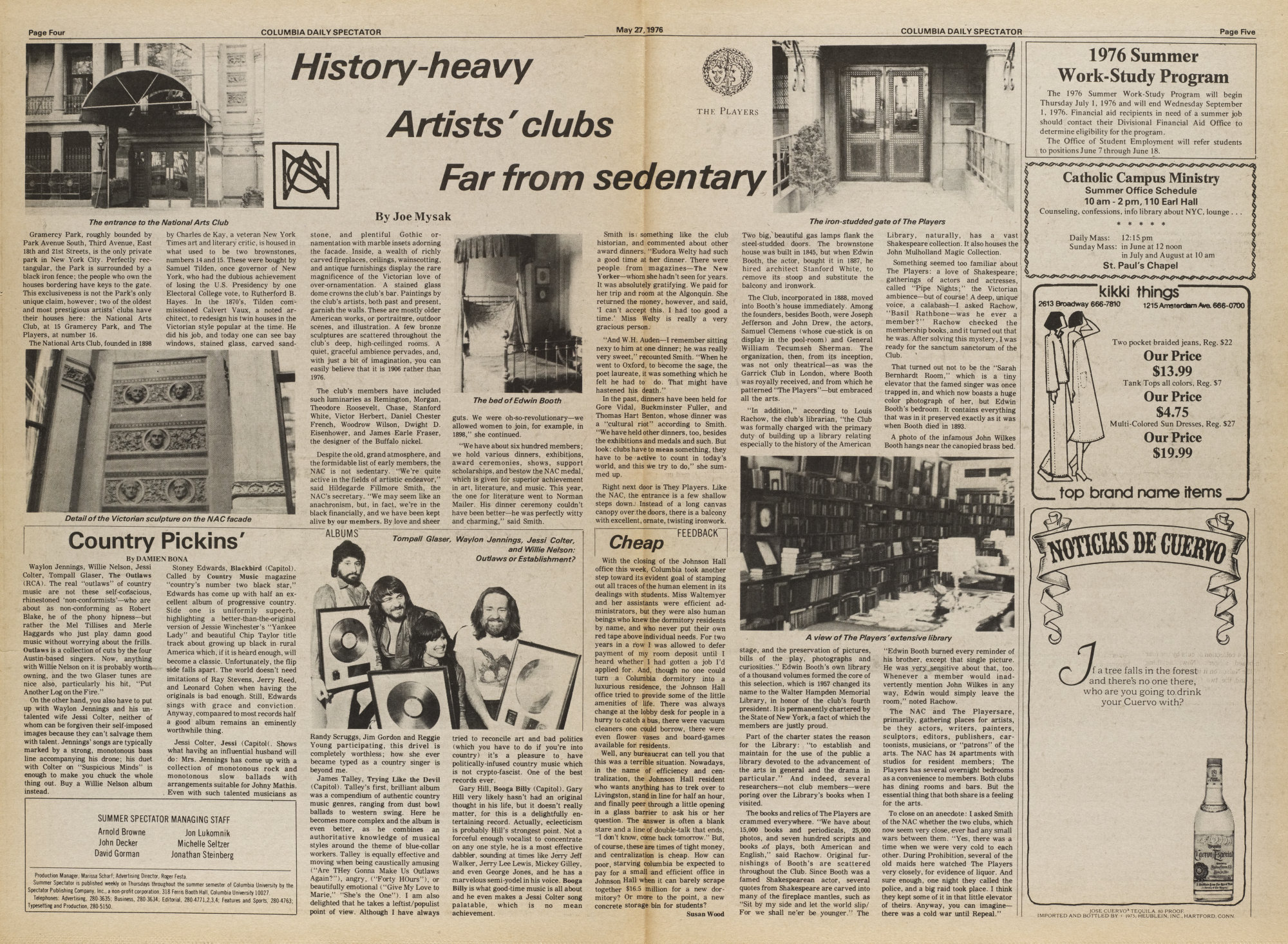
A reporter visits the National Arts Club and The Players, finding award dinners, working researchers and plenty of stories behind their historic doors.
At the National Arts Club, Joe Mysak found carved fireplaces, stained glass and rooms that seemed to belong to another era. The Club’s secretary, Hildegarde Fillmore Smith, wanted him to see the work going on inside them. In the Columbia Daily Spectator of May 27, 1976, she described exhibitions, scholarships and dinners that brought artists and writers together.
A dinner worth returning the money for
Norman Mailer had received that year’s literature medal, Smith told Mysak, and had been witty and charming at his dinner. But her recollection of Eudora Welty’s visit was especially warm. Welty had met magazine friends she had not seen for years, including people from The New Yorker. The Club paid for her journey and a room at the Algonquin; according to Smith, Welty returned the money with the explanation, “I can’t accept this. I had too good a time.”
Smith’s memories give the National Arts Club’s literary life a human scale. The medals brought distinguished guests to Gramercy, but the evenings also renewed friendships.
Readers among the relics
Next door at The Players, librarian Louis Rachow described a collection built around Edwin Booth’s books and devoted to preserving the history of the stage. Mysak saw its public purpose in practice: several researchers who were not club members were working with the library’s books during his visit.
The tour ranged from Shakespeare and the John Mulholland Magic Collection to Booth’s bedroom. When Mysak wondered whether Basil Rathbone had belonged to the club, Rachow checked the membership books and confirmed it. The library could answer a passing visitor’s question as well as support sustained research.
A story from across the wall
Mysak ended by asking Smith whether the neighboring clubs had ever quarreled. She recalled a Prohibition-era episode in which women at the NAC reported liquor at The Players to the police, provoking a raid and a chill between the clubs that lasted until Repeal. She offered no date or documentary source. It is a vivid piece of club lore, preserved here as her recollection rather than an independently established account of a raid.
The source
History-heavy Artists’ clubs Far from sedentary
Joe Mysak, Columbia Daily Spectator, May 27, 1976, pp. 4–5.
The supplied file is indexed as page 4 and contains printed pages 4 and 5. The feature combines Mysak’s observations with interviews and older anecdotes. Its historical asides are not all reliable: it places Tilden’s remodeling in the 1870s, whereas the building profile dates the work to 1881–1884. Membership and collection figures describe 1976, not the present day. The selections below retain the speakers’ wording.
Three selections from the feature, not a complete transcript. Editorial headings identify each passage. Line-end hyphenation and spacing have been adjusted for reading; wording is retained. Unrelated articles and advertisements are omitted.
Smith remembers Eudora Welty
Smith is something like the club historian, and commented about other award dinners. “Eudora Welty had such a good time at her dinner. There were people from magazines—The New Yorker—whom she hadn’t seen for years. It was absolutely gratifying. We paid for her trip and room at the Algonquin. She returned the money, however, and said, ‘I can’t accept this. I had too good a time.’ Miss Welty is really a very gracious person.
[The interview continues with memories of other writers and artists.]
The library’s public purpose
Part of the charter states the reason for the Library: “to establish and maintain for the use of the public a library devoted to the advancement of the arts in general and the drama in particular.” And indeed, several researchers—not club members—were poring over the Library’s books when I visited.
Smith’s Prohibition recollection
To close on an anecdote: I asked Smith of the NAC whether the two clubs, which now seem very close, ever had any small wars between them. “Yes, there was a time when we were very cold to each other. During Prohibition, several of the old maids here watched The Players very closely, for evidence of liquor. And sure enough, one night they called the police, and a big raid took place. I think they kept some of it in that little elevator of theirs. Anyway, you can imagine—there was a cold war until Repeal.”
Source & image credits
Joe Mysak, “History-heavy Artists’ clubs Far from sedentary,” Columbia Daily Spectator, May 27, 1976, printed pp. 4–5. NewspaperArchive PDF supplied to the GPBA research collection, indexed as p. 4. The preview reproduces the newspaper spread; the linked PDF preserves the complete supplied file. Photographs appear in the original feature without a visible individual photographer credit.