Gramercy Park Block Association

People & houses · June 9, 1907

A dressmaker crosses the threshold

Mrs. Sherwin had repaired the house, fitted it for her business and secured a five-year lease. Some neighbors wished she had never arrived.

Original clipping & transcript ↓

The fountain was still bubbling and the grass was still green. The Times began with those reassurances before announcing what some residents regarded as a serious disruption: a dressmaker had opened in one of Gramercy Park’s houses.

Mrs. C. W. Sherwin had rented No. 2, put it in repair and fitted it for her work. The paper identified Amos Pinchot as the owner who had leased it knowing its intended use. By the time the objections reached the newspaper, he had gone to Europe.

Five years in writing

Sherwin’s position was practical. Nobody had complained to her directly, she said, and she had taken care to secure a five-year lease. The report also acknowledged that some newer residents had scarcely considered the question and did not object.

The argument was larger than one business. The newspaper recalled conservative opposition even to the National Arts Club’s arrival in the Tilden mansion, and noted the Princeton Club’s anticipated use of Stanford White’s former house. Clubs, businesses and boarding establishments were finding space behind fronts designed for private households.

The later studio-apartment conversion changed No. 2’s silhouette. This earlier episode records a quieter change in its purpose—and gives the woman making that change a voice of her own.
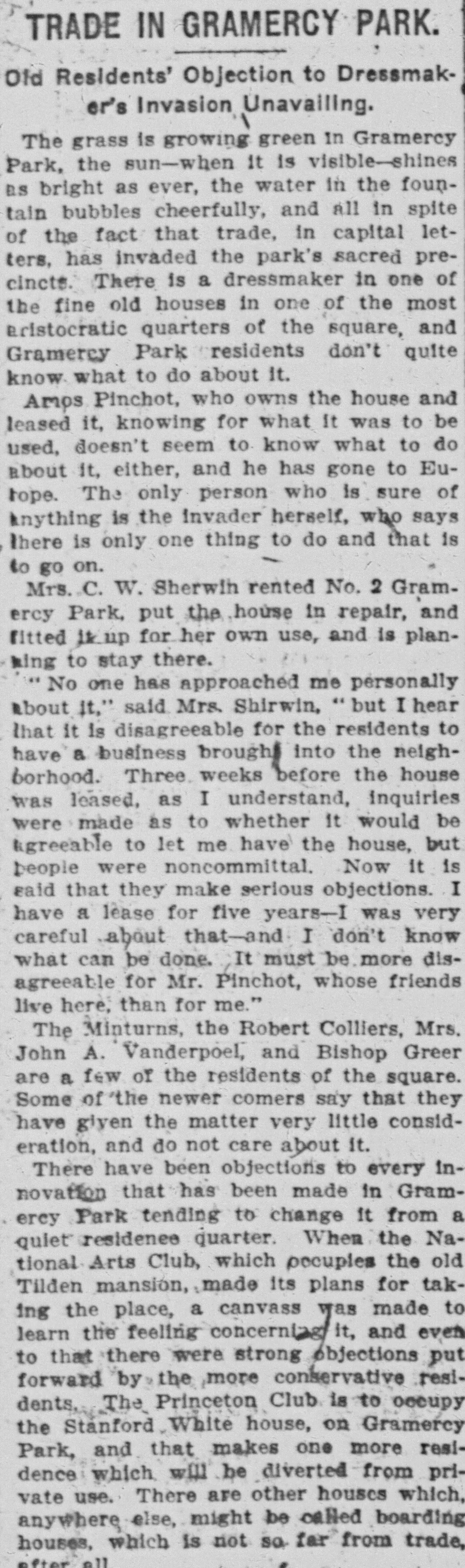
The source

Trade in Gramercy Park

The New York Times, June 9, 1907, p. 6.

Open the original scan ↗

The contemporary report identifies Amos Pinchot as owner; the profile’s later sale history refers to Mary E. Pinchot’s estate. This article is evidence of the tenancy and reported dispute, not a substitute for the property’s deed history.

View the original clippingOriginal newspaper clipping headed “Trade in Gramercy Park”. A readable transcript is provided below.

Open full-size scan in a new tab ↗

Read the article transcript

Paragraph breaks and line-end hyphenation have been adjusted for reading. Original wording and period language are retained; editorial additions appear in square brackets.

TRADE IN GRAMERCY PARK.
Old Residents’ Objection to Dressmaker’s Invasion Unavailing.

The grass is growing green in Gramercy Park, the sun—when it is visible—shines as bright as ever, the water in the fountain bubbles cheerfully, and all in spite of the fact that trade, in capital letters, has invaded the park’s sacred precincts. There is a dressmaker in one of the fine old houses in one of the most aristocratic quarters of the square, and Gramercy Park residents don’t quite know what to do about it.

Amos Pinchot, who owns the house and leased it, knowing for what it was to be used, doesn’t seem to know what to do about it, either, and he has gone to Europe. The only person who is sure of anything is the invader herself, who says there is only one thing to do and that is to go on.

Mrs. C. W. Sherwin rented No. 2 Gramercy Park, put the house in repair, and fitted it up for her own use, and is planning to stay there.

“No one has accused me personally about it,” said Mrs. Sherwin, “but I hear that it is disagreeable for the residents to have a business brought into the neighborhood. Three weeks before the house was leased, as I understand, inquiries were made as to whether it would be agreeable to let me have the house, but people were noncommittal. Now it is said that they make serious objections. I have a lease for five years—I was very careful about that—and I don’t know what can be done. It must be more disagreeable for Mr. Pinchot, whose friends live here, than for me.”

The Minturns, the Robert Colliers, Mrs. John A. Vanderpoel, and Bishop Greer are a few of the residents of the square. Some of the newer comers say that they have given the matter very little consideration, and do not care about it.

There have been objections to every innovation that has been made in Gramercy Park tending to change it from a quiet residence quarter. When the National Arts Club, which occupies the old Tilden mansion, made its plans for taking the place, a canvass was made to learn the feeling concerning it, and even to that there were strong objections put forward by the more conservative residents. The Princeton Club is to occupy the Stanford White house, on Gramercy Park, and that makes one more residence which will be diverted from private use. There are other houses which, anywhere else, might be called boarding houses, which is not so far from trade, after all.

Source & image credits

“Trade in Gramercy Park.” The New York Times, June 9, 1907, p. 6. Newspaper clipping supplied to the GPBA research collection. The source scan is reproduced without changes to its contents.