
Care was part of the original idea
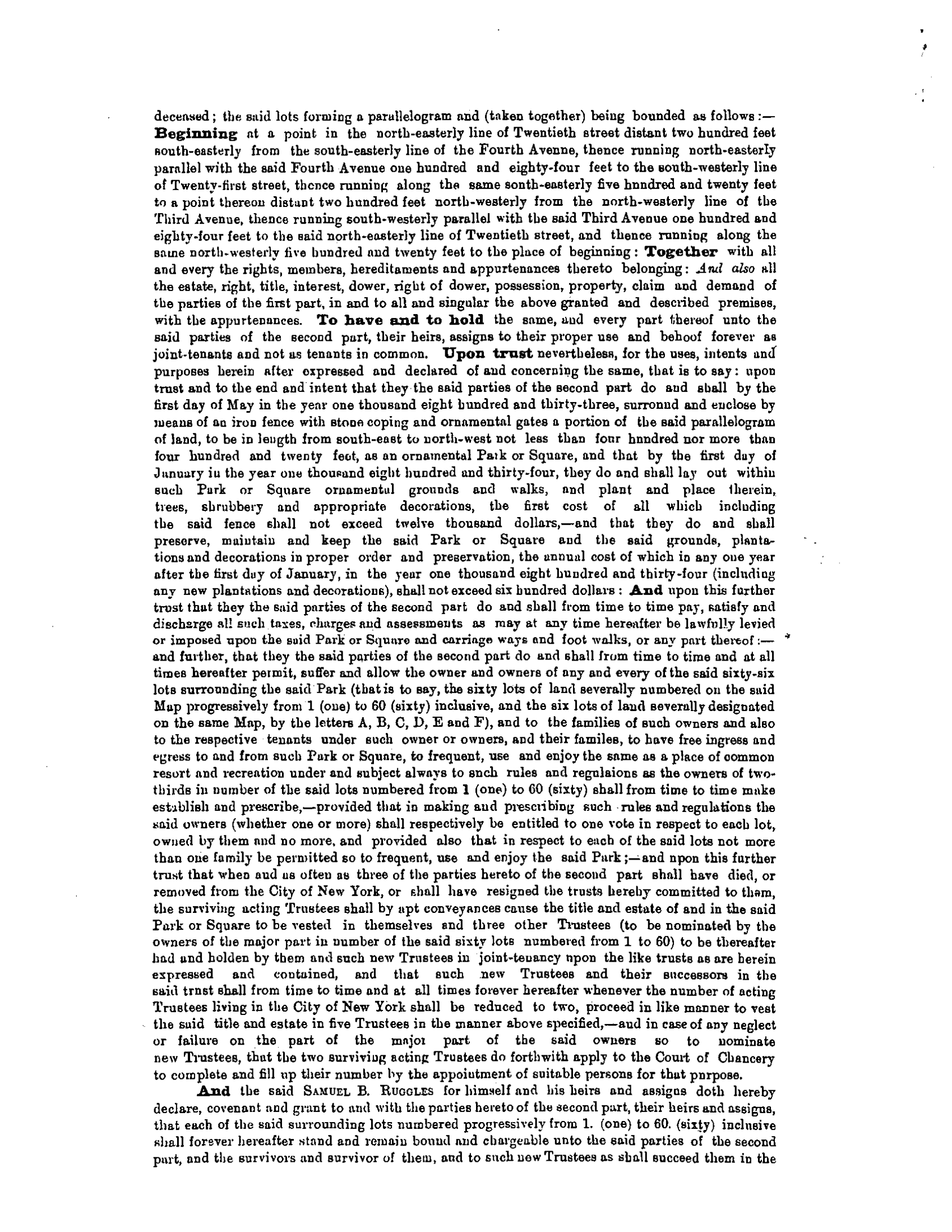
The founding indenture provided not only for making the Park, but for maintaining it. Its instructions joined fences, planting and paths with an ongoing obligation to preserve the grounds and their improvements. Each of the sixty numbered surrounding lots was assigned a share of the expenses contemplated by the trust.
That arrangement did not eliminate the practical difficulty of paying for a living landscape. John B. Pine’s 1921 history describes repeated appeals by the Trustees for contributions when the funds available were inadequate.
A changing cost of care
For many years, Pine writes, the annual charge was ten dollars per lot. Around 1877 it increased to thirty dollars. Those historical sums belong to a different period, but the underlying problem is recognizable: the resources needed to care for a place can outgrow its original assumptions.
Meetings of the lot owners often took place in the Gramercy Park House. Debates ranged from funding to the uses of the grounds, including proposals for baseball, croquet and lawn tennis. Pine records Samuel J. Tilden and Cyrus W. Field joining appeals to preserve the garden’s ornamental character.
The early twentieth-century tax dispute
Pine devotes several pages to a dispute that began with a City assessment of the Park in 1903. The Trustees contested the assessments while paying under protest. After years of litigation, the assessments were vacated.
As Pine explains the historical decision, the value of the Park privileges had already been included in assessments on the surrounding lots. The courts rejected assessing that same value again against the Park. This is an account of the particular litigation recorded in the 1921 book, not a statement about current tax treatment.
An endowment for future maintenance
Pine reports a refund, with interest, of $105,067.48. After litigation expenses, most of the money was distributed among the lot owners. With the consent of some owners, approximately $12,000 was retained as an endowment for the Park’s maintenance.
He regarded the income from that fund as a means of improving care and giving future maintenance greater security. The chapter brings the story back from a legal dispute to its everyday purpose: keeping the garden in good condition.
Distinct responsibilities
These are historical accounts of the Trustees and the surrounding property owners. They predate the Gramercy Park Block Association, founded in 1994. The Block Association’s work in the surrounding neighborhood and the Trustees’ care inside the Park have their own responsibilities and records.
Read the founding document alongside this chapter, or continue to the Block Association’s own history.
The practical side of a beautiful place
That early history makes today’s care easier to appreciate. The Trustees maintain the garden; the Block Association’s work serves the surrounding neighborhood. Both depend on sustained attention to the place people value.
Sources
Adapted from John B. Pine, The Story of Gramercy Park, 1831–1921 (1921), printed pages 4–7, 16–20.