Gramercy Park Block Association

People & houses · December 25, 1908

Emily Dickinson’s niece at No. 34

A court report places writer Martha Dickinson Bianchi at the Gramercy apartment house—and opens a connection to a remarkable literary family.

Original clipping & transcript ↓

A few words in a Christmas Day court report give Gramercy a literary connection: “Mrs. Martha G. D. Bianchi, a writer, of 34 Gramercy Park.” She was Martha Gilbert Dickinson Bianchi, Emily Dickinson’s niece, who would later publish several volumes of her aunt’s poems and letters.

The Times was covering a dispute over property in Amherst, Massachusetts. Bianchi sought to cancel a deed she said she had signed under pressure after her husband’s arrest in a civil action. Her account was contested by the attorney and a deputy sheriff. Justice Greenbaum reserved decision; the clipping does not report a judgment.

A writer between Amherst and New York

The Emily Dickinson Museum’s biography supplies the wider life. Bianchi wrote poetry and novels, traveled extensively, and eventually divided her time between The Evergreens in Amherst and New York. In 1914 she published The Single Hound, a collection of Emily Dickinson’s poems that helped renew attention to her aunt’s work.

The newspaper catches her earlier, in difficult circumstances, at an address whose best-known residents include Emma Thursby and, later, James Cagney and Margaret Hamilton. It adds another writer to the history of No. 34.

What it establishes is modest but useful: the paper gave No. 34 as Bianchi’s address in December 1908 and described her husband’s arrest outside his Gramercy home in March 1907. It does not establish when she moved in or left, identify her apartment, or tell us where she did her later editorial work.
The source

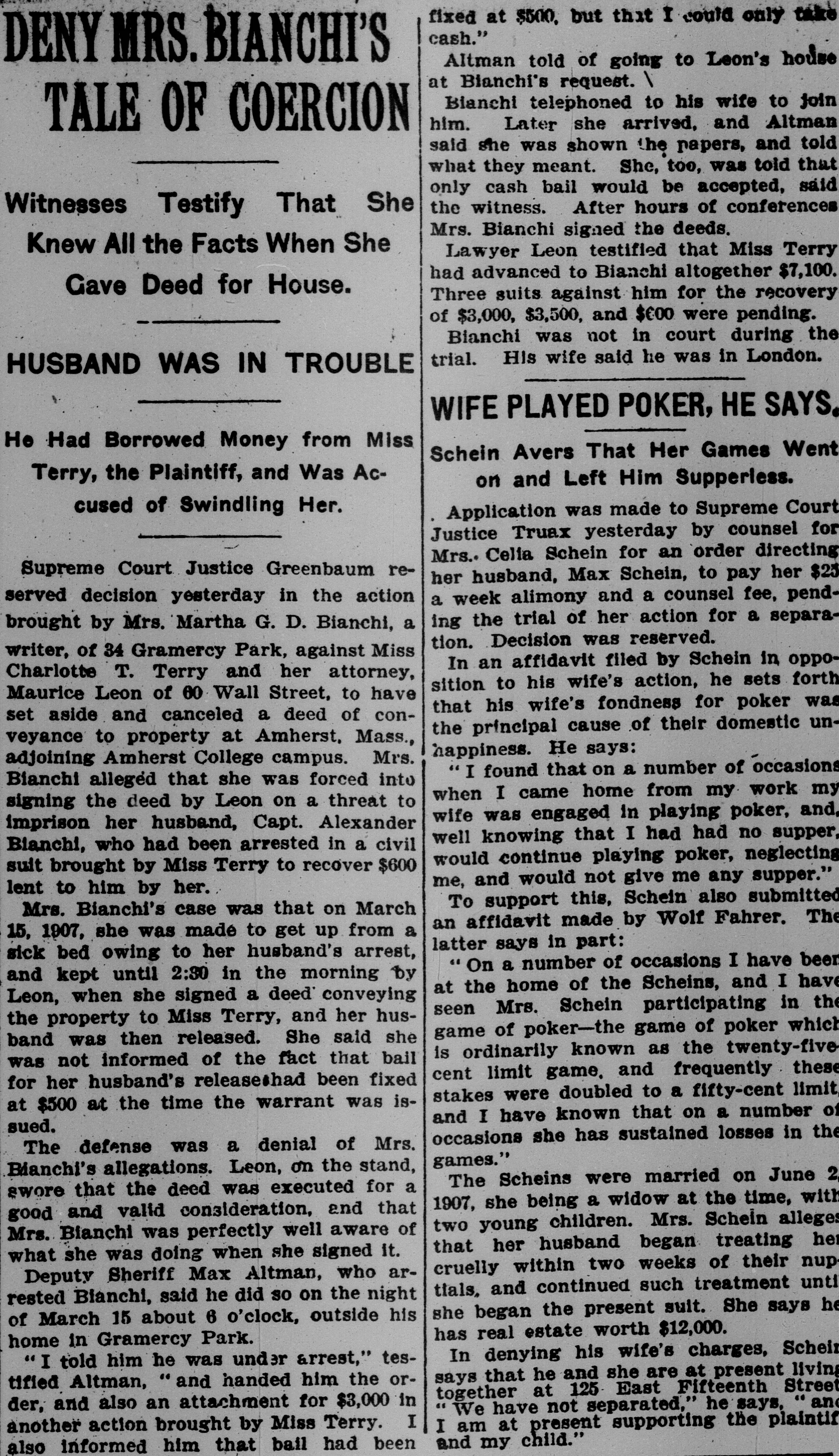
Deny Mrs. Bianchi’s Tale of Coercion

The New York Times, December 25, 1908, p. 4.

Open the original scan ↗

The headline foregrounds testimony against Bianchi’s allegation; the opening paragraph makes clear that the judge had reserved decision. The allegations remain disputed in this report. The Amherst property is not identified by a house name. The scan also includes an unrelated matrimonial case, which is excluded from the transcript.

View the original clippingOriginal newspaper clipping headed “Deny Mrs. Bianchi’s Tale of Coercion”. A readable transcript is provided below.

Open full-size scan in a new tab ↗

Read the article transcript

Paragraph breaks and line-end hyphenation have been adjusted for reading. Original wording and period language are retained; editorial additions appear in square brackets.

DENY MRS. BIANCHI’S TALE OF COERCION
Witnesses Testify That She Knew All the Facts When She Gave Deed for House.
HUSBAND WAS IN TROUBLE
He Had Borrowed Money from Miss Terry, the Plaintiff, and Was Accused of Swindling Her.

Supreme Court Justice Greenbaum reserved decision yesterday in the action brought by Mrs. Martha G. D. Bianchi, a writer, of 34 Gramercy Park, against Miss Charlotte T. Terry and her attorney, Maurice Leon of 60 Wall Street, to have set aside and canceled a deed of conveyance to property at Amherst, Mass., adjoining Amherst College campus. Mrs. Bianchi alleged that she was forced into signing the deed by Leon on a threat to imprison her husband, Capt. Alexander Bianchi, who had been arrested in a civil suit brought by Miss Terry to recover $600 lent to him by her.

Mrs. Bianchi’s case was that on March 15, 1907, she was made to get up from a sick bed owing to her husband’s arrest, and kept until 2:30 in the morning by Leon, when she signed a deed conveying the property to Miss Terry, and her husband was then released. She said she was not informed of the fact that bail for her husband’s release had been fixed at $500 at the time the warrant was issued.

The defense was a denial of Mrs. Bianchi’s allegations. Leon, on the stand, swore that the deed was executed for a good and valid consideration, and that Mrs. Bianchi was perfectly well aware of what she was doing when she signed it.

Deputy Sheriff Max Altman, who arrested Bianchi, said he did so on the night of March 15 about 6 o’clock, outside his home in Gramercy Park.

“I told him he was under arrest,” testified Altman, “and handed him the order, and also an attachment for $3,000 in another action brought by Miss Terry. I also informed him that bail had been fixed at $500, but that I could only take cash.”

Altman told of going to Leon’s house at Bianchi’s request.

Bianchi telephoned to his wife to join him. Later she arrived, and Altman said she was shown the papers, and told what they meant. She, too, was told that only cash bail would be accepted, said the witness. After hours of conferences Mrs. Bianchi signed the deeds.

Lawyer Leon testified that Miss Terry had advanced to Bianchi altogether $7,100. Three suits against him for the recovery of $3,000, $3,500, and $600 were pending.

Bianchi was not in court during the trial. His wife said he was in London.

Source & image credits

“Deny Mrs. Bianchi’s Tale of Coercion.” The New York Times, December 25, 1908, p. 4. Newspaper clipping supplied to the GPBA research collection. The source scan is reproduced without changes to its contents.

Biographical context: Emily Dickinson Museum, “Martha Dickinson (Mattie) Bianchi (1866–1943), niece.” Her own writing, the 1914 publication of The Single Hound, and her later life between Amherst and New York.