
A war felt close to home
The Civil War entered Gramercy’s history through national service, neighborhood relief efforts and violence on nearby streets. Pine’s account brings those experiences together. It does not describe a square isolated from the events transforming the country.
Henry W. Bellows and the United States Sanitary Commission organized aid for Union soldiers. George Templeton Strong served as the commission’s treasurer, while Louisa Lee Schuyler helped mobilize medical supplies and care. At the Friends Meeting House, a sewing room made garments for formerly enslaved people.
July 1863
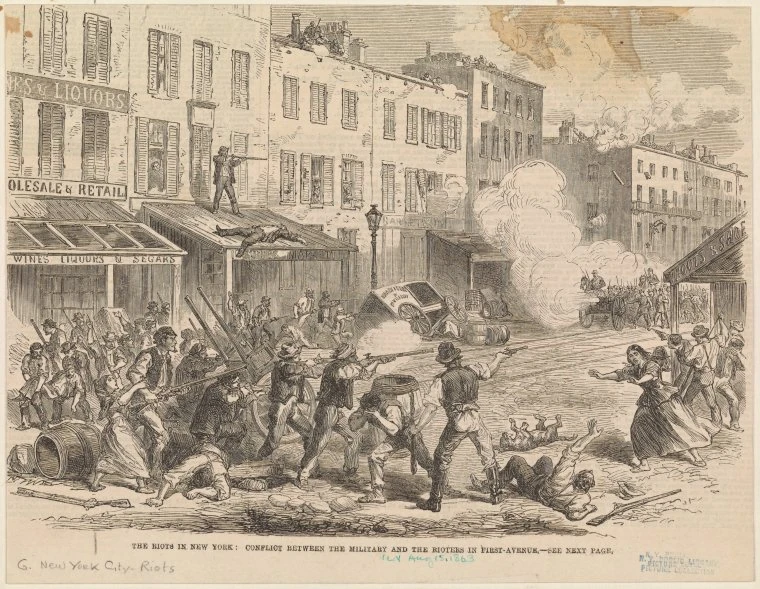
During the New York draft riots, racial violence targeted Black New Yorkers, and the Colored Orphan Asylum was burned. Pine places the Park near the disorder along Third Avenue. His narrative quotes accounts of crowds in the avenue and an attack on an enrollment office near Nineteenth Street.
These events cannot be understood only as a dramatic interruption to a quiet neighborhood. The attacks had victims, and racial persecution was central to the violence. Pine’s short local account provides evidence of what happened around the Park while leaving much of that larger human history outside its scope.
A military presence inside the gates
Pine cites a recollection of William T. Lusk commanding a detachment in Gramercy Park during the riots. He also points to the Trustees’ minutes: two years later, they unsuccessfully sought reimbursement from the federal government for expenses arising from the military occupation of the grounds.
Augustus Saint-Gaudens, who lived nearby at the time, later recalled two cannon positioned on Twenty-first Street at the Park’s northeast corner, facing east. Pine uses these accounts to document the military presence.
Public service beyond the neighborhood
Pine also describes John Bigelow’s diplomatic work in France during the war, including efforts to prevent vessels intended for the Confederacy from reaching sea. That part of the account connects a later Gramercy resident’s life with national policy and international relations.
The war chapter therefore has several strands: aid organized through civic and religious networks, violence experienced near the square, military use of the Park and service abroad. Reading them together gives a more complete account than the familiar image of an unchanging garden.
Follow the sources
The local evidence is collected on printed pages 42–45 of Pine’s book, with his discussion of Bigelow on pages 37–39. The book is a retrospective account published in 1921, drawing on earlier recollections and records. The history reading room explains how to find those passages in the complete scan.
Sources
Adapted from John B. Pine, The Story of Gramercy Park, 1831–1921 (1921), printed pages 37–45.