
Park stewardship · 2005–2025
The Trustees’ care of the Park’s trees
The canopy we admire from below depends on work we rarely see: inspecting branches, tending roots and making room for light.
Care begins below ground
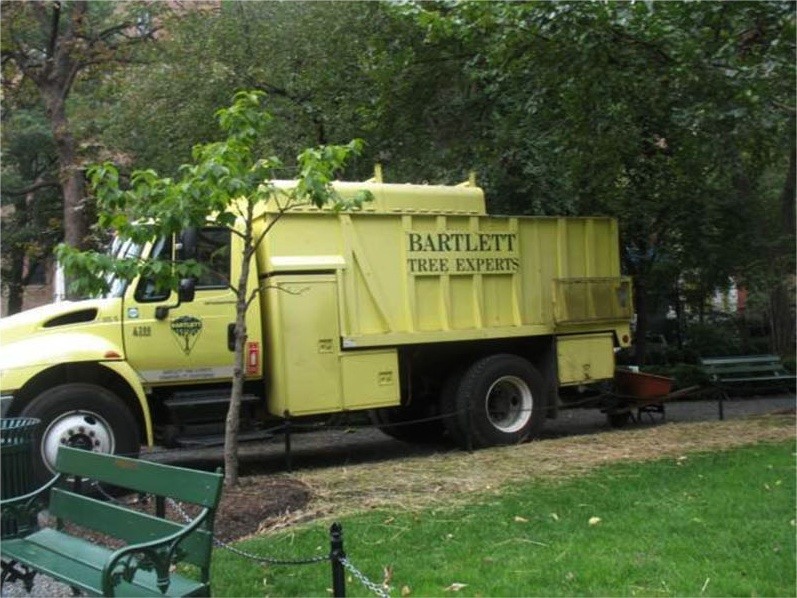
The Trustees’ May 2013 report described a maintenance program with Bartlett Tree Experts. Soil sampling informed fertilization, while inspections looked for weakened growth, discolored foliage and deteriorating branches. Seven trees were selected for root-zone work that spring.
A continuing cycle
In April 2017, the newsletter recorded deep-root fertilization of trees, shrubs and boxwoods. An August account described the annual pruning visit: removing dead limbs, opening the canopy to light, assessing heavy branches and reviewing cables and stakes.
2005
Planting for the next generation
A May 2005 report documented the arrival of four large trees: two London planes, a pin oak and a red oak. Trustees Chairman James M. Clark Jr. said ten trees had been planted that spring, with further planting hoped for in the autumn. Landscape architect Barbara Paca advised on species and placement.
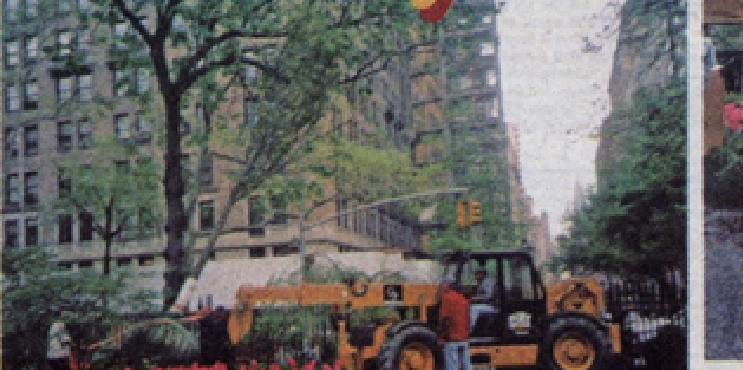
Giuseppe Barbuta’s crew began before dawn. The account credited the 13th Precinct and Emergency Service Truck 1 with helping the two large flatbed trucks reach the site, and neighbor Eric Ellenbogen with lending equipment. Its photographs show the machinery, substantial root balls and the people involved in the planting.
2009–2012
Following the roots
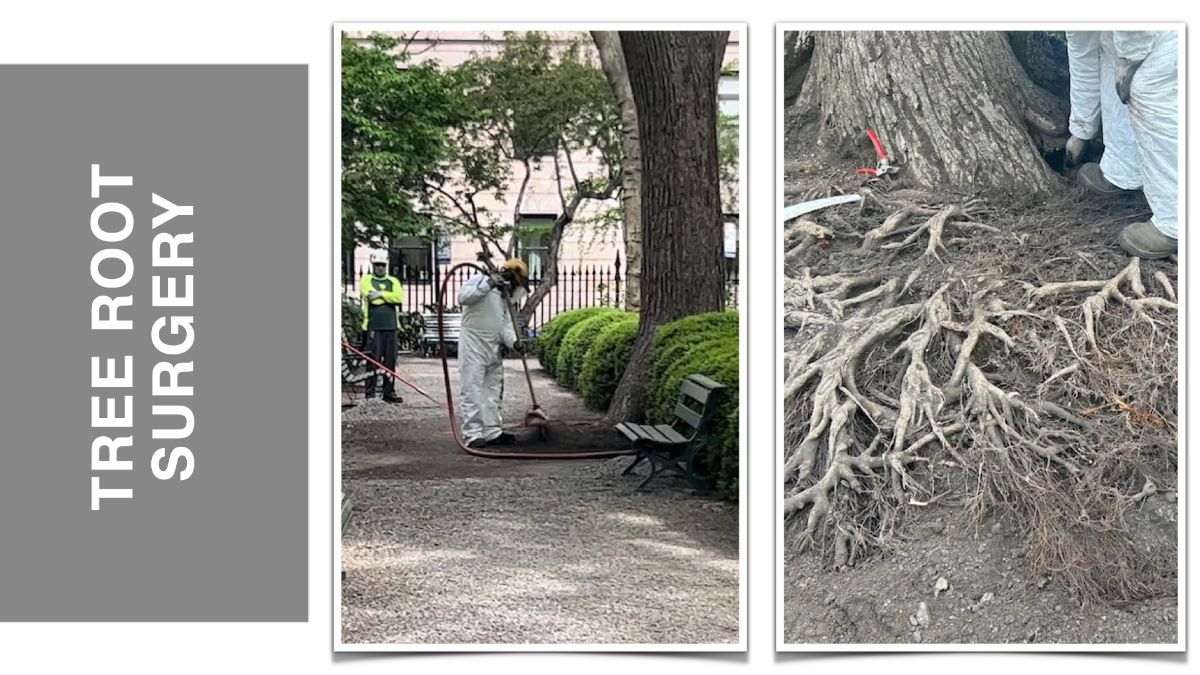
The April 2009 Trustees update described twice-yearly soil sampling and treatment tailored to the results. Bartlett Tree Experts selected seven or eight trees for work that loosened soil around the roots and returned organic material to it.
The March 2011 notice identified five trees for root invigoration: an American elm, a ginkgo and three lindens. A June 2012 report again described assessments and five selected trees. These dated accounts show individual decisions within an ongoing maintenance program.
2009
Storm damage and replacement planting
Heavy rain in June brought a maple limb down onto a bench. A July storm damaged two smaller trees and shrubs in the northwest corner. In an August update, the Trustees reported removing two maples after testing showed hollowed trunks and limbs.
Planting continued alongside these losses. By September, the Trustees reported six new trees over the preceding months: two pin oaks, two plums, a Japanese pagoda tree and a Donald Wyman flowering crabapple. These were separate planting and storm-response reports, not a single replacement project.
2010–2012
Targeted treatment and storm response
An April 29, 2010 update reported completion of a four-stage treatment for twelve struggling fruit trees, with the Trustees reporting an encouraging response. That is a historical account of their care, not a prescription for present-day treatment.
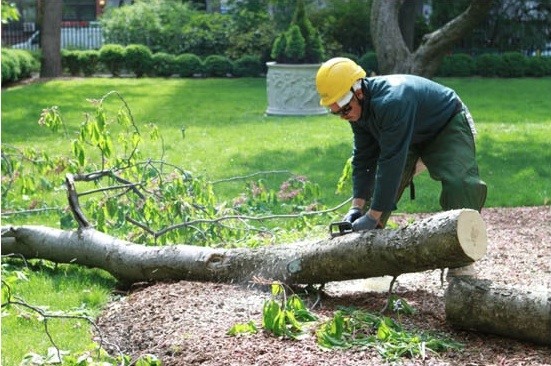
In April 2012, a large branch from an Ohio buckeye fell during rainstorms and damaged a nearby cherry. Bartlett’s crew spent two days cutting up the fallen material, tending the damaged trees and clearing debris.
2011
A citywide survey reaches the Park
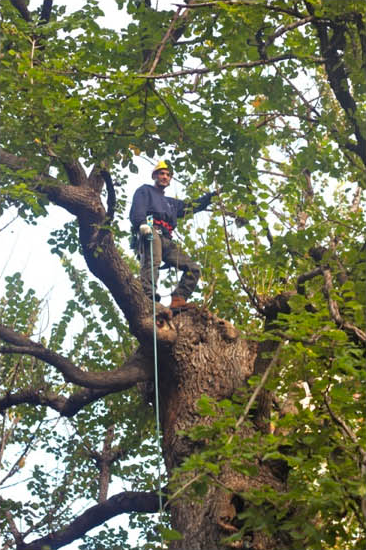
A Trustees newsletter explained why a uniformed crew had been climbing trees in Gramercy Park. Seven surveyors from the U.S. Department of Agriculture were inspecting potential host trees as part of a Manhattan survey for the Asian longhorned beetle.
The notice identified several host-tree types growing in the Park and explained the purpose of early detection. It expressly reported that USDA had never found the beetle in Gramercy Park at that time. This was a federal survey described by the Trustees, not a GPBA-organized project or a current assessment of tree health.
2013–2015
Assessments informed different decisions
A June 2013 Trustees notice said an arborist’s survey had led to a recommendation to remove three trees, including a large Ohio buckeye, mainly for safety reasons. It announced work still to come; it did not confirm removal.
For selected trees, the May 2015 report recommended aerating the root zone and adding organic matter after inspecting foliage, growth and branches.
2016
Root care and winter recovery
The May 2016 update again described Bartlett Tree Experts assessing growth, foliage and branches before selecting trees for root-zone aeration and replenishment of organic matter. The same letter recorded Mike Boag replacing boxwoods, shrubbery and pink hydrangeas damaged by winter weather.
2020
Inspection continued in a changed city
An April 2, 2020 Trustees update described Bartlett’s inspection of foliage, growth and branches and its selection of trees for root-zone care. The notice illustrates the continuation of routine landscape work during the pandemic.
2023
Responding to a fallen elm branch
After heavy rain on April 29, 2023, a large branch fell from the American elm in the southwest part of the Park. In a May 1 letter, Trustees Chairman James M. Clark Jr. reported that Bartlett Tree Experts had removed debris and inspected the tree.
Following the storm, Bartlett Tree Experts inspected the elm. The Trustees’ May 2023 letter reported that the arborists considered it safe to remain standing.
2023
Care below the surface
A separate May 9 letter reported completed tree-and-shrub work: deep-root fertilization, root invigoration, soil analysis and an assessment of groundcover. These routine tasks complemented the storm response described above.
2024
Six kinds of routine maintenance
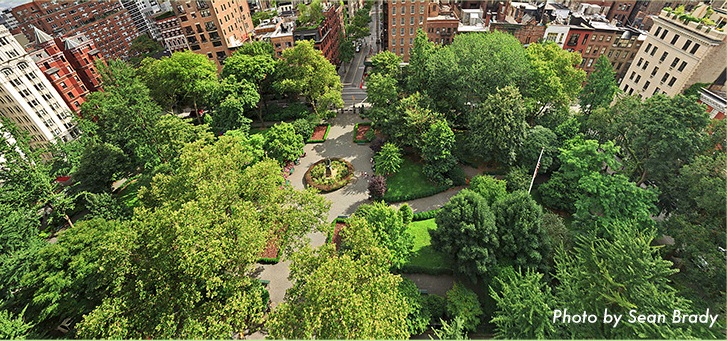
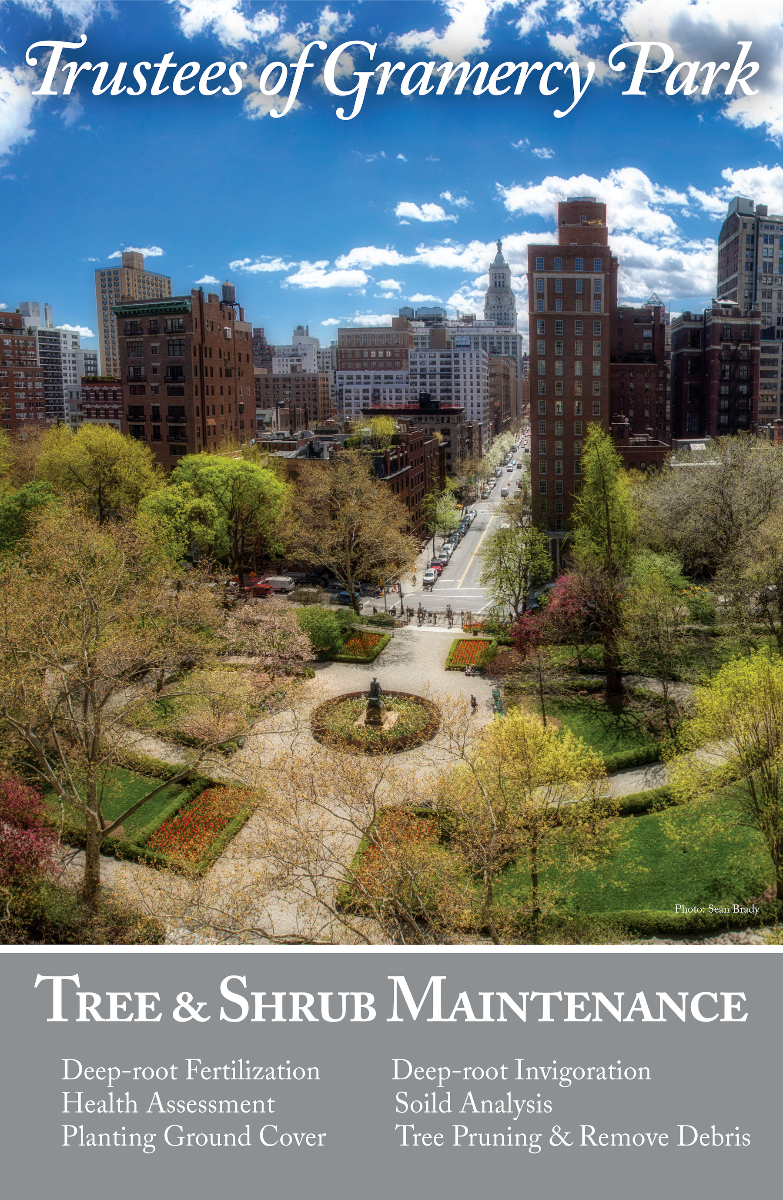
The May 2024 Trustees update brought six tasks together in a single illustrated notice: deep-root fertilization, health assessment, groundcover planting, root invigoration, soil analysis, and pruning and debris removal. Sean Brady’s photograph showed the canopy above the Park.
The notice gives a compact picture of the recurring work behind the landscape. It complements the detailed accounts of individual treatments and storm response across these years.
2025
The scale of continuing care
The December 2025 Gramercy by the Numbers graphic reported 104 trees representing nineteen species within the Park. It also described twelve to fifteen arborist inspections each year and eight trees receiving annual deep-root invigoration.
The figures refer to the landscape at the time of the report. Its separate perimeter count was 41 street-tree gardens.
Sources
Sources include the archived USDA notice and the Trustees’ public tree-care updates shared in May 2016, April 2020 and 2023.
- Tree maintenance program · May 31, 2013
- Spring root care · April 6, 2017
- Annual pruning · August 11, 2017
- Arborist survey · June 6, 2013
- Root care · May 12, 2015
- USDA survey · Trustees Neighborhood News 148, 2011
- Public Trustees update on the elm · May 1, 2023
- Tree and shrub care · May 9, 2023
- Gramercy by the Numbers · December 22, 2025
- Four large trees planted · May 5, 2005
- Tree and shrub maintenance · May 6, 2024
- Soil assessment and root care · April 27, 2009
- Tree maintenance · March 2011 archived notice
- Annual tree maintenance · June 2012
- Storm damage and new planting · June 29, 2009
- Storm damage · July 27, 2009
- Maple removals · August 2009 archived notice
- Six new trees and autumn work · September 2, 2009
- Fruit-tree treatment completed · April 29, 2010
- Storm response · April 2012