
Emma Thursby
The World in Her Drawing Room
1845–1931 · Concert soprano, teacher & Gramercy Park hostess
Acclaimed across Europe and America as a virtuoso of the concert hall, she settled at 34 Gramercy Park East in 1883—where she and her sister Ina spent nearly half a century hosting one of New York’s most cosmopolitan salons.
The salon at No. 34
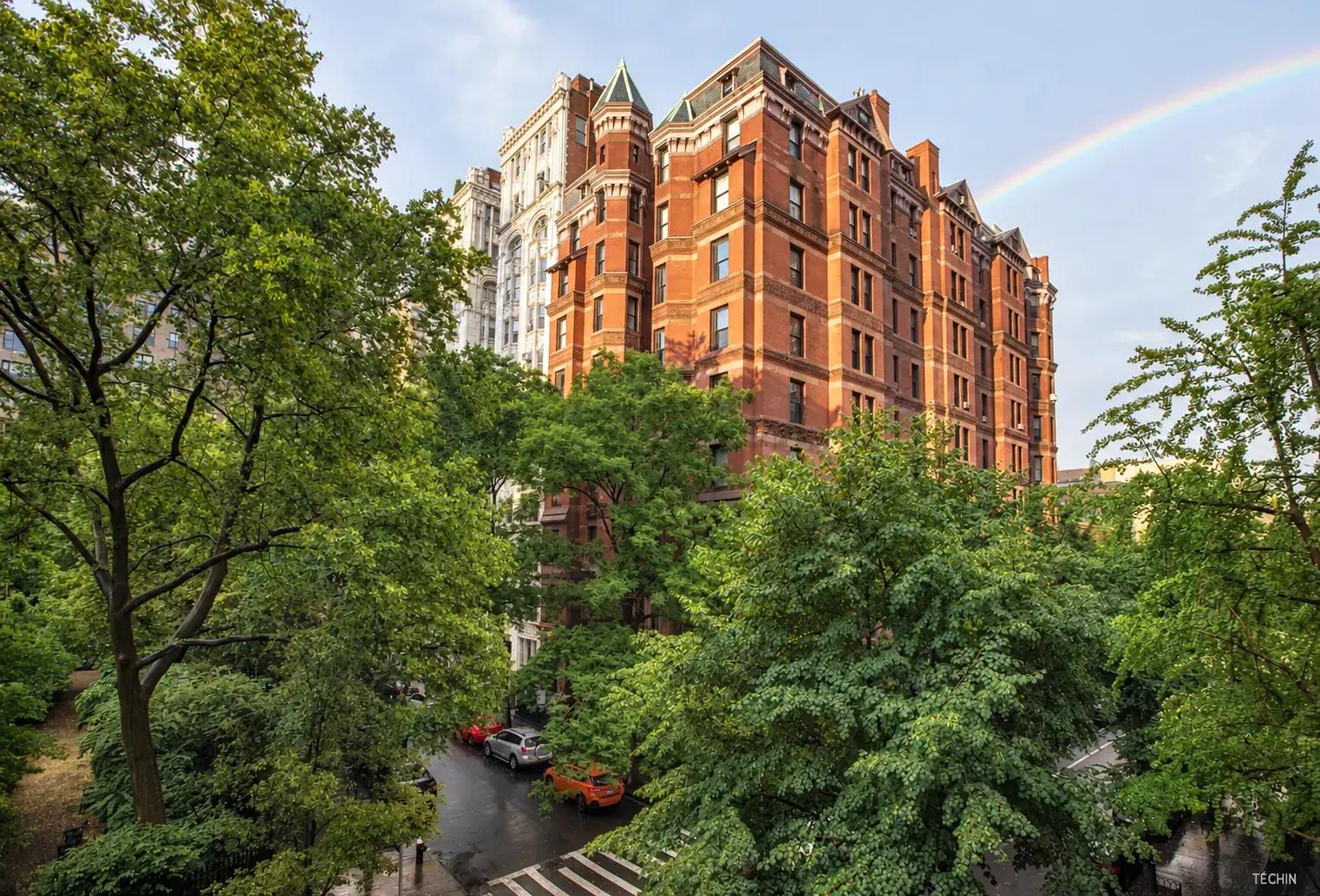
On Friday afternoons in January and February, the hydraulic Otis elevator at 34 Gramercy Park East carried a remarkable cross-section of the artistic world up to the apartment of Emma Cecilia Thursby and her younger sister, Ina. Stepping into a broad, low-ceilinged corner drawing room with windows on three sides overlooking Gramercy Park, visitors entered a gathering that contemporary writers compared to the beau monde salons of Paris.
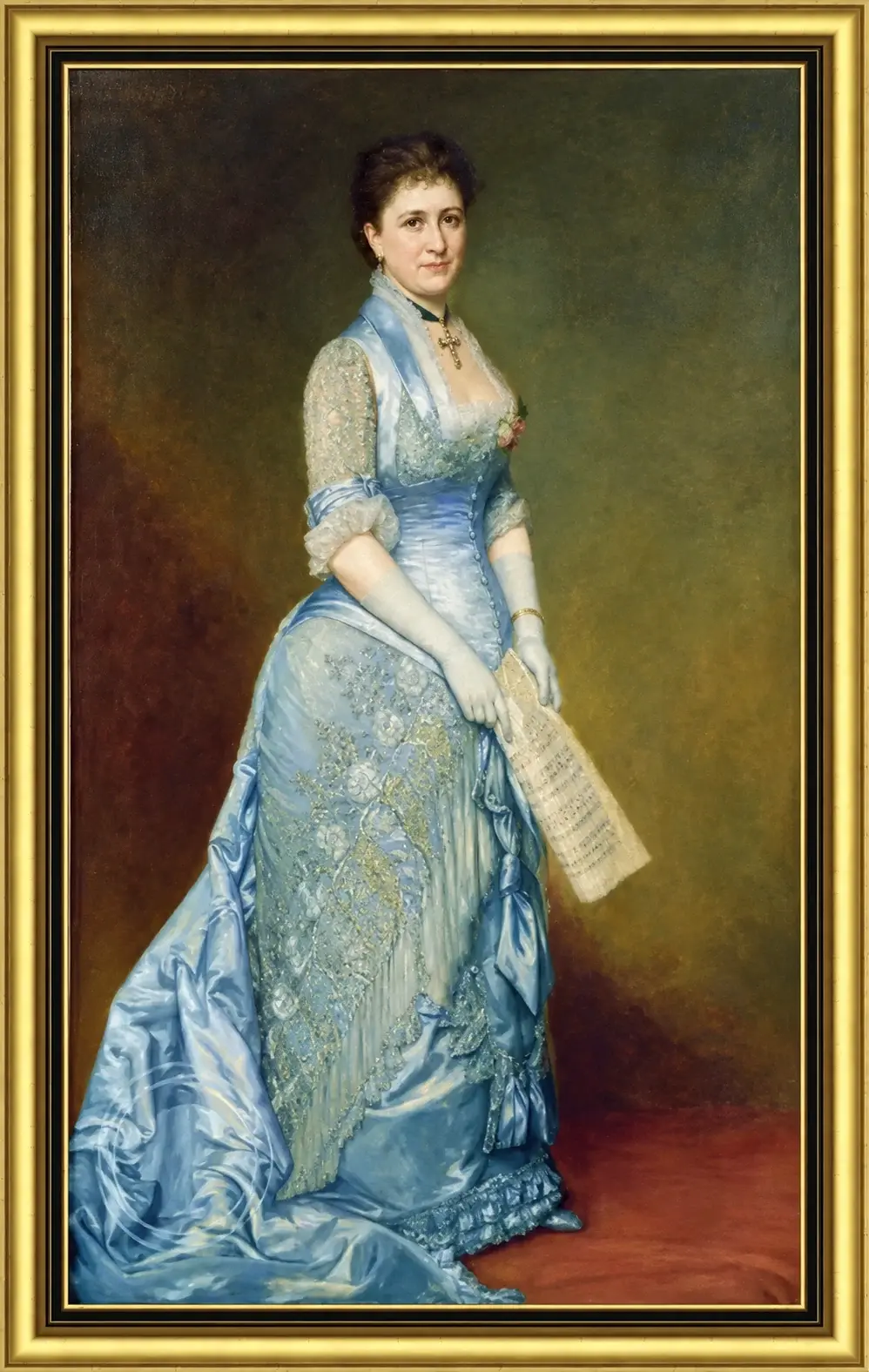
At one end of the room, framed in gilt between two fireplaces and a tall grandfather clock, hung George Peter Alexander Healy’s life-size 1879 Paris portrait of the hostess in shimmering blue silk. Around her mingled Enrico Caruso, Nellie Melba, and Geraldine Farrar alongside painters, sculptors, diplomats, and philosophers from Europe and Asia. As longtime neighbor and singer Claire Strakosch later recalled of Thursby’s Friday musicales: “They all came, they all sang.”
Long before she became the beloved hostess of 34 Gramercy Park East, Thursby had conquered the great concert halls of the nineteenth century. Born in Williamsburg, Brooklyn, she possessed a three-octave coloratura soprano of such purity, agility, and birdlike trills that critics on both sides of the Atlantic hailed her as the “American Nightingale.”
When she purchased her apartment in the newly completed Queen Anne cooperative at the corner of East 20th Street in 1883, she was among the building’s very first shareholder-residents. For the next forty-eight years—until her death in those same rooms on July 4, 1931—her home beside the Park was a haven for music, mentorship, and global conversation, presided over by Emma, Ina, and a five-language-speaking mynah bird who flew down into Gramercy Park by day to play with neighborhood children.
The voice that supported a family
Emma Cecilia Thursby was born on February 21, 1845, in Williamsburg, Brooklyn, the second of five children of John Barnes Thursby, a prosperous rope manufacturer of colonial Bushwick stock, and Jane Ann Bennett Thursby. Music entered her life at the Old Bushwick Reformed Church, where she made her first public appearance singing at age five. In 1857, her parents enrolled twelve-year-old Emma and her older sister Alice at the Moravian Seminary in Bethlehem, Pennsylvania, a community renowned for its rigorous sacred music tradition.
That idyllic training ended abruptly. Financial reverses following the Panic of 1857 crippled the family ropewalk, and on November 17, 1859, her father died, leaving the household in sudden economic distress. Fourteen-year-old Emma returned home to Brooklyn, practicing tirelessly at the family piano while giving lessons to help support her widowed mother and younger siblings, John, Louis, and four-year-old Ina.
By 1868, twenty-three-year-old Thursby had been engaged as principal soprano soloist at Henry Ward Beecher’s Plymouth Church in Brooklyn, where nearly three thousand worshippers packed the pews each Sunday. Manhattan’s wealthiest congregations soon competed for her services. Moving to the Church of the Divine Paternity and then to the Broadway Tabernacle at 34th Street, she commanded an unprecedented $3,000 a year—making her the highest-paid church soloist in America.
With her church earnings, Thursby paid off family debts, educated her brothers and sisters, and financed her own advanced training. In 1872–1873 she traveled to Milan to study under the bel canto masters Francesco Lamperti and Antonio Sangiovanni, followed by intensive work in America with the formidable German-born soprano Erminia Rudersdorff. By 1875, singing with Theodore Thomas’s orchestra, Leopold Damrosch’s Oratorio Society, and Patrick Gilmore’s band, the church soloist was ready for the world stage.
Mark Twain, Ole Bull, and the conquest of Paris
On November 13, 1876, audiences at the Brooklyn Academy of Music heard two very different American voices sharing the same bill: Emma Thursby singing florid concert arias and Mark Twain reading from his works. Their joint engagements continued through Philadelphia, Boston, Chelsea, and Providence. That same period cemented her celebrated artistic partnership with the legendary Norwegian violin virtuoso Ole Bull, whose folk-inflected poetry on the violin matched the birdlike agility of her three-octave soprano on tours across America and Europe.
In 1877, impresario Maurice Strakosch—who had managed Adelina Patti—signed Thursby to a landmark contract guaranteeing her $100,000 for three years of concert and oratorio appearances, plus travel expenses and two months’ summer vacation. Yet throughout her career, she held fast to one unshakeable principle: out of religious conviction and personal temperament, she refused every offer to appear in staged opera. Instead, standing before an orchestra in evening dress, she dazzled audiences from Mozart’s treacherous Queen of the Night aria (“Der Hölle Rache”) to simple American ballads.
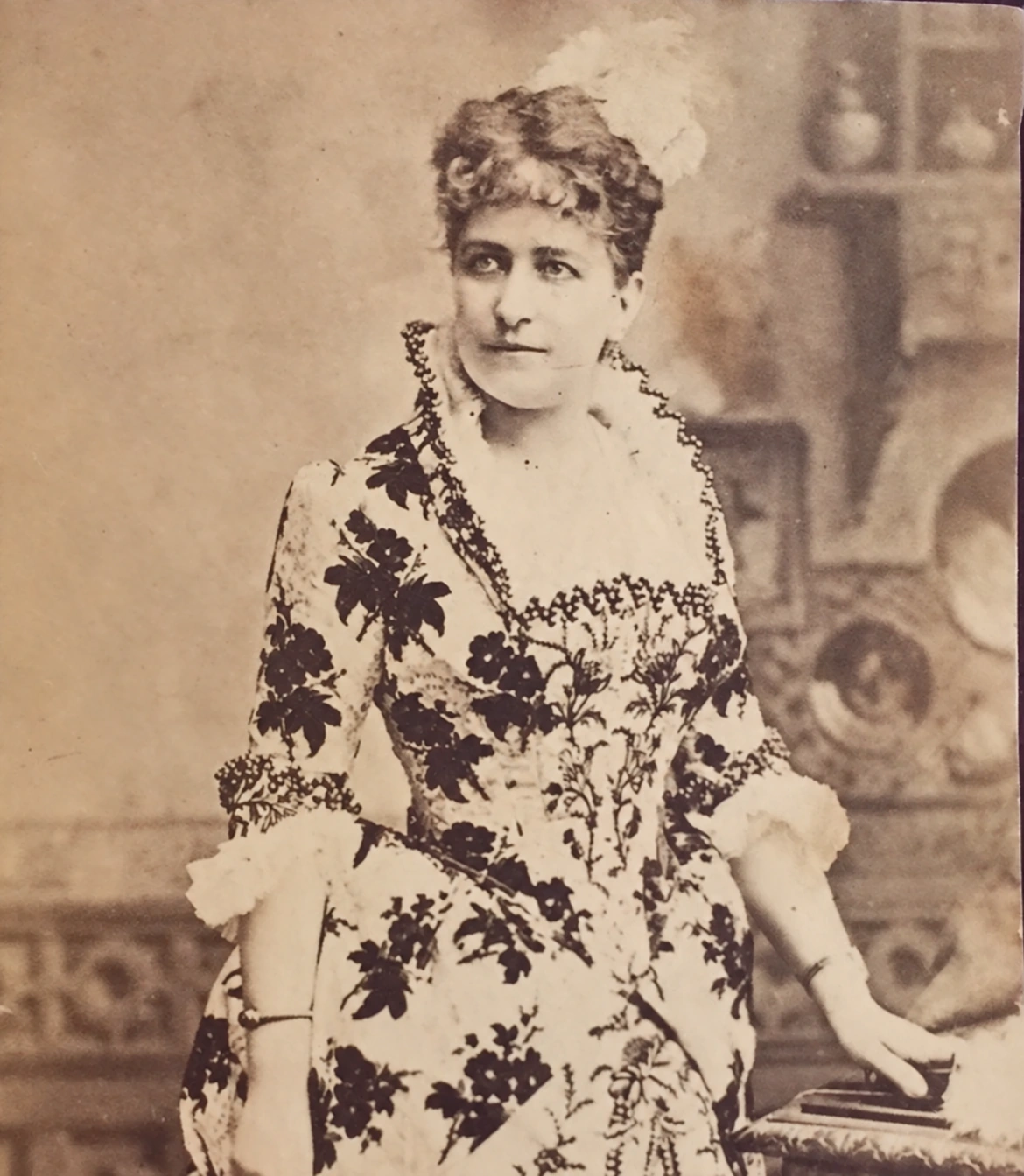
Her May 1878 London debut with the Philharmonic Society at St. James’s Hall was a triumph, and Paris surrendered even more completely the following spring. In May 1879, shortly after her sensational French debut at the Théâtre du Châtelet, she posed in the Paris studio of American painter George Peter Alexander Healy. Exhibited at the 1880 Paris Salon, the life-size portrait captured her in an opulent pale-blue silk and lace gown attributed to the House of Worth—a canvas that would later preside over her drawing room at 34 Gramercy Park East.
In April 1881, following her return engagements in Paris, the Société des Concerts du Conservatoire awarded Thursby its coveted medal—making the Brooklyn soprano the first American, and only the second singer in history after Christine Nilsson, to receive the honor. The silver medal, inscribed with the dates of her April 3 and 8, 1881 performances, still rests in its velvet-lined leather case at the New-York Historical Society.
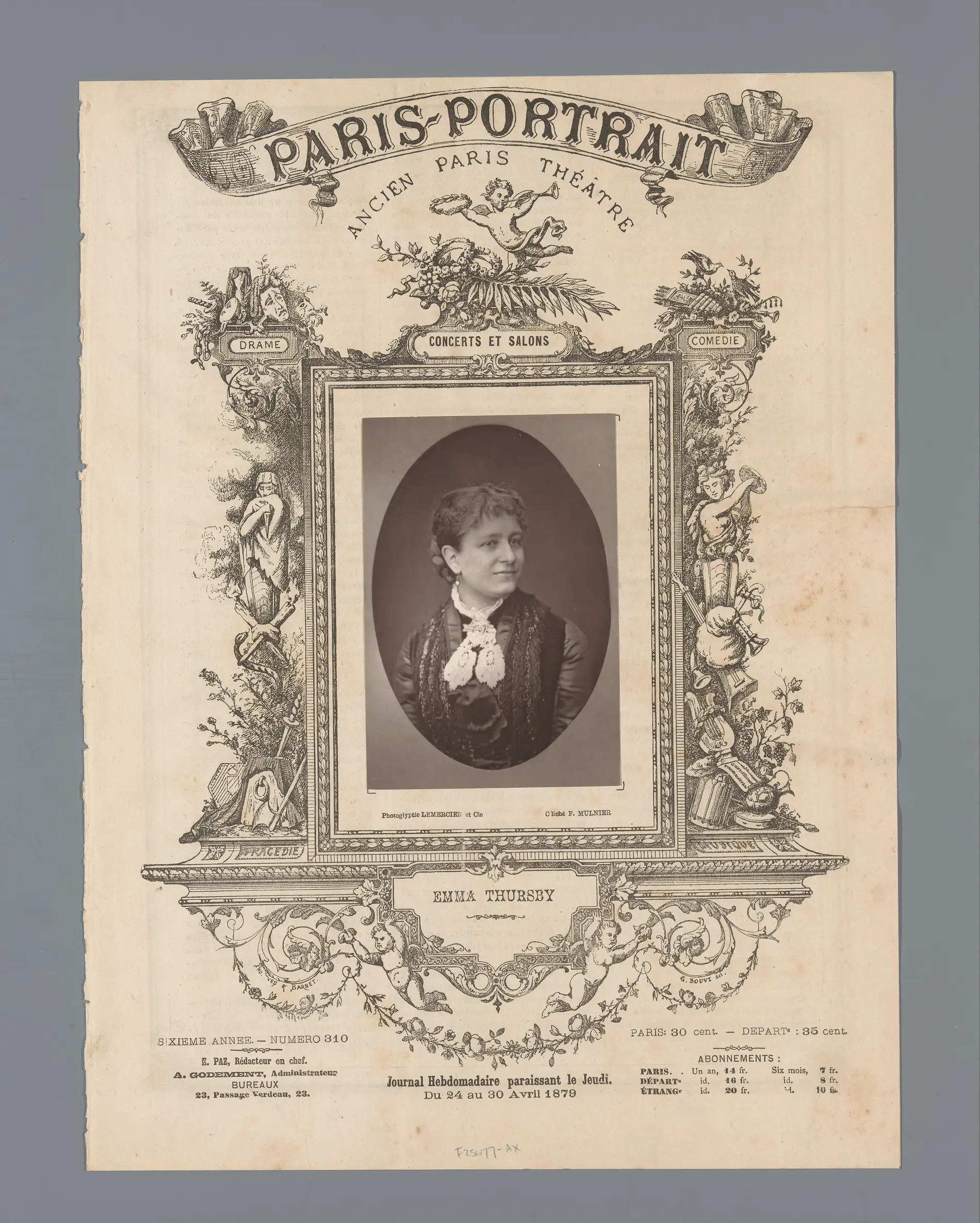
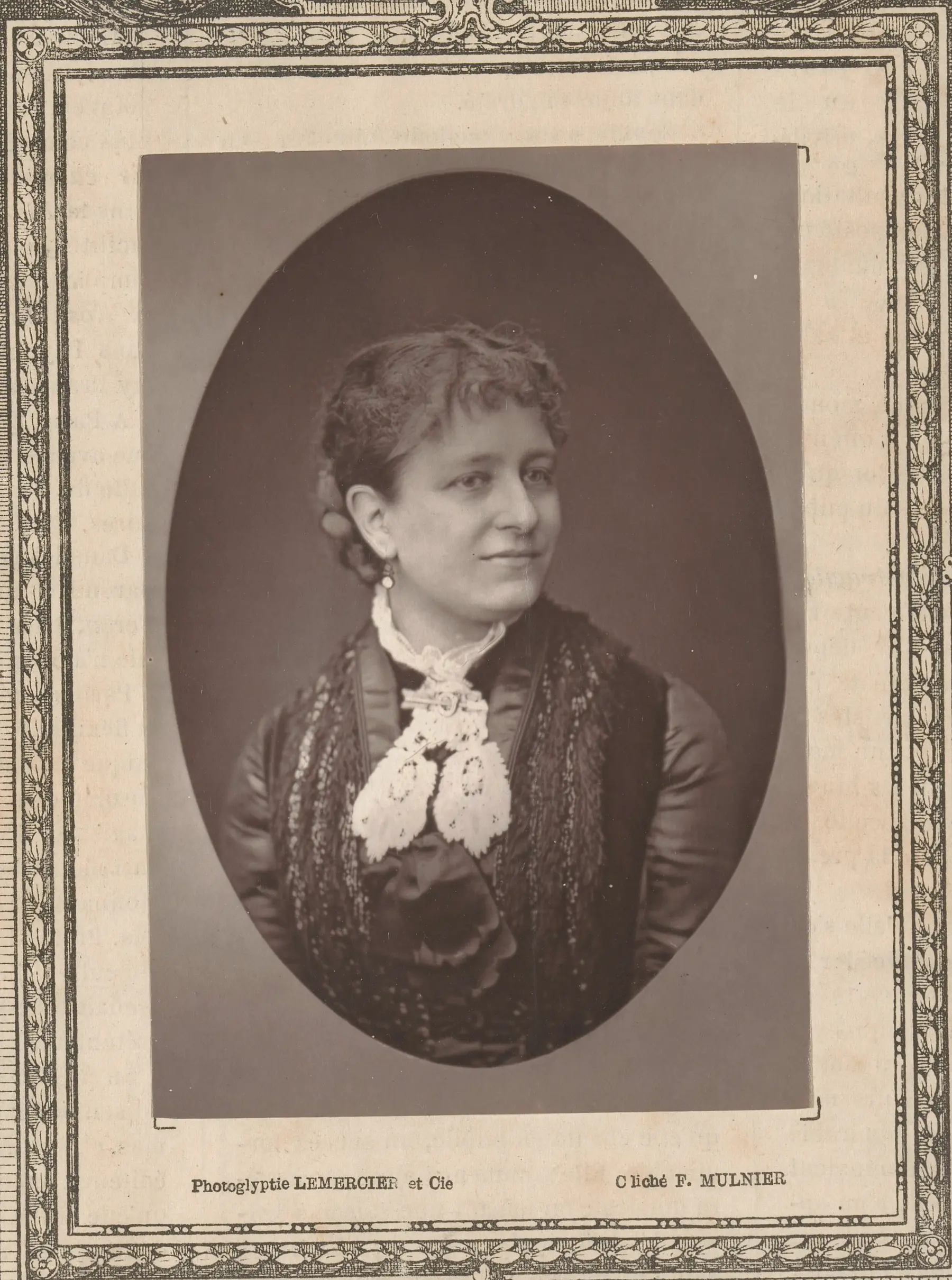
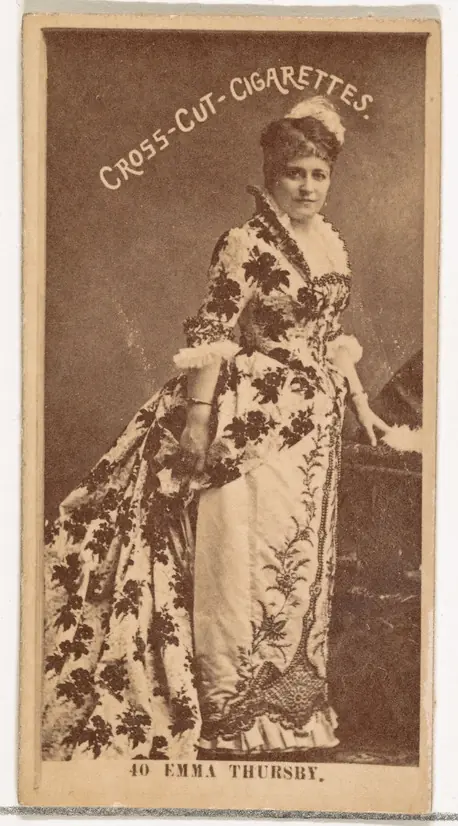
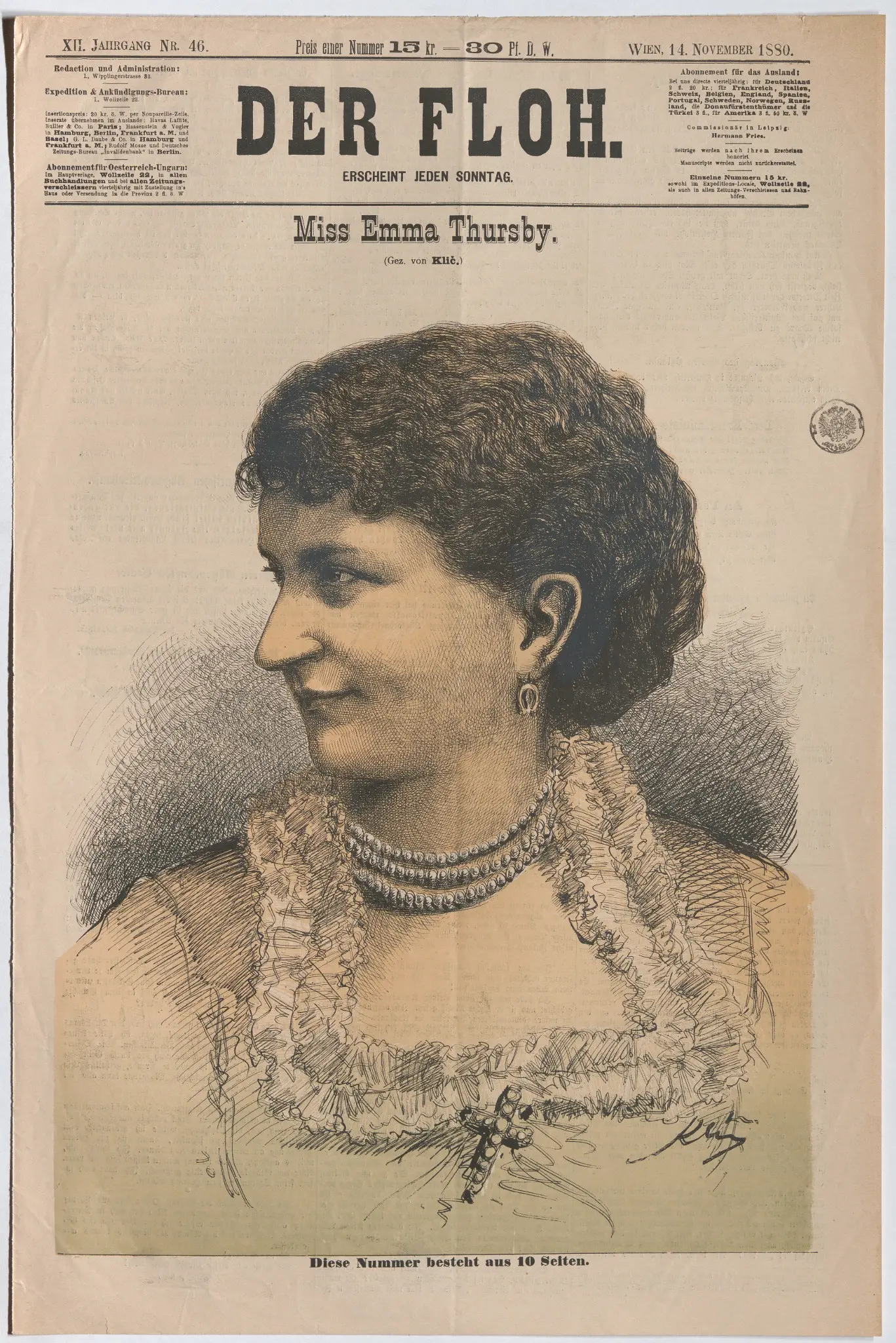
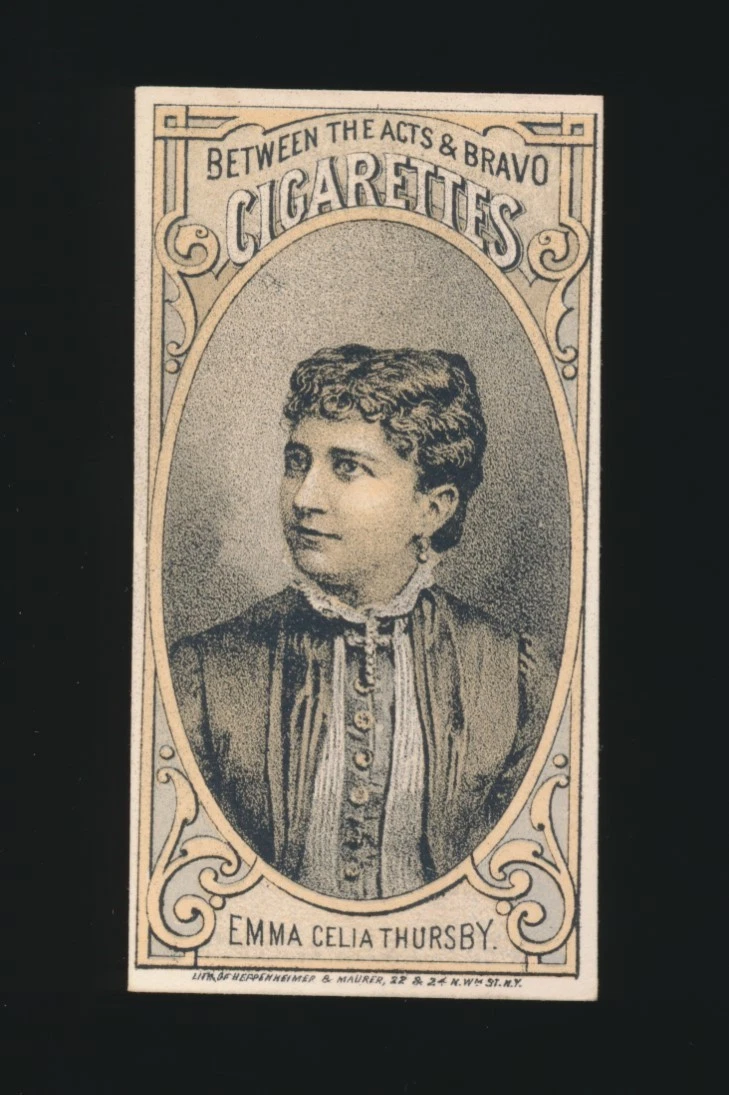
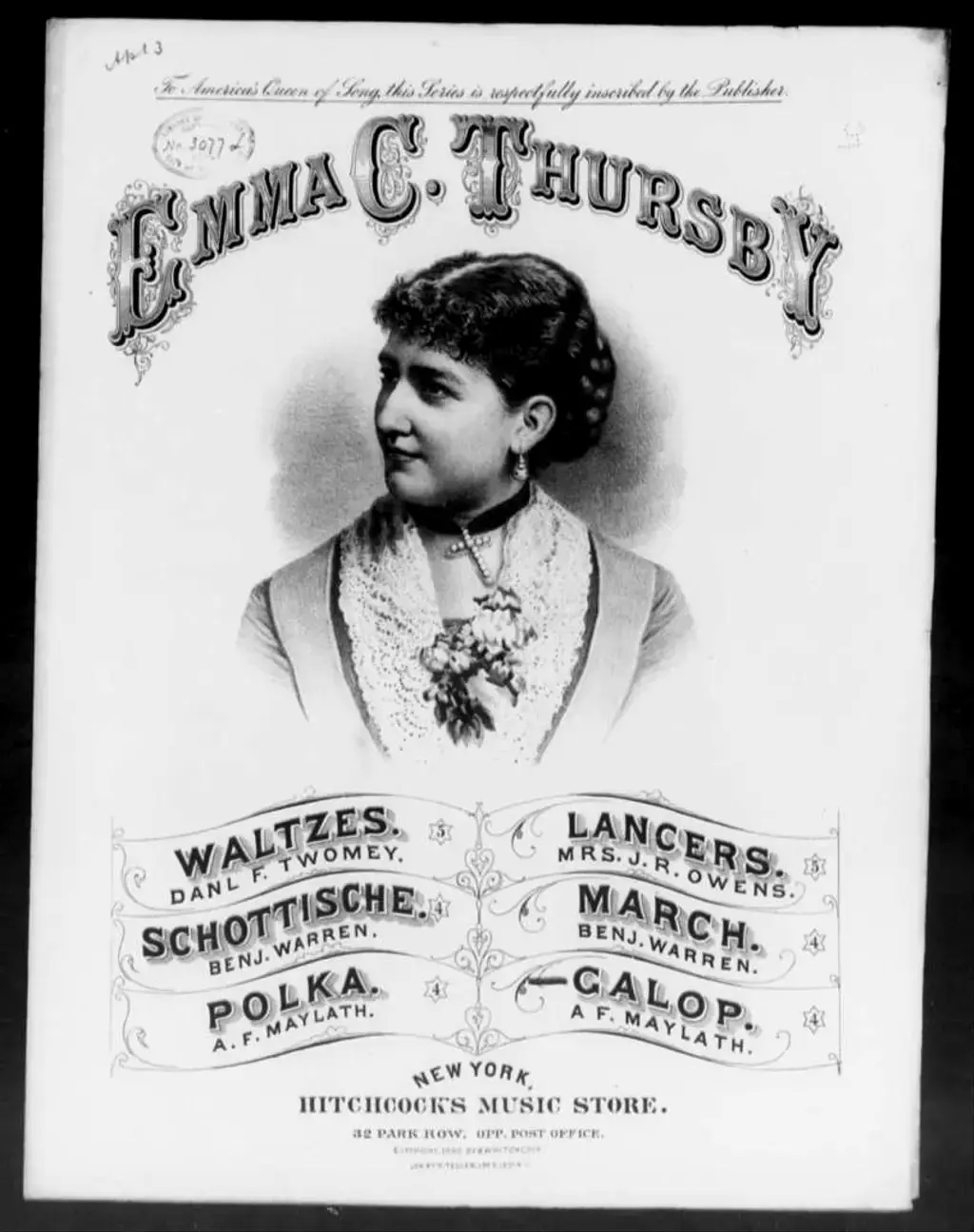
Across the continent, illustrated weeklies celebrated the “American Nightingale.” Paris put her on the ornate cover of Paris-Portrait in April 1879, and when she conquered Vienna in November 1880, the artist Karl Klič drew a striking front-page color lithograph of her for the Viennese weekly Der Floh. Triumphant tours of Germany, Austria, Spain, Holland, and Scandinavia followed, along with cross-country American seasons that took her from Henry Flagler’s new Hotel Ponce de León in St. Augustine, Florida, for three consecutive winters (1890–1892) to Santa Barbara’s Lobero Theatre. By the time she gave her formal farewell concert in Chicago in 1895, her face was familiar enough to appear on collectible cigarette cards tucked into packets across the country.
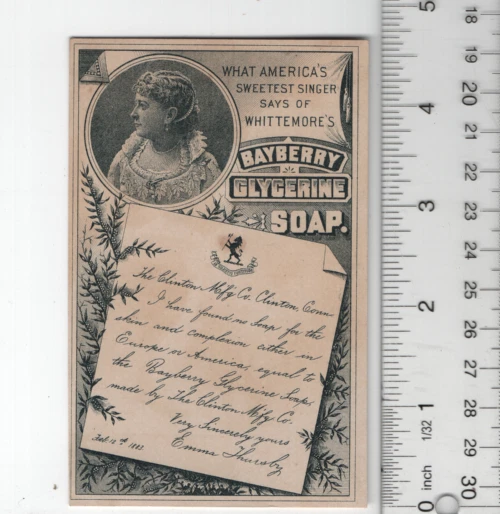
“Perhaps no singer has a warmer place in the American heart than Miss Emma Thursby. Indeed, as a special favorite of the musical world, she has no superior in her chosen line. Her sphere is not the stage, but the concert hall, where competent judges deem her to stand unrivalled.”
Living Leaders of the World, 1889, p. 53
The world came to 34 Gramercy Park East
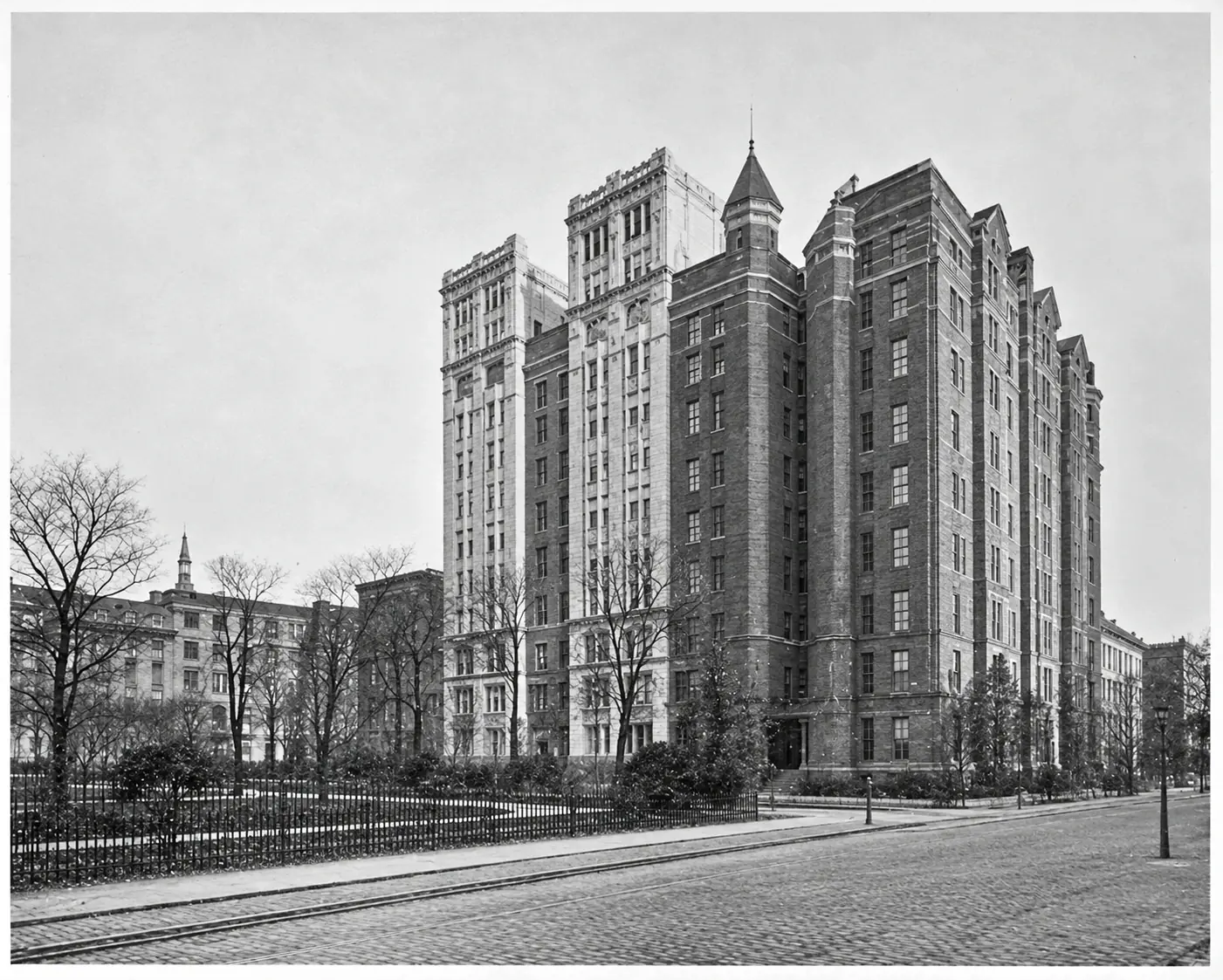
In 1883, while still at the height of her touring career, thirty-eight-year-old Thursby purchased a cooperative apartment at 34 Gramercy Park East and moved in with her mother and sisters. Completed that year at the corner of East 20th Street to designs by George W. da Cunha, “The Gramercy” was New York City’s earliest surviving co-op—a red-brick and terra-cotta Queen Anne landmark boasting stained-glass transoms, hydraulic Otis elevators, and an eighth-floor dining room run by Louis Sherry.
Grief visited the household early: her mother died in 1884 while Emma was on tour in Europe, and her older sister Alice died the following year. From then on, Emma and her younger sister Ina Love Thursby formed an inseparable forty-six-year partnership, traveling the world together and presiding side by side over their Gramercy Park home. By 1889, their Friday afternoon receptions—held especially in January and February—had become a fixture of New York cultural life.
Their spacious, low-ceilinged corner drawing room, lit by windows on three sides overlooking the Park, was filled with treasures gathered across continents, anchored by two fireplaces, a grandfather clock, and Healy’s towering Paris portrait. Directly outside their windows stood a willow tree inside Gramercy Park, grown from a cutting brought from Peter Cooper’s farm and planted in Emma’s honor.
The Brooklyn Daily Eagle observed in 1924 that Thursby’s Friday gatherings represented “more truly than any other in the whole country the salon of the Beau Monde, Paris.” Guests stepping into the room might hear Enrico Caruso, Nellie Melba, Lillian Nordica, or Geraldine Farrar sing by the piano; meet conductor Leopold Damrosch; or attend a February 1914 reception honoring Mary Garden, where soprano Enid Watkins performed Native American chants in traditional dress. Speaking to The New Yorker for the building’s seventy-fifth anniversary in 1958, resident Claire Strakosch summed up the musicales in six words: “They all came, they all sang.” Strakosch recalled a domestic detail as well: with decades of touring trunks overflowing her apartment, Thursby had colonized the building’s rooftop turrets as her private storerooms.
The other famous voice in the household
Even when opera stars filled the drawing room, another vocalist regularly stole the spotlight at 34 Gramercy Park East—and he had glossy black feathers. Around 1887, while visiting Bad Ems, Germany, Thursby was given a Greater Indian Hill Mynah (Gracula religiosa) by the German Ambassador to China, who instructed the fledgling in German to stay with his new mistress. Calling Emma “Mamma,” Mynah had his own room in the apartment and accompanied the sisters everywhere on tour.
Under a coloratura soprano’s roof, the bird acquired an astonishing repertoire: he sang musical scales, mimicked a banjo, and spoke in five languages—English, French, German, Malay, and Chinese. Visitor Joseph F. Rinn recalled watching in astonishment as Mynah hopped along the keys of Thursby’s piano to pick out the melody of “Home, Sweet Home.” At a society reception before Thursby’s 1891 concert at Santa Barbara’s Lobero Theatre, the bird entertained the crowd so flamboyantly that he nearly upstaged her recital. Whenever anyone remarked that he came from India, Mynah indignantly interrupted to insist he was African—and then repeated himself in German.
Above all, Mynah belonged to Gramercy Park. Perching at the window of No. 34, he watched the children playing behind the Park gates and begged, “Mamma, Mamma, I want to get out! I’ll come right back.” As Thursby fondly remembered: “During the day at home he would fly down to the park and play with the children, coming home for meals like a human.” Only after he was once stolen from the Park—and recovered after an anxious search—did she have to curb his solo flights.
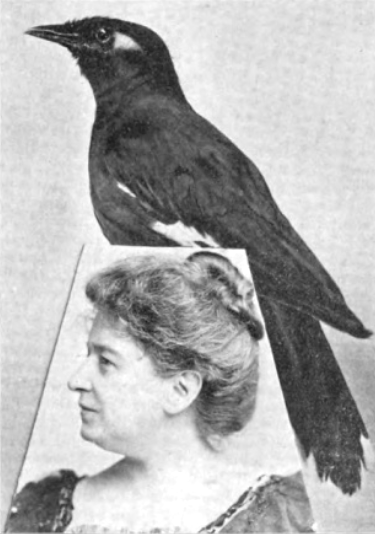
In December 1898, the New York Herald crowned Mynah the “Smartest Bird in All Creation” after he charmed crowds at the New York Ornithological Society exhibition and entertained a holiday gathering of underprivileged children. Weeks later, on January 27, 1899, the fifteen-year-old bird died of spinal meningitis, softly murmuring “Au revoir.” His death made headlines nationwide. Three physicians—including Dr. Henry Holbrook Curtis, the celebrated Manhattan laryngologist to the stars of the Metropolitan Opera—performed an autopsy, reporting in The Phrenological Journal that Mynah’s brain and vocal organs were extraordinarily developed. Preserved initially under a glass bell jar in the apartment, Mynah was eventually buried inside Gramercy Park, directly beneath the willow tree planted in Emma Thursby’s honor.
Music, philosophy, and a room open to the world
Thursby’s intellectual curiosity reached far beyond European concert halls. Through her lifelong bond with Sara Chapman Bull—widow of her former touring partner Ole Bull—she became a central figure at Green Acre, the pioneering summer community founded in 1894 by Sarah Farmer on the banks of the Piscataqua River in Eliot, Maine, where musicians, transcendentalists, poets, and scholars of Eastern and Western faiths gathered beneath the pines in open dialogue.
In 1893, while serving on the Advisory Council of the World’s Congress of Representative Women and performing at the World’s Columbian Exposition in Chicago, Thursby met the charismatic Hindu monk Swami Vivekananda, whose addresses at the Parliament of Religions had electrified American audiences. During the winter of 1895, Emma and Sara Bull helped organize Vivekananda’s New York lectures, and on the evening of Monday, January 28, 1895, Thursby welcomed him into her drawing room at 34 Gramercy Park East for an intimate parlor talk.
As her biographer Richard McCandless Gipson observed, Vivekananda’s Vedanta philosophy helped crystallize fifty-year-old Thursby’s sense of purpose as she stepped back from the concert stage in 1895—inspiring her to devote the rest of her life to the art of teaching, to philanthropic kindness, and to “that art of friendly intercourse in the spirit of which her ‘Fridays’ had already been established.”
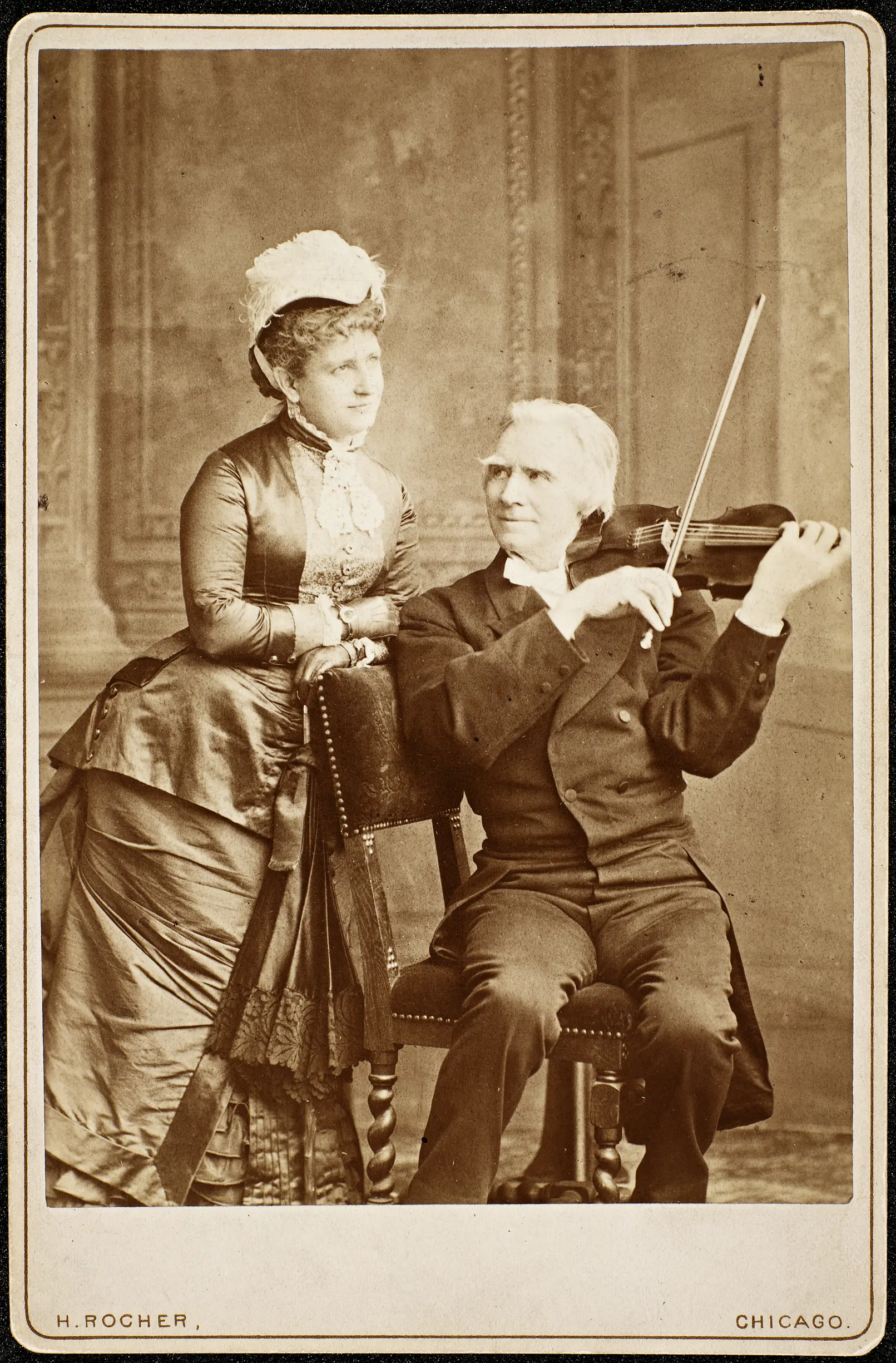
Their friendship sparked a delightful musical exchange inside 34 Gramercy Park East. Vivekananda taught Thursby the intricate theory of Indian classical music, while she marveled at the resonant, chanting baritone in which he recited Sanskrit hymns and taught him to sing romantic songs by the Norwegian composer Edvard Grieg—whom Ole Bull had mentored as a teenager in Bergen. Both Vivekananda and his colleague Swami Abhedananda were charmed by Emma’s polyglot mynah bird during their visits, declaring him “a marvel.”
In the years that followed, Thursby’s Gramercy drawing room became a Manhattan crossroads for distinguished visitors from South and East Asia, welcoming Bengali poet and Nobel laureate Rabindranath Tagore, Japanese art scholar Okakura Kakuzo, philosopher S. N. Dasgupta, and the Begum of Janjira and her sister the Princess, with whom Emma studied Hindu melodies. In 1903–1904, fifty-eight-year-old Emma and Ina embarked on an extended voyage through Japan, China, and India—filling trunks with rare textiles, artworks, and diaries that joined the European treasures lining their rooms beside Gramercy Park.
What Emma Thursby gave Geraldine Farrar
Retiring from concert touring allowed Thursby to pour her energy into discovering and mentoring young American singers. At Green Acre in the summer of 1896, she heard a fourteen-year-old girl from Melrose, Massachusetts, named Geraldine Farrar and warmly invited her to come study in New York. When sixteen-year-old Farrar arrived for the winter of 1897–1898, she found in 34 Gramercy Park East not merely a voice studio, but an enchanted doorway into the professional world of music and theatre.
In her 1916 memoir, Farrar recalled the gentle wisdom of Thursby’s teaching. Recognizing that her teenage pupil’s dramatic soprano was still maturing, Thursby refused to strain the voice with heavy repertoire, drilling her instead in breath control, pristine diction, and the “bird-like agility” of bel canto scales and trills. Outside lesson hours, Emma treated the girl as a protégée—taking her to Broadway plays and performances at the Metropolitan Opera so she could study the stagecraft of great artists firsthand.
Thursby also placed her own prestige behind her student, arranging for Farrar to sing for the reigning prima donna Nellie Melba. When Melba offered a multi-year management arrangement that Farrar’s mother feared would bind her daughter too early, Thursby respected the family’s independence without hesitation, counseling patience until the right path opened.
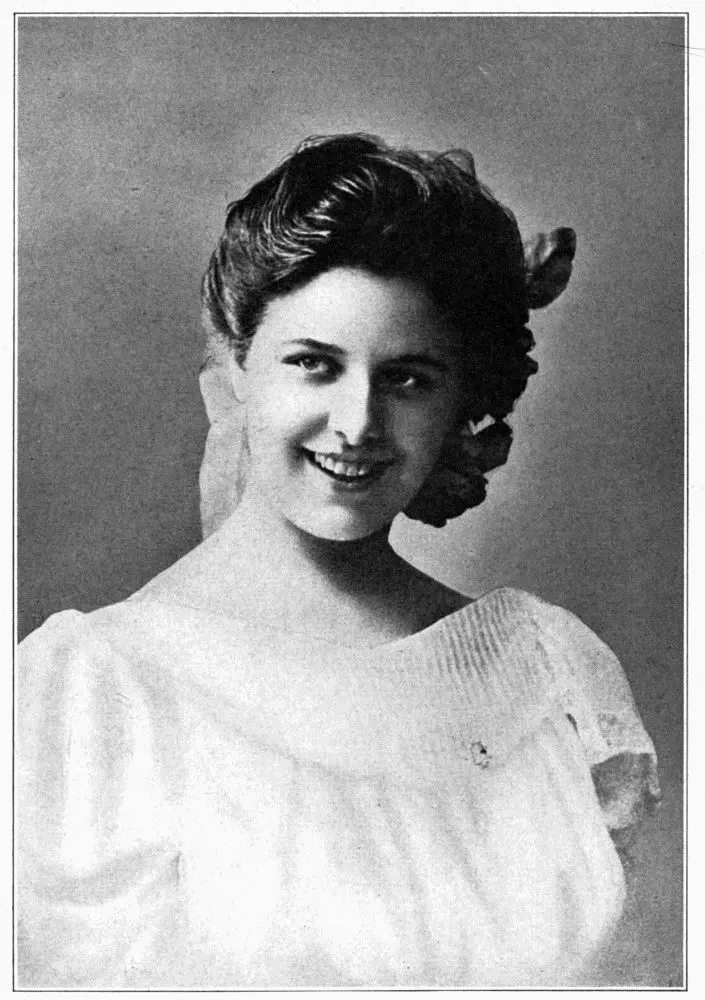
That path opened right inside Thursby’s drawing room at 34 Gramercy Park East. At an afternoon reception hosted by Emma and Ina, a visiting Boston guest, Mrs. Hannah Kimball, was captivated by Farrar’s singing and determination. Mrs. Kimball introduced the young singer to her wealthy cousin, Mrs. Bertram Webb of Salem, who agreed to advance the $30,000 needed to send the entire Farrar family to Europe so Geraldine could study in Paris and in Berlin under the legendary Lilli Lehmann. In September 1899, seventeen-year-old Farrar sailed from New York—launching a legendary career as the reigning American superstar of the Metropolitan Opera, repaying every dollar of her loan, and forever crediting the drawing room on Gramercy Park where her international journey began.
Teaching the next generation
In the autumn of 1905, when musical visionary Frank Damrosch—son of her old conductor Leopold Damrosch—founded the Institute of Musical Art, the direct forerunner of today’s Juilliard School, he turned to sixty-year-old Emma Thursby to serve as one of its founding professors of voice. Housed initially in the historic Lenox Mansion at Fifth Avenue and 12th Street, just a ten-minute walk from Gramercy Park, the conservatory gave Thursby an institutional platform where she taught until 1911, while continuing to instruct private pupils in her apartment at No. 34 until 1924.
Interviewed in 1921 for James Francis Cooke’s landmark volume Great Singers on the Art of Singing, Thursby spoke with bracing candor about vocal pedagogy. She cautioned parents against rushing girls and boys into strenuous vocal exercises before their bodies had matured, insisted on a rigorous foundation in piano, sight-reading, and poetry, and expressed deep skepticism toward charlatans peddling complex “scientific” vocal methods.
“A good teacher is far rarer than a good singer,” she declared. Too many retired virtuosos, she warned, damaged young voices by demanding that pupils imitate the teacher’s own vocal habits instead of listening patiently for the student’s natural timbre and individuality. “Judge a teacher,” she advised aspiring singers, “by the pupils they have actually brought to success.”
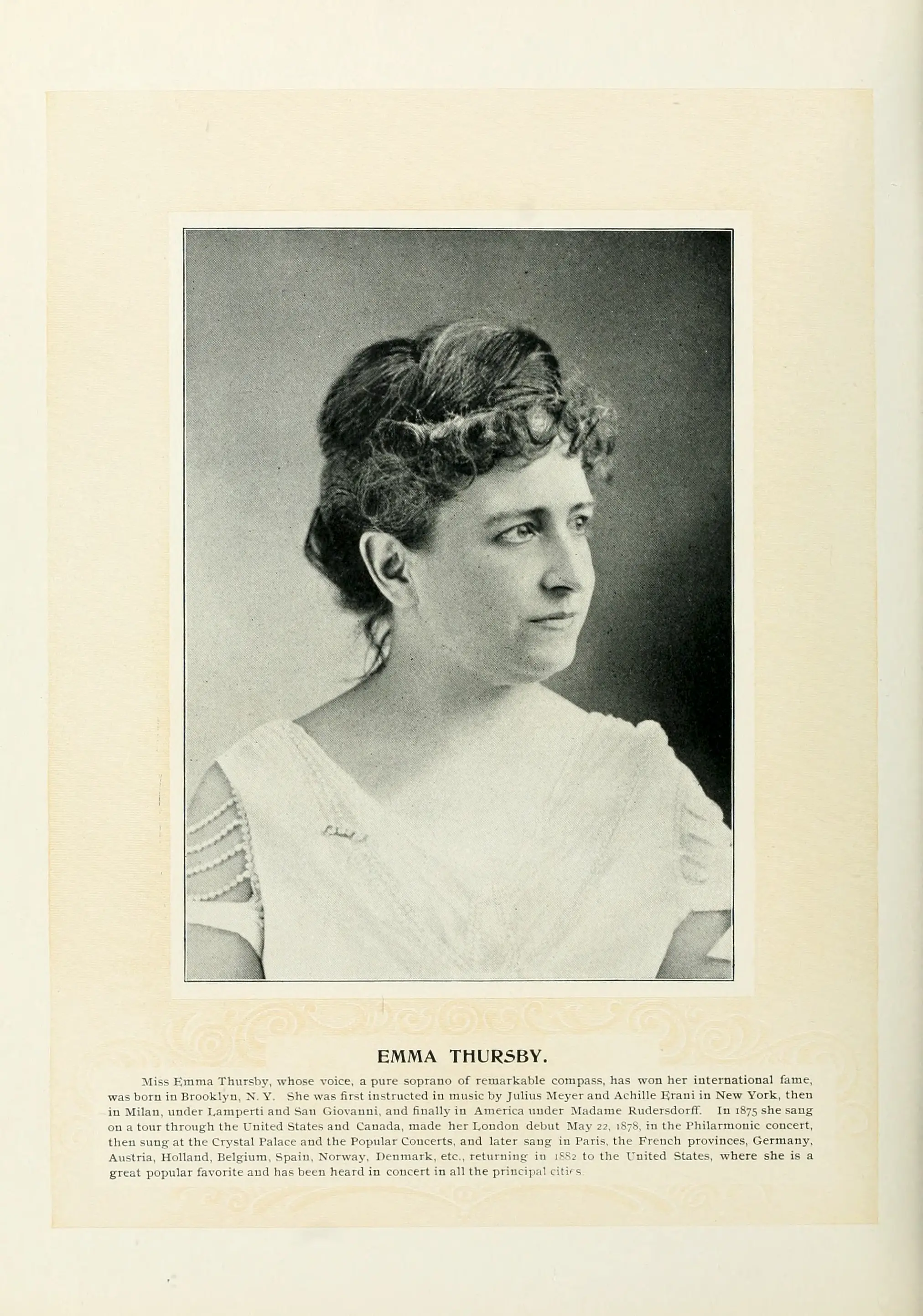
Her reflections also stripped away the romantic myths surrounding a nineteenth-century touring career. Behind the applause, floral wreaths, and royal medals lay the grueling reality of freezing railway carriages, unheated provincial dressing rooms, coarse hotel food, and weeks without domestic privacy. While twentieth-century Pullman cars and steam heat had made travel far less punishing than in the 1870s, she noted wryly, ambitious concert managers simply used the saved time to pack twice as many engagements into a singer’s itinerary—making physical stamina and disciplined living every bit as essential as vocal talent.
A life preserved by a sister and an address
In the summer of 1924, seventy-nine-year-old Thursby suffered a paralytic stroke that immobilized her left side. Yet she refused to retreat into invalid seclusion or close the doors of 34 Gramercy Park East. That July, her drawing room was the scene of what the Brooklyn Daily Eagle described as a “very pretty wedding” for her niece, Edith May Thursby, and that same week Emma welcomed journalist Lillian Morgan Edgerton into her salon to reminisce about Paris, Geraldine Farrar, Swami Vivekananda, and her beloved Mynah buried beneath the willow tree across the street in Gramercy Park. Even in her eighties, she celebrated milestone birthdays surrounded by floral tributes and musical luminaries, and insisted on being helped into Manhattan concert halls right through the 1930–1931 musical season.
On Independence Day, July 4, 1931, Emma Cecilia Thursby died peacefully in her apartment at 34 Gramercy Park East at the age of eighty-six, and was laid to rest in the Thursby family plot at The Evergreens Cemetery in her native Brooklyn. Her remarkable lifespan stretched from an antebellum childhood before the transatlantic telegraph into the era of network radio and electrical recording—yet because her prime preceded the phonograph, her legendary three-octave voice survived solely in the memories of those who had heard her and in the living artistry of the students she had trained. Newspapers across the nation ran multi-column obituaries, while preserved tributes from composers Charles Gounod, Jules Massenet, and Victor Massé testified to her international stature.
It was her devoted sister, Ina Love Thursby (1855–1942), who ensured that Emma’s legacy would endure in brick, canvas, and paper. Continuing to live in their corner apartment at 34 Gramercy Park East fifty-six years after they had moved in as the building’s original 1883 shareholders, Ina kept the drawing room just as it had been during their Friday musicales—complete with its two fireplaces, grandfather clock, and three-sided views over the Park. In 1937, Ina funded the Emma Cecilia Thursby Memorial Music Building at their girlhood alma mater, the Moravian Seminary and College for Women in Bethlehem, Pennsylvania—a gift The New York Sun hailed as one of the most consequential contributions of the era to American musical education. Three years later, in 1940, shortly before her own death in 1942 and burial beside Emma at The Evergreens, Ina donated Healy’s life-size Paris portrait, the Conservatoire medal, and nineteen linear feet of diaries, contracts, sheet music, programs, and letters to the New-York Historical Society, which published Richard McCandless Gipson’s definitive biography, The Life of Emma Thursby, 1845–1931, that same year.
Looking back near the close of her life, the woman who had brought the world to her Gramercy Park drawing room offered a simpler summation than any archive or monument could supply. She could not remember a day in her life before music, she told an interviewer: “I have always sung and gloried in my singing.”
Life at a glance
- Lived
- 1845–1931
- Gramercy address
- 34 Gramercy Park East (1883–1931)
- The apartment
- Corner drawing room with three-sided Park views, shared for forty-eight years with her sister Ina Love Thursby
- Known for
- International coloratura soprano (“The American Nightingale”), voice teacher & Friday salon hostess
- European honors
- Paris Salon portrait by George P. A. Healy (1879–1880); Medal of the Société des Concerts du Conservatoire (1881)
- Concert farewell
- Chicago, 1895
- Teaching appointment
- Founding voice faculty, Institute of Musical Art (now the Juilliard School), 1905–1911
Sources cited
- Richard McCandless Gipson, The Life of Emma Thursby, 1845–1931 (New-York Historical Society, 1940). Definitive biography documenting her Brooklyn childhood, church solo career, European triumphs, Gramercy Park salons, and association with Swami Vivekananda.
- Emma Thursby Papers, MS 2530, and Photograph Collection, PR 126, New-York Historical Society. Gift of Ina Love Thursby (1940–1941); documents the 1883 purchase at 34 Gramercy Park East, family correspondence, touring records, Mynah bird files, and Asian travels.
- Geraldine Farrar, The Story of an American Singer (1916), Chapters IV and VI. Farrar’s firsthand account of studying with Thursby, the Nellie Melba audition, and the reception at 34 Gramercy Park East that led to the financing of her European studies.
- Lillian Morgan Edgerton, “Emma Thursby, Greatest Concert Singer of Her Time,” Brooklyn Daily Eagle, July 27, 1924. Contemporary interview describing the drawing room at 34 Gramercy Park East, the Friday receptions, teaching Vivekananda songs by Grieg, and Mynah’s burial beneath the willow tree in Gramercy Park.
- Diane Marshall, “Music and Mynah in Gramercy Park,” Vedanta Kesari (June 2020) / Ka Jingshai (May 2021). Synthesizes archival and newspaper accounts of Swami Vivekananda’s visits to 34 Gramercy Park East and the life and postmortem examination of Thursby’s Hill Mynah.
- Tom Miller, “The Gramercy – 34 Gramercy Park,” Daytonian in Manhattan, March 28, 2019. Architectural history of the 1883 cooperative and contemporary press reports from The New York Sun (1914, 1937) and The New York Times on the Thursby sisters’ apartment and the Peter Cooper willow tree.
- The New Yorker, “Seventy-Five,” April 1958. Seventy-fifth anniversary feature on 34 Gramercy Park East preserving neighbor Claire Strakosch’s memories of Caruso, Melba, and Farrar singing at Thursby’s Friday musicales and her use of the building’s turrets for storage.
- James Francis Cooke, Great Singers on the Art of Singing (1921). Preserves Thursby’s own reflections on vocal pedagogy, young singers, and the physical rigors of nineteenth-century concert touring.
- J. A. Fowler, “A Remarkable Singer and Her Talented Bird Mynah,” The Phrenological Journal (September 1899), and Joseph F. Rinn, Sixty Years of Psychical Research (1950). Contemporary accounts of Mynah’s five-language vocabulary, piano playing, and postmortem examination by Dr. Henry Holbrook Curtis.
- Mark Twain Project, Letter of October 19, 1876 (Note 2); St. Augustine Historical Society, “A Diva in St. Augustine”; and Lobero Theatre, “1891: Emma Thursby.” Document her joint 1876 tour with Mark Twain, her 1890–1892 appearances at the Hotel Ponce de León, and her 1891 Santa Barbara recital.
- “Miss Emma Thursby,” Living Leaders of the World (Hubbard Bros., 1889), pp. 53–54. Contemporary profile and engraved portrait.