Gramercy Park Block Association
❦
A Stewardship Report · Summer 2026
Meet the Forty‑One
A closer look at the street trees that ring the Park — and the living record we now keep for each of them.
Dear Friends,
Last week we sent the first letter in this series — a tour of the Block Association’s work in five areas, and a promise to take each one up in turn. This is the first of those closer looks, and it begins with the work most literally rooted in the neighborhood: the trees.
Last December we introduced you to ArborScope™, the digital mapping platform we launched with Bartlett Tree Experts to care for the trees along our sidewalks. The response was wonderful — and full of questions. Which trees are ours? What did the arborists actually find? What happens now?
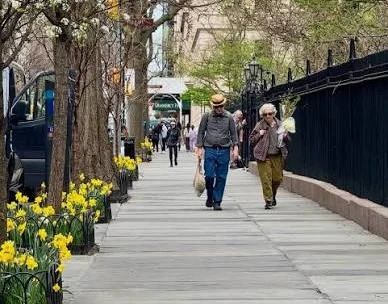
Within the fence, the Park’s magnificent trees are tended under the Trustees of Gramercy Park. Just outside it — along Gramercy Park West and Gramercy Park East, and the Park-facing blocks of East 20th and 21st Streets — stand forty-one street trees. Those trees belong to the City of New York; caring for them is a labor of love we have chosen to take on.
And every one of those forty-one trees now has a name. Or at least a number.
41
Street Trees
10
Species
1
Living Map
How It Began
One morning last July, we walked the Park’s perimeter with Bartlett’s arborists — slowly, tree by tree. What a trained eye can read in a trunk’s flare or a branch’s dieback was a revelation. That walk became a plan, and on the last day of September the formal inventory began: every accessible tree measured at the arborist’s standard height of 54 inches, photographed, assessed, and fitted with a small brass tag bearing its number.
If you have noticed those tags on your block — numbers 41 through 81 — now you know: our trees have joined the record books.
The Census
Ten species share our sidewalks. Ginkgoes — the survivors’ survivor, a lineage older than the dinosaurs — make up nearly half, twenty in all. Six willow oaks anchor the canopy; the grandest, Nº 49, measures thirty-nine inches through the trunk and has been shading East 20th Street since long before any of us arrived.
There are London planes and Japanese zelkovas, Callery pears and paperbark maples, panicled goldenraintrees — and two quiet rarities: a bald cypress, and a dawn redwood, a tree botanists knew only from fossils until living groves were discovered in China in the 1940s.
The youngest of the forty-one is a red maple, Nº 61, barely two inches across. Its tree garden on the east side of the Park sat empty after a storm claimed the tree that stood there — until the Block Association planted this young maple in its place, to begin its long life on the block.
What the Trees Told Us
The good news first: not one of the forty-one was rated in poor condition. Nine are in good health and thirty-two in fair — sound at the core, but working harder than they should.
Why “fair”? That is the life of a street tree: compacted soil, road salt, reflected summer heat, and — a finding on many of our trees — root collars buried too deep beneath the surface. These stresses are invisible from the sidewalk but plain to a trained eye, and every one of them can be treated.
41 of 41
trees measured, mapped, and tagged —
and every one now under a written care plan.
There is housekeeping, too: deadwood to be pruned over sidewalk and street, a supportive cable for a twin-stemmed ginkgo, treatment for a rust that has touched our four Callery pears, and a watchful eye on the spotted lanternfly, which paid an unwelcome visit to our youngest maple. Every item is logged and prioritized in the care plan.
A Living Record — Yours to Explore
Every finding now lives in ArborScope, where each tree has its own page: species, measurements, condition, and the care it has received and needs next. Photographs are still being catalogued and added, tree by tree — a living record in the fullest sense. Think of it as a medical chart that never gets misplaced — and it belongs to the neighborhood. Bartlett has opened a public window into our inventory.
The next time you pass a brass tag, note the number — then look your tree up.
Curious how the platform works? Watch Bartlett’s two-minute demo.
What Comes Next
The prescriptions are in hand: root-collar excavations using gentle compressed-air tools to free buried roots, targeted nutrition for our hard-working urban soil, careful pruning, the ginkgo’s cable, and treatment for the pears. The work will unfold in phases — the most pressing needs first, the rest in turn as seasons and resources allow.
And one more idea we are exploring: museum-style tags with QR codes, so that a walk around the Park becomes a self-guided tour. Scan, and the tree introduces itself.
How You Can Help
If you would like to help sustain this work, your tax-deductible gift supports the Block Association and everything we do for the neighborhood — including the inspections, treatments, and plantings that keep the canopy thriving.
Most of these trees were planted long before we arrived, for the benefit of people their planters would never know. Keeping that gift healthy — and passing it on — is the quiet heart of everything we do.
With deepest gratitude,
Arlene Harrison
President, Gramercy Park Block Association
❦
Photographs