Gramercy Park Block Association

The Park & the city · November 8, 1900

The “ghosts” were people

Two newspapers told the same neighborhood disturbance very differently. Read together, they reveal the people behind a ghost story.

Original clipping & transcript ↓

Strange cries disturbed the evening quiet. Someone reported white figures near the square. Perhaps, suggested one explanation, members of The Players were rehearsing Hamlet. The Tribune built its November 1900 story as a little mystery, then disclosed the cause: people receiving care for alcohol-related illness in a nearby house.

On the same morning, the Times gave readers the doctor’s name, address and explanation. Dr. W. M. Richards, formerly a physician in Bellevue’s alcoholic ward, had established what he called a boarding house for alcoholics at 145 East 21st Street. He believed that a quiet home, nurses and close supervision could help his patients keep their employment.

Two accounts, one contested house

The Times let Richards describe his methods and charges at length. They included sedation, withholding patients’ clothes and paying bartenders not to serve them. These are descriptions of one practitioner’s claims in 1900, not an endorsement of his treatment.

Neighbors complained about noise, ambulances and disruption. Both papers reported that the establishment would leave. The Tribune attributed that result to a Board of Health order; the Times quoted Richards saying that he had decided to move after objections and anonymous letters. The reports also gave different accounts of his fees.

The contrast is useful. A story remembered for its supernatural opening was also a dispute over illness, care, money and the boundaries of a residential neighborhood. The patients were people in distress; the language used to describe them tells us as much about the reporting as about the house.
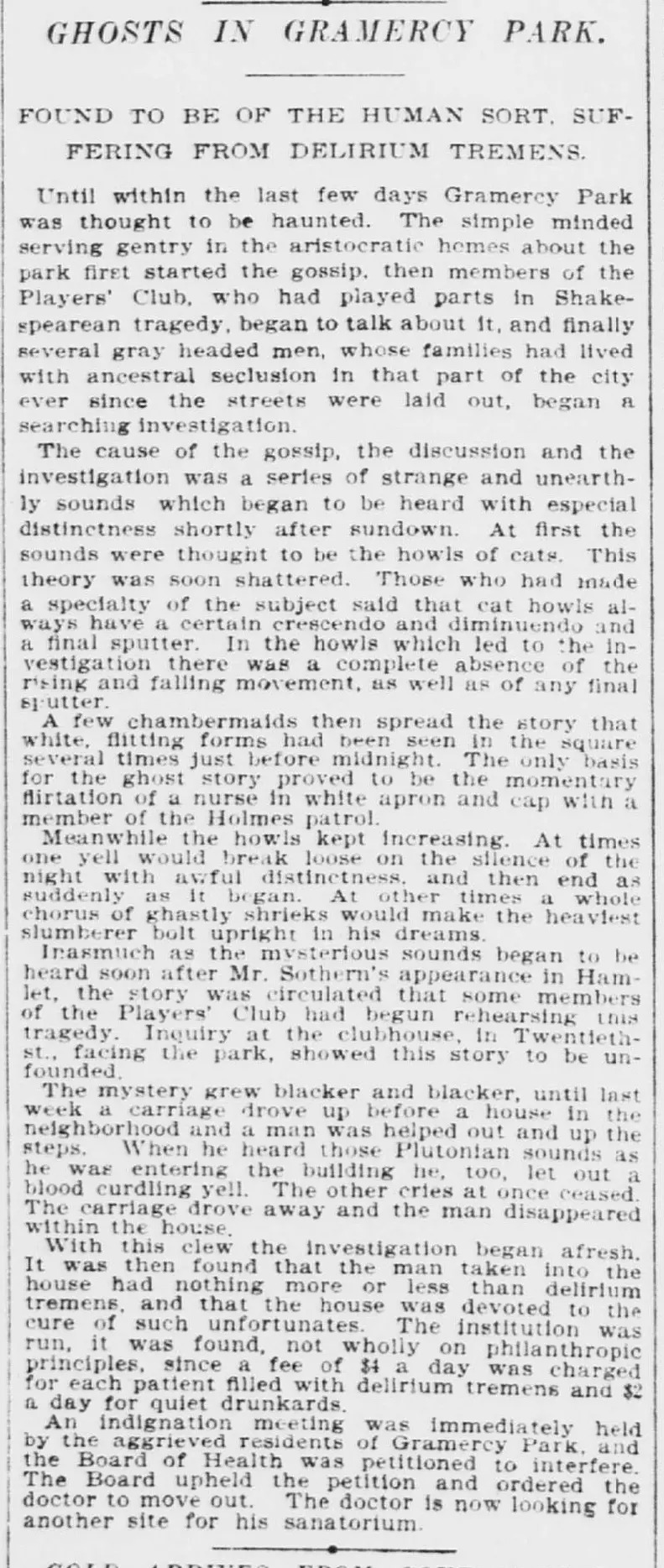
The source

Ghosts in Gramercy Park / Gramercy Park Aroused

New-York Tribune and The New York Times, November 8, 1900, Tribune, 6; Times, 14.

Open the original scan ↗

Read the companion Times clipping: “Gramercy Park Aroused” (November 8, 1900, p. 14) ↗

These contemporary reports differ on fees and on how the decision to leave was reached. Neither report establishes a supernatural event. The original language reflects period attitudes toward alcohol dependence. The Tribune article is transcribed below; the companion Times clipping is available in full.

View the original clippingOriginal newspaper clipping headed “Ghosts in Gramercy Park / Gramercy Park Aroused”. A readable transcript is provided below.

Open full-size scan in a new tab ↗

Read the article transcript

Paragraph breaks and line-end hyphenation have been adjusted for reading. Original wording and period language are retained; editorial additions appear in square brackets.

GHOSTS IN GRAMERCY PARK.
FOUND TO BE OF THE HUMAN SORT, SUFFERING FROM DELIRIUM TREMENS.

Until within the last few days Gramercy Park was thought to be haunted. The simple minded serving gentry in the aristocratic homes about the park first started the gossip, then members of the Players’ Club, who had played parts in Shakespearean tragedy, began to talk about it, and finally several gray headed men, whose families had lived with ancestral seclusion in that part of the city ever since the streets were laid out, began a searching investigation.

The cause of the gossip, the discussion and the investigation was a series of strange and unearthly sounds which began to be heard with especial distinctness shortly after sundown. At first the sounds were thought to be the howls of cats. This theory was soon shattered. Those who had made a specialty of the subject said that cat howls always have a certain crescendo and diminuendo and a final sputter. In the howls which led to the investigation there was a complete absence of the rising and falling movement, as well as of any final sputter.

A few chambermaids then spread the story that white, flitting forms had been seen in the square several times just before midnight. The only basis for the ghost story proved to be the momentary flirtation of a nurse in white apron and cap with a member of the Holmes patrol.

Meanwhile the howls kept increasing. At times one yell would break loose on the silence of the night with awful distinctness, and then end as suddenly as it began. At other times a whole chorus of ghastly shrieks would make the heaviest slumberer bolt upright in his dreams.

Inasmuch as the mysterious sounds began to be heard soon after Mr. Sothern’s appearance in Hamlet, the story was circulated that some members of the Players’ Club had begun rehearsing this tragedy. Inquiry at the clubhouse, in Twentieth-st., facing the park, showed this story to be unfounded.

The mystery grew blacker and blacker, until last week a carriage drove up before a house in the neighborhood and a man was helped out and up the steps. When he heard those Plutonian sounds as he was entering the building he, too, let out a blood curdling yell. The other cries at once ceased. The carriage drove away and the man disappeared within the house.

With this clew the investigation began afresh. It was then found that the man taken into the house had nothing more or less than delirium tremens, and that the house was devoted to the cure of such unfortunates. The institution was run, it was found, not wholly on philanthropic principles, since a fee of $3 a day was charged for each patient filled with delirium tremens and $2 a day for quiet drunkards.

An indignation meeting was immediately held by the aggrieved residents of Gramercy Park, and the Board of Health was petitioned to interfere. The Board upheld the petition and ordered the doctor to move out. The doctor is now looking for another site for his sanatorium.

Source & image credits

“Ghosts in Gramercy Park / Gramercy Park Aroused.” New-York Tribune and The New York Times, November 8, 1900, Tribune, 6; Times, 14. Newspaper clipping supplied to the GPBA research collection. The source scan is reproduced without changes to its contents.