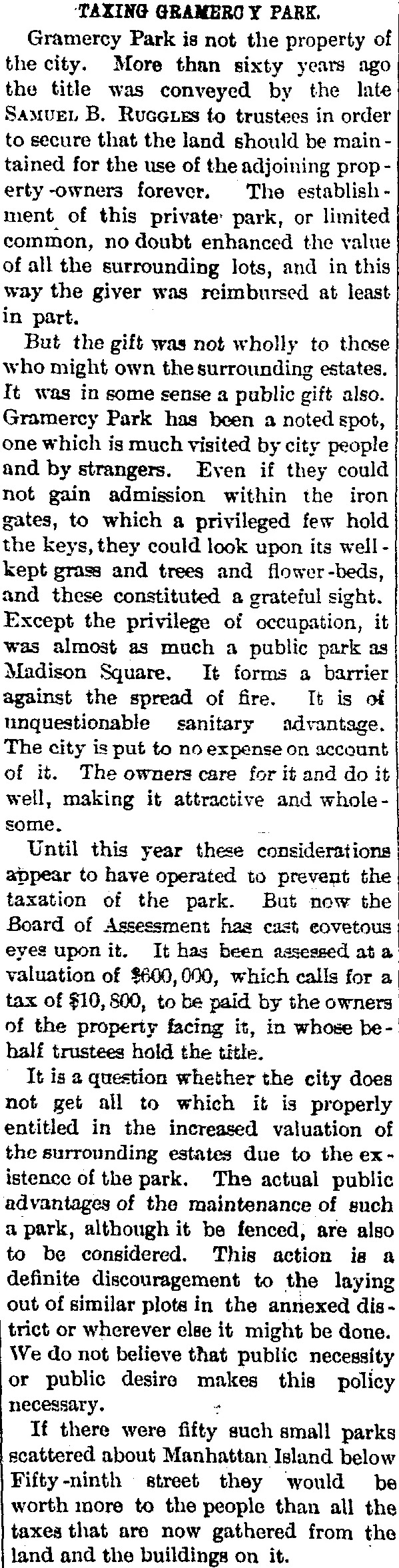
To the World’s editorial writer, the question was not simply who could enter Gramercy Park. People outside the fence could look at its trees and flower beds. Its open ground offered light, air and a break between buildings. The owners maintained it at their own expense. Did those benefits count for anything when the city assessed the land?
“Taxing Gramercy Park,” published in January 1894, reported an assessment of $600,000 and an annual tax of $10,800. The writer opposed that burden, arguing that the garden already increased the taxable value of the properties around it.
A public argument about private land
The editorial did not deny the privilege attached to a key. It asked readers to look beyond admission and consider the garden’s contribution to the surrounding city. Its final paragraph imagined fifty such small parks scattered across Manhattan.
This is an early newspaper contribution to a debate that continued into the next century. The later litigation described in the site’s source notes concerned assessments for 1903, 1904 and 1905. The 1894 editorial should be read on its own terms: an argument made at the time, not a judgment or proof of the later case’s outcome.
It also widens the preservation story. Gramercy’s future could be contested through a tax assessment as well as a proposed road. The garden’s advocates had to explain why keeping the land open mattered outside its boundaries.
An unsigned editorial. The date and page attribution follow the supplied clipping’s filename; the cropped image does not include a masthead. Its reported 1894 assessment is distinct from the 1903–1905 assessments discussed in the later reported case.
Paragraph breaks and line-end hyphenation have been adjusted for reading. Original wording and period language are retained; editorial additions appear in square brackets.
TAXING GRAMERCY PARK.
Gramercy Park is not the property of the city. More than sixty years ago the title was conveyed by the late SAMUEL B. RUGGLES to trustees in order to secure that the land should be maintained for the use of the adjoining property-owners forever. The establishment of this private park, or limited common, no doubt enhanced the value of all the surrounding lots, and in this way the giver was reimbursed at least in part.
But the gift was not wholly to those who might own the surrounding estates. It was in some sense a public gift also. Gramercy Park has been a noted spot, one which is much visited by city people and by strangers. Even if they could not gain admission within the iron gates, to which a privileged few hold the keys, they could look upon its well-kept grass and trees and flower-beds, and these constituted a grateful sight. Except the privilege of occupation, it was almost as much a public park as Madison Square. It forms a barrier against the spread of fire. It is of unquestionable sanitary advantage. The city is put to no expense on account of it. The owners care for it and do it well, making it attractive and wholesome.
Until this year these considerations appear to have operated to prevent the taxation of the park. But now the Board of Assessment has cast covetous eyes upon it. It has been assessed at a valuation of $600,000, which calls for a tax of $10,800, to be paid by the owners of the property facing it, in whose behalf trustees hold the title.
It is a question whether the city does not get all to which it is properly entitled in the increased valuation of the surrounding estates due to the existence of the park. The actual public advantages of the maintenance of such a park, although it be fenced, are also to be considered. This action is a definite discouragement to the laying out of similar plots in the annexed district or wherever else they might be done. We do not believe that public necessity or public desire makes this policy necessary.
If there were fifty such small parks scattered about Manhattan Island below Fifty-ninth street they would be worth more to the people than all the taxes that are now gathered from the land and the buildings on it.
Source & image credits
“Taxing Gramercy Park.” The World, January 16, 1894, p. 2. Newspaper clipping supplied to the GPBA research collection. The source scan is reproduced without changes to its contents.