
A stopping place on migration
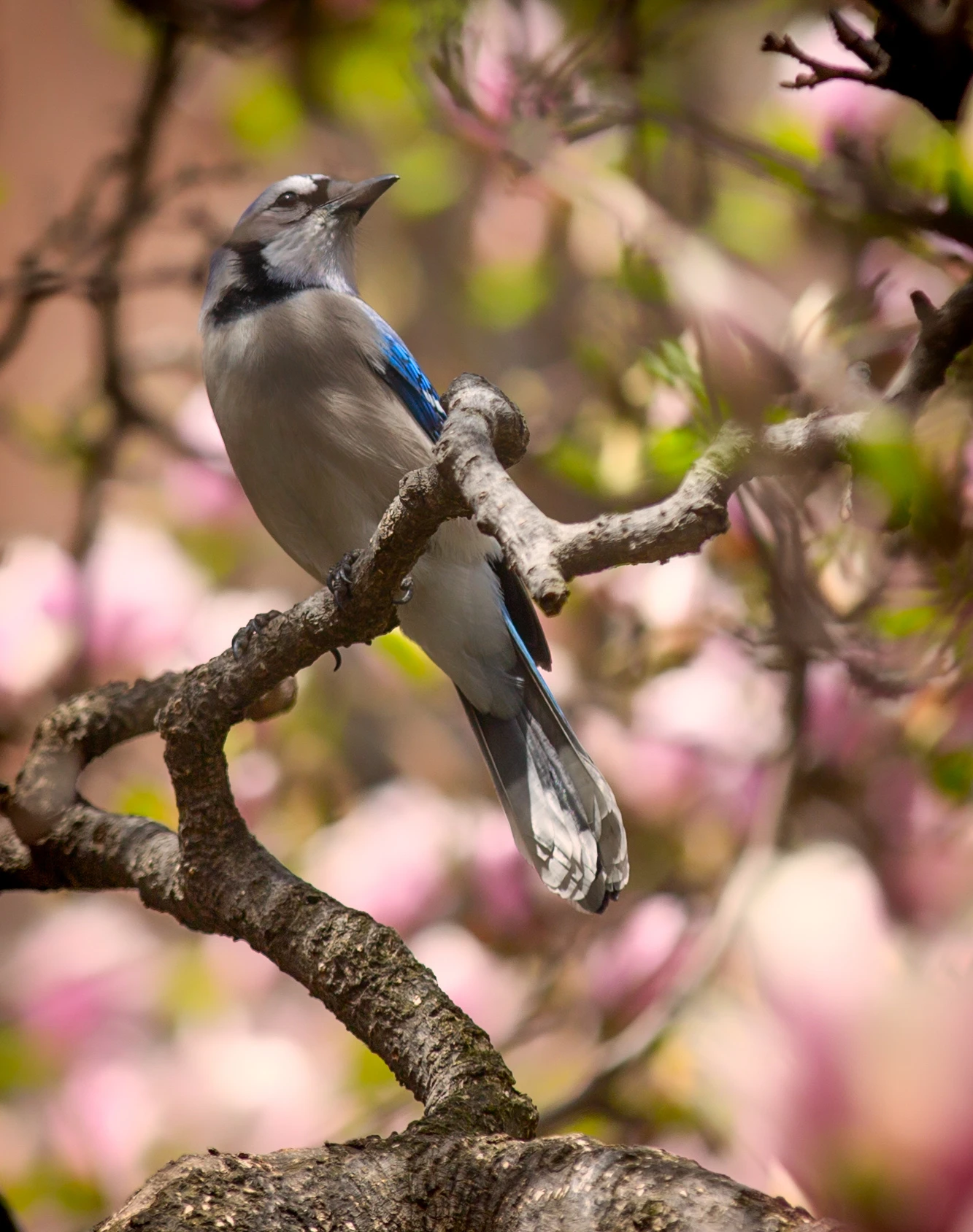
Every spring millions of song birds migrate from their winter homes in South and Central America to their nesting grounds in North America. There are three “super highways” birds have traveled for thousands of years, one of which is the Eastern Flyway running up the U.S. eastern coast. Song birds, or passerines, fly primarily at night for safety and take advantage of the stars to navigate their historic path. They require protected places to rest during the day, areas that must offer adequate food and hiding places. A world-famous migrant trap, a location noted for the density of sightings, is the Ramble in Central Park. Another secret but very reliable sanctuary for migrating birds is Gramercy Park.
While the Park is only two acres in size, we have identified almost 100 species in the three years that we have been keeping our Gramercy Park list. The greater number of birds on our list are no larger than 3-to-5 inches long and require some practice in order to identify. We have identified 23 wood warblers, the treasures of spring migration, all of the eastern thrushes, including the rarer Bicknell’s thrush, 13 sparrows, one of which is our resident wintering sparrow, the white-throated sparrow who you will hear singing “Old Sam Peabody-Peabody-Peabody”.
House sparrows do not number in this group – they are actually a European finch that were brought into the US along with European Starlings in order to fulfill someone’s misguided goal to have all of the birds referenced in Shakespeare’s plays in our country. Anyone who has an ear for the bird references in The Bard’s plays will note that he uses several bird metaphors in each of the majority of his plays, so the complete count must number in the hundreds. Our particular favorite is “the lowly bobolink”. Alas, we have yet to see one in Gramercy Park, but we are looking out for a fly over.
Hawks and falcons
We have seen several raptors and have found that several of our neighbors have also noted them. Raptors are hawks, accipiters and falcons. There is a pair of kestrels who once nested in the synagogue, but have since moved to 19th Street. They frequently hunt in the Park. Kestrels are beautifully-colored small falcons, no larger than a robin. Earlier this year a male peregrine falcon was seen for a couple of weeks flying over the park and perching on top of one of the buildings on the south side of the Park. A Cooper’s Hawk, an accipiter, was found on the top of the lopped-off tree in the center of the park munching on the carcass of a rock dove (pigeon).
Many of us have been anxiously watching a male red tail hawk who has been hunting the Park and appeared to be eyeing the surrounding buildings for a nesting spot. You are probably familiar with the world-famous red tail hawk on Fifth Avenue, Pale Male. He and his mate Lola have fledged young in the past several years. We suspect this hawk is one of Pale Male and Lola’s offspring. He may find our neighborhood similar to the one in which he grew up – tall buildings overlooking a park. It would be very beneficial to have a resident predator to naturally control the excess of pigeons, surfeit of squirrels and other vermin, not to speak of the cachet of the hawk’s lineage.
Along the hedges
We have no resident wrens, only migrants. Every year we have sighted and heard house and Carolina wrens. Winter wrens, the smallest of the group, are charming, dark short-tailed and extremely difficult to see in other environments. We find them in Central Park only with the greatest of difficulty however they may be seen much more easily on the manicured lawns and short hedges of Gramercy. One non-birding neighbor was able to see the winter wren one fall and noted that someone had chopped off the poor bird’s tail. Our assurances to the contrary were not accepted. Should you see a tiny very dark and short tailed wren coming from the hedge surrounding the path, trust us, no one chopped off his tail.
Perusing the short hedges as one walks the paths of the Park is very productive during spring (April and May) and fall migration (late August through early October). Thrushes love to hide there – Hermit thrush, one of the earliest spring migrants, arrive in early April. They are robin-sized (who are also members of the thrush family) with a warm taupe back, chestnut tail, and a cream chest with light upper spots. Ovenbirds, warblers who look like miniature thrushes – dark back, spotted breasts – however, they are much smaller (3 inches long), have a stripe front to back on their heads and walk like tiny chickens. They can be seen walking in the flower beds from the outside of the park, coming in and out of the hedges, and under the star magnolia, particularly the one at the southeast quadrant.
Common yellowthroat warblers are also very common in both spring and fall migrations. They have brown backs and look rather drab from behind. However, when seen from the front the males have a distinctive black mask and very attractive lemon yellow chest. Other warblers that are more easily seen if one is lucky are the Louisiana and Northern waterthrush (they aren’t thrushes, but have the name due to the brown backs and spotted chests). They normally hang around the hedges or the grass and constantly bob their tails. After large rain one afternoon we spotted no less than six northern waterthrush taking advantage of the pools of water left from the rainfall.
The songs of thrushes
The songs of thrushes can frequently be heard in May. We all know the sing-song that Robins make. In the spring their songs become more complex and suggest why they are part of a family of amazing songsters. Anyone who has walked through the woods in New England in the summer has experienced the haunting melody of Wood, Hermit, perhaps Swainson’s, Grey Cheeked and Bicknell’s Thrush species. It takes practice to discern the differences. We have heard Swainson’s song every spring and were delighted with a singing Grey Cheeked thrush last spring. Male birds normally sing only in the spring as they identify their nesting territory and attract a mate.
Last Thanksgiving morning we happened to be outside about 6 in the morning. A hermit thrush was singing his haunting springtime fully-developed song. This and the song of the winter wren are very often considered the two most beautiful bird songs. As one listens to the Largo movement of Dvorak’s 9th Symphony, one can understand why he was inspired by the sounds From The New World.
Memorable birding moments
We have accumulated what we call “memorable birding moments” in Gramercy Park. The Catalpa tree adjacent to the shed attracts fall migrating birds that require protein to complete their return trip to Central America and beyond. One afternoon a tiny young girl ran up to Dennis and said “Mr. Bird Man, Mr. Bird Man, the tree is filled with humming birds – let me show you!” The tree was filled with tiny jewel-like ruby-crowned kinglets that weren’t humming birds but their flitting behavior certainly mimics the image of a humming bird. That so small a child would be so observant to notice such a wonderful sight that most adults walk right by is remarkable.
Last spring we sat with our coffee on a bench and saw more than a dozen male northern orioles with their bright orange and black bodies move in a group from tree to tree and then up Lexington Avenue, heading for somewhere further north in which they would separate and then compete for nesting spots. That they would be together and seemingly cooperative just prior to fighting for the best tree to attract the best mate was very interesting to note.
Very early one May morning, a tiny bird we had seen only in books of Southeast Asian birds (and recently introduced into Puerto Rico) was sitting in the middle of the path right by the shed. He had a beautiful chestnut back and a black and white scalloped chest with such an unusual demeanor. It was a chestnut mannikin. We called a friend at the Museum of Natural History and the NYC Rare Bird Alert. The bird has been sighted in the US so rarely that it has yet to be listed on the American Birding Association (ABA) list which means that one cannot report it as a rarity to any US Rare Bird Alert system nor can one legitimately count the bird on one’s Life List (the list of all sightings one has recorded).
We learned that we hadn’t lost our minds later because there were calls all during the day to the Rare Bird Alert about a tiny bird that was impossible to identify. Many suspected he was an escapee from a Zoo or collection. We have counted the nutmeg mannikin on our Gramercy list, the ABA be hanged. He saw fit to visit Gramercy Park; surely we can be hospitable in return. We do not, however, count the Raven housed at the National Arts Club although we hear him calling longingly especially in the spring time.
Neighbors who notice
We appreciate our helpful neighbors who point out birds of interest. Dennis has several “spotters” who take early morning laps around the Park and have alerted him to some very interesting findings including a Cooper’s Hawk and a white-crowned sparrow. Several neighbors were delighted by a scarlet tanager, a brilliant red bird with black wings, who visited a couple of spring migrations ago. Our youngest spotter is a toddler in our building, Alexander, who has an excellent ability to describe field markings. He provided good information to allow us to confirm that he had seen an indigo bunting (a bird which we later spotted ourselves to our delight) and he has located bird nests; definitely a Gramercy birder in the making. We definitely appreciate the information from our neighbors and are happy at any time to report what’s “going on” from a bird’s eye view.
Toward the century mark
Gramercy Park can be appreciated on many levels. It carries historic preservation responsibilities, provides a place to display horticultural expertise and beauty, anchors a neighborhood and shelters thousands of migratory birds every year. You may see only the pigeons (rock doves) and squirrels as the extent of the park’s fauna. Confucius said “everything has beauty, but not everyone sees it.” It does take patience and practice to identify migratory birds. Our life Gramercy List has reached 99 species of birds, 14 of which are seasonal and permanent resident birds. We are delighted to hear about what you notice – perhaps your finding will make our list hit the century mark.
Dennis and Sandy Kisiel